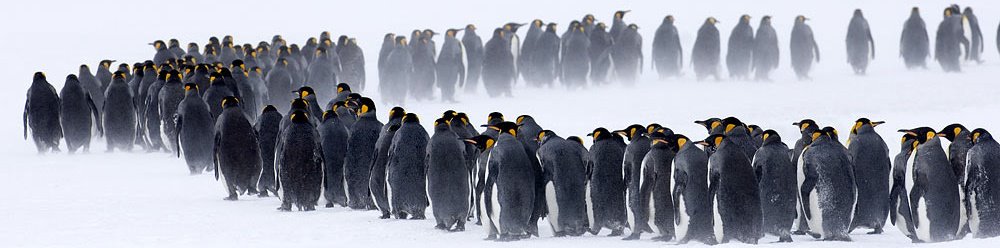
Forget emperor penguins, say hello to the colossus
penguin. Newly unearthed fossils have revealed that Antarctica was once
home to the biggest species of penguin ever discovered. It was 2 metres
long and weighed a hefty 115 kilograms.
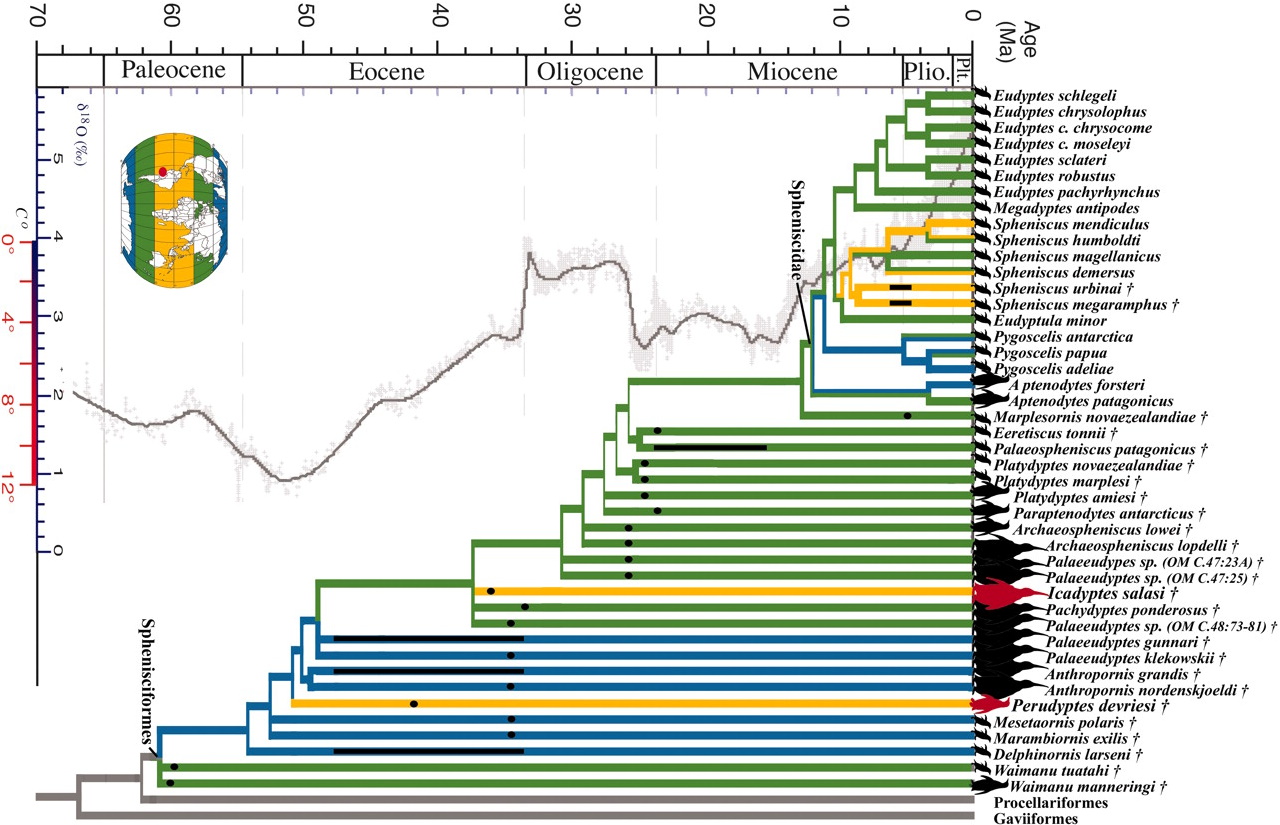
Palaeeudyptes klekowskii lived 37
to 40 million years ago. This was "a wonderful time for penguins, when
10 to 14 species lived together along the Antarctic coast", says
Carolina Acosta Hospitaleche of the La Plata Museum in Argentina.
She has been excavating fossil deposits on Seymour Island,
off the Antarctic peninsula. This was a warmer region 40 million years
ago, with a climate like that of present-day Tierra del Fuego, the
islands at the southern tip of South America.
The site has yielded thousands of penguin bones. Earlier this year, Acosta Hospitaleche reported the most complete P. klekowskii skeleton yet, although it contained only about a dozen bones, mostly from the wings and feet (Geobios, DOI: 10.1016/j.geobios.2014.03.003).
Now she has uncovered two bigger bones.
One is part of a wing, and the other is a tarsometatarsus, formed by the
fusion of ankle and foot bones. The tarsometatarsus measures a record
9.1 centimetres. Based on the relative sizes of bones in penguin
skeletons, Acosta Hospitaleche estimates P. klekowskii was 2.01 meters long from beak tip to toes.
Its height will have been somewhat less than its
length owing to the way penguins stand. But it was nevertheless larger
than any known penguin.
Emperor penguins can weigh 46 kilograms and reach lengths of 1.36 metres, 0.2 metres above their standing height. Another extinct penguin used to hold the height record, at around 1.5 metres tall.
P. klekowskii's tarsometatarsus "is the longest foot bone I've ever seen. This is definitely a big penguin," says Dan Ksepka
at the Bruce Museum in Greenwich, Connecticut. However, he cautions
that the estimate of its length is uncertain because giant penguins had
skeletons "very differently proportioned than living penguins."
Larger penguins can dive deeper and stay underwater longer than smaller ones. A giant like P. klekowski could have stayed down for 40 minutes, giving it more time to hunt fish, says Acosta Hospitaleche.
July 30, 2014 |
Emperor penguins, the large, charismatic birds known from their
frequent film and TV appearances, are in danger. A collaborative
research project is drawing attention to the impending plight of the
emperors. By 2100, according to a new study, their numbers will have
fallen by around 19% and will continue to decline, qualifying the
species for endangered status.
Emperor penguin communities entirely ring the continent
of Antarctica. Of the 45 known colonies, only one has been extensively
studied for decades, and most of the others have never been visited by
humans, nor are they likely to be. Emperors live on sea ice off the
coast of the continent, and the amount of ice plays a major role in
determining the health of a colony. Too much ice and the penguins have a
long, debilitating walk to the sea and food; too little ice and the
colony is more exposed and vulnerable to predation.
A colony of emperor penguins at Australia's Snow Hill Island, October 2009. (Photo by Jenny Varley, Wikimedia Commons.)
Stéphanie Jenouvrier (Woods Hole Oceanographic
Institution) is an expert on penguin life, and she wanted to project the
size of emperor populations into the future as Earth’s climate warms.
The problem, she says, was her “limited background on climate science.”
Meanwhile, at NCAR, senior scientist Marika Holland is a climate
scientist with a longstanding specialty in modeling sea ice changes,
although she has never been to Antarctica and has never seen an emperor
penguin.
Aware of Holland’s previous work, Jenouvrier contacted
her and Julienne Stroeve at the University of Colorado’s Cooperative
Institute for Research in Environmental Sciences. The three of them
collaborated on preliminary studies published in 2009. Jenouvrier
received a fellowship from CIRES and worked in Boulder for almost a
year, collaborating closely with Holland, Stroeve, Mark Serreze at the
CIRES National Snow and Ice Data Center, and other scientists on a
follow-up study, published in 2012, and on their most extensive update,
recently published in Nature Climate Change.
The biologists used long-term data from the one
well-studied emperor colony, off the coast of Terre Adélie, to estimate
the relationship between sea ice and rates of breeding success and
survival of chicks. They used the record of penguin population and sea
ice concentrations at Terre Adélie to estimate vital rates
(births/deaths) and population dynamics at each colony.
Learning each other’s languages: biology and climate
The next challenge was to project sea ice changes over the rest of the 21st
century and relate that to the health of each penguin community. Sea
ice off Antarctica does not behave uniformly: although the total area of
sea ice around the continent has increased somewhat in recent years,
the trends vary by region during the course of a year and over longer
periods. Sea ice must therefore be studied in the relatively small
segments that host individual colonies, in order to assess the viability
of penguin populations. At first, says Holland, the biologists and
climate modelers spoke two different languages, which was “a bit of a
barrier.” The frequent interchanges during Jenouvrier’s year in Boulder
helped bridge that gap, she adds.
The sea ice scientists began with a group of 20 or so
climate models and settled on a widely used midrange scenario of
emissions produced for the Intergovernmental Panel on Climate Change
called SRES A1B.
Once the penguin population models and sea ice change models were set,
climate projections were fed into the penguin population models. Due to
inherent uncertainties in the models, Jenouvrier ran tens of thousands
of computer simulations to achieve the results that the team published.
They found that sea ice will generally decline and its
variability will increase by the end of this century. As a result, the
simulations indicate that emperor populations will increase by around
10% through midcentury, but then decline to 19% below current levels by
2100. One group of 7 colonies facing the Ross Sea will still be
non-threatened by that time, although with a reduced population. On the
other side of the continent, facing the Indian Ocean and Weddell Sea, 10
colonies will face quasi-extinction. Most of the rest will qualify as
endangered.
The collaborative nature of a study like this, Holland
says, allows the expertise of NCAR scientists to inform such other
fields as biology and economics to better understand the global system.
The researchers conclude that the emperor penguin is “fully deserving of
Endangered status due to climate change, and can act as an iconic
example of a new global conservation paradigm for species threatened by
future climate change.”
WriterHarvey Leifert ContactDavid Hosansky, NCAR & UCAR Communications Collaborating institutionsNational Center for Atmospheric Research
University of Amsterdam
University College London
University of Colorado/Cooperative Institute for Research in Environmental Sciences
University of La Rochelle
Woods Hole Oceanographic Institution FundersAlexander von Humboldt Foundation
European Research Council
Grayce B. Kerr Fund
National Oceanic and Atmospheric Administration
National Science Foundation
Penzance Endowed Fund in Support of Assistant Scientists
Woods Hole Oceanographic Institution
Annual mean change of sea ice concentrations (SIC) between the twentieth and twenty-first centuries and conservation status of emperor penguin colonies by 2100. SIC projections were obtained from a subset of atmosphere-ocean general circulation models. Dot numbers refer to each colony evaluated, with dot color showing conservation status (red = quasi-extinct, orange = endangered, yellow = vulnerable, green = not threatened). (Figure 1 from Jenouvrier et al., Projected continent-wide declines of the emperor penguin under climate change, doi:10.1038/nclimate2280; image courtesy Nature Climate Change.)
There’s nothing quite like the sultry squawk of a jackass
penguin. Coastal residents of Namibia and South Africa, African penguins
(Spheniscus demersus) got the nickname “jackass” from their donkey-like calls.
But it turns out their vocalizations are a lot more complicated than haws and brays. A study published today in the journal PLoS ONE
examines the vocal repertoire of African penguins. Researchers analyzed
hours of audio and video and found that the quirky birds emit four
different calls and that baby penguins emit two previously undescribed
vocalizations. Perhaps most important, the researchers think they were
able to discern what the penguins were trying to communicate with each
call.
Understanding penguin call function has implications for
conservation and learning about penguin biology. “Vocalizations have the
opportunity to provide a huge amount of information about these birds,”
says Livio Favaro,
a biologist at the University of Turin and the lead author on the
study. Encoded in penguin vocal calls are clues to their sex, age and
social status.
Before this study, penguins were known to vocalize
in four ways: contact calls (“Hey! I’m here. Where are you guys?”),
agonistic or threat calls (“Watch it, buddy!”), and display songs
directed towards mates, chicks and parents (“Heyyy”). Display songs fall into two categories, ecstatic and mutual, and are uttered alone or in pairs, respectively.
Most penguin vocal research has focused on species that don’t
build nests, such as the Emperor and king penguin species in Antarctica,
which rely on their vocal system to stick together. By contrast, aside
from some basic descriptions and minimal audio,
the vocalizations of African penguins—a species that does build
nests—remain largely unknown. Previous work also limited the focus to
the breeding season, rather than observing the birds over a longer time
period.
Favaro and colleagues wanted to know if these nesting penguins
voice different calls than their non-nesting cousins. They also sought
to discern the accoustic intricacies of different types of calls. But
studying penguin vocalizations in the wild can be difficult. Ambient
noise, sounds from other animals and human interference can mess with
the audio.
So for their study, Favaro and his colleagues selected a captive
colony of 48 African penguins living at a zoo in Torino, Italy. For 104
separate days in 2010 and 2011 (both in and out of the breeding season),
the researchers took audio and video of the penguins.
Using visualizations of the call notes called spectrograms,
the researchers analyzed the acoustics of each call as well as the
behavior of the penguin making the call. Based on patterns of behavior
and acoustic similarities, four types of adult calls and two new calls
unique to penguin chicks emerged from the noise. Statistical analysis of
spectrograms confirmed that each call type represented a different
vocalization.
You can see video footage of all six calls here:
Contact calls were single-syllable, averaging around half a
second in length. When voicing them, penguins typically stood up with
their beaks half open and extended their necks vertically as much as
possible. When fighting, they extend their necks toward the other
penguin and emitted agonistic calls, also one-syllable and sometimes
followed by a peck.
Mutual display songs began with noise pulses, and when making
them the penguins stretched out horizontally with wide-open beaks while
emitting a lower pitched harmony. Finally, the penguins emitted an
ecstatic display song, the longest and loudest of all vocalizations. The
birds began with a series of short syllables as they thrust their
chests upwards with wings spread and ended with one long note,
occasionally two.
Both adults and juveniles displayed agonistic calls and contact
calls, but penguin chicks emitted some additional calls of their own:
begging moans and begging peeps. Begging moans were short, but typically
emitted in sequence until fed. The chicks also bobbed their heads.
Begging peeps were higher pitched and short, but could go on for several
minutes until feeding.
Chicks began emitting begging peeps at three months of age.
Moans, which sound more like adult calls, were more common in older
chicks. So Favaro thinks that peeps and moans may represent the
evolution of the same noise with age.
Such threats put pressure on researchers to learn as much as they
can about penguin vocalizations—and how they fit into the broader
picture of the evolution of animal communication—before it’s too late.
Favaro and his colleagues next plan to delve into how penguins produce these complex calls through their syrinx, the bird equivalent of the larynx in humans, and how vocalizations identify an individual. In non-nesting species, birds use a two-voice system that
creates a beat pattern unique to each individual, while other nesting
species, such as the Adelie penguin, use pitch, frequency, and harmony
to make unique calls from one penguin to another.
It’s even possible, the researchers suggest, that African penguin speech production follows a theory based on human vocalization that
links individuality to variation in the vocal tract. If that proves to
be the case, we may be more similar to penguins than we ever imagined.
In the olden days of scientific research, the only way to know how
many buffalo roamed the prairie or monkeys bounced around the rain forest was to trek out there and take a head count. But thanks to advances in satellite imagery, researchers
today can take stock of some species without risking a single venomous
snakebite or frost-bitten toe.
Take Seth Stapleton, a postdoctoral researcher at the University of Minnesota in St. Paul, who published a study this month in PLOS ONEon new ways to spot far-flung polar bears, including leveraging the same satellite that provides images for Google Earth. Even though polar bears are the biggest bear species alive
today and one of the most widely studied large mammals on Earth, we know
surprisingly little about their whereabouts across much of the remote
Arctic.
To find the white bears on the icy landscape, Stapleton and
colleagues restricted their scope to darker islands where bears often
get stranded in the late summer after the surrounding ice melts. The researchers successfully identified nearly a hundred
polar bears by satellite. In a separate test, they verified that what
they were seeing were actually bears (and not rocks or foam) by
conducting aerial surveys in a helicopter.
What's more, new advances in satellite resolution and
automation may one day allow us to count polar bears no matter what
they're standing on. "The technology is evolving so rapidly, it has the potential to open
up huge areas of research and conservation avenues," said Stapleton.
Let's take a look at a few more animals getting the cosmic paparazzi treatment.
Emperor penguins are seen in Dumont d'Urville in
April 2012. Counting emperor penguins in Antarctica wasn't easy until
researchers used new technology to map the birds from space.
Photograph by Stringer, Reuters/Corbis
Emperor Penguins
Emperors may be the largest penguins on Earth,
but that isn't the only thing that makes them visible from space. In
fact, the most conspicuous evidence of an emperor penguin colony is what
they leave behind on the ice—their poop. "The brown stains stand out really well on the fresh snow,"
said Peter Fretwell, a scientist with the British Antarctic Survey.
(Related: "Emperor Penguins Counted From Space—A First.")
Using Landsat satellite images of Antarctica, Fretwell and his colleagues have found
that they can use these "fecal stains" as an indicator of a potential
colony. Once the team finds a brown spot, they can zero the satellites
in to count birds individually or make population estimates based on how
many penguins are huddled together.
Just by looking at such satellite images, Fretwell and his
colleagues have more than doubled the number of known emperor penguin
colonies.
Right Whales
Fretwell also led a study about detecting whales from space, published in PLOS ONE in 2013. Instead of scanning the whole ocean for whale tails, or flukes, his study focused on Golfo Nuevo, Argentina—a bay where right whales come to breed between July and November. Breeding areas are ideal for counting whales by satellite
because many species choose calm, clear waters where they can bask near
the surface with their calves.
Fretwell found that it was indeed possible to manually
count whales by satellite. What's more, he and his team looked at
possible ways computer animation could help scientists cover more
ground.
For instance, in the simplest analysis, the researchers
found that the computer could identify all the bright areas of a
whale-ish size and shape on a given image.
In fact, Fretwell said right whales may be easier for a
computer to identify than other species, on account of the gray-white
calluses that grow on the animal's dark heads. Just imagine having a growth on your face visible from space.
Bats, Birds, and Turtles
If the goal is to spot an animal using satellite imagery, then the animal will obviously have to be relatively large. For instance, Stapleton said an adult male polar bear appears as no more than six to eight white pixels using the WorldView-2 satellite. But a new addition to the International Space Station, called ICARUS
(International Cooperation for Animal Research Using Space), may one
day soon help scientists keep tabs on individual animals smaller than a Smart car.
Most GPS tags log location data but lack the power to
transmit that information up to a satellite. This means a study animal
must be recaptured at some point to obtain that information—a
particularly difficult feat when you're working with small migratory
animals. But with the new ICARUS hardware, scientists will be able
to employ more advanced GPS tags that transmit information back to the
space station, which orbits much closer to Earth than most satellites
do.
The ICARUS Initiative aims to track birds, bats, sea
turtles, and rodents to better understand ecosystems, improve aviation
safety, track endangered species, and monitor the spread of infectious
diseases. And the transmitters are getting smaller all the time. One day soon, it may be possible to monitor a single monarch butterfly flying in your backyard from more than 200 miles (320 kilometers) up in the sky.
Jurassic fossils may mean that feathers were all in the family.
This illustration of Kulindadromeus zabaikalicus, a newfound feathered dinosaur, shows it in its natural environment. Illustration by Andrey Atuchin
Dan Vergano
National Geographic
Published July 24, 2014
Almost all dinosaurs were probably covered in feathers,
Siberian fossils of a tufted, two-legged running dinosaur dating from
roughly 160 million years ago suggest.
Now in a discovery reported by an international team in the journal Science, the new dinosaur species, Kulindadromeus zabaikalicus
(KOO-lin-dah-DRO-mee-us ZAH-bike-kal-ik-kuss), suggests that feathers
were all in the family. That's because the newly unearthed 4.5-foot-long
(1.5 meter) two-legged runner was an "ornithischian" beaked dinosaur,
belonging to a group ancestrally distinct from past theropod
discoveries. "Probably that means the common ancestor of all dinosaurs had feathers," says study lead author Pascal Godefroit
of the Royal Belgian Institute of Natural Science in Brussels.
"Feathers are not a characteristic [just] of birds but of all
dinosaurs." (Related: "Dinosaur Feathers Changed With Age.")
The
fossils, which included six skulls and many more bones, greatly broaden
the number of families of dinosaurs sporting feathers—downy, ribboned,
and thin ones in this case—indicating that plumes evolved from the
scales that covered earlier reptiles, probably as insulation. In
addition to its feathers, Kulindadromeus also had scales, notably arched ones that appeared in rows on its long tail. "It's really fantastic that dinosaurs with 'fluff' are found outside of China," says paleontologist Jakob Vinther of
the United Kingdom's University of Bristol, who was not on the
discovery team. "The material and specimens are nothing short of
fantastic; their age and sheer number are rarely to be expected."
Kulindadromeus
adds a whole new dimension to understanding feather evolution, Vinther
says, pointing to the fact that the three feather types found as
imprints with the fossils are different from ones found on feathered
dinosaurs or modern birds.
What exactly did all these different
feathers do? "I don't know; nobody knows for sure," Godefroit says.
"These animals couldn't fly, that's all we can tell you."
Jurassic Peeps
During the Jurassic, Kulindadromeus
lived near what is now Siberia's Kulinda River, sporting feathery tufts
on its legs and elbows, as well as more streamlined feathers on its
back. Its shins had "ribbon-shaped" feathers of a type never seen
before.
At least six skulls of the species, along with
hundreds of bones, have turned up in a fossil bed that was once a lake
bottom and is now a Siberian hillside. Most of the fossils were
juveniles, which suggests that they died in single events, not in a mass
catastrophe, according to Godefroit.
The dinosaur's
name essentially means "Kulinda River running dinosaur." Zabaikalsky
Krai is the region of Siberia where it was discovered (which explains
its species name, zabaikalicus). "There were
lakes and there were volcanoes there, lots of volcanoes," Godefroit
says. The plant-eating dinosaurs likely died and fell to the lake
bottom, where eruptions soon after covered them with a fine ash. That is
what preserved the feather imprints with the fossil bones. "We don't know how big this fossil bed is, and it is likely we will find more when we go back," Godefroit says.
The Feather Connection
The scales on Kulindadromeus
resemble the scaly skin seen on some birds, the study says, which also
argues for a deep genetic root linking dinosaurs to birds.
Two earlier ornithischian dinosaurdiscoveries, both from China, had hinted that featherlike bristles had covered dinosaurs, notes paleontologist Stephen Brusatte of the United Kingdom's University of Edinburgh. "But
the new Siberian fossils are the best example yet that some
ornithischian [beaked] dinosaurs had feathers, so it wasn't only the
theropods that had downy coats," Brusatte says. "This
does mean that we can now be very confident that feathers weren't just
an invention of birds and their closest relatives, but evolved much
deeper in dinosaur history," he adds. "I think that the common ancestor
of dinosaurs probably had feathers, and that all dinosaurs had some type
of feather, just like all mammals have some type of hair."
Even
so, Godefroit suggests that the largest dinosaurs likely had the fewest
feathers, as they wouldn't have needed them for insulation. "Just like
elephants in Africa don't need fur," he says.
Speaking for the continent and its magnificent species - from krill to blue whales
by Claire Christian
The way climate change research is reported in the media can be
confusing, even if it’s part of your job to keep up with the latest
findings. As many, many commentators, scientists, and fake news anchors
have noted, this unfortunately means that people think that climate
change, if it exists, is some sort of scam cooked up by
environmentalists who want to stop doing fun things like removing
mountaintops and dumping them into streams so we can get more coal to
burn. The truth is that climate change is a complex phenomenon. If you
don’t understand this, you are likely to run into trouble when you read
news stories about scientific research, sometimes even when those
stories are really not about proving or disproving climate change. Take this post, for example. The writer completely misrepresents the results of a recent global Adélie survey by Lynch and LaRueand fans the flames of climate denialism.
The post suggests that this research and other studies indicate that
penguins are doing super great under climate change, so why can’t we all
stop worrying? In fact, these studies don’t say that at all. We know
this because we actually talked to the researchers involved. To clarify a
few technical points, the survey by Lynch and LaRue demonstrates that
the known breeding population of Adélie penguins is 53% larger than was
previously estimated in 1993. As the paper points out, this increase in
known breeding population is roughly divided between growth at known
populations and the discovery of several new populations, the latter of
which include some populations that were so remote that they may have
simply been missed in previous surveys. Nevertheless, the survey results
do suggest that the populations of breeding Adélie penguins in East
Antarctica and in the Ross Sea have grown over the last several decades,
and these increases in abundance have more than offset the losses
previously reported on the Antarctic Peninsula (and confirmed by this
recent study).
These kinds of results are not particularly surprising to people who
follow Antarctic scientific research closely. Antarctica is a big place,
and climate change affects different regions of the continent
differently. The Antarctic Peninsula is warming more rapidly than other
Antarctic areas, and more rapidly than the rest of the world, save,
perhaps, for the Arctic. So although the total number of Adélie penguins
has not declined, climate change is still having a measurable impact on
Antarctica. This may be good for penguins in some areas like East
Antarctica and the Ross Sea, but it doesn’t mean that warmer
temperatures are necessarily a Good Thing for Adélies, the continent as a
whole, or the planet.
In fact, the authors note that one climate-related explanation for
increasing populations may be glacial retreat (not happy news if you live in a coastal city),
which opens up new habitat for Adélie penguin breeding. Study author
Heather Lynch also notes, “That climate change may cause both increases
and decreases in Adélie penguin populations is a tribute to its utility
as a biomonitor, and highlights the Adélie’s important role as an early
warning system for ecological change. Adélie penguin increases have
previously been linked to a growing toothfish fishery, which itself
presents concerns over the influence of Southern Ocean fisheries on the
Antarctic food web.” Therefore, what’s important about this study is
that it establishes a “baseline for understanding future changes in
abundance and distribution”, not that it proves that all is well with
penguins now and forever.
Another penguin researcher (not connected with the global Adélie
survey study) who was also quoted in the National Review’s blog post,
Ron Naveen, told me that “To suggest that Adélies are booming or that
all penguins globally are booming is bad reporting. The only way to
really know that, of course, would be to compare the latest numbers with
a previous survey using the same technology — and that's not possible.
Rather, the big story is that we humans know more than we did because we
now have more sophisticated tools in our kit. And, as a result, we have
much improved baselines for detecting and assessing change.”
Species-threatening decreases in abundance, such as those projected to occur for emperor penguins within the next century (see Jenouvrier et al.'s recent paper in Nature Climate Change),
remain a grave concern. Other rapid changes in abundance and
distribution, including the increasing abundance reported by Lynch and
LaRue, provide a reminder that both climate change and resource
extraction can upset the natural ecological balance of the Southern
Ocean. While the warning signs in this case represent good news for the
Adélie penguin as a species, they nevertheless reflect major changes in
Southern Ocean ecosystems that will have enormous consequences. Thus the
Adélie penguin can be both be helped and hurt by climate change. It’s
not the kind of simple message the media likes, but it’s a scientific
reality.
Claire Christian
Director, Secretariat Antarctic and Southern Ocean Coalition
King penguin chicks form groups to navigate to their home spot and they
need to make collective decisions as they move along their way. As with
humans or any animal, when behaving in a group, decisions have to be
made. Some will be leaders, some followers. Sometimes there will be
cooperation and sometimes conflict. A recent study, published in the
journal Animal Behavior, provided some empirical data on how well
king penguin chicks work in pairs to navigate. The study was carried
out by scientists from the University of Oxford in the United Kingdom,
the University of Amsterdam in The Netherlands and CFE-CNRS Montpellier
in France.
King penguins live in Antarctica and an entire colony of adult king
penguins may consist of a half a million breeding pairs. The colony
moves in groups of different sizes on land and in the water. After eggs
are hatched and chicks are born, the parents at first split up and one
parent makes a very long trip (up to 400 km, which is about 250 miles)
traveling to the sea in winter for food. An interesting thing to note is
that when the parents return from their long trip, they can identify
their own chick’s voice among the crowd, even though the crowd may
consist of about 500,000 penguins. When the chicks are a bit older, then
both parents leave to get food and the younger chicks are left in the
care of other juveniles.
The chicks form crèches, which are chick groups, to keep warm and
avoid predators, and each crèche has a specific location. Being able to
navigate to the location of the crèche is crucial for a chick’s
survival. When parents eventually return with food, they need to return
to the locality of the home crèche to feed their young. If the chicks
are not in the right place, they will not get food.
The chicks must move together to get to their home spot. The
researchers in the study aimed to determine how king penguin chicks make
collective decisions about which direction to move in to find the
crèche. They considered the trade-off between group cohesion and
individual preferences. The aim of the study was to collect empirical
data on conflict resolution during navigation.
In the study, they chose to look at pairs of chicks. The scientists
manipulated the levels of conflict by pairing individuals from either
the same crèche (no conflict) or different crèches (conflict over
desired destination). They then observed the “homing” behavior of both
types of pairs. 15 pairs of same- crèche chicks and 16 pairs of
different crèche chicks were studied. Each chick had a GPS system
attached to their body.
The results showed whether the chicks were better at navigating to
their crèche in pairs or when moving alone. The results also determined
whether conflict over the desired destination changed the navigation and
how the chicks resolve conflicts. Chicks from the same crèche were more
precise in getting to their home crèche. Each of the king penguin
chicks in a pair took turns being the leader and following. Chicks that
were from different crèches were more likely to split up the pair than
those pairs that were from the same crèche. The results showed that king
penguin chicks use collective decision making when traveling long
distances to get to their home spot.
Animals
have used the same technique to search for food that's in short supply
for at least 50 million years, a new study suggests. Researchers
analyzed fossilized sea urchin trails from northern Spain and found the
tracks reflect a search pattern still used by a huge range of creatures
today.
Fossilized sea urchin tracks at Zumaia.
Credit: Richard Twitchett / Trustees NHM
Animals
have used the same technique to search for food that's in short supply
for at least 50 million years, a University of Southampton-led study
suggests.
Researchers
analysed fossilised sea urchin trails from northern Spain and found the
tracks reflect a search pattern still used by a huge range of creatures
today. But this is the first example of extinct animals using such a strategy. The
findings could explain why so many modern animals use the technique,
and suggest the pattern may have an even more ancient origin. Creatures
including sharks, honeybees, albatrosses and penguins all search for
food according to a mathematical pattern of movement called a Lévy walk
-- a random search strategy made up of many small steps combined with a
few longer steps. Although a Lévy walk is random, it's the most
efficient way to find food when it's scarce.
David Sims,
Professor of Marine Ecology at the University of Southampton and lead
author of the study, says: "How best to search for food in complex
landscapes is a common problem facing all mobile creatures. "Finding
food in a timely fashion can be a matter of life or death for animals
-- choose the wrong direction to move in often enough and it could be
curtains. But moving in a random search pattern called a Lévy walk is
mathematically the best way to find isolated food."
Even though a
wide range of modern creatures search for food according to this
pattern, scientists had no idea how the pattern came about, until now. Professor
Sims and colleagues from the University of Southampton, NERC's National
Oceanography Centre, Rothamsted Research, VU University Amsterdam and
the Natural History Museum analysed the fossilised Eocene-era tracks
that were made by sea urchins that lived on the deep sea floor around 50
million years ago. The long trails are preserved in rocky cliffs in a
region called Zumaia in northern Spain.
"Finding the signature of
an optimal behaviour in the fossil record is exceedingly rare and will
help to understand how ancient animals survived very harsh conditions
associated with the effects of dramatic climate changes," says Professor
Sims, who is currently seconded to the Marine Biological Association in
Plymouth. "Perhaps it's a case of when the going got tough, the tough
really did get going." "The patterns are striking, because they
indicate optimal Lévy walk searches likely have a very ancient origin
and may arise from simple behaviours observed in much older fossil
trails from the Silurian period, around 440 million years ago," he adds. Professor
Richard Twitchett of the Natural History Museum and co-author of the
study adds: "It's amazing to think that 50 million-year-old fossil
burrows and trails have provided us with the first evidence of foraging
strategies in animals that live on and in the deep-sea floor -- studies
which would be nearly impossible and very expensive to do in modern
oceans. "Trace fossils are remarkable and beautiful records of
the movements of ancient animals, which have been frozen in time and
tell us so much about the evolution of life on Earth and the
environments of the past."
The researchers think the collapse of
primary producers, such as phytoplankton, and widespread food scarcity
caused by mass extinctions, which show up in the fossil record, could
have triggered the evolution of Lévy-like searches.
The Eocene
lasted from 56 to 33.9 million years ago, and began as a time of global
warming, with temperatures soaring across the planet.
Lévy walks
aren't just confined to animals; our ancient hunter-gatherer ancestors
used exactly the same approach, as do modern hunter-gatherers in
northern Tanzania.
The study is published in The Proceedings of the National Academy of Sciences.
Story Source:
The above story is based on materials provided by University of Southampton. Note: Materials may be edited for content and length.
Journal Reference:
D. W. Sims, A. M. Reynolds, N. E. Humphries, E. J. Southall, V. J. Wearmouth, B. Metcalfe, R. J. Twitchett. Hierarchical random walks in trace fossils and the origin of optimal search behavior. Proceedings of the National Academy of Sciences, 2014; DOI: 10.1073/pnas.1405966111
Past demographic trend of the king penguin colony of ‘La Baie du
Marin’ on Possession Island, Crozet archipelago: median value (red) and
95% confidence interval ( pale red). Credit: Proceedings of the Royal
Society B, DOI: 10.1098/rspb.2014.0528
(Phys.org) —A team made up of researchers from several European
countries has used DNA analysis to better understand how it was that
King Penguins came to breed on the Crozet Islands. In their paper
published in Proceedings of the Royal Society B, the team
describes how they managed to gather DNA samples from King Penguins
without disturbing them and how analyzing what they found helped to
reveal how the penguins came to colonize the Crozet Islands.
King Penguins are the second largest penguins and live and
breed on islands north of Antarctica—most predominantly the Crozet
Islands in the southern Indian Ocean. In this new effort the researchers
sought to learn more about the history of the penguins on the islands,
which they hoped would help in discovering what might happen to them as
global warming causes changes to their environment.
The research team ventured to one of their island breeding grounds
and snuck chicks out from under their watchful parents, replacing them
temporarily with fake eggs. In addition to taking physical measurements,
blood samples were taken from each of the chicks before they were
returned to their parents, apparently none the worse for the wear. The
team then analyzed over 65,000 snippets of DNA obtained from eight of
the chicks. Their genomes revealed that the penguins had existed as a
small group until about 15,000 years ago—after that, their population
soared. This time period, the researchers note, coincides with the end
of the last ice age.
As the ice abated, conditions for the penguins became ideal. When
taking care of their young, adults swim 250 miles offshore to what is
known as the polar front—a place where cold polar water collides with
warm tropical waters. There the penguins fill up on lanternfishes,
returning every three to five days to feed their chicks. In the winter,
the adults swim even farther, traveling over 600 miles to find food.
Unfortunately, for the penguins, as the planet heats up, some climate
models suggest it's likely the site of the polar front will move
farther south, perhaps taking food out of reach of adults who need to
return to breeding grounds to feed their offspring. Thus, the fate of
King Penguins, could very well be in doubt.
A pair of Gentoo penguins. Credit: Gemma Glucas
A study of how penguin populations have changed over the last
30,000 years has shown that between the last ice age and up to around
1,000 years ago penguin populations benefitted from climate warming and
retreating ice. This suggests that recent declines in penguins may be
because ice is now retreating too far or too fast.
An international team, led by scientists from the
Universities of Southampton and Oxford, has used a genetic technique to
estimate when current genetic diversity arose in penguins
and to recreate past population sizes. Looking at the 30,000 years
before human activity impacted the climate, as Antarctica gradually
warmed, they found that three species of penguin; Chinstrap, Adélie and
southern populations of Gentoo penguins increased in numbers. In
contrast, Gentoo penguins on the Falkland Islands were relatively
stable, as they were not affected by large changes in ice extent.
A report of the research is published in the journal Scientific Reports.
Lead author of the paper, Gemma Clucas, from Ocean and Earth Sciences
at the University of Southampton comments: "Whereas we typically think
of penguins as relying on ice, this research shows that during the last ice age
there was probably too much ice around Antarctica to support the large
populations we see today. The penguins we studied need ice-free ground
to breed on and they need to be able to access the ocean to feed. The
extensive ice-sheets and sea ice around Antarctica would have made it
inhospitable for them.
A Chinstrap penguin. Credit: Dr Tom Hart
"What is particularly interesting is that after the ice age, all of these penguin populations
were climate change 'winners', that is to say the warming climate
allowed them to expand and increase in number. However, this is not the
pattern we're seeing today. Adélie and Chinstrap penguins appear to be
declining due to climate change around the Antarctic Peninsula, so
they've become 'losers'. Only the Gentoo penguin has continued to be a
'winner' and is expanding its range southward."
Dr Tom Hart of the University of Oxford's Department of Zoology, an
author of the paper, continues: "We are not saying that today's warming
climate is good for penguins, in fact the current decline of some
penguin species suggests that the warming climate has gone too far for
most penguins.
"What we have found is that over the last 30,000 years
different penguin species have responded very differently to a gradually
warming world, not something we might expect given the damage current
rapid warming seems to be doing to penguins' prospects."
A group of Adélie penguins. Credit: Dr Tom Hart
To estimate changes in penguin genetic diversity, the researchers
collected feathers and blood samples from 537 penguins in colonies
around the Antarctic Peninsula. The scientists then sequenced a region
of mitochondrial DNA that evolves relatively quickly. Using the rate of
mutation of this region of DNA as a calibration point, the researchers
were able to chart how the size of these populations has varied over
time. The team working on the project included scientists from the
British Antarctic Survey and also US scientists from Oceanites Inc,
Woods Hole Oceanographic Institution, and the University of North
Carolina, Wilmington.
"During the last ice age Antarctica was encircled by 100 per cent
more winter sea ice than today," says Dr Tom Hart. "As ice retreated,
these penguins had access to more breeding sites and more open ocean to
feed."
More information: A reversal of fortunes: climate change 'winners' and 'losers' in Antarctic Peninsula penguins, Scientific Reports, 2014.
The
first global census of the Adélie penguin, long considered a key
indicator species to monitor and understand the effects of climate
change and fishing in the Southern Ocean, has revealed its population
(3.79 million breeding pairs) to be 53 percent larger than previously
estimated. By using high-resolution satellite imagery, researchers have
applied a new method that permits regular monitoring of Adélie penguins
across their entire breeding range, and by extension the health of the
Southern Ocean ecosystem.
Adélie penguin incubating chicks.
Credit: Philip McDowall
The
first global census of the Adélie penguin, long considered a key
indicator species to monitor and understand the effects of climate
change and fishing in the Southern Ocean, has revealed its population
(3.79 million breeding pairs) to be 53 percent larger than previously
estimated. By using high-resolution satellite imagery, Stony Brook
University ecologist Heather Lynch, PhD, and conservation biologist
Michelle LaRue, PhD, of the University of Minnesota, have applied a new
method that permits regular monitoring of Adélie penguins across their
entire breeding range, and by extension the health of the Southern Ocean
ecosystem. Their findings are published in The Auk, Orinthological Advances.
Ecologists
have been tracking Adélie penguin population declines on the Antarctic
Peninsula for decades but have found conflicting trends elsewhere in
their breeding range. Lynch and LaRue's new paper, titled "First global
census of the Adélie Penguin," finally puts all of these scattered
pieces of information into a global perspective, finding that Adélie
populations at the global scale appear to be growing. Key to identifying
the colonies -- including the discovery of 17 populations not known to
exist -- was use of satellite imagery to pinpoint the spectral
characteristics of the excrement (called guano) of Adélies, a way to
clearly identify the species' breeding grounds. The research has
implications to better inform policy makers and scientists regarding
Marine Protected Areas and climate change.
"We believe this is a
landmark study with data that provides not only information on the
population dynamics of Adélie penguins but injects critically needed
information into the ongoing negotiations regarding the implementation
of Marine Protected Areas in the Southern Ocean," said Dr. Lynch,
Assistant Professor of Ecology & Evolution at Stony Brook University
and a leading researcher using the increasingly popular technique of
high-resolution satellite imagery to map the presence and abundance of
Antarctic seabirds.
Over the past several years, the Commission
for the Conservation of Antarctic Marine Living Resources (CCAMLR) has
discussed the establishment of a series of Marine Protected Areas
surrounding Antarctica and the sub-Antarctic islands. Dr. Lynch
explained that Adélie penguins are not only themselves a species of
conservation concern, but their distribution and abundance globally also
reflect the distribution of their marine prey -- primarily krill and
fish.
"Our finding of a 53 percent increase in Adélie penguin
breeding abundance compared to 20 years ago suggests that estimates of
krill consumption by this species may be seriously underestimated.
Leaving enough prey for natural krill predators is an important element
in ensuring fisheries proceed sustainably, and for the first time we
have a global map of Adélie abundance that can be used by CCAMLR," added
Dr. Lynch. "Not only do we have a comprehensive baseline that can be
updated and improved in the future, but we've identified a method for
monitoring this important species at a global scale."
Other key findings from the global census include:
High-resolution
satellite imagery can be effectively used to get near real-time
information about penguin populations and their distribution.
The
53 percent increase in known abundance is roughly equally divided
between genuine growth of known colonies and the discovery of, or first
population estimates at, previously unknown or unsurveyed colonies.
Stable
or growing populations of Adélie penguins in Eastern Antarctica and the
Ross Sea more than offset the rapid declines witnessed on the Antarctic
Peninsula, where climate change has significantly changed the timing
and decreased the extent of sea ice.
The researchers discovered
17 previously unknown Adélie colonies. The survey did not find 13
previously known colonies, 8 of which were declared extirpated.
While
we celebrate the news that Adélie penguin populations are thriving,
learning of these population booms reinforces the need to protect the
Antarctic food web," said Andrea Kavanagh, director of The Pew
Charitable Trusts' global penguin conservation campaign. The project's
aim is to restore and protect penguin breeding and feeding grounds in
coastal waters throughout the Southern Hemisphere, and to create large
no-take marine reserves in the Southern Ocean. "We call on CCAMLR to
implement a strong ecosystem management plan for the Antarctic krill, so
that all penguin species have access to abundant protein and can
continue to thrive."
Drs. Lynch and LaRue used high-resolution
satellite imagery, recent ground counts and other techniques to identify
Adélie Penguin colonies over the 5,500 kilometer Antarctic coastline in
the lowest regions of the Antarctic Ocean, or Southern Ocean -- a
distance 40 percent longer than from New York to Los Angeles.
There
has been an exploding interest among scientists internationally in
using satellites to survey Antarctic species such as penguins, seals and
whales. The relative simplicity of the landscape makes satellite-based
surveys an exciting way to look at Antarctic biology at scales not
previously thought possible, paving the way for Antarctica to become an
unlikely hotbed of discovery for understanding the population dynamics
of seabirds and marine mammals.
Story Source:
The above story is based on materials provided by Stony Brook University. Note: Materials may be edited for content and length.
The
re-examination of a sparrow-sized fossil from China challenges the
commonly held belief that birds evolved from ground-dwelling theropod
dinosaurs that gained the ability to fly. The birdlike fossil is
actually not a dinosaur, as previously thought, but much rather the
remains of a tiny tree-climbing animal that could glide.
This is a skeletal reconstruction of Scansoriopteryx with outlines to indicate the extent of the feathers.
Credit: Stephen A. Czerkas
The
re-examination of a sparrow-sized fossil from China challenges the
commonly held belief that birds evolved from ground-dwelling theropod
dinosaurs that gained the ability to fly. The birdlike fossil is
actually not a dinosaur, as previously thought, but much rather the
remains of a tiny tree-climbing animal that could glide, say American
researchers Stephen Czerkas of the Dinosaur Museum in Blanding, Utah,
and Alan Feduccia of the University of North Carolina. The study appears
in Springer's Journal of Ornithology.
The fossil of the Scansoriopteryx
(which means "climbing wing") was found in Inner Mongolia, and is part
of an ongoing cooperative study with the Chinese Academy of Geological
Sciences. It was previously classified as a coelurosaurian theropod
dinosaur, from which many experts believe flying dinosaurs and later
birds evolved. The research duo used advanced 3D microscopy, high
resolution photography and low angle lighting to reveal structures not
clearly visible before. These techniques made it possible to interpret
the natural contours of the bones. Many ambiguous aspects of the
fossil's pelvis, forelimbs, hind limbs, and tail were confirmed, while
it was discovered that it had elongated tendons along its tail vertebrae
similar to Velociraptor.
Czerkas and Feduccia say that Scansoriopteryx
unequivocally lacks the fundamental structural skeletal features to
classify it as a dinosaur. They also believe that dinosaurs are not the
primitive ancestors of birds. The Scansoriopteryx should rather
be seen as an early bird whose ancestors are to be found among
tree-climbing archosaurs that lived in a time well before dinosaurs.
Through
their investigations, the researchers found a combination of
plesiomorphic or ancestral non-dinosaurian traits along with highly
derived features. It has numerous unambiguous birdlike features such as
elongated forelimbs, wing and hind limb feathers, wing membranes in
front of its elbow, half-moon shaped wrist-like bones, bird-like
perching feet, a tail with short anterior vertebrae, and claws that make
tree climbing possible. The researchers specifically note the primitive
elongated feathers on the forelimbs and hind limbs. This suggests that Scansoriopteryx
is a basal or ancestral form of early birds that had mastered the basic
aerodynamic maneuvers of parachuting or gliding from trees.
Their
findings validate predictions first made in the early 1900's that the
ancestors of birds were small, tree-dwelling archosaurs which enhanced
their incipient ability to fly with feathers that enabled them to at
least glide. This "trees down" view is in contrast with the "ground up"
view embraced by many palaeontologists in recent decades that birds
derived from terrestrial theropod dinosaurs. "The identification of Scansoriopteryx
as a non-dinosaurian bird enables a reevaluation in the understanding
of the relationship between dinosaurs and birds. Scientists finally have
the key to unlock the doors that separate dinosaurs from birds,"
explained Czerkas.
Feduccia added, "Instead of regarding birds as deriving from dinosaurs, Scansoriopteryx reinstates the validity of regarding them as a separate class uniquely avian and non-dinosaurian."
Story Source:
The above story is based on materials provided by Springer. Note: Materials may be edited for content and length.
Journal Reference:
Stephen A. Czerkas, Alan Feduccia. Jurassic archosaur is a non-dinosaurian bird. Journal of Ornithology, 2014; DOI: 10.1007/s10336-014-1098-9