Tuesday, February 28, 2012

More News about Kairuku

First Full Look at Prehistoric New Zealand Penguin

For Immediate Release

Tracey Peake | News Services | 919.515.6142
Release Date: 02.27.2012

Artwork by Chris Gaskin, owner and copyright owner: Geology Museum, University of Otago. Used with permission.

After 35 years, a giant fossil penguin has finally been completely reconstructed, giving researchers new insights into prehistoric penguin diversity.

The bones were collected in 1977 by Dr. Ewan Fordyce, a paleontologist from the University of Otago, New Zealand. In 2009 and 2011, Dr. Dan Ksepka, North Carolina State University research assistant professor of marine, earth and atmospheric sciences and North Carolina Museum of Natural Sciences colleague Dr. Paul Brinkman traveled to New Zealand to aid in the reconstruction of the giant penguin fossil.
Researchers dubbed the penguin Kairuku, a Maori word that loosely translates to “diver who returns with food.” Ksepka was interested in the fossil because its body shape is different from any previously known penguin, living or extinct. He was also interested in the diversity of penguin species that lived in what is now New Zealand during the Oligocene period, approximately 25 million years ago.

According to Ksepka, “The location was great for penguins in terms of both food and safety. Most of New Zealand was underwater at that time, leaving isolated, rocky land masses that kept the penguins safe from potential predators and provided them with a plentiful food supply.”

Kairuku was one of at least five different species of penguin that lived in New Zealand during the same period. The diversity of species is part of what made the reconstruction difficult, and the penguin’s unique physique added to the difficulty.

“Kairuku was an elegant bird by penguin standards, with a slender body and long flippers, but short, thick legs and feet,” says Ksepka. “If we had done a reconstruction by extrapolating from the length of its flippers, it would have stood over 6 feet tall. In reality, Kairuku was around 4-feet-2 inches tall or so.”

The researchers reconstructed Kairuku from two separate fossils, using the skeleton of an existing king penguin as a model. The result is a tall bird with an elongated beak and long flippers – easily the largest of the five species that were common to the area in that time period.

Their results appear in the Journal of Vertebrate Paleontology.

New Zealand has a history of producing exceptional fossils that give important insights into the history of penguins and other marine creatures. Ksepka hopes that the reconstruction of Kairuku will give other paleontologists more information about some the other fossils found in that area as well as add to the knowledge about giant penguin species. “This species gives us a more complete picture of these giant penguins generally, and may help us to determine how great their range was during the Oligocene period.”
Ksepka’s research was funded by a grant from the National Science Foundation and support from the University of Otago. Ksepka has a research appointment at the North Carolina Museum of Natural Sciences. The Department of Marine, Earth and Atmospheric Sciences is part of the College of Physical and Mathematical Sciences.
-peake-
Note to editors: An abstract of the paper follows.
“New Fossil Penguins (Aves, Sphenisciformes) from the Oligocene of New Zealand Reveal the Skeletal Plan of Stem Penguins”

Authors: Daniel T. Ksepka, North Carolina State University and the North Carolina Museum of Natural Sciences; R. Ewan Fordyce, Tatsuro Ando, Craig M. Jones, University of Otago, New Zealand, et al.
Published: Feb. 27, 2012,  in the Journal of Vertebrate Paleontology

Abstract: Three skeletons collected from the late Oligocene Kokoamu Greensand of New Zealand are among the most complete Paleogene penguins known. These specimens, described here as Kairuku waitaki, gen. et sp. nov., and Kairuku grebneffi, sp. nov., reveal new details of key elements of the stem penguin skeleton associated with underwater flight, including the sternum, flipper, and pygostyle. Relative proportions of the trunk, flippers, and hind limbs can now be determined from a single individual for the first time, offering insight into the body plan of stem penguins and improved constraints on size estimates for ‘giant’ taxa. Kairuku is characterized by an elongate, narrow sternum, a short and flared coracoid, an elongate narrow flipper, and a robust hind limb. The pygostyle of Kairuku lacks the derived triangular cross-section seen in extant penguins, suggesting that the rectrices attached in a more typical avian pattern and the tail may have lacked the propping function utilized by living penguins. New materials described here, along with re-study of previously described specimens, resolve several long-standing phylogenetic, biogeographic, and taxonomic issues stemming from the inadequate comparative material of several of the first-named fossil  penguin species. An array of partial associated skeletons from the Eocene–Oligocene of New Zealand historically referred to Palaeeudyptes antarcticus or Palaeeudyptes sp. are recognized as at least five distinct species: Palaeeudyptes antarcticus, Palaeeudyptes marplesi, Kairuku waitaki, Kairuku grebneffi, and an unnamed Burnside Formation species.

source

New Fossil Penguin from New Zealand May Be the Biggest Ever


Two Kairuku penguins come ashore, passing a stranded Waipatia dolphin. (Credit: Artwork by Chris Gaskin, owner and copyright owner: Geology Museum, University of Otago. Used with permission.)
 
ScienceDaily (Feb. 27, 2012) — After 35 years, a giant fossil penguin has finally been completely reconstructed, giving researchers new insights into prehistoric penguin diversity.

The bones were collected in 1977 by Dr. Ewan Fordyce, a paleontologist from the University of Otago, New Zealand. In 2009 and 2011, Dr. Dan Ksepka, North Carolina State University research assistant professor of marine, earth and atmospheric sciences and North Carolina Museum of Natural Sciences colleague Dr. Paul Brinkman traveled to New Zealand to aid in the reconstruction of the giant penguin fossil.
Researchers dubbed the penguin Kairuku, a Maori word that loosely translates to "diver who returns with food." Ksepka was interested in the fossil because its body shape is different from any previously known penguin, living or extinct. He was also interested in the diversity of penguin species that lived in what is now New Zealand during the Oligocene period, approximately 25 million years ago.

According to Ksepka, "The location was great for penguins in terms of both food and safety. Most of New Zealand was underwater at that time, leaving isolated, rocky land masses that kept the penguins safe from potential predators and provided them with a plentiful food supply."

Kairuku was one of at least five different species of penguin that lived in New Zealand during the same period. The diversity of species is part of what made the reconstruction difficult, and the penguin's unique physique added to the difficulty.

"Kairuku was an elegant bird by penguin standards, with a slender body and long flippers, but short, thick legs and feet," says Ksepka. "If we had done a reconstruction by extrapolating from the length of its flippers, it would have stood over 6 feet tall. In reality, Kairuku was around 4-feet-2 inches tall or so."

The researchers reconstructed Kairuku from two separate fossils, using the skeleton of an existing king penguin as a model. The result is a tall bird with an elongated beak and long flippers -- easily the largest of the five species that were common to the area in that time period.

New Zealand has a history of producing exceptional fossils that give important insights into the history of penguins and other marine creatures. Ksepka hopes that the reconstruction of Kairuku will give other paleontologists more information about some the other fossils found in that area as well as add to the knowledge about giant penguin species. "This species gives us a more complete picture of these giant penguins generally, and may help us to determine how great their range was during the Oligocene period."
Ksepka's research was funded by a grant from the National Science Foundation and support from the University of Otago. Ksepka has a research appointment at the North Carolina Museum of Natural Sciences. The Department of Marine, Earth and Atmospheric Sciences is part of the College of Physical and Mathematical Sciences.

Story Source:
The above story is reprinted from materials provided by North Carolina State University, via Newswise.
Note: Materials may be edited for content and length. For further information, please contact the source cited above.

Journal Reference:
  1. Ksepka, D.T., R.E. Fordyce, T. Ando, & C.M. Jones. New Fossil Penguins (Aves, Sphenisciformes) from the Oligocene of New Zealand Reveal the Skeletal Plan of Stem Penguins. Journal of Vertebrate Paleontology, 2012; 32(2): 235-254
North Carolina State University (2012, February 27). New fossil penguin from New Zealand may be the biggest ever. ScienceDaily. Retrieved February 28, 2012, from http://www.sciencedaily.com­ /releases/2012/02/120227152546.htm

Monday, February 20, 2012

Broad-scale study suggests sea ice not driving changes in penguin populations

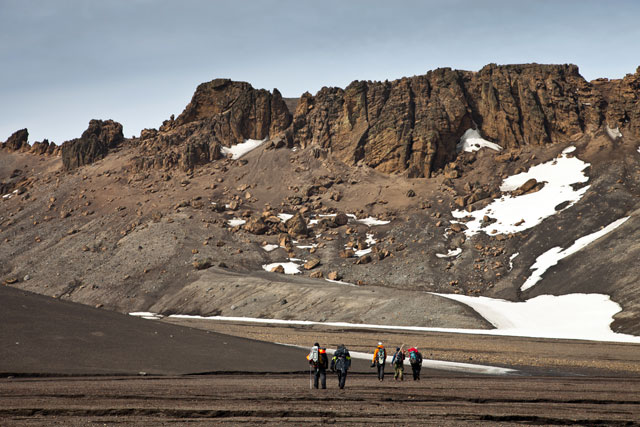
People hike in rugged terrain.
Photo Credit: ©Thomas Mueller
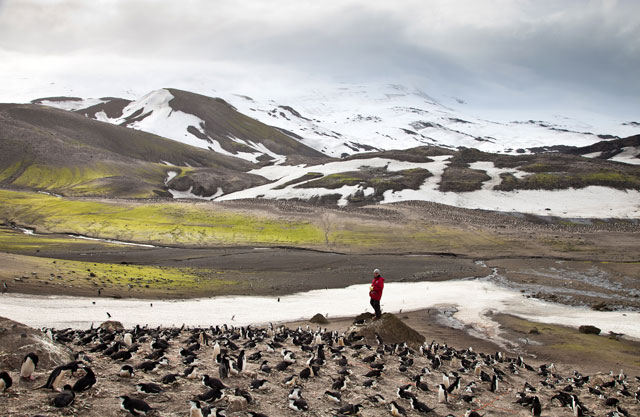
Members of the Oceanites/Antarctic Site Inventory team hike toward Baily Head, Deception Island. This past season, the team spent 12 days at the site, carrying out the most comprehensive survey ever of the world's largest chinstrap colony.
 
Person stands among group of penguins.
Photo Credit: ©Thomas Mueller
Steve Forrest of the Oceanites/Antarctic Site Inventory team conducts a census on a subcolony of chinstrap penguins at Baily Head, Deception Island. Baily Head is home to the largest congregation of chinstraps in the world, but their numbers appear to be in steep decline.

The big picture

The story of how three little penguin species are coping with significant changes in climate around the Antarctic Peninsula has followed a familiar narrative in recent years.

Colonies of ice-dependent Adélie penguins along the western side of the peninsula are blinking out of existence. A subantarctic species called gentoos that disdain ice is thriving, pushing farther south. The third species of brushtail penguin known as the chinstrap is somewhere in the middle.

All of this is under way in a region considered one of the fastest warming in the world. It’s where average year-round temperatures are 3 degrees Celsius higher over the last 60-plus years — and about double that during just the winter season.

A driving force in the success and failure of the different penguins revolves around sea ice, its extent and duration shrinking dramatically in recent decades. Such a scenario means that the true Antarctic penguin, the Adélie, is losing habitat to the subantarctic gentoos and chinstraps. 

That’s the story. But it’s not the whole picture, according to scientists who have recently published a paper in the journal Ecology that synthesized penguin census data from a 31-year period at 70 sites around the Antarctic Peninsula.

The findings suggest that site-specific long-term studies may not accurately reflect regional trends because population responses to climate change vary spatially. By looking at a large number of populations along the Antarctic Peninsula, the authors find that they call the “classic sea ice hypothesis,” while likely still a factor in the dynamics of the food web, “misses many of the key details that emerge from a more comprehensive regional-scale analysis.”
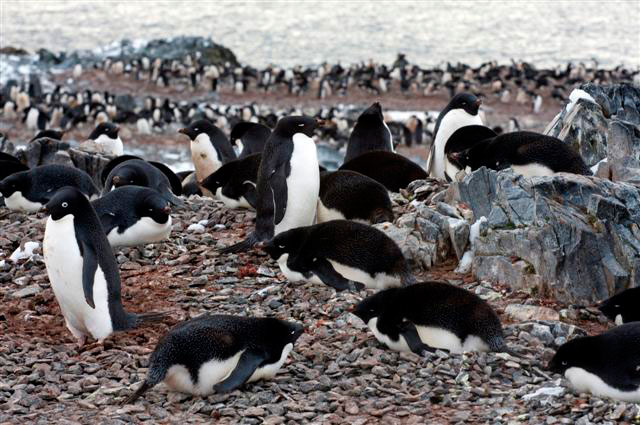
Adelie Penguins
Photo Credit: Jon Brack/Antarctic Photo Library
Adélie penguins at Torgersen Island, Antarctic Peninsula.
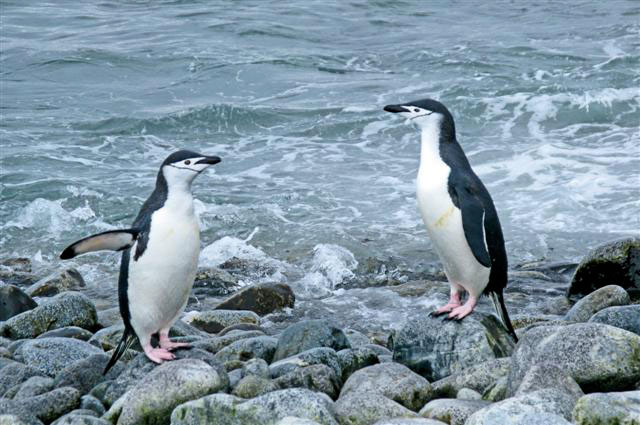
Chinstrap Penguins
Photo Credit: Jon Brack/Antarctic Photo Library
Chinstrap penguins around the Antarctic Peninsula.
Gentoo Penguins
Photo Credit: Kris Perry
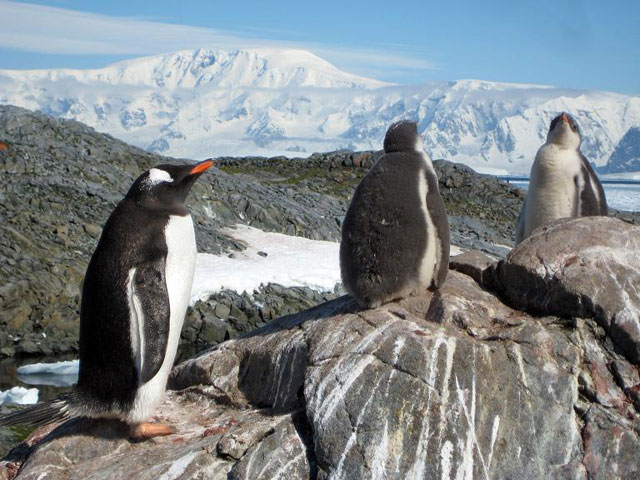
Gentoo penguins at Biscoe Island, Antarctic Peninsula.
“This study really captures what we’re trying to do, which is to understand the broad-scale picture of penguin population dynamics, not necessarily looking at any one site in particular. We’re trying to get a bird’s eye view of what is going on,” explained Heather Lynch External Non-U.S. government site, lead author of the paper.

More than five years ago, while a post-doctoral fellow with William Fagan External Non-U.S. government site at the University of Maryland, College Park External Non-U.S. government site, Lynch joined forces with Ron Naveen and his nonprofit conservation organization, Oceanites Inc. External Non-U.S. government site In 1994, with funding from theNational Science Foundation (NSF) External U.S. government site, Naveen had initiated the Antarctic Site Inventory, an ambitious program to census the seabird populations around the Antarctic Peninsula.
Naveen had the data. Lynch and Fagan had the analytical tools to create models that would pinpoint trends over time and space. For the Ecology paper, the researchers also drew upon other long-term datasets, including those by National Oceanic and Atmospheric Administration (NOAA) External U.S. government site scientists working in the South Shetland Islands off the northwest tip of the peninsula.

The analysis found that Adélies were in significant decline. No surprise there. Out of 24 breeding sites, Adélies were down at 18 sites and increasing significantly at only three colonies. But chinstraps — contrary to some previous research that implied they were mostly thriving alongside gentoos, as both species are not dependent on sea-ice like their cousin — are also failing. The 29 chinstrap sites surveyed found significant declines at 16 sites and increases at seven.

“If you look at the big picture, chinstraps are declining rapidly and regionally,” Lynch said, even more so than Adélies in the last decade.
But none of the changes affecting chinstraps or Adélies appear to be directly related to sea ice, according to the research. That finding supports a paper published last year by NOAA scientists in the journal Proceedings of the National Academy of Sciences.

“We suggest that sea ice no longer drives trends in penguin populations through direct, physical effects on habitat. Rather, sea ice is one of several factors that mediate prey availability to penguins,” wrote the authors, led by Wayne Trivelpiece External U.S. government site, a scientist with NOAA’s National Marine Fisheries Service External U.S. government site.

The work by Lynch, Naveen and their colleagues also suggest a correlation to food, at least for the peninsula Adélies, which rely almost exclusively on shrimplike krill. They used chlorophyll a as a proxy, or as a way to estimate biological activity, because actual estimates of krill biomass in the Southern Ocean are unavailable on the scales covered by the research.

Chlorophyll a is a green pigment in phytoplankton, microscopic plantlike organisms that float in the ocean. Krill feed on phytoplankton, hence the connection. Scientists believe the little crustaceans are also reliant on sea ice as both a habitat and source of food, as juvenile krill feed on algae that grow under the ice. So sea ice is still in the equation.

The scientists found that neither chlorophyll a nor changes in spring sea ice were correlated to the spatial pattern of chinstrap population declines.

In contrast to the other two Pygoscelis species, gentoo penguin populations are significantly increasing at 32 of 45 sites and significantly decreasing at only nine sites, the researchers reported. Lynch and colleagues found that gentoo colonies are restricted to areas with less than 50 percent sea ice cover in November. Their southward march has been rapid, thanks to the decline in sea ice at that time of year.
“I think we have to rethink the paradigm of population change in all three species,” said Lynch, now an assistant professor at Stony Brook University External Non-U.S. government site.

Naveen said the disparate findings suggest that researchers still have much to learn about what is driving the ecosystem.

“We want to try to understand more precisely why we’re seeing different responses by these three species in what is a vastly warming ecosystem. It could be food related. It could be oceanography. It could be something else,” he said.

Both scientists made separate expeditions to the Antarctic Peninsula this season, the 18th of the Antarctic Site Inventory, which now includes 142 sites. The current research is partly funded by the NSF’s Office of Polar Programs External U.S. government site.

Most of Oceanites’ fieldwork is opportunity-based, hitching rides aboard tourist vessels during the Antarctic summer. This year, Naveen and his team were able to raise additional funds and charter the yacht Pelagic. They spent 12 days at Deception Island, home to world’s largest chinstrap colony at a location called Baily Head.

“Deception Island has never been counted like that in one season, let alone in a 12-day period. We’re pretty excited about the results,” Naveen said.

The manuscript describing their findings is still in the works, but Lynch said the numbers will shock those scientists familiar with the Baily Head colony.

“We have found a complete collapse of the penguin colony there,” she said. “I was there this year, and it’s like a ghost town.”

Meanwhile, this season Lynch worked aboard the research vessel Laurence M. Gould External U.S. government site, one of two science vessels in the U.S. Antarctic Program External U.S. government site, which is managed by the NSF. She was able to visit several islands where she saw visible signs of change.

“We spend a lot of time chasing ghosts and going to a lot of empty colonies now,” she said.
Box sits next to penguins.
Photo Credit: ©Thomas Mueller
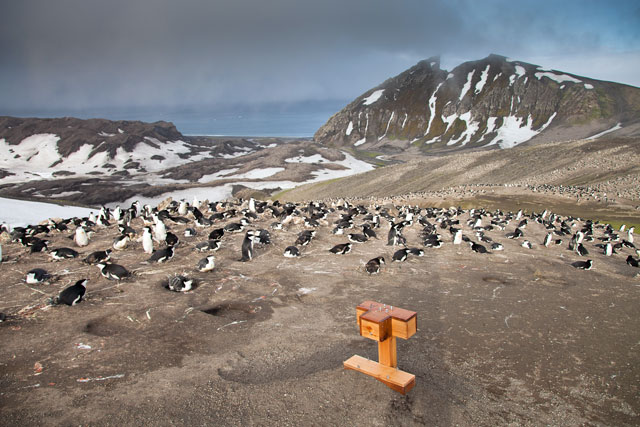
A sound recorder installed by the Oceanites/Antarctic Site Inventory team at Baily Head, Deception Island.
The chinstrap story has been largely ignored until recently, according to Lynch. She and Naveen want to focus more attention to their plight. This year they installed a sound-recording device at the Baily Head colony that captures 20 minutes of sound per day. The scientists will be able to hear when the chinstraps return to their colony in the summer to begin breeding — and even when the eggs begin to hatch.

“There’s some natural wobble every year when the peak of egg laying occurs. The better and better we get at understanding that date and refining our data, we reduce the error in our analyses,” Naveen explained.

A second device was set up at another location on Cuverville Island, with a large gentoo population. “It’s just another tool that we have in the arsenal. We’ll be testing it out over the next few years to see if it is useful to us, and we’re optimistic,” Naveen said.

Another very useful tool has been high-resolution satellite imagery. Lynch and Naveen predict the technology will eventually lend itself to monitoring penguin colonies around the entire Antarctic. [See related article — Eyes in the sky: Scientists use satellites to track health of seal, penguin populations in Antarctica.]
For instance, counts from satellite pictures matched up closely with previous Oceanites estimates for the Adélie population breeding on Paulet Island in the Weddell Sea, and a more recent analysis shows a near perfect match between satellite image-based estimates and ground counts for chinstraps breeding at Baily Head.

“We’re very clear now that for some of these large colonies, this is the way to go to measure change, to see if the colonies are expanding or shrinking,” Naveen said. “The satellite stuff is going to be pretty amazing.”
Predictions about what might happen to the penguins of the Antarctic Peninsula are a little harder to come by. The current population trends will likely continue, assuming the region’s climate and ecosystem trends also follow their current trajectories.

Regional extinction may be a possibility, unless the penguins can change their behavior. Naveen noted that previous studies of tissue samples of eggs from ancient penguin colonies in the Antarctic Peninsula region show that Adélies once ate a diet similar to gentoos, one more rich in fish.

Human pressures through whaling 200 years ago removed a major predator from the peninsula ecosystem for decades, presumably creating a surplus of krill. Now the whale populations are bouncing back, and krill are fished commercially for products like omega-3 nutrition supplements. Throw in climate change, and there appears to be less krill to go around.

A switch to a less krill-centric diet may help. But a research cruise in 2010 in search of silverfish, a sardine-sized fish favored by penguins, found little evidence that they were still available around the peninsula region — another possible casualty of climate warming. [See previous article — Fishy business: Climate change may be to blame for disappearance of Antarctic silverfish.]

Naveen sees a lesson here: Can species adapt quick enough to a multitude of changes driven by climate change?

“We’re going to see more and more of that around the globe. What’s happening in the peninsula may be giving us some clues as to what we who live in more temperate climates may be facing in the future,” he said.

NSF-funded research in this article: Ron Naveen, Oceanites Inc., Award No. 0739430 External U.S. government site; and William Fagan and Heather Lynch, University of Maryland College Park, Award No. 0739515 External U.S. government site.

source 

Study tackles emperor penguin diving physiology, population dynamics and even leopard seals

Penguins leave the water in a hurry.
Photo Credit: Paul Ponganis
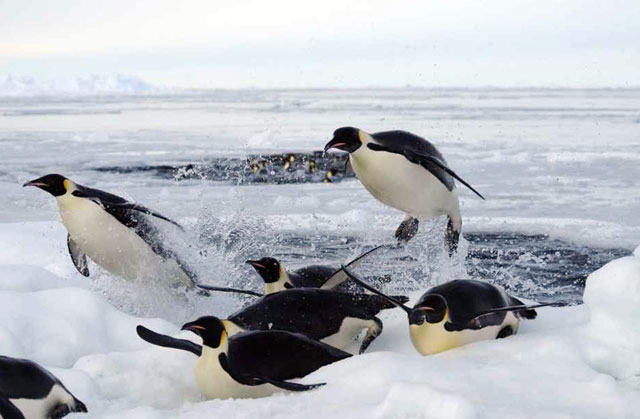
A group of emperor penguins exits the water at Cape Washington. The birds are regularly capable of going down to depths of 500 meters for five to 12 minutes at a time.

A big breath

Leopard seals are sort of the Great White Sharks of the Southern Ocean — viciously effective and elusive predators that are notoriously difficult to study. Never mind all the sharp teeth.

Two years ago, Dr. Paul Ponganis External Non-U.S. government site and his research team moved their main base of operations from near McMurdo Station External U.S. government site to Cape Washington, 300 kilometers away, where an emperor penguin colony goes to breed every Antarctic summer. They had hoped that during their ongoing research into emperor penguin physiology that one of the handful of leopard seals that prowl around the colony might be used for behavioral research.

But they never got close.

“They are a poorly studied animal. Not many people get access to them,” Ponganis said. “I knew it was going to take a lucky year at Cape Washington to do this leopard seal study.”

An anesthesiologist and marine biologist, Ponganis has studied Antarctica’s largest penguin species for more than 20 years, research first pioneered in the 1960s by his colleague at the University of California-San Diego’s Scripps Institution of Oceanography, Jerry Kooyman External Non-U.S. government site.

The researchers are particularly interested in the penguins for their innate diving abilities. Over the years, the scientists have collected plenty of data on how fast the emperors can swim, the number of strokes they take on a dive, and just about any other tangible detail imaginable.

Leopard Seal
Photo Credit: Paul Ponganis
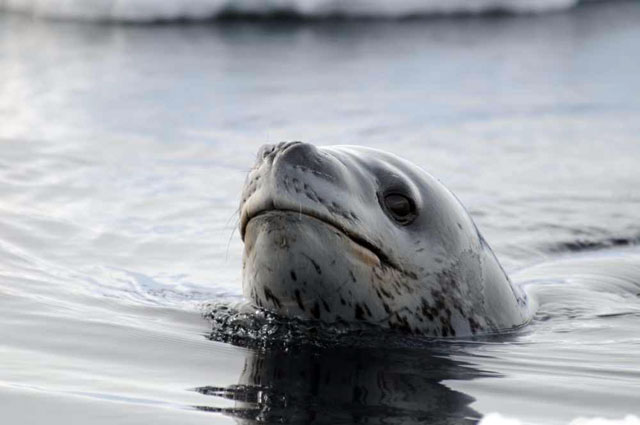
A leopard seal on the prowl at Cape Washington.
Emperor penguins with chicks.
Photo Credit: Paul Ponganis
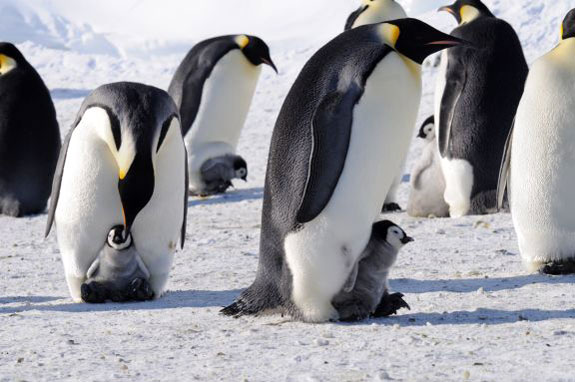
Emperor penguin chicks still under their parent's brood patches early in October at Cape Crozier.
They’ve learned the birds are regularly capable of going down to depths of 500 meters for five to 12 minutes at a time. They’ve been able to calculate the air volume in the birds’ lungs while they are diving. The deeper the birds go, the bigger the gulp of breath in their lungs. The oxygen from the lungs is then carried through the bloodstream to the animal’s muscles.

The latest question has to do with the deepest dives, which presumably require more oxygen to be extracted from the lungs and circulated through the body. In theory, that should require the heart to pick up the beat.

“Is the pattern during the deep dives different?” Ponganis said. “Is the overall heart rate for a deep dive of equivalent duration to a shallow dive lower, the same or higher?”

Much of the team’s previous research into emperor penguin diving physiology has taken place on the sea ice that covers McMurdo Sound through the early part of the Antarctic summer. Dubbed Penguin Ranch, the study site is located over an area where the water column is only about 100 meters deep.
The move to Cape Washington allowed the scientists to study swimming behavior five times as deep. For the last two years, working from a field camp on the coast of Victoria Land, they outfitted the birds with electrocardiogram recorders to monitor their heart rates as they plunged to great depths in search of food.
Ponganis and his team know from their work at Penguin Ranch that the birds hyperventilate before a dive, revving their heart rate as high as 220 beats per minute, before it slows down to about 60 beats.

“They’re really oxygenating themselves, storing things up to get ready for this dive. They’re really fired up. When they dive, it plunges back down,” he explained.

The heart rate on shallow dives can slow markedly, as time drags on. After 10 minutes or more, the heart drums out a beat 20 times a minute. On one dive, an emperor stayed under water for a record 27 minutes, possibly trapped from reaching the surface because a hole in the ice had closed or a leopard seal was prowling about.

“I wish we had a heart rate monitor on that one,” Ponganis said, estimating a heart rate of five beats a minute. “This animal is just eking things out. That’s an extreme situation, but they are capable of doing that.”
So, what does all this have to do with leopard seals? While a major focus of the study is on diving physiology, the scientists are also interested in colony population dynamics. The group monitors the seven emperor penguin colonies around the Ross Sea.

In the case of Cape Washington, home to between 15,000 and 20,000 breeding pairs, the researchers wondered if the leopard seals affect the Cape Washington colony through predation.
The plan had been to locate a seal, sedate it, and put a digital backpack camera on the animal capable of taking up to 10,000 images. A radio transmitter on the instrument package would help the scientists relocate the animal and recover the camera.

No one even knows how many penguins a leopard seal typically consumes in a day, Ponganis noted. “If we take one picture a minute, we would get every capture,” he said.

Dark patches on the snow.
Photo Credit: Paul Ponganis
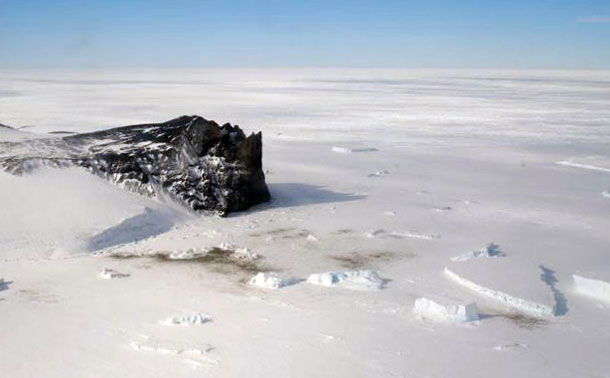
An aerial overview of Cape Washington and the colony..
Ponganis said it is highly unlikely that the leopard seals alone could threaten a colony, but it is one of many factors that must be understood if scientists are to properly assess how the emperor penguins will respond to a changing climate.

The physiology work is also part of that assessment, he explained. Are the emperors already pushing the limits? If so, how would changes to the environment affect them? Some scientists believe the emperors are already being affected, calling for their protection.

But studying penguins isn’t just about helping save one species. Medical science can also learn a thing or two from the diving physiology of animals like the deep-diving emperor or some mammals like seals.
“The big thing in both emperors and seals is that they can tolerate levels of oxygen that are so low, and levels of blood flow that are so low, we would have serious tissue damages, strokes, all sorts of problems,” Ponganis explained.

In stroke victims, for example, a lot of tissue damage actually occurs when blood flow returns to an organ that had its supply temporarily cut off. Such oxidative stress can produce free radicals — sort of rogue molecules — that can damage cells. In recent years, there has been a big push in medical science to treat such conditions with antioxidants, molecules capable of “scavenging” free radicals.

Studies of emperors at Penguin Ranch and other research on seals have found that the animals have elevated antioxidant levels, particularly of a molecule known as glutathione, which is also important in recycling other antioxidants, according to Ponganis.

“Essentially, they have this system that as oxygen free radicals form, they can scavenge them and break them down and prevent any of the deleterious effects of any of these oxygen free radicals,” Ponganis explained.
“Research on penguins and marine mammals can provide insight into the processes that are going on in human patients, and eventually lead, even if it’s tangential, into some improved therapies,” he added.

source

NSF-funded research in this story: Paul Ponganis, University of California-San Diego’s Scripps Institution of Oceanography, Award No. 0944220 External U.S. government site.

New book chronicles four polar research expeditions: about penguins

Penguins gather on a hillside.
Photo Credit: Chris Linder/WHOI
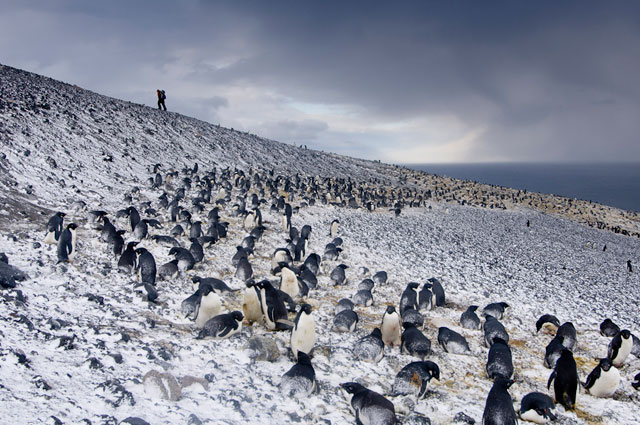
A picture by photographer Chris Linder of Adélie penguins from his 2007 trip to Ross Island for a story about the work done by penguin scientist David Ainley, which was included in Linder's recent book about polar research called "Science on Ice."

Embedded with scientists

New book chronicles four polar research expeditions

Chris Linder External Non-U.S. government site has taken part in two dozen research expeditions over the last decade, many of them to the polar regions.

But Linder is not a scientist per se, though he earned a master’s degree from the Massachusetts Institute of Technology and Woods Hole Oceanographic Institution Joint Program External Non-U.S. government site in oceanography. That background has served him well as an expedition photographer whose work has appeared in books and magazines, such as Geo, Nature’s Best, Outdoor Photographer and Wired.

He recently published a book about four of his adventures to the Arctic and Antarctic in a book called Science on Ice External Non-U.S. government site (University of Chicago Press 2011), as part of an outreach project originally funded by the National Science Foundation External U.S. government site.

Chris Linder
Photo Credit: Mike Carlowicz/WHOI
Chris Linder with McMurdo Station in the background.
The four chapters of the book focus on a particular expedition, each written by a different science journalist. The first chapter features researcher David Ainley External Non-U.S. government site, who studies Adélie penguins in the Ross Sea region. Linder and science writer Hugh Powell External Non-U.S. government site visited Ainley in November-December 2007, capturing images from McMurdo Station External U.S. government site, Cape Royds and Cape Crozier. 

Linder recently answered a few questions from The Antarctic Sun External U.S. government site about his new book and a more recent project about one of Antarctica’s lesser-known seabirds, the predatory skua.

1. Science on Ice features four research expeditions that you accompanied, along with a science writer, as part of a grant from the National Science Foundation for the International Polar Year External U.S. government site. What made you choose to highlight those four particular projects, especially the one in Antarctica about Adélie penguins?

I chose those four particular expeditions to showcase the broad diversity of environments (Ross Island, the Greenland Ice Sheet, Bering Sea, Arctic Ocean) and disciplines (biology, engineering, glaciology, geology, chemistry, physics) that encompass polar science. On our trip to McMurdo Station, we chose to highlight David Ainley’s penguin science research External Non-U.S. government site for a few reasons. First, Adélie penguins are iconic — they are one of those species that people immediately associate with Antarctica. In terms of the science, Dr. Ainley is also an Antarctic icon (Ainley Peak, on Ross Island, is named after him). His team’s long-term study of Adélie penguins was a natural fit for our outreach project.

A person carries a penguin.
Photo Credit: Chris Linder/WHOI
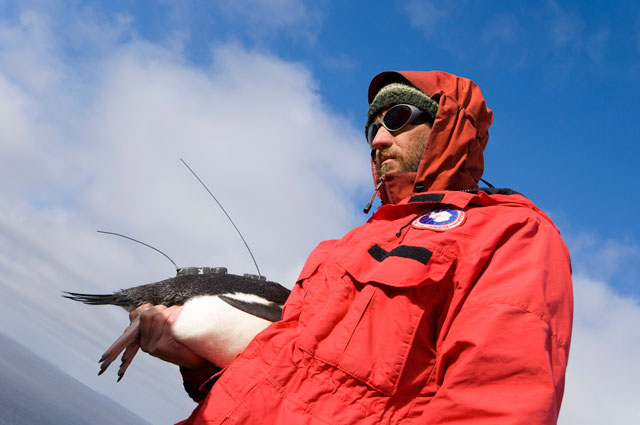
Scientist Grant Ballard holds a tagged Adélie penguin.
Two people tend to equipment.
Photo Credit: Chris Linder/WHOI
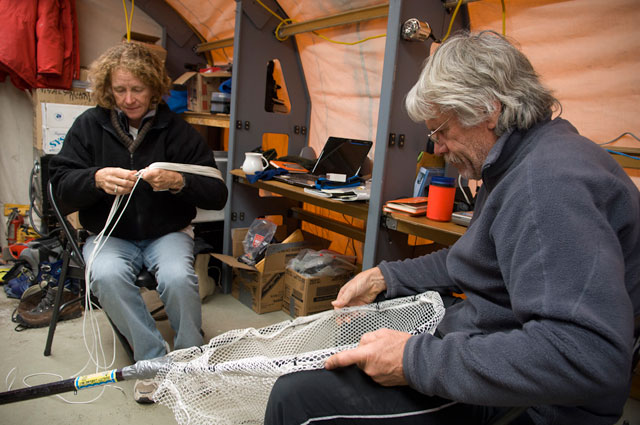
Jean Pennycook, left, and David Ainley mend a net.
Penguin walks through gate.
Photo Credit: Chris Linder/WHOI
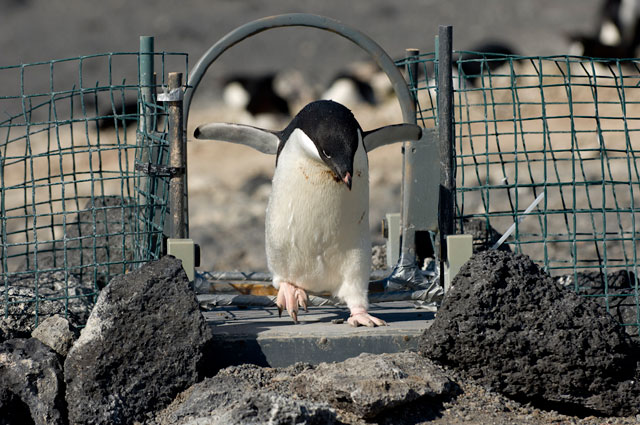
An Adélie penguin steps onto a scale.
2. How does your training as an oceanographer help you as a photographer while on assignment?

Having a science background gives me a distinct advantage when photographing fieldwork. I understand how long it takes to get a grant funded and how precious every second of field time is on an expedition. I carefully research each expedition’s logistics and science goals so that I know exactly what is going to happen, when, and why. I never ask scientists to change their activities to suit my images. Instead, I make sure that I am always ready for the action, even if that means working all night or waiting hours to document a unique science event. The science team appreciates my hands-off approach. This makes them more comfortable around the camera, and it’s easier for me to capture candid, behind-the-scenes moments.

3. Since 2002, you have photographed two dozen science expeditions, including 14 to the polar regions, no doubt working closely with many of the researchers you’ve photographed. What have you learned about the world of science by embedding yourself with your subjects for what can be weeks at a time? I know from my experiences that I’ve always been impressed with their commitment and tireless work ethic.

The scientists I photograph are my heroes. Aside from their determination and drive, the other quality that stands out to me is their creativity. Whether it’s dealing with logistical snafus, a broken instrument, or weather delays, researchers always come up with creative solutions to unexpected problems in the field.

4. Aside from the book, you did a number of outreach activities as part of the IPY grant. Would you talk about some of the creative ways you communicated polar research to the public?

One of the most enriching, but stressful, things we did on the Live from the Poles External Non-U.S. government site project was to facilitate a series of live calls from the science teams to audiences at museums, classrooms, and radio programs across the U.S. I still remember the sleepless nights I spent worrying about if the satellite phone connection would actually work. But listening to the insightful questions from kids and adults at the venues always reminded me of the value of this direct interaction.

5. You received a second grant from the NSF in 2010 under its Antarctic Artists and Writers Program External Non-U.S. government site. Your subject: the South Polar skua, which took you back to the Ross Sea region. Why a project about a relatively obscure, gull-like bird that likes to prey on penguins? And what do you hope to produce from that project?

On my first visit to Cape Royds and Cape Crozier, I was amazed by the teamwork and intelligence the skuas displayed as they robbed Adélie penguins of their eggs and chicks. After I returned home, I picked up a copy of Euan Young’s book Skua and Penguin: Predator and Prey, which explains in detail the research done on this topic. Surprisingly (to me), their observations revealed that the skuas acted more like scavengers than predators — essentially, they were eating the eggs and chicks that wouldn’t have survived anyway. I decided to write an Artists and Writers proposal to photograph the life history and behavior of the skuas at Cape Crozier, Ross Island. I spent six weeks photographing the birds, and was lucky enough to witness a wide range of behavior, including a penguin disturbing a skua nest and a skua pair feeding their chick. The story was shot as a first-look agreement with National Geographic magazine, and is still pending publication.

6. Anything you’d like to add?
Photographing these expeditions, with all of the stress, sleepless nights, and cold fingers, has been the hardest but most exhilarating job of my life. But the polar bears and penguins don’t make my job extraordinary; the people do. The scientists who kindly invited me to join their expeditions, the crews of the ships and field camps who kept me alive and happy, and the readers of the Polar Discovery website External Non-U.S. government site who sent in insightful questions and comments all reminded me why I was out there: to tell the stories of science on ice.

source
Saturday, February 18, 2012

Satellites Track Health of Seal, Penguin Populations in Antarctica


A satellite image shows chinstrap penguin colonies at Baily Head, Deception Island, in 2003. The white patches are the colonies. Researchers are using high-resolution imagery shot from satellites to find, count and assess the population health of penguin and seal colonies around the Antarctic. Photo Credit: (c)DigitalGlobe Inc.; Image provided by National Geospatial-Intelligence Agency Commercial Imagery Program

Peter Rejcek, Antarctic Sun Editor: Penguins from outer space. Sounds like the title of some new B-movie science fiction film starring Vin Diesel. But polar researchers are increasingly using high-resolution imagery shot from orbiting satellites to find, count and assess the population health of penguin and seal colonies around the Antarctic.

"The satellite imagery is the most important advancement in my field since satellite tagging. I think it's an absolute game-changer," said Heather Lynch, an assistant professor at Stony Brook University involved in a long-term census survey of brushtail and crested penguins around the Antarctic Peninsula.

"Suddenly, we know what we don't know," Lynch explained. "We can look through the imagery and find colonies that we never knew existed, and look at population changes at colonies that were either inaccessible because of their location or they were impossible to census because of their size."

Lynch is an active user and advisory member of the Polar Geospatial Center (PGC), based at the University of Minnesota. PGC has access, through the National Geospatial-Intelligence Agency, to commercial satellite imagery with half-meter resolution -- about the breadth of a man's shoulders. The National Science Foundation-funded center provides high-resolution imagery and maps for U.S. Antarctic Program research and operations.

The main point of contact for all those users is Michelle LaRue, a research fellow at PGC whose interest in wildlife ecology has segued nicely with the remote sensing work. She has collaborated closely with Antarctic researchers involved in studying the polar region's most iconic animals, including Weddell seals and emperor penguins.

LaRue was the lead author on a paper published last year in the journal Polar Biology that argued that satellite imagery is a reliable way to assess seal abundance and population trends. She counted seals in pictures in collaboration with a research group from Montana State University (MSU) that conducts an annual population census of Weddell seals in McMurdo Sound around an area called Erebus Bay.

"The counts are highly correlated, which basically means what we're seeing in the satellite images is representative of what's on the ground at the same general time," said LaRue, who is working on a PhD in conservation biology at the University of Minnesota.

Robert Garrott, principal investigator for the MSU team, along with Jay Rotella, also a professor in MSU's Ecology Department, said the collaboration is beneficial to both sides.

"We can ground truth and help refine Michelle's algorithms and her ability to actually count seals on the ice," he said. In turn, the satellite technology and associated methodology will help the project expand beyond Erebus Bay without chartering an expensive research vessel.

"We can start asking questions about seal population and ecology over larger spatial scales without all the logistic support," Garrott said.

Lynch is certainly a believer in the technology. She and colleagues have a paper in press with Polar Biology outlining their methodology to use satellites to survey colonies of Adelie, chinstrap and gentoo penguins around the Antarctic Peninsula. The latter species is thriving as the Antarctic Peninsula region warms, while the other two are in steep decline. The paper also includes work on a crested penguin known as a macaroni, with a prominent yellow crest that looks like long, wild eyebrows.

Detailed counts of the penguins around the peninsula are inherently more difficult than the seal census. The large, dark bodies of the Weddell seals stand out starkly on the white sea ice. The terrain on the islands around the peninsula, on the other hand, is generally dark and snow-free in the summer months where the birds breed and raise their young.

A combination of extensive fieldwork and familiarity with each species' ecology helped with interpretation of the satellite pictures, according to Lynch, a co-principal investigator on the Antarctic Site Inventory program, which was started nearly 20 years ago by Ron Naveen, head of the nonprofit science and education organization Oceanites Inc.

"The remote sensing stuff is pretty incredible," Naveen said. "We're not quite putting our on-the-ground work out of business, which I'm happy about because I really enjoy doing it, but it's really an amazing supplement to what we've been up to for many years."

The imagery is also a valuable tool to the group's fieldwork, which spans more than 140 locations around the Antarctic Peninsula. "We were able to find penguins that were not on maps previously," Lynch noted. "It's going to make the time we spend in the field much more efficient."

Satellites have been around for more than 50 years, beginning with the launch of Sputnik I by the former Soviet Union in 1957. But it's probably only been within the last five years or so that pictures from space have been good enough for this sort of ecological research.

In fact, one of the first papers published on the topic was in 2007 in Polar Biology, about estimating relative abundance of emperor penguin colonies in the Ross Sea.

Paul Ponganis, a medical doctor and marine biologist at the University of California-San Diego's Scripps Institution of Oceanography, was a co-author on that paper, along with Gerald Kooyman, an emeritus professor at Scripps. Kooyman had gotten an exploratory grant from NSF in 2000 to test the feasibility of using satellite pictures to census emperor penguin colonies.

Ponganis said there are still a number of hurdles to overcome before satellites replace the aerial surveys that he and colleagues have conducted at seven emperor penguin colonies around the Ross Sea for the last 20 years or so.

For instance, it's still difficult to differentiate shadows from the black back of an emperor. Emperors stand vertically on the ice where they breed, not horizontally like a seal, which also causes some challenges. And the world's largest penguin also tends to congregate in tight huddles.

Still, Ponganis is optimistic. "I think that will be the future -- the satellite," he said.

Lynch agreed that there are still obstacles associated with the imagery, particularly around the Antarctic Peninsula, where clouds often obscure the region, making 90 percent of the imagery unusable. Weekly shots of Zavodovski Island in the South Sandwich Islands over a five-month period produced only one cloud-free scene.

But she boldly predicts that in five to 10 years scientists will be able to monitor every penguin colony in the Antarctic, from a handful of birds to groups that are a million strong.

"I think it's going to completely change the way we do penguin science in the Antarctic," she said.

Indeed, the British Antarctic Survey (BAS) made headlines in 2009 when it announced researchers had used satellite images to detect the light brown stain of emperor penguin guano on the sea ice. The imagery came from the Landsat Image Mosaic of Antarctica (LIMA), which seamlessly stitched together satellite photos of Antarctica acquired between 1999 and 2004.

The BAS study found 38 colonies from the guano stains, four more than were thought to exist. Ten were new colonies, while six previously known colonies either had disappeared or could not be found. A half-dozen colonies had relocated more than 10 kilometers away from their last-known position.

Such data are key to wildlife conservation issues, LaRue said.

Currently, emperor penguins are a species of "least concern," according to the International Union for Conservation of Nature and Natural Resources (IUCN). But some scientists have argued environmental changes and human impact from activities like industrial fishing are causing problems. A paper in 2009 published in the journal Proceedings of the National Academy of Sciences predicted emperors could be on the brink of extinction by the end of the century.

"There are lots of locations where there have never been counts, so the current estimate based on all of those sporadic, insufficient data is not that great," LaRue noted. "By being able to do this, we can actually see every single colony we know about and have a little bit better estimate of how many there are. You can't tell if they're going up and down if you don't know how many there are.

"That's the conservation issue: We don't really know how many there are, so how can you say if they're doing fine or not?" she added.

Such is the case of a chinstrap colony on Deception Island in the South Shetland Islands. A single satellite image from January 2003 compared to one from January 2010 shows dramatic changes are under way, according to Lynch.

"You can see in the imagery how a penguin colony collapses," she said. "You look at those two images and there's absolutely no question that there's something serious, seriously wrong going on with the chinstraps.

"It's concerning and scientifically exciting to be able to document those kinds of changes," Lynch added. "Moving forward, we'll be able to put together some amazing timelines."

NSF-funded research in this article: Paul Morin, University of Minnesota, Award No. 1043681; Robert Garrott, Jay Rotella, and Donald Siniff, Montana State University, Award No. 0635739; William Fagan and Heather Lynch, University of Maryland College Park, Award No. 0739515; Ron Naveen, Oceanites Inc., Award No. 0739430; Paul Ponganis, University of California-San Diego Scripps Institution of Oceanography, Award No. 0944220.

Please follow SpaceRef on Twitter and Like us on Facebook.

source

Thursday, January 26, 2012

Winged Dinosaur Archaeopteryx Dressed for Flight


Berlin specimen of Archaeopteryx: Paleontologists have long thought that Archaeopteryx fossils, including this one discovered in Germany, placed the dinosaur at the base of the bird evolutionary tree. (Credit: Museum für Naturkunde Berlin)

ScienceDaily (Jan. 24, 2012) — Since its discovery 150 years ago, scientists have puzzled over whether the winged dinosaur Archaeopteryx represents the missing link in birds' evolution to powered flight. Much of the debate has focused on the iconic creature's wings and the mystery of whether -- and how well -- it could fly.

Some secrets have been revealed by an international team of researchers led by Brown University. Through a novel analytic approach, the researchers have determined that a well-preserved feather on the raven-sized dinosaur's wing was black. The color and parts of cells that would have supplied pigment are evidence the wing feathers were rigid and durable, traits that would have helped Archaeopteryx to fly.

The team also learned from its examination that Archaeopteryx's feather structure is identical to that of living birds, a discovery that shows modern wing feathers had evolved as early as 150 million years ago in the Jurassic period. The study, which appears in Nature Communications, was funded by the National Geographic Society and the U.S. Air Force Office of Scientific Research.
"If Archaeopteryx was flapping or gliding, the presence of melanosomes [pigment-producing parts of a cell] would have given the feathers additional structural support," said Ryan Carney, an evolutionary biologist at Brown and the paper's lead author. "This would have been advantageous during this early evolutionary stage of dinosaur flight."

The Archaeopteryx feather was discovered in a limestone deposit in Germany in 1861, a few years after the publication of Charles Darwin's On the Origin of Species. Paleontologists have long been excited about the fossil and other Archaeopteryx specimens, thinking they place the dinosaur at the base of the bird evolutionary tree. The traits that make Archaeopteryx an evolutionary intermediate between dinosaurs and birds, scientists say, are the combination of reptilian features (teeth, clawed fingers, and a bony tail) and avian features (feathered wings and a wishbone).

The lack of knowledge of Archaeopteryx's feather structure and color bedeviled scientists. Carney, with researchers from Yale University, the University of Akron, and the Carl Zeiss laboratory in Germany, analyzed the feather and discovered that it is a covert, so named because these feathers cover the primary and secondary wing feathers birds use in flight. After two unsuccessful attempts to image the melanosomes, the group tried a more powerful type of scanning electron microscope at Zeiss, where the group located patches of hundreds of the structures still encased in the fossilized feather.

"The third time was the charm, and we finally found the keys to unlocking the feather's original color, hidden in the rock for the past 150 million years," said Carney, a graduate student in the Department of Ecology and Evolutionary Biology, studying with Stephen Gatesy.

Melanosomes had long been known to be present in other fossil feathers, but had been misidentified as bacteria. In 2006, coauthor Jakob Vinther, then a graduate student at Yale, discovered melanin preserved in the ink sac of a fossilized squid. "This made me think that melanin could be fossilized in many other fossils such as feathers," said Vinther, now a postdoctoral researcher at the University of Texas-Austin. "I realized that I had opened a whole new chapter of what we can do to understand the nature of extinct feathered dinosaurs and birds."

The team measured the length and width of the sausage-shaped melanosomes, roughly 1 micron long and 250 nanometers wide. To determine the melanosomes' color, Akron researchers Matthew Shawkey and Liliana D'Alba statistically compared Archaeopteryx's melanosomes with those found in 87 species of living birds, representing four classes: black, gray, brown, and a type found in penguins. "What we found was that the feather was predicted to be black with 95 percent certainty," Carney said.
Next, the team sought to better define the melanosomes' structure. For that, they examined the fossilized barbules -- tiny, rib-like appendages that overlap and interlock like zippers to give a feather rigidity and strength. The barbules and the alignment of melanosomes within them, Carney said, are identical to those found in modern birds.

What the pigment was used for is less clear. The black color of the Archaeopteryx wing feather may have served to regulate body temperature, act as camouflage or be employed for display. But it could have been for flight, too.

"We can't say it's proof that Archaeopteryx was a flier. But what we can say is that in modern bird feathers, these melanosomes provide additional strength and resistance to abrasion from flight, which is why wing feathers and their tips are the most likely areas to be pigmented," Carney said. "With Archaeopteryx, as with birds today, the melanosomes we found would have provided similar structural advantages, regardless of whether the pigmentation initially evolved for another purpose."

Contributing authors include Vinther, Shawkey, D'Alba, and Jörg Ackermann from Carl Zeiss.

Story Source:
The above story is reprinted from materials provided by Brown University.

Journal Reference:
  1. Ryan M. Carney, Jakob Vinther, Matthew D. Shawkey, Liliana D'Alba, Jörg Ackermann. New evidence on the colour and nature of the isolated Archaeopteryx feather. Nature Communications, 2012; 3: 637 DOI: 10.1038/ncomms1642

Brown University (2012, January 24). Winged dinosaur Archaeopteryx dressed for flight. ScienceDaily. Retrieved January 26, 2012, from http://www.sciencedaily.com­ /releases/2012/01/120124113036.htm