Thursday, July 31, 2008

An interview with David Ainley


Letters from Antarctica: Interview with Penguin Researcher David Ainley


Patricia Ballou

David AinleyIt has been four months since I left Antarctica but the stories of those striving to understand this dynamic continent and the array of polar science continues. Dr. David Ainley is a remarkable scientist with 40 years experience researching Adélie penguins. His achievements include; a PhD from John Hopkins University, numerous published works within the science community and authorship of five books. A standout among these accomplishments is the book, The Adélie Penguin: Bellwether of Climate Change. Penguin Science : What is it, how does it explain adaptations to climate change and who is involved? Everyone has a soft spot for the feathery inhabitants of Antarctica. So few humans make the journey to the southernmost land mass that when these flightless creatures encounter people, they tend to act like they've known you all their lives. With all the niceties set aside, it is thought that these penguins are the bellwether of polar climate change and the studies conducted on Adélie penguins by David Ainley and other scientists are set to reveal some interesting trends.

Patricia Ballou: What type of research have you been conducting and name the major players in the Adélie penguin studies?

David Ainley: We are funded by the National Science Foundation, Office of Polar Programs , U.S. Antarctic Program , and I work for H.T. Harvey and Associates . This is our 12th season working on this particular penguin project . The study of Adélie penguins was undertaken because we noticed their colonies were increasing dramatically in the Ross Sea area, but declining in the Antarctic Peninsula region. Smaller colonies in the Ross Sea are increasing in size and far more rapidly than the larger ones. These noticeable changes are based on aerial censuses taken by Landcare Research - Manaaki Whenua, New Zealand.

PB: What areas are you and cooperative scientists focused on? What type of research is being conducted?

DA: The photo reconnaissance takes place around the beginning of December. Resources limit Landcare's ability to conduct annual surveys for every colony so some colonies, especially those in northern Victoria Land, are counted every few years. They collaborate with us by contributing scientists to help study four colonies of interest: Cape Royds, Cape Crozier, Cape Bird and Beauford Island. Every year our teams go to these areas and track, record and study Adélie colonies and fossil remains from times gone by. The bones left behind have stories to tell about environmental conditions of that time and how these birds adapted to climate change.

http://www.celsias.com/article/letters-antarctica-interview-penguin-researcher-da/

Monday, July 21, 2008

Antarctic Life Hung by a Thread During Ice Ages


Science News

Antarctic Life Hung By A Thread During Ice Ages

ScienceDaily (Feb. 20, 2008) — Frozen in time... frozen in place... frozen solid... All of these phrases have been used to describe Antarctica, and yet they all belie the truth about this southerly point on the globe. Although the area is covered in ice and bears witness to some of the most extreme cold on the planet, this ecosystem is dynamic, not static, and change here has always been dramatic and intense. A report published in the March issue of Ecology argues that the extreme cold and environmental conditions of past Ice Ages have been even more severe than seen today and changed life at the Antarctic, forcing the migration of many animals such as penguins, whales and seals. Understanding the changes of the past may help scientists to determine how the anticipated temperature increases of the future will work to further transform this continent.

Extreme cold and lasting darkness have always worked to limit the productivity of the microscopic algae in Antarctica. The availability of such algae drives the entire region's food web, from one-celled organisms to top predators such as whales and seals, making life in this region challenging for all kinds of animals.

But during the Ice Ages, animals in Antarctica faced conditions even more life-threatening. Massively thick and permanent ice covered most of the land, and sea-ice coverage around the continent was permanent. The Antarctic continental shelf was glaciated and most seafloor animals dodged extinction by emigrating into deeper waters.

Sven Thatje from the University of Southampton's School of Ocean and Earth Science (UK) has been studying geological records of the area for such insights. He and his team from the British Antarctic Survey in Cambridge and the German Alfred Wegener Institute have found that penguins, whales and seals were very dependant upon areas of open water known as polynyas. The polynyas, the team contends, must have existed far south of the present winter sea-ice boundaries, and far north of the Antarctic shelf.

Polynyas have been important both in the past and today because they cause upswells of warmer water, and thereby help establish local food webs for many animals.

Thatje's team analyzed geologic and genetic records and found that during glacial periods the permanent sea-ice belt advanced much further to the North than it is now. In parts of the Southern Ocean, the summer sea-ice boundary was located where the winter sea-ice limit is today, and ice coverage was complete and a magnitude thicker than seen today. These boundaries would have forced a complete shut down of food supplies for most life, both from the sea and land.

Only species that are champions of cold weather adaptation in the present day, such as Emperor Penguins and Snow Petrels, were likely able to survive in locally restricted areas of biological productivity. Those animals, it seems likely, may have stayed in Antarctica during the Ice Ages.

But the polynyas were too isolated to support larger top predators, such as seals and whales, which had to move north to escape starvation. Many other penguin species lost access to traditional feeding grounds and ice-free breeding areas on land, which are crucial for their survival. Some of those animals may have thus been forced to emigrate as far north as the Patagonian shelf off the coast of what is now Argentina.

"Science is only now beginning to ponder what happened here during the Ice Ages," says Thatje. "This research is leading to a radical reconsideration of those time periods. Antarctic species are champions in adaptations to extreme cold and the harshest environmental conditions. Understanding how the stunning Antarctic fauna has evolved and coped with glacial-interglacial periods will help us to assess their sensitivity to current climate warming."

Thatje also notes that the animals of Antarctica are extremely vulnerable to warming temperatures. Their ability to survive in extreme cold is unique and has taken tens of millions of years to evolve.

Shifts in the distribution of animals over glacial cycles have likely been a very common phenomenon in region, he says. But given the fact that sub-Antarctic organisms are invading the area as temperatures rise, Thatje says it is time to assess how and if the Antarctic ecosystems will be able to cope with the new invaders.
Adapted from materials provided by Ecological Society of America, via EurekAlert!, a service of AAAS

Ecological Society of America. "Antarctic Life Hung By A Thread During Ice Ages." ScienceDaily 20 February 2008. 21 July 2008 .

Wednesday, July 9, 2008

Dee Boersma's full paper

In her paper published in the July-August edition of the journal BioScience, Dee Boersma contends that penguins are the litmus test of our world's environment. In my next to last post, I included an article on this paper from Science Digest. Here is the link to read her entire paper.

I cannot help but thank Dr. Boersma for her dedication in reporting to the world the ever current situation of the penguin's plight. I call her the Patron Saint of Penguins and I commend her for bringing to us, an awareness that is needed for not only the penguins' survival, but our own as well.


http://www.aibs.org/bioscience-press-releases/resources/Boersma.pdf

National Geographic--Global Warming Freezes Penguin Chicks


..A gentoo penguin chick (center) is drenched by rain at Port Lockroy on the Antarctic Peninsula in January 2008. Unlike adult penguins, chicks lack water-repellent feathers and so become drenched during rainstorms. The chicks are then susceptible to freezing to death during nighttime's below-freezing temperatures.


Increasing rain in penguin habitats may be caused by global warming, making the precipitation one of many human-caused ills affecting the seabirds, a July 2008 paper says.

Photograph by Fiona Stewart via Jon Bowermaster..

Penguin Chicks Frozen by Global Warming?
John Roach
for National Geographic News
July 2, 2008

This January—deep summer in Antarctica—explorer Jon Bowermaster suffered through a five-day stretch of torrential rains on the west side of the Antarctic Peninsula. The same cannot be said for thousands of downy penguin chicks.
Epic rains are unusual in Antarctica, even in summer, said Bowermaster, who had been in the region on an expedition funded in part by the National Geographic Society's Expeditions Council.

With daytime temperatures above freezing, the rains soaked young Adélie and gentoo penguins not yet equipped with water-repellent feathers (see video below).

At night, when the mercury dipped below freezing, the wet chicks froze.

(Related: "Adelie Penguins Extinct in a Decade in Some Areas?" [December 28, 2007].)

"Many, many, many of them—thousands of them—were dying," Bowermaster said.

The experience, he added, painted a clear and grim picture of the impact of global climate change.

"It's not just melting ice," he said. "It's actually killing these cute little birds that are so popular in the movies."

The freezing of chicks is just one example of how human activity is endangering about two thirds of all penguin species, according to a new paper based on decades of research and observations.

The conservation biologist behind the paper, Dee Boersma of the University of Washington, points out some of the many ways penguins are suffering, such as by ingesting oil from spills, by being run over by tourists, by having their nesting times confused by climate change, and by losing their prey to changing currents.
She and her colleagues have watched that population decline by 22 percent since 1987, with the biggest drop coming in 1991 after a major oil spill. The colony has also lost members to fishing nets, starvation linked to overfishing, and shifting ocean currents that force penguins to swim farther from their nests to feed.

Penguins are going about 60 kilometers [37 miles] farther to find food than they did a decade ago," she writes in the paper, published today in the journal BioScience.


Global Warming

Increasing temperatures are also affecting breeding populations in Antarctica by breaking up ice, changing precipitation patterns, and altering nesting times, Boersma writes.

In 2006 she visited the seasonal sea-ice home of the penguin colony featured in the 2005 movie March of the Penguins. The region was uncharacteristically ice free.

Apparently sensing danger, the penguins had marched the colony several miles farther inland to more protected ice. A windstorm a few weeks later broke up the ice, forcing the birds into the water.

While the adults could survive, the young chicks had yet to fully develop and most likely all died, Boersma notes.

In the Galápagos Islands a penguin population is down to just 2,500 birds from the nearly 10,000 that were there when Boersma first studied the birds in the 1970s.

More frequent El Niño weather patterns—believed to be a consequence of climate change—are pushing penguin prey further out to sea, which is causing the Galápagos seabirds to starve, she noted.

On South African islands, where penguins burrow into mound of seabird droppings to make nests, humans harvesting the guano for fertilizer contributed to a penguin population decline from 1.5 million a century ago to 63,000 breeding pairs today.

Even tourists, Boersma said, can wreak havoc on penguins. At Punta Tombo, Argentina, for example, vehicles ran over five penguins in January 2007.

"The visitors who flock to Punta Tombo are loving the penguins to death," she wrote.

Poster Species?

Boersma would rather see humans' affection for penguins focused into efforts to improve the birds' marine environments.

"If people really know that we're having this kind of effect on penguins, we might change how we do business," she said.

But Boersma isn't just interested in raising awareness.

She advocates the creation of an international institution that regularly monitors penguins to gain insight into changes in the ocean food chain and long-term climate variation. Such an effort would make the seabirds "marine sentinels," she said.

"If we can understand more about them, we presumably could reduce the problems that penguins and other species are having—and maybe save ourselves," she said.

The idea of using penguins as a poster species is not novel, according to David Ainley, an ecologist and penguin expert with ecological consulting firm H.T. Harvey & Associates in San Jose, California.

For example, Ainley noted the California-based Center for Biological Diversity petitioned the U.S. government in 2006 to list ten penguin species under the Endangered Species Act.

"Because penguins are so well known, [the center's] agenda was to use them as a kind of handle to increase awareness of climate change," he said.

Ainley said Boersma makes a "nice" case that penguins could serve as useful, attractive environmental monitors. In fact, several Antarctic penguin species are already monitored under the Antarctic Treaty System—a series of agreements among states operating on the continent—he noted.

Bowermaster, the explorer and writer, said any studies that highlight changes in the marine environment, especially those in Antarctica due to global climate change, are valuable.

"If you can use penguins to that end," he said, "I would say great."

Tuesday, July 1, 2008

Science Digest: Penguins Warn of Ocean's Health

Rain has soaked this Adélie penguin chick in Antarctica before its feathers are capable of repelling water. Though the icy continent is in essence a dessert, coastal rainfall is becoming more common with changing climate. (Credit: Dee Boersma)
Penguins Setting Off Sirens Over Health Of World's Oceans

ScienceDaily (July 1, 2008) — Like the proverbial canary in the coal mine, penguins are sounding the alarm for potentially catastrophic changes in the world's oceans, and the culprit isn't only climate change, says a University of Washington conservation biologist.

Oil pollution, depletion of fisheries and rampant coastline development that threatens breeding habitat for many penguin species, along with Earth's warming climate, are leading to rapid population declines among penguins, said Dee Boersma, a University of Washington biology professor and an authority on the flightless birds.

"Penguins are among those species that show us that we are making fundamental changes to our world," she said. "The fate of all species is to go extinct, but there are some species that go extinct before their time and we are facing that possibility with some penguins."

In a new paper published in the July-August edition of the journal BioScience, Boersma notes that there are 16 to 19 penguin species, and most penguins are at 43 geographical sites, virtually all in the Southern Hemisphere. But for most of these colonies, so little is known that even their population trends are a mystery. The result is that few people realized that many of them were experiencing sharp population declines.

Boersma contends the birds actually serve as sentinels for radically changing environment. She advocates a broad international effort to check on the largest colonies of each penguin species regularly-- at least every five years -- to see how their populations are faring, what the greatest threats seem to be and what the changes mean for the health of the oceans.

"We have to be able to understand the world that we live in and depend on," she said. "It is the responsibility of governments to gather the information that helps us understand and make it available, but if they can't do it then we need non-governmental organizations to step up."

For 25 years, working with the Wildlife Conservation Society and UW colleagues, Boersma has studied the world's largest breeding colony of Magellanic penguins at Punta Tombo on the Atlantic coast of Argentina. That population probably peaked at about 400,000 pairs between the late 1960s and early 1980s, and today is just half that total.

There are similar stories from other regions. African penguins decreased from 1.5 million pairs a century ago to just 63,000 pairs by 2005. The number of Galapagos Islands penguins, the only species with a range that extends into the Northern Hemisphere, has fallen to around 2,500 birds, about one-quarter what it was when Boersma first studied the population in the 1970s.

The number of Adélie and Chinstrap penguins living on the Antarctic Peninsula, the northernmost part of the continent, has declined by 50 percent since the mid-1970s. Other species in Africa, South America, Australia, New Zealand, the Falklands Islands and Antarctica also have suffered significant population declines, Boersma said.

She recounts watching in 2006 as climate anomalies wreaked havoc on breeding of the same population of Emperor penguins that was featured in the popular 2005 film "March of the Penguins." The colony bred in the same location as in other years, where the ice is protected from the open sea and wind keeps snow from piling up and freezing the eggs. But in September, with the chicks just more than half-grown, the adults apparently sensed danger and uncharacteristically marched the colony more than 3 miles to different ice. The ice they chose remained intact the longest, but in late September a strong storm broke up the remaining ice and the penguin chicks were forced into the water. While the adults could survive, the chicks needed two more months of feather growth and buildup of insulating fat to be independent. The likely result of the climate anomaly, Boersma said, was a total colonywide breeding failure that year.

Changing climate also appears to be key in the decline of Galapagos penguins, she said. As the atmosphere and ocean get warmer, El Niño Southern Oscillation events, which affect weather patterns worldwide, seem to occur with greater frequency. During those times, ocean currents that carry the small fish that the penguins feed on are pushed farther away from the islands and the birds often starve or are left too weak to breed.

These problems raise the question of whether humans are making it too difficult for other species to coexist, Boersma said. Penguins in places like Argentina, the Falklands and Africa run increasing risks of being fouled by oil, either from ocean drilling or because of petroleum discharge from passing ships. The birds' chances of getting oiled are also increasing because in many cases they have to forage much farther than before to find the prey on which they feed.

"As the fish humans have traditionally eaten get more and more scarce, we are fishing down the food chain and now we are beginning to compete more directly with smaller organisms for the food they depend on," she said.

As the world's population continues to explode and more and more people live in coastal areas, the negative effects are growing for both marine and shore-based habitats used by a variety of species. There is an urgent need to begin monitoring those negative impacts, Boersma said.

"I don't think we can wait. In 1960 we had 3 billion people in the world. Now it's 6.7 billion and it's expected to be 8 billion by 2025," she said. "We've waited a very long time. It's clear that humans have changed the face of the Earth and we have changed the face of the oceans, but we just can't see it. We've already waited too long.

"The Discovery Channel and public television are very popular for their nature programs, and those featuring penguins are especially popular. But we don't want to just have them in our television sets. We want to have them out in the world."

The research was funded by the Wildlife Conservation Society and other foundations and donors.

University of Washington. "Penguins Setting Off Sirens Over Health Of World's Oceans." ScienceDaily 1 July 2008. 1 July 2008 .

Sunday, June 29, 2008

The Penguin Recognition Program

Most everyone has read or heard about the new Penguin Recognition Program, but as much as the news sites do tell you, they have only begun to scratch the surface. As this post is about the science of penguins, then let's have the truth straight from the source:

The Penguin Recognition Project----Non-invasive Monitoring of Individual Animals in their Natural Habitat

Brief Summary

* The Research. Our research aims to provide non-invasive solutions to problems of field biology and to better understand and conserve endangered species. Specifically we are developing hardware and software to permit remote monitoring and identification of large populations using techniques that originated in computer vision and human biometrics. Our initial work has been centred around the African penguin (Spheniscus demersus).

* The Application. We have built an autonomously operating prototype system capable of monitoring and recognising individual African penguins in their natural environment without tagging or otherwise disturbing the animals. Currently, we are commissioning a permanent monitoring system on Robben Island for an entire penguin colony of nearly 20,000 individuals.

* The Collaboration. The Penguin Recognition Project is the flagship project of the COMBINE research collaboration at the University of Bristol, United Kingdom. It is conducted together with the Animal Demography Unit at the University of Cape Town, South Africa. The project is funded by the Leverhulme Trust, with long-term support in the field from the Earthwatch Institute, and with pilot tests run in collaboration with Bristol Zoo Gardens.

The Current Prototype

* Vision Software. As one essential part of our research we focus on developing the 'intelligent' software that allows systems to make sense of complex camera images and interpret animals and their patterns as individual entities.

* Hardware Architecture. Our current prototype system has a distributed design: client systems gather data at different locations in the penguin colony while a central server holds the population data. All necessary software components are created to run on relatively inexpensive consumer hardware. The physical components of a client system typically cost less than $1000. They consist of a high-resolution camera, a processing laptop and some local networking infrastructure. The link between the clients in the field and the server is implemented by long distance bridges between wireless local area networks (WLANs).

* Data Flow and Networking. The cameras capture images and send a time-stamped version of them in a live stream to locally connected laptop computers which identify members of species in real-time. The relevant areas of interest in each image (the penguin chest patterns) are then transferred to local hotspots using a wireless network (standard 802.11g TCP/IP). From there directional YAGI antennas (Point-to-Point Bridging) allow for long distance submission to the central server network. The server extracts the biometrical patterns from the observed penguin snapshots and compares these to the population database. As a result, the presence of particular penguins can be confirmed at a certain time and location. Several servers can be synchronised through the internet.


Project History

* 2003 Related Previous Work - The 3C-Research project on Intelligent Content-based Retrieval (ICBR), a collaboration between the University of Bristol, Granada/ITV and Matrix Data, put in place a number of research foundations and tools for the analysis of wildlife media.

* 2004 The Idea - The physicist Peter J Barham approached the Dept. of Computer Science pointing out that African penguins carry individually characteristic chest markings. Tilo Burghardt (at the time supervised by Barry T Thomas) started working on the problem, researching and actually engineering a biometric computer vision system that can exploit the patterns.

* 2004 First Lab Prototype - The first lab prototype required near-perfect operating conditions to work. It was very limited in its abilities and could only differentiate between a small number of individuals. (The toy system for the royal society exhibition used to showcase the concept of our approach resembles this prototype.) Most of the techniques were very basic and tests were limited to hand-picked web images of African penguins. However, the system contained all the three conceptual components needed for fully automated animal identification from visual media:
o a species recognition module (Where is a penguin in an image or video frame?)
o an entity registration module (Where exactly is this penguin's chest?)
o a biometric identification module (Which penguin is it?).

* 2004 Initial Technical Paper - The first technical paper about a basic penguin recognition system was published at the 5th International Penguin Conference. The paper described an extended lab prototype that utilised a single Viola-Jones detector for species detection, snake lines and morphological operators for entity detection, and Procrustes' algorithm for pairwise pattern comparison. Based on first results from preliminary tests at Bristol Zoo Gardens, it was argued in the paper that the automated identification of individual African penguins is technically feasible.

* 2005 Field Experiments at Bristol Zoo - In order to start turning the lab prototype into a field-proven prototype a serious of tests, adjustments and further tests were conducted at Bristol Zoo Gardens. In particular, lighting correction, basic multi-pose detection, and the task of tracking individuals over multiple frames for improving the recognition confidence were addressed. Tilo Burghardt's PhD work started focusing on Visual Animal Biometrics and, as his supervisor, Neill W Campbell joined the project.

* 2005 Prelimenary Test on Robben Island - The first experiments under the African sun were sponsored by the Earthwatch Institute. The tests revealed a number of challenges a real-world system would face: rapid motion of animals inducing motion blur, non-static and cluttered backgrounds, deep shadows, large groups of animals occluding each other, and a rapid change as well as a high dynamic range of lighting conditions. In addition, the lack and unreliability of the infrastructure for power suppy and data transmission posed serious problems.

* 2006 First Field Prototype on Robben Island - An improved field prototype was tested on Robben Island. Lighting changes were addressed using z-Score normalisation, the cameras were fitted with automatic, object-specific aperture control and we designed a plastic cover housing all components of the client system.

*
2006 Leverhulme Research Grant and COMBINE Collaboration - The project secured funding from the Leverhulme Trust for creating a penguin monitoring system on Robben Island. Innes C Cuthill from the Faculty of Biological Sciences joined the team and Richard B Sherley started his PhD. His work focuses both on studying the African penguin and on facilitating the commissioning and application of the computer vision system. The COMBINE research collaboration was born.

* 2007 Theoretical Foundation - All methods were formalised and optimised, the system was formally described. Further field tests were used to measure the system's performance under real world conditions. A formal description of all methods and extended experimental results were fixed, they are published in detail in Tilo Burghardt's PhD thesis on Visual Animal Biometrics.

* 2007 Infrastructure Construction - We put in place a wireless networking infrastructure that links the client systems operating at the colony with a central server bridging several kilometers. The network covers a large area so that camera systems can be moved to penguin routes of choice without loosing connectivity.

* 2008 Ongoing Installation of Full Scale Monitoring System - Currently, we are commissioning a permanent monitoring system on Robben Island for an entire penguin colony of nearly 20,000 individuals. This task includes the duplication of client systems, the creation of an easy-to-use system front-end and the finalisation of a central population server that is accessible over the web and the analysis of the data generated by the system.


Future Goals

* It is our long term goal to integrate the use of computer vision and emerging technologies into the biological sciences. We aim to provide a range of easy-to-use tools to assist biologists, ecologists and conservationists to carry out essential research work in a totally automated, non-invasive fashion. Further, we believe that the unrealised potential of remote automated monitoring to capture large amounts of reliable data will permit researchers in the biological sciences to answer questions that could not previously even have been imagined.

* See 'Get Involved!' for further information on the future of the project and how to support our research.

http://combine.cs.bris.ac.uk:8080/opencms/opencms/xmlcontentdemo/

The above is the link to the site; please get involved with this project. They need our help to further not only the science of penguins, but to keep them alive, as well.

Saturday, June 28, 2008

Breaking news about bird relationships

Science News

Huge Genome-scale Phylogenetic Study Of Birds Rewrites Evolutionary Tree-of-life

ScienceDaily (June 27, 2008) — The largest ever study of bird genetics has not only shaken up but completely redrawn the avian evolutionary tree. The study challenges current classifications, alters our understanding of avian evolution, and provides a valuable resource for phylogenetic and comparative studies in birds.


Birds are among the most studied and loved animals, and much of what we know about animal biology -- from natural history to ecology, speciation, reproduction, etc. -- is based on birds. Nevertheless, the avian tree-of-life has remained controversial and elusive -- until now.

For more than five years, the Early Bird Assembling the Tree-of-Life Research Project, centered at The Field Museum, has been examining DNA from all major living groups of birds. Thus far, scientists have built and analyzed a dataset of more than 32 kilobases of nuclear DNA sequences from 19 different locations on the DNA of each of 169 bird species. The results of this massive research, which is equivalent to a small genome project, will be published in Science on June 27, 2008.

"Our study and the remarkable new understanding of the evolutionary relationships of birds that it affords was possible only because of the technological advances of the last few years that have enabled us to sample larger portions of genomes," said Shannon Hackett, one of three lead authors and associate curator of birds at The Field Museum. "Our study yielded robust results and illustrates the power of collecting genome-scale data to reconstruct difficult evolutionary trees."

The results of the study are so broad that the scientific names of dozens of birds will have to be changed, and biology textbooks and birdwatchers' field guides will have to be revised. For example, we now know that:

Birds adapted to the diverse environments several distinct times because many birds that now live on water (such as flamingos, tropicbirds and grebes) did not evolve from a different waterbird group, and many birds that now live on land (such as turacos, doves, sandgrouse and cuckoos) did not evolve from a different landbird group.

Similarly, distinctive lifestyles (such as nocturnal, raptorial and pelagic, i.e., living on the ocean or open seas) evolved several times. For example, contrary to conventional thinking, colorful, daytime hummingbirds evolved from drab nocturnal nightjars; falcons are not closely related to hawks and eagles; and tropicbirds (white, swift-flying ocean birds) are not closely related to pelicans and other waterbirds.

Shorebirds are not a basal evolutionary group, which refutes the widely held view that shorebirds gave rise to all modern birds.

"With this study, we learned two major things," said Sushma Reddy, another lead author and Bucksbaum Postdoctoral Fellow at The Field Museum. "First, appearances can be deceiving. Birds that look or act similar are not necessarily related. Second, much of bird classification and conventional wisdom on the evolutionary relationships of birds is wrong."

Avian evolution

The evolution of birds has been notoriously difficult to determine. This is probably because modern birds arose relatively quickly (within a few million years) during an explosive radiation that occurred sometime between 65 million and 100 million years ago. The result of this rapid divergence early in the evolutionary history of birds is the fact that many groups of similar-looking birds (for example, owls, parrots and doves) have few, if any, living intermediary forms linking them to other well-defined groups of birds. This makes it very difficult to determine how some of these groups are evolutionarily related.

Many previous studies of avian evolution yielded conflicting results. This new study, however, is more robust because of the use of large amounts of sequence data from across the genome. The Early Bird group sequenced approximately 32 kilobases of aligned data per species, which is about five times more nuclear data than any previous study. Furthermore, the data were analyzed using several different methods and programs.

"Unlike other studies, we consistently found several well-supported, deep divisions within Neoaves (a basal division of birds that includes 95% of all living birds), and this signal was persistent across analyses," said Rebecca Kimball, the third lead author of the study and [associate professor of zoology] at the University of Florida, Gainesville.

The other co-authors of this study include scientists from the University of California, Berkeley; Smithsonian Institution; Stellenbosch University (South Africa); University of Maryland; Louisiana State University; Wayne State University; and the University of New Mexico. More than half of the people who worked on or trained in this project were women.

At The Field Museum, much of the DNA sequencing and analysis was conducted in the Pritzker Laboratory for Molecular Systematics and Evolution. The lab was established in 1974 for genetic research and to study and help preserve the world's biodiversity. Since 2000, over 190 scientists from 29 countries have trained in the lab. Today, there are more than 60 active projects in the Pritzker Lab, examining everything from sharks to plants to lichens, and from owls to flamingos.

Just last month, The Field Museum opened the Daniel F. and Ada L. Rice DNA Discovery Center, which puts a public face on the Pritzker Lab. The center opens up a working state-of-the-art laboratory to Museum visitors, who will be able to observe researchers extracting, sequencing, and analyzing DNA for several projects, including the Early Bird research. In addition, they will be able to speak with scientists at set times as they work.

In addition to the viewing area, the 1,850-square-foot DNA Discovery Center includes videos, hands-on interactives, and informative displays. The exhibition is intended for adults and students in junior high school and above. Located on the mezzanine overlooking Stanley Field Hall, the DNA Discovery Center is free with general admission.

There are an estimated 82 million birdwatchers in the United States alone, making it the country's second (to gardening) most popular hobby. Therefore, interest in the results of the Early Bird research project will be far reaching.

"We now have a robust evolutionary tree from which to study the evolution of birds and all their interesting features that have fascinated so many scientists and amateurs for centuries," Reddy said. "Birds exhibit substantial diversity (largest of the tetrapod groups), and using this 'family tree' we can begin to understand how this diversity originated as well as how different bird groups are interrelated."

Field Museum. "Huge Genome-scale Phylogenetic Study Of Birds Rewrites Evolutionary Tree-of-life." ScienceDaily 27 June 2008. 28 June 2008 /releas/2008/06/080626141117.htm

Wednesday, June 25, 2008

Evolution a la bird style

http://www-tc.pbs.org/wgbh/evolution/library/03/4/images/l_034_01_l.jpg?Log=0

(Image courtesy of National Geographic)

Bird Evolution:

Few subjects in evolutionary theory have posed such intriguing puzzles for so long as the origin of birds. Evidence of avian beginnings has been elusive in the fossil record because birds' light, hollow bones rapidly decompose. So far, the oldest-known bird fossil is the famous Archaeopteryx lithographica, discovered in 1861 just two years after the publication of Darwin's On the Origin of Species, but Archaeopteryx leaves many questions unanswered.

This odd, crow-sized creature had long legs and three toes tipped with claws; its jawbone and teeth were like those of a small dinosaur, and its extended spine formed a tail, another reptilian feature found in small dinosaurs too. But the creature also had wings and bore feathers -- certainly birdlike traits.

Scientists now view Archaeopteryx, which lived about 150 million years ago, as the earliest known (or most basal) member of the lineage of modern birds, but it still retained many features of small dinosaurs. These small, two-legged dinosaurs called theropods scurried around something like today's roadrunners. Many characteristics that typify birds were present in the theropods before birds evolved, including hollow bones, a wishbone, a backward-pointing pelvis, and a three-toed foot. In the course of theropod evolution, the forelimbs and hands became progressively longer. In some theropods, the bones of the wrist took on a shape that allowed the joint to flex sideways. This would have allowed these animals to whip their long hands forward in a swift snatching motion, perhaps to catch prey. The wishbone in theropods served to anchor the muscles that pulled the forelimb forward in this grabbing movement -- a motion that functional analysis shows to be almost identical to the flight stroke of modern birds. Theropods, though, probably remained largely on the ground.

Despite the increasingly clear picture of the evolution of birds from theropod dinosaurs that has emerged, a few scientists are still unconvinced. No alternative hypothesis has been offered to explain the multiple similarities between birds and theropods, however, and there is scant evidence to support a link to any of the other animals that have been suggested as possible ancestors or relatives. Meanwhile, the evidence connecting birds and theropods continues to accumulate.

For a long time, feathers were regarded as a uniquely avian feature. Bur recent fossil evidence suggests that feathers, too, evolved in theropods before birds. Whether they evolved for warmth, for display, or served some other function is not yet known. But in a small, lightly built bipedal predator leaping into the air to catch insect prey, even primitive feathers could have given a small amount of lift. Larger feathers would have increased lift until it was possible to stay airborne for short distances. The evolution of feathers with an asymmetrical shape, like those of Archaeopteryx, further enhanced the flight capabilities of early birds.

After Archaeopteryx, the fossil record suggests that birds diversified rapidly, though some of these Cretaceous early birds would have looked quite strange to our eyes, with their toothed beaks and clawed fingers. Our knowledge of this period of bird evolution is growing rapidly. Since 1990, more than three times as many bird fossils dating from the Cretaceous have been discovered than were found in the previous two centuries. While most of the bird lineages that arose during the Cretaceous died out, some of them survived to gave rise to the wonderful diversity of birds we see today.


(Information courtesy of PBS Evolution Library-- http://www.pbs.org/wgbh/evolution/library/03/4/l_034_01.html )

Monday, June 2, 2008

And now... what we know (so far)

Systematics

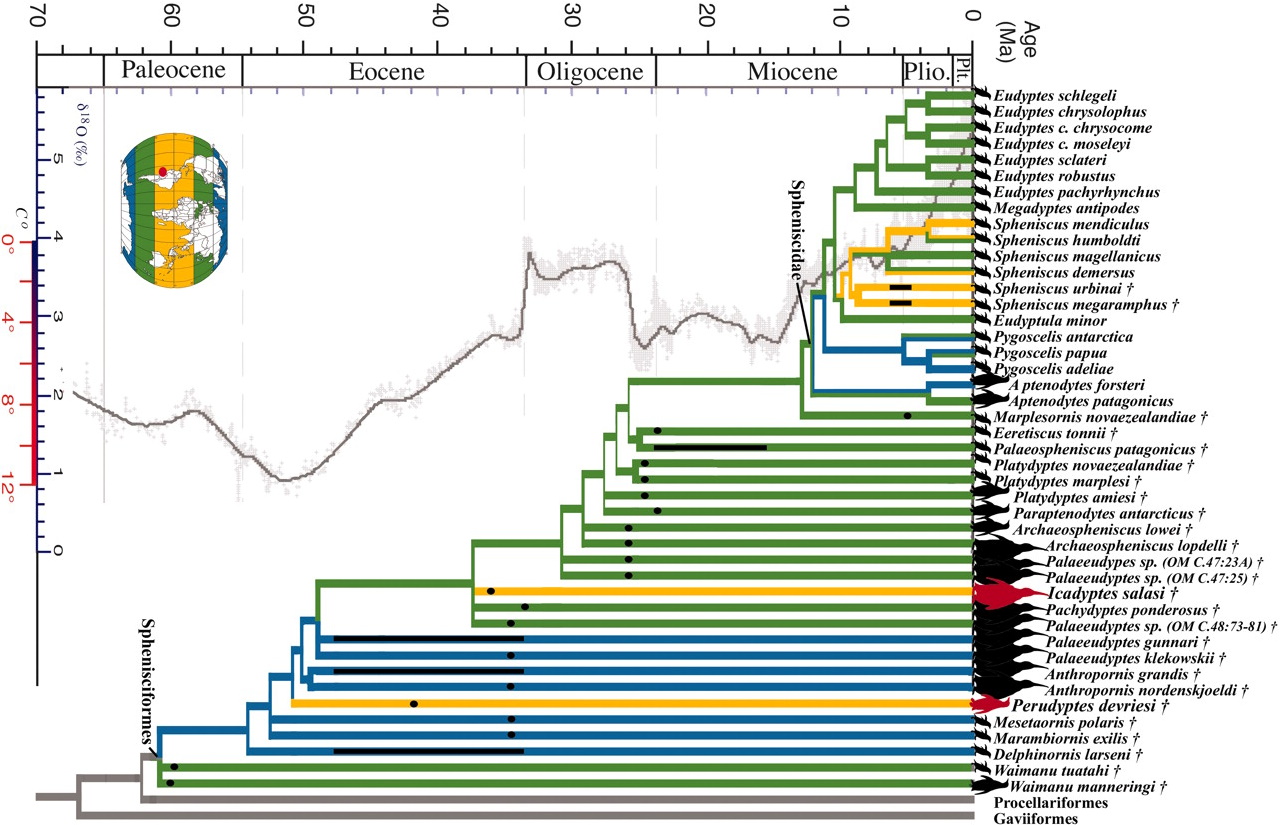
Updated after Marples (1962), Acosta Hospitaleche (2004), and Ksepka et al. (2006). See the gallery for images of most living species.

ORDER SPHENISCIFORMES

  • Basal and unresolved taxa (all fossil)
    • Waimanu - basal (Middle-Late Paleocene): Waimanu was a genus of early penguin which lived soon after the Cretaceous-Tertiary extinction event, lending support to the theory that the radiation of modern birds took place before the extinction of the dinosaurs, not after as others had proposed. While it was a very early member of the sphenisciformes, Waimanu was flightless (like all modern members of its order). Though its wing bones do not show the extreme specializations modern penguins have for an aquatic lifestyle, it does seem adapted for wing-propelled diving, and may have resembled a flightless loon. Discovered in Canterbury, New Zealand riverbed sediments (near the Waipara River) of the Waipara Greensand Formation in 1980, the name Waimanu comes from Māori for "waterbird". Two species are known, W. manneringi from the Early Paleocene and W. tuatahi from the Late Paleocene.
    • Perudyptes (Middle Eocene of Atacama Desert, Peru) - basal?
    • Sphenisciformes gen. et sp. indet. CADIC P 21 (Leticia Middle Eocene of Punta Torcida, Argentina: Clarke et al. 2003)
    • Delphinornis (Middle/Late Eocene ?- Early Oligocene of Seymour Island, Antarctica) - Palaeeudyptinae, basal, new subfamily 1?
    • Archaeospheniscus (Middle/Late Eocene - Late Oligocene) - Palaeeudyptinae? New subfamily 2? : Archaeospheniscus is an extinct genus of large penguins. It currently contains three species, known from somewhat fragmentary remains. A. wimani, the smallest species (about the size of a Gentoo Penguin), was found in Middle or Late Eocene strata (34-50 MYA) of the La Meseta Formation on Seymour Island, Antarctica, whereas the other two, about the size of a modern, Emperor Penguin are known from bones recovered from the Late Oligocene Kokoamu Greensand Formation (27-28 MYA) at Duntroon, New Zealand. The genus is one of the earliest known primitive penguins. Its humerus is still very slender, between the form seen in ordinary bird wings and the thickened condition found in modern penguins. On the other hand, the tarsometatarsus shows a peculiar mix of characters found in modern and primitive forms. Whether this signifies that the genus is an ancestor of modern taxa or represents a case of parallel evolution is unknown.
      • Species
        • Lowe's Penguin (Archaeospheniscus lowei) : Lowe's Penguin (Archaeospheniscus lowei) is the type species of the extinct penguin genus Archaeospheniscus. It stood approximately 85-115 cm high, between a modern King Penguin and an Emperor Penguin in size. It is known from bones of a single individual (Otago Museum C.47.20) and possibly some additional material such as the OM C.47.27 femur, all recovered from the Late Oligocene Kokoamu Greensand Formation (27-28 MYA) at Duntroon, New Zealand. The species' binomen was given in honor of Percy Lowe, who researched prehistoric penguins and proposed a theory (now considered erroneous) that these birds were derived from reptiles independently of the other modern birds.
        • Lopdell's Penguin (Archaeospheniscus lopdelli) : Lopdell's Penguin (Archaeospheniscus lopdelli) was the largest species of the extinct penguin genus Archaeospheniscus, standing about 90-120 cm high, or somewhat less than the extant Emperor Penguin. It is only known from bones of a single individual (Otago Museum C.47.21) which was found in the Late Oligocene Kokoamu Greensand Formation (27-28 MYA) at Duntroon, New Zealand. Bones apparently belonging to this species are now also known from the Late Eocene La Meseta Formation (34-37 MYA) on Seymour Island, Antarctica (Tambussi et al., 2006). As the bird is not very well distinguished except in size from its contemporary congener Archaeospheniscus lowei and the size range, an estimated 85-120 cm, is in the upper range of the variation found in modern penguins, it is probable that A. lopdelli is a synonym of A. lowelli. As the recent finds in Antarctica suggest, this is far from certain, however, and there remains much to be learned about the systematics and biogeography of the two larger Archaeospheniscus species. The species' binomen honors J. C. Lopdell, who assisted Marples in recovering the fossils of this bird and others found in the Duntroon excavations.
        • Archaeospheniscus wimani : Archaeospheniscus wimani is an extinct species of penguin. It was the smallest species of the genus Archaeospheniscus, being approximately 75-85 cm high, or about the size of a Gentoo Penguin. It is also the oldest known species of its genus, as its remains were found in Middle or Late Eocene strata (34-50 MYA) of the La Meseta Formation on Seymour Island, Antarctica. It is known from a fair number of bones. The species' binomen honors Carl Wiman, an early 20th century researcher who laid the groundwork for the classification of the prehistoric penguins.
    • Marambiornis (Late Eocene -? Early Oligocene of Seymour Island, Antarctica) - Palaeeudyptinae, basal, new subfamily 1?
    • Mesetaornis (Late Eocene -? Early Oligocene of Seymour Island, Antarctica) - Palaeeudyptinae, basal, new subfamily 1?
    • Tonniornis (Late Eocene -? Early Oligocene of Seymour Island, Antarctica)
    • Wimanornis (Late Eocene -? Early Oligocene of Seymour Island, Antarctica)
    • Duntroonornis (Late Oligocene of Otago, New Zealand) - possibly Spheniscinae
    • Korora (Late Oligocene of S Canterbury, New Zealand)
    • Platydyptes (Late Oligocene of New Zealand) - possibly not monophyletic; Palaeeudyptinae, Paraptenodytinae or new subfamily?
    • Spheniscidae gen. et sp. indet (Late Oligocene/Early Miocene of Hakataramea, New Zealand)
    • Madrynornis (Puerto Madryn Late Miocene of Argentina) - possibly Spheniscinae
    • Pseudaptenodytes (Late Miocene/Early Pliocene) : The extinct penguin genus Pseudaptenodytes contains the type species P. macraei; smaller bones have been assigned to P. minor, although it is not certain whether they are really from a different species or simply of younger individuals; both taxa are known by an insufficient selection of bones. The fossils of Pseudaptenodytes have been found in deposits in Victoria (Australia) which are of Late Miocene or Early Pliocene age.
    • Dege (Early Pliocene of South Africa) - possibly Spheniscinae
    • Marplesornis (Early Pliocene) - possibly Spheniscinae
    • Nucleornis (Early Pliocene of Duinfontain, South Africa) - possibly Spheniscinae
    • Inguza (Late Pliocene) - probably Spheniscinae; formerly Spheniscus predemersus : Inguza predemersus is an extinct species of penguin. It was formerly placed in the genus Spheniscus and presumed to be a close relative of the African Penguin, but after its well-distinct tarsometatarsus was found, it was moved into its present monotypic genus. What is known from molecular data is that the time at which the present species lived is not too distant from the arrival of the ancestors of the African Penguin on the Atlantic coasts of southern Africa. On the other hand, it may be closer to Pygoscelis. This would mean that its ancestors diverged from those of the extant Pygoscelis most likely at an indeterminate point of time during the Oligocene.(Baker et al. 2006) Alternatively, it might not be close to extant penguins (the Spheniscinae), but a late survivor of an extant lineage. This is not very likely given its age - it would be the last known survivor of the non-spheniscine penguins - but as some of these still lived a few million years ago, it cannot be ruled out.
  • Family Spheniscidae
    • Subfamily Palaeeudyptinae - Giant penguins (fossil) : The New Zealand Giant Penguins, Palaeeudyptinae, are an extinct subfamily of penguins. It includes several genera of medium-sized to very large species - including Palaeeudyptes marplesi and Anthropornis nordenskjoeldi which grew 1.5 meters (4 ft 11.1 in) tall or even larger, and the massive Pachydyptes ponderosus which weighed at least as much as an adult human male. They belonged to an evolutionary lineage more primitive than modern penguins. In some taxa at least, the wing, while already having lost the avian feathering, had not yet transformed into the semi-rigid flipper found in modern penguin species: While the ulna and the radius were already flattened to increase propelling capacity, the elbow and wrist joints still retained a higher degree of flexibility than the more rigidly lockable structure found in modern genera. The decline and eventual disappearance of this subfamily seems to be connected by increased competition as mammal groups such as cetaceans and pinnipeds became better-adapted to a marine lifestyle in the Oligocene and Miocene. The members of this subfamily are known from fossils found in New Zealand, Antarctica, and possibly Australia, dating from the Middle or Late Eocene to the Late Oligocene; the Australian Middle Miocene genus Anthropodyptes is also often assigned to this subfamily, as are the remaining genera of primitive penguins except those from Patagonia. Indeed, it was long assumed that all prehistoric penguins which cannot be assigned to extant genera belonged into the Palaeeudyptinae; this view is generally considered obsolete today. It is likely that some of the unassigned New Zealand/ Antarctican/ Australian genera like Delphinornis, Marambiornis, and Mesetaornis do indeed belong into this subfamily, but it is just as probable that others, such as Duntroonornis and Korora, represent another, smaller and possibly somewhat more advanced lineage. The Palaeeudyptinae as originally defined (Simpson, 1946) contained only the namesake genus, the remainder being placed in the Anthropornithidae. The arrangement followed here is based on the review of Marples (1962) who synonymized the two, with updates to incorporate more current findings.
      • Crossvallia (Cross Valley Late Paleocene of Seymour Island, Antarctica) - tentatively assigned to this subfamily
      • Anthropornis (Middle Eocene ?- Early Oligocene of Seymour Island, Antarctica) - tentatively assigned to this subfamily
        • Nordenskjoeld's Giant Penguin, Anthropornis nordenskjoeldi : Anthropornis nordenskjoeldi, or Nordenskjoeld's Giant Penguin, was a penguin species that lived 45–37 million years ago, during the Late Eocene and the earliest part of the Oligocene. It reached 1.7 meters (5 ft 6.9 in) in height and 90 kilograms (198 lb) in weight. Fossils of it have been found on Seymour Island off the coast of Antarctica and in New Zealand. By comparison, the largest modern penguin species, the Emperor Penguin, is just 1.2 meters (3 ft 11.2 in) tall. Anthropornis nordenskjoeldi had a bent joint in the wing; this indicates a carryover from its flying ancestors. Penguins were descended from grebe or loon-like ancestors, and became flightless as they became full-time swimmers.
      • Icadyptes (Late Eocene of Atacama Desert, Peru) : Icadyptes salasi was a giant penguin species from the late Eocene period, in the tropics of South America. "Ica" for the Peruvian region where it was found, "dyptes" from the Greek word for diver, and "salasi" for Rodolfo Salas, a noted Peruvian paleontologist. The fossilised remains of the penguin, which lived some 36 million years ago, were found in the coastal desert of Peru by the team of North Carolina State University palaeontologist Dr. Julia Clarke, assistant professor of marine, earth and atmospheric sciences. Its well-preserved fossil skeleton was found on the southern coast of Peru together with an early Eocene species Perudyptes devriesi (comparable in size to the living King Penguin), and the remains of three other previously undescribed penguin species, all of which seem to have preferred the tropics over colder latitudes. Perudyptes devriesi is named after the country, and Thomas DeVries, a University of Washington palaeontologist who has long worked in Peru. Standing 1.5 metres (5 ft) tall, the penguin was much larger than any of its modern-day cousins. It had an exceptionally long spear-like beak resembling that of a heron. The researchers who discovered the penguins believe the long, pointed beaks to be the likely ancestral shape for all penguins. Icadyptes salasi is the third largest penguin ever described. Icadyptes salasi and Perudyptes devriesi appear to have flourished at warmer latitudes at a time when world temperatures were at their warmest over the past 65 million years. Only a few modern-day penguins, such as the African and Galapagos penguins prefer such a balmy climate. The discovery of the fossils has caused a re-evaluation of penguin evolution and expansion. Previously, scientists believed that penguins evolved near the poles in Antarctica and New Zealand, and moved closer to the equator around 10 million years ago. Since Icadyptes salasi lived in Peru during a period of great warmth, penguins must have adapted to warm-climates around 30 million years earlier than previously believed.
      • Palaeeudyptes (Middle/Late Eocene - Late Oligocene) - polyphyletic; some belong in other subfamilies : Palaeeudyptes is an extinct genus of large penguins, currently containing four accepted species. They were probably larger than almost all living penguins, with the smaller species being about the size of an Emperor Penguin and the largest ones having stood about 1.5 meters tall. Of the four species, two (P. gunnari and P. klekowskii) are known from numerous remains found in Middle or Late Eocene strata (34 to 50 MYA) of the La Meseta Formation on Seymour Island, Antarctica. P. antarcticus, the first fossil penguin described, is only really known from a single incomplete tarsometatarsus found in the Late Oligocene Otekaike Limestone (23 to 28, possibly up to 34 MYA) at Kakanui, New Zealand, but numerous other bones have been tentatively assigned to the species. The other described New Zealand species, P. marplesi, is known from parts of a skeleton, mainly leg bones, from the Middle or Late Eocene Burnside Mudstone (34 to 40 MYA) at Burnside, Dunedin. To this species also a number of additional remains have been tentatively assigned. The problem with the indeterminate New Zealand specimens is that they at least in part are intermediate in size between the two species (Simpson, 1971). It may be that P. marplesi simply evolved into the smaller P. antarcticus. Bones unassignable to species also were found on Seymour Island, but in these cases they seem to be from juvenile individuals or are simply too damaged to be of diagnostic value (Jadwiszczak, 2006). In addition, an incomplete right tibiotarsus (South Australian Museum P10862) and one left humerus (South Australian Museum P7158) and assignable to this genus were found in the Late Eocene Blanche Point Marls at Witton Bluff near Adelaide, Australia (Simpson, 1946, 1971). The supposed genus Wimanornis, based on two Seymour Island humeri, is apparently a synonym of P. gunnari (Jadwiszcak, 2006). The genus is the namesake for the subfamily of primitive penguins, Palaeeudyptinae. Altogether, their osteological characteristics seem to have been somewhat less advanced that those of the slightly smaller Archaeospheniscus and about on par with the gigantic Anthropornis. The exact nature of the relationship of the Palaeeudyptinae to modern penguins is unknown.
      • Pachydyptes (Late Eocene) : Pachydyptes is an extinct genus of penguin. It contains the single species Pachydyptes ponderosus, the New Zealand Giant Penguin. This taxon is known from a few bones from Late Eocene (34 to 37 MYA) rocks in the area of Otago, and a fine specimen found near Kawhia, New Zealand, in January 2006[verification needed]. With a height of 140 to 160 cm (about 5 ft) and weighing around 80 to possibly over 100 kg, it was the second-tallest penguin ever, surpassed only by Anthropornis nordenskjoeldi in size, but probably not in weight. As George Gaylord Simpson famously quipped, "Pachydyptes' height would not suffice for basketball but their weight was about right for American football." Pachydyptes was slightly larger than Icadyptes salasi, the best-identified of the giant penguins.
      • Anthropodyptes (Middle Miocene) - tentatively assigned to this subfamily : Anthropodyptes is a poorly known monotypic genus of extinct penguin. It contains the single species Anthropodyptes gilli, known from a Middle Miocene humerus from Australia. The bone is somewhat similar to those found in members of the New Zealand genus Archaeospheniscus and thus this genus might, like them, belong to the subfamily Palaeeudyptinae. [edit] References
    • Subfamily Paraptenodytinae - Stout-legged penguins (fossil)
      • Arthrodytes (San Julian Late Eocene/Early Oligocene - Patagonia Early Miocene of Patagonia, Argentina)
      • Paraptenodytes (Early - Late Miocene/Early Pliocene) : Paraptenodytes is an extinct genus of penguins which contains two or three species sized between a Magellanic Penguin and a small Emperor Penguin (P. antarcticus). They are known from fossil bones ranging from a partial skeleton and some additional material in the case of P. antarcticus, and a single humerus in the case of P. brodkorbi. The latter species is therefore often considered invalid; Bertelli et al. (2006) think that it is indeed valid, but distinct enough not to belong into Paraptenodytes. The fossils were found in the Santa Cruz and Chubut Provinces of Patagonia, Argentina, in Patagonian Molasse Formation rocks of Early Miocene age; later occurrences are apparently from Late Miocene or possibly even Early Pliocene deposits (Stucchi et al. 2003). Together with the related genus Arthrodytes, they form the subfamily Paraptenodytinae, which is not an ancestor of modern penguins (Bertelli et al., 2006
    • Subfamily Palaeospheniscinae - Slender-legged penguins (fossil) : Palaeospheniscus is an extinct genus of penguins which contains three species at present. They are all (except P. bergi, which is somewhat enigmatic) known from one or two handful of bones. All specimens were found in Santa Cruz and Chubut Provinces of Patagonia, Argentina. The fossils were recovered from the Patagonian Molasse Formation, and are probably Early Miocene to Late Miocene or possibly Early Pliocene in age (Stucchi et al. 2003). Palaeospheniscus gracilis was long believed to be from the Early Oligocene, but this is now thought to be erroneous. P. gracilis and P. wimani are often considered synonyms of P. patagonicus[citation needed]. Recent researchers also tend to merge Chubutodyptes into this genus as P. biloculatus[citation needed]. The species of Palaeospheniscus were medium-sized to largish penguins, ranging from P. gracilis with an estimated maximal length of 55 cm to P. wimani, which reached up to 73 cm. Palaeospheniscus is the namesake genus of the subfamily Palaeospheniscinae, the Patagonian slender-legged penguins. These are apparently not closely related to the modern genus Spheniscus.
      • Eretiscus (Patagonia Early Miocene of Patagonia, Argentina)
      • Palaeospheniscus (Early? - Late Miocene/Early Pliocene) - includes Chubutodyptes : Palaeospheniscus is an extinct genus of penguins which contains three species at present. They are all (except P. bergi, which is somewhat enigmatic) known from one or two handful of bones. All specimens were found in Santa Cruz and Chubut Provinces of Patagonia, Argentina. The fossils were recovered from the Patagonian Molasse Formation, and are probably Early Miocene to Late Miocene or possibly Early Pliocene in age (Stucchi et al. 2003). Palaeospheniscus gracilis was long believed to be from the Early Oligocene, but this is now thought to be erroneous. P. gracilis and P. wimani are often considered synonyms of P. patagonicus[citation needed]. Recent researchers also tend to merge Chubutodyptes into this genus as P. biloculatus[citation needed]. The species of Palaeospheniscus were medium-sized to largish penguins, ranging from P. gracilis with an estimated maximal length of 55 cm to P. wimani, which reached up to 73 cm. Palaeospheniscus is the namesake genus of the subfamily Palaeospheniscinae, the Patagonian slender-legged penguins. These are apparently not closely related to the modern genus Spheniscus.
    • Subfamily Spheniscinae - Modern penguins
      • Aptenodytes - Great penguins (2 species) : The genus Aptenodytes (from the Greek for "flightless diver") contains two extant species of penguins collectively known as "the great penguins".
        • King Penguin, Aptenodytes patagonicus
        • Emperor Penguin, Aptenodytes forsteri

        Ridgen's Penguin (Aptenodytes ridgeni) is an extinct species known from fossil bones of Early or Late Pliocene age.

      • Pygoscelis- Brush-tailed penguins (3 species)
      • Eudyptula- Little penguins (2 species)
      • Spheniscus- Banded penguins (4 species)
      • Megadyptes- Yellow-eyed Penguin
      • Eudyptes- Crested penguins (6-8 living species)

Taxonomy: Clarke et al. (2003) and Ksepka et al. (2006) apply the phylogenetic taxon Spheniscidae what here is referred to as Spheniscinae. Furthermore, they restrict the phylogenetic taxon Sphenisciformes to flightless taxa, and establish (Clarke et al. 2003) the phylogenetic taxon Pansphenisciformes as equivalent to the Linnean taxon Sphenisciformes, i.e., including any flying basal "proto-penguins" to be discovered eventually. Given that neither the relationships of the penguin subfamilies to each other nor the placement of the penguins in the avian phylogeny is presently resolved, this seems spurious and in any case is confusing; the established Linnean system is thus followed here.


Evolution

The evolutionary history of penguins is well-researched and represents a showcase of evolutionary biogeography; though as penguin bones of any one species vary much in size and few good specimens are known, the alpha taxonomy of many prehistoric forms still leaves much to be desired. Some seminal articles about penguin prehistory have been published since 2005 (Bertelli & Giannini 2005, Baker et al. 2006, Ksepka et al. 2006, Slack et al. 2006), the evolution of the living genera can be considered resolved by now.

According to the comprehensive review of the available evidence by Ksepka et al. (2006), the basal penguins lived around the time of the Cretaceous–Tertiary extinction event somewhere in the general area of (southern) New Zealand and Byrd Land, Antarctica. Due to plate tectonics, these areas were at that time less than 1,500 kilometers (932 mi) apart rather than the 4,000 kilometers (2,486 mi) of today. The most recent common ancestor of penguins and their sister clade can be roughly dated to the Campanian-Maastrichtian boundary, around 70-68 mya (Baker et al. 2006, Slack et al. 2006). What can be said as certainly as possible in the absence of direct (i.e., fossil) evidence is that by the end of the Cretaceous, the penguin lineage must have been evolutionarily well distinct, though much less so morphologically; it is fairly likely that they were not yet entirely flightless at that time, as flightless birds have generally low resilience to the breakdown of trophic webs which follows the initial phase of mass extinctions because of their below-average dispersal capabilities (see also Flightless Cormorant).


Origin and systematics of modern penguins

Modern penguins constitute two undisputed clades and another two more basal genera with more ambiguous relationships (Bertelli & Giannini 2005). The origin of the Spheniscinae lies probably in the latest Paleogene, and geographically it must have been much the same as the general area in which the order evolved: the oceans between the Australia-New Zealand region and the Antarctic (Baker et al. 2006). Presumedly diverging from other penguins around 40 mya (Baker et al. 2006), it seems that the Spheniscinae were for quite some time limited to their ancestral area, as the well-researched deposits of the Antarctic Peninsula and Patagonia have not yielded Paleogene fossils of the subfamily. Also, the earliest spheniscine lineages are those with the most southern distribution.

The genus Aptenodytes appears to be the basalmost divergence among living penguins; they have bright yellow-orange neck, breast, and bill patches, incubate by placing their eggs on their feet, and when they hatch, they are almost naked. This genus has a distribution centered on the Antarctic coasts and barely extends to some subantarctic islands today.

Pygoscelis contains species with a fairly simple black-and-white head pattern; their distribution is intermediate, centered on Antarctic coasts but extending somewhat northwards from there. In external morphology, these apparently still resemble the common ancestor of the Spheniscinae, as Aptenodytes' autapomorphies are in most cases fairly pronounced adaptations related to that genus' extreme habitat conditions. As the former genus, Pygoscelis seems to have diverged during the Bartonian, but the range expansion and radiation which lead to the present-day diversity probably did not occur until much later, around the Burdigalian stage of the Early Miocene, roughly 20-15 mya (Baker et al. 2006).

The genera Spheniscus and Eudyptula contain species with a mostly subantarctic distribution centered on South America; some, however, range quite far northwards. They all lack carotenoid coloration, and the former genus has a conspicuous banded head pattern; they are unique among living penguins in nesting in burrows. This group probably radiated eastwards with the Antarctic Circumpolar Current out of the ancestral range of modern penguins throughout the Chattian (Late Oligocene), starting approximately 28 mya (Baker et al. 2006). While the two genera separated during this time, the present-day diversity is the result of a Pliocene radiation, taking place some 4-2 mya (Baker et al. 2006).

The Megadyptes -Eudyptes clade occurs at similar latitudes (though not as far north as the Galapagos Penguin), has its highest diversity in the New Zealand region, and represent a westward dispersal. They are characterized by hairy yellow ornamental head feathers; their bills are at least partly red. These two genera diverged apparently in the Middle Miocene (Langhian, roughly 15-14 mya), but again, the living species of Eudyptes are the product of a later radiation, stretching from about the late Tortonian (Late Miocene, 8 mya) to the end of the Pliocene (Baker et al. 2006).

It is most interesting to note that the geographical and temporal pattern or spheniscine evolution corresponds closely to two episodes of global cooling documented in the paleoclimatic record (Baker et al. 2006). The emergence of the subantarctic lineage at the end of the Bartonian corresponds with the onset of the slow period of cooling that eventually led to the ice ages some 35 million years later. With habitat on the Antarctic coasts declining, by the Priabonian more hospitable conditions for most penguins existed in the subantarctic regions rather than in Antarctica itself. Notably, the cold Antarctic Circumpolar Current also started as a continuous circumpolar flow only around 30 mya, on the one hand forcing the Antarctic cooling, and on the other facilitating the eastward expansion of Spheniscus to South America and eventually beyond (Baker et al. 2006).

Later, an interspersed period of slight warming was ended by the Middle Miocene Climate Transition, a sharp drop in global average temperature from 14 to 12 mya, and similar abrupt cooling events followed at 8 mya and 4 mya; by the end of the Tortonian, the Antarctic ice sheet was already much like today in volume and extent. The emergence of most of today's subantarctic penguin species almost certainly was caused by this sequence of Neogene climate shifts.


Relationship to other bird orders

Penguin ancestry beyond Waimanu remains unknown and not well resolved by molecular or morphological analyses. The latter tend to be confounded by the strong adaptive autapomorphies of the Sphenisciformes; a sometimes perceived fairly close relationship between penguins and grebes is almost certainly an error based on both groups' strong diving adaptations, which are homoplasies. On the other hand, different DNA sequence datasets do not agree in detail with each other either.

What seems clear is that penguins belong to a clade of Neoaves (living birds except paleognaths and fowl) which comprises what is sometimes called "higher waterbirds" to distinguish them from the more ancient waterfowl. This group contains such birds as storks, rails, and the seabirds, with the possible exception of the Charadriiformes (Fain & Houde 2004).

Inside this group, penguin relationships are far less clear. Depending on the analysis and dataset, a close relationship to Ciconiiformes (e.g. Slack et al. 2006) or to Procellariiformes (Baker et al. 2006) has been suggested. Some (e.g. Mayr 2005) think the penguin-like plotopterids (usually considered relatives of anhingas and cormorants) may actually be a sister group of the penguins, and that penguins may have ultimately shared a common ancestor with the Pelecaniformes and consequently would have to be included in that order, or that the plotopterids were not as close to other pelecaniforms as generally assumed, which would necessitate splitting the traditional Pelecaniformes in three.

The Auk of the Northern Hemisphere is superficially similar to penguins, they are not related to the penguins at all, but considered by some to be a product of moderate convergent evolution.

Copyright: Wikipedia. This article is licensed under the GNU Free Documentation License. It uses material from Wikipedia.org

Sunday, June 1, 2008

More background information

NZ fossil penguin shows modern bird groups lived with Dinosaurs

New Waimanu genus of ancient penguins described by Otago Scientists

05 April 2006

New Waimanu genus of ancient penguinsA newly-recognised species of ancient penguin, studied and named by University of Otago palaeontologists, is helping to refute the theory that many modern bird groups did not emerge until after the dinosaurs were wiped out.

The Otago scientists' official description of the Waimanu penguin genus, which lived in the shallow seas off eastern New Zealand between 60 and 62 million years ago, is published in an upcoming issue of the international journal Molecular Biology and Evolution.

The fossil penguins, found at the Waipara River in Canterbury in the 1980s, are the oldest reported in the world, says Associate Professor Ewan Fordyce of the University's Geology Department.

"These 'proto' penguins were about the size of yellow-eyed penguins and probably looked a bit like shags. It's very unlikely that they could fly, but their wing bones were compressed and dense, which would allow their wings to be used to swim underwater," says Assoc Prof Fordyce.

Their official description of the genus appears as part of a research article suggesting that many modern bird groups evolved well before the dinosaurs died out. The research is a collaborative synthesis of fossil study and DNA detective work, he says.

"With the geological age of the penguins fossils firmly dated, Massey's Allan Wilson Centre for Molecular Ecology and Evolution could predict how far back in time other groups of living birds originated," he says.

To predict the time of origin of living birds, Wilson Centre researchers led by Professor David Penny examined the genetic evidence from distant penguin relatives such as storks, albatrosses, ducks and moas. Genetic studies were carried out both in New Zealand and Sweden, by Wilson Centre graduate student Kerryn Slack.

By using the age of the fossil penguins as a reference point, and then examining the birds' pattern of evolutionary interrelationships through studying their DNA, the researchers were able to establish a new time frame for when groups of modern birds branched out.

"It became clear that as these early penguins lived in southern seas not long after the extinction of dinosaurs, then other more distantly related bird groups must have been established even earlier - which goes directly against a recent theory from the United States," says Assoc Prof Fordyce.

A prominent US scientist, Professor Alan Feduccia, has claimed that many living bird groups are geologically young, having emerged after the catastrophic extinction event 65 million years ago.

Prof Feduccia argues that most birds from before this event represented ancient groups which disappeared along with dinosaurs and are not related to living forms.

"In contrast, our study suggests that many groups of living birds date well back in Cretaceous times, when the dinosaurs were thriving," says Assoc Prof Fordyce.

Contact

Associate Professor Ewan Fordyce
Department of Geology
University of Otago
Tel 03 479 7510
Email ewan.fordyce@stonebow.otago.ac.nz

Professor David Penny, Scientific Director
Allan Wilson Centre for Molecular Ecology and Evolution
Massey University
Email D.Penny@massey.ac.nz

Notes

To obtain jpgs of artistic impressions of the penguins, please contact Simon Ancell, Email simon.ancell@otago.ac.nz, Tel 03 479 5016

Information about the University of Otago's Paleontological research can be viewed at: http://www.otago.ac.nz/geology/features/paleontology/paleontology.html

Information about the Allan Wilson Centre for Molecular Ecology and Evolution, a National Centre of Research Excellence, of which the University of Otago is a partner, can be found at: http://awcmee.massey.ac.nz/about_us.htm

From National Geographic

Dino-Era Bird Fossil Found; One of Oldest Known

Kevin Holden Platt in Beijing, China
for National Geographic News
May 6, 2008

A fossil of a new species of dinosaur-era bird found in China is one of the oldest ever discovered, experts say in a new study.

The new bird, called Eoconfuciusornis zhengi, or "the dawn of the Confucius bird," is predated only by the 150-million-year-old Archaeopteryx, which lived during the Jurassic period.

Chinese and British paleontologists discovered the well-preserved fossil along a forested lakeside in the country's northern Hebei Province.

"Eoconfuciusornis provides a new piece in the puzzle of the evolution from Archaeopteryx to more advanced birds," said study co-author Zhou Zhonghe, executive director of the Institute of Vertebrate Paleontology and Paleoanthropology in Beijing.

Etched in Stone

The fossil bird likely plunged into a lake 131 million years ago, where it drifted to the bottom and was quickly covered in sediment. Over time the animal became encased in mudstone.

The specimen's fully developed, modern-looking wings and symmetrically balanced tail feathers were etched into the stone in curved lines of black and brown.

"The brown and black may reflect the original colors, but these might alternatively have been the bright reds, blues, and yellows of modern birds," said study co-author Mike Benton, a paleontologist at the University of Bristol in the United Kingdom.

Lead author Zhang Fucheng, a professor at the Beijing institute, added: "Eoconfuciusornis was extraordinarily well preserved for the fossil to have contained such depth of detail."

The study appeared recently in the journal Science in China.

Awkward to Smooth

Archaeopteryx was likely an awkward flier, weighted down with a long bony tail, teeth, and other physical features of a dinosaur The newfound bird and a long lineage of descendants, which lived between 120 and 131 million years ago in the Cretaceous period, had developed a skeletal and muscle structure that provided more maneuverability and powered flight, Zhou said

But Eoconfuciusornis and Archaeopteryx did share a limited ability to ascend from flat, low surfaces—an anatomical drawback that would have made both birds vulnerable to attack, Zhou said.

Eoconfuciusornis probably lived in trees and had claws to help it climb trunks and perch on branches, Zhou said.

It also likely glided across lakes to track and target fish, he added.

Remarkable Diversity

Xu Xing is a paleontologist at the Chinese paleontology institute who was not involved in the new study.

"The new discovery of Eoconfuciusornis adds to the remarkable diversity of the species known to be capable of flying or gliding in this part of the world 125 million years ago," Xu said.

In 2003 Xu discovered the 128 million year old fossil of a strange, four-winged dinosaur, Microraptor gui, which he said probably could glide from tree to tree.

And earlier this year scientists unearthed the fossill of a miniature pterosaur that also soared across the same Cretaceous-period lakes and forests as Eoconfuciusornis.

http://news.nationalgeographic.com/news/2008/05/080506-dinosaur-bird_2.html


Friday, May 30, 2008

dino eating proto-birds?


Huge Flying Reptiles Ate Dinosaurs

By Jeanna Bryner, Senior Writer

posted: 27 May 2008 08:00 pm ET


With a name like T. rex, you'd expect to be safe from even the fiercest paleo-bullies. Turns out, ancient, flying reptiles could have snacked on Tyrannosaurus Rex babies and other landlubbing runts of the dinosaur world.

A new study reveals a group of flying reptiles that lived during the Age of Dinosaurs some 230 million to 65 million years ago did not catch prey in flight, but rather stalked them on land.

Until now, paleontologists pictured the so-called "winged lizards" or pterosaurs as skim-feeders. In this vision, the creatures would have flown over lakes and oceans grabbing fish from the water's surface, much as gulls do today.

The new findings, detailed this week online in the journal PLoS ONE, don't ground the animals totally.

"In our hypothesis, flight is primarily a locomotive method," said co-researcher Mark Witton of the University of Portsmouth in England. "They're just using it to get from point A to point B. We think the majority of their lives, when they're feeding and reproducing, that's all being done on the ground rather than in the air."

To uncover these feeding habits, Witton and Portsmouth colleague Darren Naish analyzed fossils of a group of toothless pterosaurs called azhdarchids, which are much larger on average than other pterosaurs. For example, one of the largest azhdarchids, Quetzalcoatlus, weighed about 550 pounds (250 kilograms) with a wingspan of more than 30 feet (10 meters) and a height comparable to a giraffe.

Witton and Naish learned that more than 50 percent of the azhdarchid fossils had been found inland. Other skeletal features, including long hind limbs and a stiff neck, also didn't fit with a mud-prober or skim-feeder.

"All the details of their anatomy, and the environment their fossils are found in, show that they made their living by walking around, reaching down to grab and pick up animals and other prey," Naish said.

A skim-feeder, such as a gull, trawls its lower jaw through the water, eventually smacking into a fish or shrimp and pulling it from the water. "Regardless of what they hit, the impact force drives the head and neck underneath the body and into the water, thus requiring a hugely flexible neck," Witton said.

This is the case with gulls and pelicans (which are considered plunge divers), but azhdarchid's neck, despite potentially reaching nearly 10 feet (3 meters) in length, was super stiff. "Whatever these animals were doing, it had to involve minimal neck action," Witton said.

Their tiny feet also ruled out wading in the water or probing the soft mud for food. "Some of these animals are absolutely enormous," Witton told LiveScience. "If you go wading out into this soft mud, and you weigh a quarter of a ton, and you've got these dinky little feet, you're going to just sink in."

The reptile's head also was pretty lengthy, up to 10 feet (3 meters). So Witton said an azhdarchid would only have to dip its head part way to the ground, enough for the tip of its jaws to touch down, to hunt and feed on terrestrial prey. Back before they went extinct 65 million years ago during the event that also killed off non-avian dinosaurs, these pterosaurs could lunch on animals ranging from small bird-like Velicoraptors to T. rex babies to amphibians

http://www.livescience.com/animals/080527-giant-reptile.html