Saturday, March 26, 2016

Penguin brain evolution lags behind loss of flight


Photo Credit: Connor Murphy | Daily Texan Staff
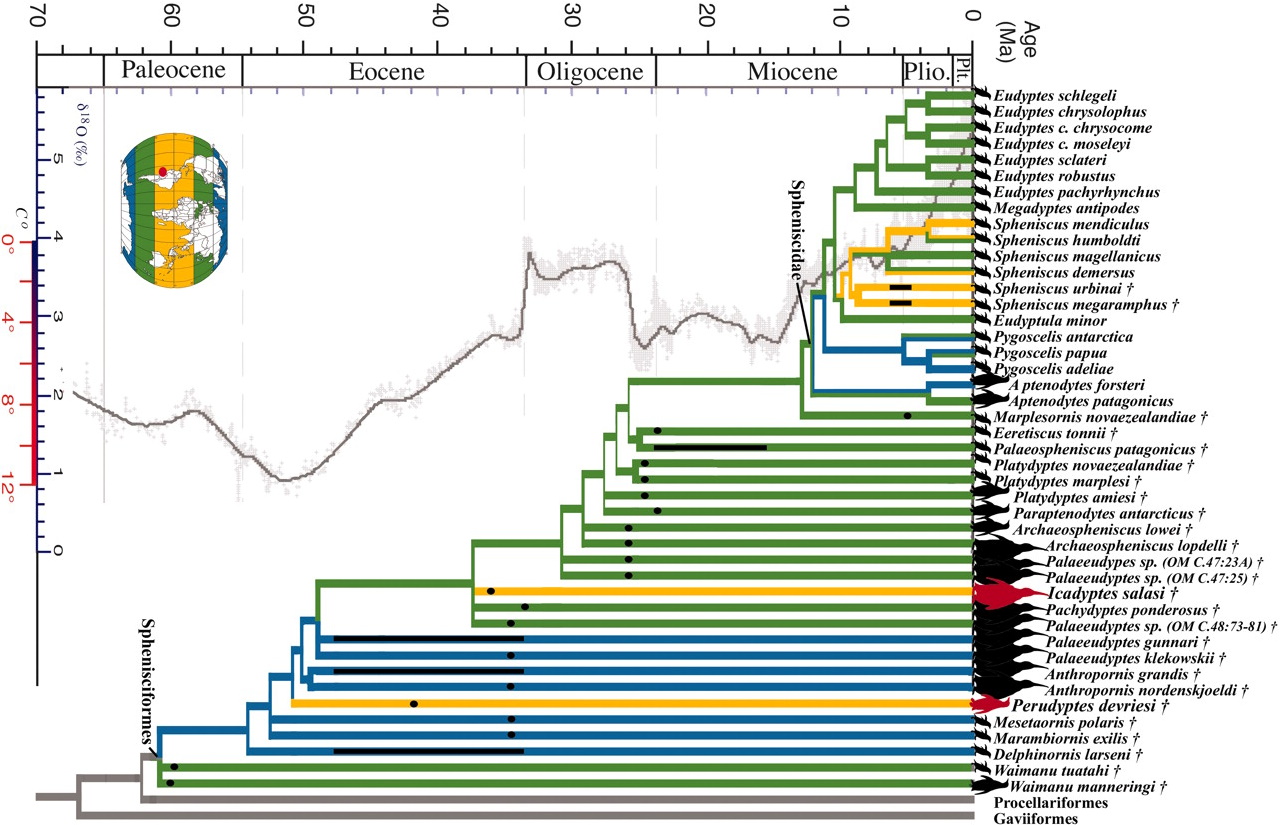
Until about 60 million years ago, penguins soared above the ocean. When they lost the ability to fly, their brains took a while to catch up.

UT geological sciences graduate student James Proffitt compared 3-D models of the inside of the earliest-known flightless penguin skull fossil to the brain shapes of modern penguins. This fossil is about 60 million years old — this penguin was probably alive soon after all penguins stopped flying.
He expected to find that flightlessness soon affected the ancient penguin’s brain structure, making it similar to modern penguins. However, this ancient penguin brain was significantly different from those of modern penguins, even though they were both flightless. These differences suggest modern penguin brains may not have evolved until relatively recently, according to Proffitt.

“It seems like ancient penguins have a lot more in common with other close diving relatives than they do with modern penguins,” Proffitt said. “When flightlessness evolved, the changes in the brain that you see in modern penguins don’t show up until much later.”

Even though it couldn’t fly, this 60-million-year-old penguin’s skull is more similar to those of present-day birds that can both dive and fly than to modern flightless penguins. Penguin
neurology took a long time to catch up to flightless behavior, according to Paul Scofield, the senior curator of natural history at the Canterbury Museum in New Zealand and co-author of the paper.

“I think this result clarifies that the evolution of penguins was rapid and that not all elements of the body suddenly became perfectly adapted to diving,” Scofield said. “Other studies have shown that the brain’s development lags behind the evolution of the body and this is certainly the case in this species.”

The evolution of bird brains is easier to study than other types of animals because bird skulls are closely fitted to the brain. Proffitt’s work used x-ray computed tomography, or CT scanning, to look inside the fossilized skull and observe the shape of the brain.

Chris Torres, an ecology, evolution and behavior graduate student currently in Antarctica studying bird evolution, also uses this CT scanning method to learn about other types of bird brains from fossils.

“Odd as it may sound, we don’t need brains to study brains anymore,” Torres said. “This has profound implications for what we can learn from fossil record, which preserves hard structures like skulls but not soft tissues like brains. CT has revolutionized the way we study how bird brains evolve.”

Proffit is interested in studying penguin evolution because, according to him, they came from a larger group of birds that both fly and swim, but have since evolved flightlessness.

“They make a really great group to examine this broader evolutionary idea of how animals respond to such a big change in ecology and what happens to the rest of their body,” he said.

There is still a lot of research that scientists need to do to understand the relationship between behavior and brain structure, according to Proffitt.

“I think it’s a complicated question to try and disentangle how locomotion effects neurology,” he said. “That’s more of a nuanced scientific story that isn’t as appealing as a firm answer.”

source

Friday, March 18, 2016

Wednesday, March 9, 2016

Penguin Feathers Inspire Ice-Proof Material

By mimicking the hierarchical microstructure of penguin feathers, researchers have developed an ice-proof insulating material.

Rebecca Tan | March 8, 2016

AsianScientist (Mar. 8, 2016) - Have you ever wondered how penguins stay warm and dry despite their sub-zero living environments? Now, researchers from Beihang University have identified microstructures on penguin feathers responsible for their anti-icing properties, and have even designed a feather-inspired nanofiber membrane that can be used as an ice-proof material. Their results have been published in The Journal of Physical Chemistry C.

Nature is a rich source of inspiration for scientists studying superhydrophobic, or water-repelling, materials. The rough texture of lotus leaves, for example, have served as the basis for the design of stain-resistant clothing. Similarly, the ability of penguins to survive in cold and wet environments is thought to be due to the superhydrophobic nature of their feathers which would cause water to slide off before ice has had a chance to form.

However, superhydrophobic surfaces are known to function poorly precisely under cold and wet conditions. When humidity is high, the rough structure of superhydrophobic materials encourages the condensation of water which quickly turns into a layer of ice, while the adhesion strength of ice increases at ultralow temperatures, making it harder for ice that has been formed to slide off.
To better understand the anti-icing properties of penguin feathers, a team of researchers at Beihang University used scanning electron microscopy to study the microstructure of feathers from Humboldt penguins (Spheniscus humboldti).

The feathers had a hierarchical structure, with tiny hooks arranged at regular intervals on larger barbules that were in turn arranged on even larger barbs. The hooks formed a wrinkled three-dimensional network that effectively prevented water from soaking through.
“We found that the air-infused microscale and nanoscale hierarchical rough structures endow the body feathers of S. humboldti penguins with icephobicity,” study corresponding author Dr. Wang Jingming told Asian Scientist Magazine.
Mimicking the structure of the feathers with polyimide nanofibers, the researchers developed a membrane where the fibers were spaced a few micrometers apart. The membrane was shown to be highly water-resistant, even to microdroplets that had been cooled to -5°C.
“Because of its excellent electrical insulation and icephobicity, the polyimide nanofiber membrane could be used in applications such as ice-proof coatings for electrical cables,” Wang explained.
The researchers plan to further improve the anti-icing properties of their artificial feathers by studying the packing style of natural penguin feathers, another decisive factor determining their anti-icing properties.


The article can be found at: Wang et al. (2016) Icephobicity of Penguins Spheniscus Humboldti and an Artificial Replica of Penguin Feather with Air-Infused Hierarchical Rough Structures.
———
Photo: f.c.franklin/Flickr/CC.

source


Friday, March 4, 2016

Sex-Based Differences in Adélie Penguin (Pygoscelis adeliae) Chick Growth Rates and Diet

Authors:
PLOS
  • Published: March 2, 2016
  • DOI: 10.1371/journal.pone.0149090

Abstract

Sexually size-dimorphic species must show some difference between the sexes in growth rate and/or length of growing period. Such differences in growth parameters can cause the sexes to be impacted by environmental variability in different ways, and understanding these differences allows a better understanding of patterns in productivity between individuals and populations. We investigated differences in growth rate and diet between male and female Adélie Penguin (Pygoscelis adeliae) chicks during two breeding seasons at Cape Crozier, Ross Island, Antarctica. Adélie Penguins are a slightly dimorphic species, with adult males averaging larger than adult females in mass (~11%) as well as bill (~8%) and flipper length (~3%). We measured mass and length of flipper, bill, tibiotarsus, and foot at 5-day intervals for 45 male and 40 female individually-marked chicks. Chick sex was molecularly determined from feathers. We used linear mixed effects models to estimate daily growth rate as a function of chick sex, while controlling for hatching order, brood size, year, and potential variation in breeding quality between pairs of parents. Accounting for season and hatching order, male chicks gained mass an average of 15.6 g d-1 faster than females. Similarly, growth in bill length was faster for males, and the calculated bill size difference at fledging was similar to that observed in adults. There was no evidence for sex-based differences in growth of other morphological features. Adélie diet at Ross Island is composed almost entirely of two species—one krill (Euphausia crystallorophias) and one fish (Pleuragramma antarctica), with fish having a higher caloric value. Using isotopic analyses of feather samples, we also determined that male chicks were fed a higher proportion of fish than female chicks. The related differences in provisioning and growth rates of male and female offspring provides a greater understanding of the ways in which ecological factors may impact the two sexes differently.

Download the entire paper at this link

Wednesday, March 2, 2016

Penguin brains not changed by loss of flight


University of Texas at Austin
IMAGE
IMAGE: This is an ancient penguin skull and endocast. Scale bar is 2.5 cm and letters indicate parts of the brain: ce, cerebellum; el, endosseus labyrinth; fl, floccular lobe; ol, optic lobe; os, occipital sinus impression; pb, pituitary bulb; t, telencephalon; w, wulst.
Credit: Courtesy of James Proffitt
Losing the ability to fly gave ancient penguins their unique locomotion style. But leaving the sky behind didn't cause major changes in their brain structure, researchers from The University of Texas at Austin suggest after examining the skull of the oldest known penguin fossil.

The findings were published in the Journal of Anatomy in February.

"What this seems to indicate is that becoming larger, losing flight and becoming a wing-propelled diver does not necessarily change the [brain] anatomy quickly," said James Proffitt, a graduate student at the university's Jackson School of Geosciences who led the research. "The way the modern penguin brain looks doesn't show up until millions and millions of years later."

Proffitt conducted the research with Julia Clarke, a professor in the Jackson School's Department of Geological Sciences, and Paul Scofield, the senior curator of Natural History at the Canterbury Museum in Christchurch, New Zealand, where the skull fossil is from.

The skull is from a penguin that lived in New Zealand over 60 million years ago during the Paleocene epoch. According to Proffitt, it likely lived much like penguins today. But while today's penguins have been diving instead of flying for tens of millions of years, the change was relatively new for the ancient penguin.

"It's the oldest [penguin] following pretty closely after the loss of flight and the evolution of flightless wing-propelled diving that we know of," Proffitt said.

The shape of bird skulls is influenced by the structure of the brain. To learn about early penguin brain anatomy, Proffitt used X-ray CT-scanning to digitally capture fine features of the skull's anatomy, and then used computer modeling software to create a digital mold of the brain, called an endocast.

The researchers thought that loss of flight would impact brain structure--making the brains of ancient penguins and modern penguins similar in certain regions. However, after analyzing the endocast and comparing it to modern penguin brain anatomy, no such similarity was found, Proffitt said. The brain anatomy had more in common with skulls of modern relatives that both fly and dive such as petrels and loons, than modern penguins.

It's difficult to know why modern penguins' brains look different than their ancestors' brains, Proffitt said. It's possible that millions of years of flightless living created gradual changes in the brain structure. But the analysis shows that these changes are not directly related to initial loss of flight because they are not shared by the ancient penguin brain.

However, similarities in the brain shape between the ancient species and diving birds living today suggest that diving behavior may be associated with certain anatomical structures in the brain.

"The question now is do the old fossil penguins' brains look that way because that's the way their ancestors looked, or does it have something maybe to do with diving?" Proffitt said. "I think that's an open question right now."
###
The research was funded by a grant from the National Science Foundation.

 source

Sunday, February 28, 2016

UNCW researcher finds evidence of past penguin supercolony


Adélie penguins nest on the lower terrace of Cape Adare in the Ross Sea region of Antarctica. During a research trip in mid-January, UNCW biology and marine biology professor Steven Emslie said evidence found suggests around 2,000 years ago the area may have been the nesting ground for a "supercolony" of nearly 1 million Adélie penguins. Photo contributed by Steven Emslie.
Published: Sunday, February 28, 2016
WILMINGTON -- For more than two decades, University of North Carolina Wilmington biology and marine biology professor Steven Emslie has traveled to Antarctica to study Adélie penguins.

During his most recent research trip from December to January to Cape Adare in the northern Ross Sea, Emslie found evidence that an Adélie colony that breeds on a lower terrace in the region may have once been double in size.

The colony on Cape Adare today is the largest Adélie penguin colony in Antarctica, he said, with more than 338,000 nests of breeding pairs.

Because of past research trips, Emslie said he knew abandoned penguin colonies were along an upper terrace above where the birds breed today, but he did not know the scale of them until this season.
“I was probing the ground, and I would see the eggshell remains that indicated former nests there,” he said. “It just kept going on and on and I just couldn’t believe it. We walked a kilometer from the terrace where penguins can gain access to the top and we were still finding abandoned sites.”

Emslie said this evidence means once the lower beach had filled in and penguins had covered that with their nests, more penguins coming in would climb 300 meters up a cliff and then walk up to a kilometer farther to get a nest site.

“I’ve never seen anything like that,” he said.

The two-month research trip stems from collaborative research conducted by UNCW, Louisiana State University and the University of California at Santa Cruz using grants from the National Science Foundation totaling nearly $1.28 million.

Emslie's research partner at LSU, Michael Polito, an assistant professor of oceanography and coastal sciences and principal investigator for the overall project, received his undergraduate and Ph.D degrees from UNCW. Ashley McKenzie, a UNCW graduate student, also helped collect samples on the trip.

With the discovery, Emslie estimates the former “supercolony,” as he calls it, would have comprised of more than half a million nests, or a million birds, when a major population shift occurred nearly 2,000 years ago.

Using sediment and other data samples collected during their trip, Emslie said the next steps will be to complete stable isotope and radiocarbon dating analyses to try and determine if there was a dietary shift going on at the time that would account for such a large colony to amass at the location.

And he hopes to also find answers as to why the area was later abandoned.

Just because the area was abandoned does not mean the number of Adélie penguins is dwindling. He said the birds may have had to move somewhere else to nest because of changes in the environment such as sea ice blockage or icebergs changing the currents.

The data and any answers found, he said, could help direct further research into the current colonies in Antarctica.

"If we can understand what happened in the past with population shifts and dietary changes it can help us understand and predict what will happen in the future with current warming trends and changes in ocean environments and how that’s impacting penguins today," Emslie said. "(Penguins) are really a bioindicator species for the marine environment because they feed on krill and any changes in krill is due to changes in algae, and that’s due to sea ice so there is a linkage between the physical and biological environments."

source

Thursday, February 25, 2016

Penguin feathers’ ice-resistant design revealed

24 February 2016
© Shutterstock
The structural features that prevent ice forming on penguins’ feathers have been copied to make an ice-resistant polymer surface. The team behind the work says the surface could help to design new freeze-resistant coatings, and might one day lead to a coating to protect ships and aeroplanes from deadly ice storms.

In recent years much effort has gone into developing superhydrophobic surfaces that repel water, using ridges or bumps to create unevenness that prevents water settling. But at low temperatures, these are vulnerable to becoming coated with ice if ice crystals form in the gaps between ridges, or water droplets coalesce and freeze.

Some hydrophobic surfaces take their designs from nature, such as the leaves of slippery plants or the namib desert beetle, and in this case researchers turned to penguins – who can walk and swim in sub-zero temperatures without their feathers frosting over – for inspiration.

They collected some shed Humboldt penguin feathers from a zoo in Beijing and looked at them under a scanning electron microscope. They identified several air-trapping structures including nanoscale ridges and interlocking hooks on the barbs of the feathers that would create the characteristic rough surface needed for superhydrophobicity. When they sprayed them with supercooled water microdroplets they found that as well as being very good at repelling water, the feathers stopped ice forming. ‘We believe that the nano-grooves on the feather and the microscale distances between the adjacent feathers are crucial to the icephobicity,’ says team member Jingming Wang from Beihang University. The group observed that neither water droplets nor ice crystals were able to stick to the feathers well.

Under the microscope, the polyimide replica feather (top) has a radial density distribution (bottom) similar to a real penguin feather © American Chemical Society
The next step was to try and replicate these ice-resistant properties on an artificial surface. The team used high pressure electrospinning to build a fan-shaped replica ‘feather’ using very thin polyimide fibres. ‘The structure of the penguin feather is too complicated to replicate completely,’ says Wang. ‘We chose to focus on the main structure of the nanoscale fibres and the microscale distances [between them].’

When they carried out similar tests on the polyimide surface, they found that it was less icephobic than actual feathers. But the icephobicity could be altered by adjusting the spacing between the fibres. ‘If the distance between the air-infused nanostructures is high enough, the adhesion force between the ice and ice-resistant surfaces can be reduced, [and] the replica achieves good icephobicity,’ says Wang. When the spaces between the fibres were greater than the diameter of the droplets the surface could be sprayed with supercooled water at -5°C for hours without any ice forming.

The team hope their observations could be useful for designing new materials that are resistant to ice, such as the insulators used for electric cables.

Neil Shirtcliffe, who works on superhydrophobic surfaces at Rhine-Waal University of Applied Sciences in Germany says the findings are interesting because there has been ‘surprisingly little’ work on penguin feathers and ice. ‘The conclusions seem to agree with many others, that ice-resistant surfaces can be produced using roughness, but that more is needed than for superhydrophobicity,’ he comments. ‘We have many ways of producing and arranging polymer fibres, so this could help reduce the cost of ice-resistant coatings,’ he says, adding that the feather-inspired design would probably have to be further optimised, as ‘penguins have different environmental demands than a typical icing storm that might hit an aeroplane or bridge’.

References

S Wang et al, J. Phys. Chem. C, 2016, DOI: 10.1021/acs.jpcc.5b12298

source 

Saturday, February 20, 2016

WATCH: A Detroit Zoological Society expedition to Antarctica


Feb 19, 2016

The Detroit Zoological Society (DZS) posted some footage of their donor-funded expedition to Antarctica. They uploaded some of the footage to Facebook, but have yet to go through all the footage they took.

The Detroit Zoological Society got footage of their expedition to Antarctica. DZS CEO Ron Kagan was on board the ship. As well as world-renowned polar ecologist and penguin expert Dr. Bill Fraser, head of the Polar Oceans Research Group. 30 donors and DZS board members joined them, and DZS staff members took part in the expedition.

The staff members objectives included “filming for the Science On a Sphere network, creating educational video and content for the Polk Penguin Conservation Center, using infrared thermography in animal welfare research, and identifying new field sites for research which the National Science Foundation funds.” According to Jennie Miller of the DZS.

While there they retrieved one of their life sciences staff members. The staff member had been there for the last three months assisting with penguin research.

The video was posted to Facebook February 17th, and has over 7,000 views. It has been shared over 70 times.

source


Clues to Penguins’ Response to Climate Change May Be Uncovered in Recently Discovered Abandoned ‘Supercolony

02/16/2016
Supercolony of Adelie penguins on Cape Adare, Antarctica More than 600,000 Adelie penguins nest on Cape Adare, Antarctica.Steve Emslie, UNCW

BATON ROUGE – Researchers recently discovered that Antarctica’s most populous colony of Adélie penguins may have once been nearly twice the size it is today. Clues about why the colony grew so large and what caused the population to decline could help scientists chart the penguins’ response to changes in climate and food resources.

Collaborative research conducted by LSU, University of North Carolina Wilmington, University of California at Santa Cruz and University of Saskatchewan led to this discovery at Cape Adare, Antarctica.

“The goal of this multi-institutional collaborative project is to use penguins as sensitive indicators of past changes in the Antarctic marine environment,” said LSU Assistant Professor Michael Polito, the principal investigator of the project. "Samples from this newly discovered ancient colony at Cape Adare will allow us to track the penguins’ diets and population movements relative to natural and human-induced shifts in climate and food availability.”

Last month, a research team led by UNCW Professor Steve Emslie visited the large breeding colony of Adélie penguins at Cape Adare in the northern Ross Sea, which currently has more than 338,000 breeding pairs in one area.

During this visit, they found an abandoned “supercolony” on an upper ridge, which the researchers estimate was populated by more than 500,000 breeding pairs or more than 1 million penguins based on the total area of the abandoned nesting sites.

About 2,000 years ago there may have been a large influx of penguins to the colony at Cape Adare as climate shifted causing ice to block access to other nesting colonies farther south along the Antarctic continent, the researchers theorize. As the Cape Adare colony grew, the nesting grounds expanded to the upper ridge. However, a supercolony can thrive only as long as rich food resources are available.
“Many seabirds have large breeding colonies today that are located near abundant food resources,” Emslie said. “Most of those colonies are in decline, though, due to changing ocean temperatures and other factors that impact those food resources.”

The researchers will use radiocarbon dating to pinpoint the age of the abandoned nesting sites and stable isotope analysis of the colony’s ancient penguin feathers and eggshells to determine what the penguins’ diets were at the time the supercolony was active. This will lead to further clues as to when and why the Cape Adare colony shrunk to its current size.

“Understanding the past diets and population movements of penguins will help us better understand how these predators, and the Antarctic marine ecosystem as a whole, will respond to current challenges such as global climate change and expanding commercial fisheries,” Polito said.
This research is supported by the National Science Foundation.

Michael Polito is an assistant professor in the Department of Oceanography & Coastal Sciences. He is available for interviews. LSU has a video uplink studio with live broadcast capabilities.

source

Wednesday, February 17, 2016

Chubby king penguins wobble when they waddle

Science Ticker
by Helen Thompson
fat vs. thin penguins
When king penguins put on weight, it changes their waddling posture and causes them to walk less steadily (right) than when they are thinner (left), a new study suggests. Given that previous work has suggested that fat penguins expend the same amount of energy as thin penguins when walking, it’s unclear what the metabolic cost of this wobbling might be. 

King penguins excel at swimming. With such short legs, walking is not their forte and drains a lot of energy. Yet, every summer king penguins come ashore and trek inland to breed. They can’t forage during that time, so they pack on the pounds before coming ashore and then fast while on land.
To determine how the extra weight affects a penguin’s waddle, biologist Astrid Willener and her colleagues captured 10 wild male king penguins as they came ashore on Possession Island, between Madagascar and Antarctica. Special monitors called accelerometers measured aspects of the penguins’ gait while the animals walked on treadmills before and after a fasting period.

Fat birds were less steady on their feet than thin birds, the team reports February 17 in PLOS ONE. King penguins carry this weight on their front, which likely shifts their center of gravity and results in a less stable posture.

Penguins that are too wobbly could be vulnerable. If king penguins can't stand up and walk, they will be spotted by their predators such as giant petrels and eaten, says Willener. “So it is a huge matter for them to be able to still walk steady while being ‘fat’.”


source


Thursday, February 11, 2016

Penguin Apocalypse: Adelie colony in Antarctica faces extinction as giant iceberg blocks sea (VIDEO)


© Intrepid Science
The iceberg named B09B, which hit the Commonwealth Bay in 2011, is the size of a small country. It has cut off the birds’ food supply and altered their environment. While the unfolding events sound like a plot right out of the animated movie Happy Feet, it took scientists several years of serious research to realize how grave the penguins’ situation really is.

Researchers from the University of New South Wales censused the penguins as part of the Australasian Antarctic Expedition 2013–14 and have now published their findings in The impact of the giant iceberg B09B on population size and breeding success of Adélie penguins in Commonwealth Bay, Antarctica in Antarctic Science.


They found that the sea ice extended up to 60 kilometers across East Antarctica's Commonwealth Bay in 2013 and the penguin colony at Cape Denison now has a 120-kilometer journey to feed at the sea ice edge, leaving a devastating impact on the population.

About a century ago, it was estimated that around 100,000 penguins made their base at Cape Denison.

There are now less than 10,000 left, according to the research team, which also noted the remaining penguins were docile and that many were not hatching eggs.

The researchers found, however, that an Adélie population “on the eastern fringe of Commonwealth Bay, just 8 km, from the fast ice edge was thriving, indicating the arrival of B09B and fast ice expansion” were the probable factors behind the population decline at Cape Denison.

They also noted hundreds of abandoned eggs and “freeze-dried carcasses of the previous season’s chicks” on the ground.

Professor Chris Turney of the University of New South Wales, one of the report’s authors, told IFL Science: “We have no idea how long B09B will stay there. It could move this year, or it could be there for decades to centuries.”


"There is some evidence that this might have happened in the past," Turney added.

It is not known how the 5,520 surviving penguins pairs have been finding food - whether it is through rare cracks in the ice or if they are making the journey all the way to the edge.

Turney said the penguins appear unable to move to new colonies and there is no prospect for rescuing them by carving holes in the ice, as these would rapidly freeze over.

That leaves them at the mercy of the iceberg.

Turney and his colleagues concluded that “unless the B09B relocates or the now perennial fast ice within the bay breaks out” the Adélie penguin colony of Cape Denison could be no more in two decades time.

source

Wednesday, February 10, 2016

Penguin parents: Inability to share roles increases their vulnerability to climate change


Young penguins suffer at feeding time due to an inflexible division of parental duties
Springer
The fixed division of labour between crested penguin parents increases their chicks' vulnerability to food shortages made ever more common by climate change. The parents have been unable to adapt their habits to the challenges of increasingly frequent years of limited food supply and, as a result, will become further threatened by extinction. So says Kyle Morrison of Massey University and the National Institute of Water & Atmospheric Research in New Zealand, who led a study published in Springer's journal Behavioral Ecology and Sociobiology.

The main duties of all penguin parents are to provide food and to defend their offspring against predatory seabirds and other intruding penguins. While on guard duty, parents fast and do not go off to sea to feed. Most penguins avoid long fasting periods by alternating brooding and chick-provisioning duties between the sexes. However, the seven species of Eudyptes penguins (the crested penguins, including rockhopper penguins) are an exception. Males guard and fast for the first three to four weeks after eggs have hatched. During this time, females are the sole providers. During the next six weeks, chicks gather together in crèches and can be fed by both parents. During this crèche phase, both sexes may make extended multi-day trips to sea to regain weight.

These parental roles never vary, no matter what the environmental conditions. However, how frequently each sex brings food to their chick can change drastically between years, depending on how much krill, fish, and squid the parents can find. Eudyptes populations have already seen worrying long-term declines, especially because of climate-induced food shortages.

The researchers studied Eastern Rockhopper Penguins (Eudyptes chrysocome filholi) on New Zealand's sub-Antarctic Campbell Island over two consecutive breeding seasons. During the 2011 season, abundant food was available, but 2012 was a lean year. The researchers noted how often chicks were fed, their subsequent size at one month old, and the colony's overall success in raising chicks. Data-loggers installed along a narrow travel pathway from the sea were used to gather accurate data on how much time tagged adult birds spent away from the island and how frequently they returned to feed their chicks.

Morrison and his team found that chicks were hatched and reared more successfully during the 2011 season than in 2012's lean months. During the 2012 crèche phase, males in particular spent more time at sea in search of food to regain the mass they lost during their chick-guarding fast ashore. This made males less likely to regularly bring food to their offspring. Chicks that were fed less also grew more slowly.

The results show that these penguins' rigid division of parental roles is not suited to ensure that their chicks grow and survive as well as possible, especially in times of poor food supply. The situation is expected to become worse with increasing climate change. The researchers estimate that if Eudyptes penguins were to share guarding and foraging duties equally, up to 34.5 percent more feeds could be provided to their chicks. However, changing their breeding strategy isn't a simple matter, because the smaller, less aggressive females would be less effective in the role of guarding chicks.

"Eudyptes penguins, ostensibly anchored in a reproductive strategy maladapted to a marine environment where food availability is less predictable, will continue to be highly threatened by climate change," warns Morrison.
###
Reference: Morrison, K. et al (2016). The canalized parental roles of a Eudyptes penguin constrain provisioning and growth of chicks during nutritional stress, Behavioral Ecology and Sociobiology, DOI 10.1007/s00265-016-2060-z

source