Thursday, April 18, 2013

Dinosaur egg study supports evolutionary link between birds and dinosaurs


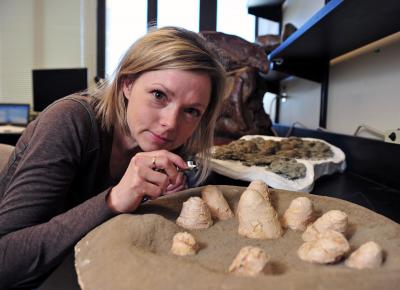
Darla Zelenitsky from the University of Calgary collaborated with David Varricchio at Montana State University to closely examined the shells of fossil eggs from a small meat-eating dinosaur called Troodon.
 
Published: Thursday, April 18, 2013
Jay Im (University of Calgary).
 
A small, bird-like North American dinosaur incubated its eggs in a similar way to brooding birds -- bolstering the evolutionary link between birds and dinosaurs, researchers at the University of Calgary and Montana State University study have found. Among the many mysteries paleontologists have tried to uncover is how dinosaurs hatched their young. Was it in eggs completely buried in nest materials, like crocodiles? Or was it in eggs in open or non-covered nests, like brooding birds?
Using egg clutches found in Alberta and Montana, researchers Darla Zelenitsky at the University of Calgary and David Varricchio at Montana State University closely examined the shells of fossil eggs from a small meat-eating dinosaur called Troodon.

In a finding published in the spring issue of Paleobiology, they concluded that this specific dinosaur species, which was known to lay its eggs almost vertically, would have only buried the egg bottoms in mud. "Based on our calculations, the eggshells of Troodon were very similar to those of brooding birds, which tells us that this dinosaur did not completely bury its eggs in nesting materials like crocodiles do," says study co-author Zelenitsky, assistant professor of geoscience. "Both the eggs and the surrounding sediments indicate only partial burial; thus an adult would have directly contacted the exposed parts of the eggs during incubation," says lead author Varricchio, associate professor of paleontology.

Varricchio says while the nesting style for Troodon is unusual, "there are similarities with a peculiar nester among birds called the Egyptian Plover that broods its eggs while they're partially buried in sandy substrate of the nest."

Paleontologists have always struggled to answer the question of how dinosaurs incubated their eggs, because of the scarcity of evidence for incubation behaviours. As dinosaurs' closest living relatives, crocodiles and birds offer some insights. Scientists know that crocodiles and birds that completely bury their eggs for hatching have eggs with many pores or holes in the eggshell, to allow for respiration. This is unlike brooding birds which don't bury their eggs; consequently, their eggs have far fewer pores.

The researchers counted and measured the pores in the shells of Troodon eggs to assess how water vapour would have been conducted through the shell compared with eggs from contemporary crocodiles, mound-nesting birds and brooding birds. They are optimistic their methods can be applied to other dinosaur species' fossil eggs to show how they may have been incubated. "For now, this particular study helps substantiate that some bird-like nesting behaviors evolved in meat-eating dinosaurs prior to the origin of birds. It also adds to the growing body of evidence that shows a close evolutionary relationship between birds and dinosaurs," Zelenitsky says.

source

###########################################################################

Dinosaur embryos twitched in their eggs like those of modern birds

A collection of embryos fossilised at various ages in different nests reveals how dinosaurs developed in the egg
  • The Guardian,
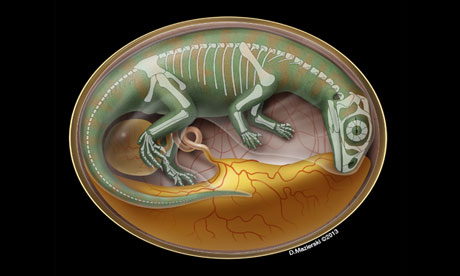
Illustration of a dinosaur embryo inside its egg.
A Lufengosaurus dinosaur embryo inside its egg. Illustration: D. Mazierski
 
Dinosaur embryos moved around inside their eggs and grew in much the same way as those of modern animals such as birds, say scientists who have examined more than 200 fossilised bones from 190m-year-old embryos found in China.

The bones came from the genus known as Lufengosaurus, a long-necked dinosaur that could grow up to eight metres long, and were found among fragments of egg shells at a site near the city of Lufeng in Yunnan, south west China. They are the oldest dinosaur embryos ever found and seem to have come from several nests and from eggs at various stages of development. "Most of the time you get single glimpses of embryonic life in a dinosaur because they are preserved as a nest and all the eggs are in the same developmental stage," said Robert Reisz, a palaeontologist at the University of Toronto Mississauga, who led the team that analysed the bones. "Here we have a growth series of embryos, which allowed us to track how these animals grew."

The team's results are published in the journal Nature. Reisz's team focused their analysis on the largest bone, the femur. They found that, inside the eggs, these bones seemed to be growing very quickly, implying that their incubation period might have been relatively short.

Inside the bones is a honeycomb structure of "primary spaces". The larger these are, said Reisz, the faster the embryo would have grown. In addition, the scientists found that the bones were shaped inside the eggs, as they grew, as attached muscles pulled on them. "This suggests that dinosaurs, like modern birds, moved around inside their eggs," said Reisz. "It represents the first evidence of such movement in a dinosaur.

source

Tuesday, April 9, 2013

Free download - Excellent Adélie Penguin research paper

    
Research Article

Climate Change Winners: Receding Ice Fields Facilitate Colony Expansion and Altered Dynamics in an Adélie Penguin Metapopulation

Authors:

  • Michelle A. LaRue mail,
  • David G. Ainley,
  • Matt Swanson,
  • Katie M. Dugger,
  • Phil O′B. Lyver,
  • Kerry Barton,
  • Grant Ballard    
  •  
    Download

  • PDF
  • Citation
  • XM
  • Friday, April 5, 2013

    Climate Change Winners: Adélie Penguin Population Expands as Ice Fields Recede

     Adélie penguin. The population size of an Adélie penguin colony on Antarctica’s Beaufort Island increased 84 percent as the ice fields retreated between 1958-2010, with the biggest change in the last three decades. (Credit: University of Minnesota)

    Apr. 3, 2013 — Adélie penguins may actually benefit from warmer global temperatures, the opposite of other polar species, according to a breakthrough study by an international team led by University of Minnesota Polar Geospatial Center researchers. The study provides key information affirming hypothetical projections about the continuing impact of environmental change.

    Researchers from the United States and New Zealand used a mix of old and new technology studying a combination of aerial photography beginning in 1958 and modern satellite imagery from the 2000s. They found that the population size of an Adélie penguin colony on Antarctica's Beaufort Island near the southern Ross Sea increased 84 percent (from 35,000 breeding pairs to 64,000 breeding pairs) as the ice fields retreated between 1958-2010, with the biggest change in the last three decades. The average summer temperature in that area increased about a half a degree Celsius per decade since the mid-1980s.

    The first-of-its-kind study was published today in PLOS ONE, a leading peer-reviewed scientific journal. The research affirms models published in 2010 projecting how south polar penguins will respond to changed habitat as Earth's atmosphere reaches 2 degrees Celsius above pre-industrial levels, a point that is rapidly approaching.

    The study showed that available habitat for Adélie penguins on the main portion of the Beaufort colony, on the south coast, increased 71 percent since 1958, with a 20 percent increase from 1983-2010. The extent of the snow and ice field to the north of the main colony did not change from 1958-1983, but then retreated 543 meters from 1983-2010.

    In addition to the overall population growth, researchers saw an increase in population density within the colony as it filled in what used to be unsuitable habitat covered in snow and ice. They also found that the emigration rates of birds banded as chicks on Beaufort Island to colonies on nearby Ross Island decreased after 2005 as available habitat on Beaufort increased, leading to altered dynamics of the population studied. "This research raises new questions about how Antarctic species are impacted by a changing environment," said Michelle LaRue, the paper's co-author and research fellow at the Polar Geospatial Center in the University of Minnesota's College of Science and Engineering. "This paper encourages all of us to take a second look at what we're seeing and find out if this type of habitat expansion is happening elsewhere to other populations of Adélie penguins or other species."

    Penguin expert and study co-author David Ainley, a lead author of an earlier study, agreed that this study gives researchers important new information. "We learned in previous research from 2001-2005 that it is a myth that penguins never move to a new colony in large numbers. When conditions are tough, they do," said Ainley, a senior marine wildlife ecologist with H.T. Harvey and Associates, an environmental consulting company in California. "This study at Beaufort and Ross Islands provides empirical evidence about how this penguin attribute will contribute to their response to climate change."

    Adélie penguins are common along the southern Antarctic coast. They are smaller than their Emperor penguin counterparts standing about 46 to 75 cm (18 to 30 inches) when upright and weighing about 4.5-5.4 kg (10-12 pounds). The Adélie penguin lives only where there is sea ice but needs the ice-free land to breed. Breeding pairs produce on average one chick per year and return to the same area to breed if conditions haven't changed.

    To determine changes in available nesting habitat in this study, researchers gathered aerial photos during the penguin incubation period in 1958, 1983 and 1993 and high-resolution satellite images from 2005 and 2010. Researchers overlaid the images exactly, lining up rocks and other geographical landmarks. They studied guano (penguin feces and urine) stains to determine the available habitat.
    In the future, researchers plan to use additional satellite imagery to look at other Adélie penguin populations to help understand the dynamics and environmental factors that influence regional populations. "This study brought together researchers from different academic disciplines who all contributed their expertise," LaRue said. "We had people who study climate change, spatial analysis, and wildlife population dynamics. This is how good science leads to results."

    In addition to LaRue and Ainley, other researchers involved in the study included Matt Swanson, a graduate student researcher at the University of Minnesota Polar Geospatial Center; Katie M. Dugger from Oregon State University; Phil O'B. Lyver from Landcare Research in New Zealand; Kerry Barton from Bartonk Solutions in New Zealand; and Grant Ballard from PRBO Conservation Science in California.

    The study was primarily funded by the National Science Foundation (NSF).


    Story Source:
    The above story is reprinted from materials provided by University of Minnesota.
    Note: Materials may be edited for content and length. For further information, please contact the source cited above.

    Journal Reference:
    1. Michelle A. LaRue, David G. Ainley, Matt Swanson, Katie M. Dugger, Phil O′B. Lyver, Kerry Barton, Grant Ballard. Climate Change Winners: Receding Ice Fields Facilitate Colony Expansion and Altered Dynamics in an Adélie Penguin Metapopulation. PLoS ONE, 2013; 8 (4): e60568 DOI: 10.1371/journal.pone.0060568

    University of Minnesota (2013, April 3). Climate change winners: Adélie penguin population expands as ice fields recede. ScienceDaily. Retrieved April 5, 2013, from http://www.sciencedaily.com­ /releases/2013/04/130404092827.htm


    Tuesday, March 26, 2013

    Uncovering Africa's Oldest Known Penguins

    Only one penguin species lives in Africa today -- the endangered black-footed penguin, or Spheniscus demersus. But newly found fossils confirm that as many as four penguin species coexisted on the continent in the past. (Credit: Photo by Daniel Thomas)


    Mar. 26, 2013 — Africa isn't the kind of place you might expect to find penguins. But one species lives along Africa's southern coast today, and newly found fossils confirm that as many as four penguin species coexisted on the continent in the past. Exactly why African penguin diversity plummeted to the one species that lives there today is still a mystery, but changing sea levels may be to blame, the researchers say.

    The fossil findings, described in the March 26 issue of the Zoological Journal of the Linnean Society, represent the oldest evidence of these iconic tuxedo-clad seabirds in Africa, predating previously described fossils by 5 to 7 million years.

    Co-authors Daniel Thomas of the National Museum of Natural History and Dan Ksepka of the National Evolutionary Synthesis Center happened upon the 10-12 million year old specimens in late 2010, while sifting through rock and sediment excavated from an industrial steel plant near Cape Town, South Africa.

    Jumbled together with shark teeth and other fossils were 17 bone fragments that the researchers recognized as pieces of backbones, breastbones, wings and legs from several extinct species of penguins.

    Based on their bones, these species spanned nearly the full size spectrum for penguins living today, ranging from a runty pint-sized penguin that stood just about a foot tall (0.3 m), to a towering species closer to three feet (0.9 m).

    Only one penguin species lives in Africa today -- the black-footed penguin, or Spheniscus demersus, also known as the jackass penguin for its loud donkey-like braying call. Exactly when penguin diversity in Africa started to plummet, and why, is still unclear.

    Gaps in the fossil record make it difficult to determine whether the extinctions were sudden or gradual. "[Because we have fossils from only two time periods,] it's like seeing two frames of a movie," said co-author Daniel Ksepka. "We have a frame at five million years ago, and a frame at 10-12 million years ago, but there's missing footage in between."

    Humans probably aren't to blame, the researchers say, because by the time early modern humans arrived in South Africa, all but one of the continent's penguins had already died out.
    A more likely possibility is that rising and falling sea levels did them in by wiping out safe nesting sites.

    Although penguins spend most of their lives swimming in the ocean, they rely on offshore islands near the coast to build their nests and raise their young. Land surface reconstructions suggest that five million years ago -- when at least four penguin species still called Africa home -- sea level on the South African coast was as much as 90 meters higher than it is today, swamping low-lying areas and turning the region into a network of islands. More islands meant more beaches where penguins could breed while staying safe from mainland predators.

    But sea levels in the region are lower today. Once-isolated islands have been reconnected to the continent by newly exposed land bridges, which may have wiped out beach nesting sites and provided access to predators.

    Although humans didn't do previous penguins in Africa in, we'll play a key role in shaping the fate of the one species that remains, the researchers add.

    Numbers of black-footed penguins have declined by 80% in the last 50 years, and in 2010 the species was classified as endangered. The drop is largely due to oil spills and overfishing of sardines and anchovies -- the black-footed penguin's favorite food.

    "There's only one species left today, and it's up to us to keep it safe," Thomas said.

    Story Source:
    The above story is reprinted from materials provided by National Evolutionary Synthesis Center (NESCent), via EurekAlert!, a service of AAAS.
    Note: Materials may be edited for content and length. For further information, please contact the source cited above.

    Journal Reference:
    1. Daniel B. Thomas, Daniel T. Ksepka. A history of shifting fortunes for African penguins. Zoological Journal of the Linnean Society, 2013; DOI: 10.1111/zoj.12024

    National Evolutionary Synthesis Center (NESCent) (2013, March 26). Uncovering Africa's oldest known penguins. ScienceDaily. Retrieved March 26, 2013, from http://www.sciencedaily.com­ /releases/2013/03/130326101606.htm

    Monday, March 18, 2013

    The Early Bird Loses an Ovary


    ScienceNOW - Up to the minute news from Science
    on 17 March 2013,
    Sunny side up. The follicles (close-up, inset) preserved in the fossilized ovary of this 125-million-year-old bird (main image), provide insights into the reproductive biology of these early birds and into bird evolution. 
     
    Credit: Aijuan Shi; Zhonghe Zhou (inset)
     
    The dinosaurs most closely related to today's birds were super egg producers. Known as maniraptorans, these bipedal creatures had two functional ovaries and produced a large number of eggs per clutch. Living species of birds, on the other hand, have only one functional ovary, typically on the left side of the body, and most produce only a few eggs at a time. When and why did today's flyers ditch a reproductive organ? Newly described fossils of early birds may hold the answer.

    All the fossils in this study come from rocks laid down as sediments about 125 million years ago in northeastern China. Despite the poor bone preservation in two of the fossils, all include the well-preserved remains of ovaries and mature or nearly mature follicles, structures within the ovaries that contain developing eggs—the first such fossils of early birds known to do so, says Zhonghe Zhou, a paleontologist with the Institute of Vertebrate Paleontology and Paleoanthropology in Beijing. One set of remains represents Jeholornis, a long-tailed bird about the size of a pigeon.

    Neither of the other fossils is preserved well enough to identify its species, Zhou notes, but each represents a bird somewhat larger than a sparrow. Each of the fossils included only one ovary—which, as in modern birds, appears to be located on the left side of the body.

    Analyses by Zhou and his colleagues showed that the structures assumed to be follicles weren't seeds, because they weren't located in parts of the body where stomach contents would typically be found. The structures also weren't gastroliths, or stomach stones, because such stones typically retain their three-dimensional shape, whereas these structures appeared to have been soft tissue because they had been somewhat flattened before they were preserved.

    "These are really incredible fossils," says Stephen Brusatte, a vertebrate paleontologist at the University of Edinburgh in the United Kingdom who wasn't involved in the study. Preservation of soft tissues is exceedingly rare, he notes, but "to have ovarian follicles preserved is just amazing."
    The fossils furnish information about the reproductive habits of these animals. In one of the birds, some of the bones in the creature's wing weren't fully fused, Zhou says. That suggests that the creature wasn't an adult, hinting that females of its species became sexually mature before they were fully grown, he and his colleagues report online today in Nature.

    One of the fossilized ovaries includes at least 20 mature or near-mature follicles. That's a sign that unlike modern birds, early birds probably laid a large number of relatively small eggs in a single clutch, Brusatte says. "We don't have any fossil nests of early birds, but this tells us that the reproductive biology of early birds was quite different than modern birds."

    Some scientists have assumed that the evolutionary loss of one functional ovary—a weight-saving change that might have proved beneficial to flying birds—took place early in avian evolution. Until the new study, paleontologists hadn't unearthed any evidence for the notion that early birds, like their modern-day kin, had only one ovary.

    The findings even provide hints about how early birds cared for their young, says Richard Prum, an evolutionary ornithologist at Yale University. Previous analyses of fossil dinosaur nests have suggested that in birds' closest dinosaur relatives, which laid large clutches of eggs, males sat on the nests and presumably cared for the hatchlings. That's also true of some of today's birds—including ratites, a group that includes ostriches and emus—which typically lay eggs in several nests and then leave the childcare to males. "So, large clutch size in early birds is strong evidence for male care," Prum contends.

    The new findings "are very exciting," says Frankie Jackson, a vertebrate paleontologist at Montana State University, Bozeman. Besides revealing that even early birds had reproductive biology significantly different from that of their closest dinosaur kin, they provide a new approach to estimate the brood size and the onset of sexual maturity in adults. These reproductive traits—including the loss of one of the ovaries, which probably would have rendered egg-laden females significantly lighter—likely had a substantial impact on the evolution of flight, she notes. That development may even have helped some bird lineages survive the mass extinctions in the wake of an asteroid impact that claimed the dinosaurs 66 million years ago.

    source

    Saturday, March 16, 2013

    Penguin Ancestor swimming with the predators

    From the Eocene -
    Icadyptes salasi, an unnamed protocetid, Ocucajea picklingi, and Supayacetus muizoni

    The Rise and Fall of Four-Winged Birds


    Look at the leg of almost any bird and you’ll see feathers covering the thigh but scales covering everything from the ‘knee’ downwards. There are a couple of exceptions—some birds of prey look like they’re wearing baggy trousers and golden eagles have fluffy foot feathers for insulation. But for the most part, living birds have naked lower legs.

    It wasn’t always this way. We know that birds evolved from small two-legged, meat-eating dinosaurs that were covered in simple fuzzy feathers. Those on their arms eventually became longer and flatter, evolving from hollow tubes into flat asymmetrical vanes. They transformed from “dino-fuzz” into flight feathers, and their arms transformed into wings.

    Meanwhile, it’s tempting to think that the feathers on their hind legs gradually became smaller and gave way to scales. But that’s not how it happened. For a start, we know that some small dinosaurs had long feathers on their legs as well as their arms. And now, 11 newly analysed fossils tell us that some early birds shared the same feature. These specimens suggest that some of our feathered friends had four wings.

    It was an ornithologist called William Beebe who first suggested that early birds might have passed through a four-winged gliding stage on their way to evolving true flapping flight. That was in 1915 and though Beebe’s idea was fanciful, there wasn’t much strong evidence behind it.

    Then, in 2003, the prolific Chinese dinosaur-hunter Xing Xu found an actual four-winged dinosaur. He called it Microraptor gui. Xu saw the outlines of feathers clearly splaying from the creature’s legs as well as its arms. These were clearly traces of long, flat and asymmetric plumes, much like those that keep today’s flying birds aloft. While it lived, Microraptor probably looked like a starling wearing flares. Xu suggested that it may have used its leg wings to help it glide, while others later suggested that it could have flown like a biplane.

    Xu went on to find other dinosaurs with long leg feathers, such as Anchiornis, Pedopenna and Xiaotingia. For a time, it looked like these feathers disappeared before true birds arrived on the scene, but Xu is now back with 11 new fossils that discount that idea.

    Confuciusornis. From Zheng et al, 2013. Science/AAAS
    Confuciusornis. From Zheng et al, 2013. Science/AAAS

    The specimens include species like Sapeornis, Confuciusornis, Cathayornis, and Yanornis. All of them are early birds, perched on primitive branches of the group’s family tree. All of them lived in China during the Cretaceous period. And all of them had four wings, with long feathers on their legs.
    You can see them in the images throughout this post—dark shadows protruding from the bones of the lower leg. In some of the specimens, the leg feathers show a stiff, curved central rod (or “rachis”) with symmetrical vanes sticking out from either side. They protrude from the bones at right angles and seem to form a large flat surface.

    Xu thinks that these feathers might have helped the owners to fly. They could have produced extra lift or maybe helped the birds to turn more easily. But other scientists who work on the evolution of flight are not convinced. “[Xu] has basically just taken a punt that because the feathers were stiff, they were probably aerodynamic in function,” says Michael Habib from the University of Southern California. “It is a bit of a weak argument.”

    Habib thinks that the long asymmetric leg feathers of Microraptor probably did play some role in gliding or flying, but the smaller plumes of other baggy-legged species “might have merely been there because of a developmental quirk”. If some genes are producing large feathers on the front limbs, “it might not take much to tweak a set onto the hind limbs too,” he says.

    Kevin Padian from the University of California, Berkeley agrees. He points out that no one has actually done any proper tests to show if the leg feathers were involved in flight. They would certainly have created drag, but they could only have provided lift if they sat in a flat sheet like the wings of modern birds. Xu claims that they were, but Padian says that the feathers could just have been flattened into a plane as they became fossilised.  “It hasn’t been shown that this is really an aerodynamically competent wing,” he says.

    Nonetheless, both Habib and Padian praise Xu’s work. “It’s a great study because it establishes that leg feathers were widely distributed,” says Padian. From beginnings as small outgrowths, leg feathers became dramatically bigger in some of the dinosaur groups on the evolutionary line leading to birds. They eventually shrank away again before disappearing entirely and being replaced by scales.
    Scenario for the evolution of leg feathers. From Zheng et al, 2013. Science/AAAS
    Scenario for the evolution of leg feathers. From Zheng et al, 2013. Science/AAAS

    Of course, like any evolutionary story, this one could be falsified or complicated by the next cool discovery. Xu says that if he discovered early birds or feathered dinosaurs with extensive scales on their feet, that would spell trouble for his hypothesis. “But personally, I am quite confident with our scenario,” he says.

    Why did the leg feathers, having first become large, eventually disappear? Xu thinks that it was because the birds set their two pairs of limbs towards different ends—the front pair for flying and the hind pair for walking or running. At the same time, they might have moved from life in the trees to life on the ground, or near water. Under all these scenarios, long leg feathers would have just got in the way, and were soon lost.

    Something similar may have happened in other flying animals. For example, the earliest flying insects tend to have four wings, while some of the most competent flyers like, well, flies, only have two. The second pair has evolved into a pair of gyroscopes called halteres. “In the early evolution of flight, different animal groups always try to use as much surface as possible,” says Xu. “Once the major flight organ is well developed, the animal just fires the other organs.”

    Xu’s 11 specimens all came from private collectors and had been housed at the Shandong Tianyu Museum of Nature for roughly a decade. The museum contains over 2,000 specimens of early birds, many of which preserve beautiful traces of feathers, skin and more. In fact, the museum’s treasure trove of riches is so huge that it has turned into a backlog. There’s simply too much good stuff there to go through. “It took a while for me to realize how important these specimens are,” says Xu. “These days, we are working hard to extract new information from these wonderful specimens and hopefully can produce more interesting results in future.”

    Reference: Zheng, Zhou, Wang, Zhang, Zhang, Wang, Wei, Wang & Xu. 2013. Hind Wings in Basal Birds and the Evolution of Leg Feathers. Science http://dx.doi.org/10.1126/science.1228753


    source

    Saturday, March 9, 2013

    Penguin Hookers. Really. (Your Humorous Science of the Day)

    Posted by Alex Falcone on Thu, Mar 7, 2013 

    Very important information has recently come to my attention. Some penguins are prostitutes.
     We all know humans do it. Some people will even show their boobs to a prison guard for a chocolate chip cookie, but penguins?! Those adorable animals dressed like banquet waiters who engage in Morgan Freeman-narrated lifelong monogomy? Yes. They're prostitutes.

    It's not exactly new news but an alert reader Jake H. pointed me towards a 1998 study that somehow didn't make it to my daily reading habits because it's too amazing. Apparently when the small rocks they use to make nests get scarce, some penguins will exchange sexual favors for them. Not only do they prostitute themselves, they do it for pebbles!

    According to this excellent Wikipedia article, prostitution has also been observed in chimpanzees, Capuchin monkeys, and the crab-eating macaque. That's not super surprising: chimpanzees and Capuchins are gross. And of course something called a "crab-eating macaque" would sell its body (am I right ladies?). But penguins? PENGUINS? I feel let down.

    Read some more about the behavior (and make sure to hear Morgan Freeman's voice in your head):
    The female penguins observed under the study were coupled with males. The females will go outside alone to collect pebbles, but the males did not suspect their female partners. According to the observations and analysis made by Hunter, the prostitute penguins targeted single males, because if instead they picked a male penguin with a partner, the male penguin's current partner will come in conflict with the prostitute female.
    All that stuff about sitting on the egg waiting for their partners to come back is less romantic when you know they're being cuckolded. You're not a faithful husband penguin, you're a fool. While you're making dinner for your unborn chick, your woman is out Roxanning it up for building materials, perhaps sucking a macaque or two.

    Today is a sad, sad day. Well, some day in 1998 was a sad day, but I've fallen behind on my penguin sex Wikipedia reading.

    source 

    Thursday, March 7, 2013

    Researchers find emperor penguins outer feathers colder than surrounding air

    March 7, 2013 by Bob Yirka report
    Emperor penguin body surfaces cool below air temperature
    Thermal image of penguin. Credit: Université de Strasbourg and Centre National de la Recherche Scientifique (CNRS), Strasbourg, France
    (Phys.org) —A research team made up of members from France and the U.K. has discovered that when in cold temperatures, the outer feathers of the emperor penguin are actually colder than the surrounding air. As the team describes in their paper published in the journal Biology Letters, they discovered the unusual thermal properties of the penguin's feathers while studying the birds in their natural environment using infrared imaging.
     
    To gain a better understanding of how emperor are able to withstand extremely low temperatures for months at a time, the research team ventured down to Terre Adélie, Antarctica, during June 2008. There they took hundreds of infrared of penguins that had moved slightly apart from the others—that allowed for full body images to be taken and minimized the collective warming that occurs as the animals huddle together.

    Upon examining the multicolored images, the researchers were surprised to discover that the outer feathers that cover most of the penguins' body, were actually four to six degrees Celsius colder than the surrounding air. With most other birds, and animals, the air around their bodies is warmer. The researchers explain that the apparent anomaly appears to be due to what they describe as "extreme radiative cooling." It's similar to frost building up on surfaces on a cold morning. It happens with the penguins when their protective coat radiates more heat into the colder sky than is absorbed from the surrounding air—this causes the temperature at the surface of their feathers to fall below that of the surrounding air. The end result, the researchers report, is that the penguins are able to draw very tiny amounts of heat back to their feathers from the surrounding air, helping them to conserve energy. It's not much, the researchers conclude, but when trying to survive in a very for very long periods of time, every little bit helps.

    In looking at the thermal images, the researchers also noted that the birds do have a few "hot" spots—eyes, beak and feet, where heat escapes. The eyes in particular, bright red in the photos, suggest that penguins must take care to protect such vulnerable areas from bitter wind. They note that earlier studies have found that the more at-risk areas of the penguins' body have special blood vessels that help to conserve heat.

    More information: Emperor penguin body surfaces cool below air temperature, Published online Biology Letters, March 6, 2013. doi: 10.1098/rsbl.2012.1192

    Abstract
    Emperor penguins Aptenodytes forsteri are able to survive the harsh Antarctic climate because of specialized anatomical, physiological and behavioural adaptations for minimizing heat loss. Heat transfer theory predicts that metabolic heat loss in this species will mostly depend on radiative and convective cooling. To examine this, thermal imaging of emperor penguins was undertaken at the breeding colony of Pointe Géologie in Terre Adélie (66°40′ S 140° 01′ E), Antarctica in June 2008. During clear sky conditions, most outer surfaces of the body were colder than surrounding sub-zero air owing to radiative cooling. In these conditions, the feather surface will paradoxically gain heat by convection from surrounding air. However, owing to the low thermal conductivity of plumage any heat transfer to the skin surface will be negligible. Future thermal imaging studies are likely to yield further insights into the adaptations of this species to the Antarctic climate.

    Press release

    source
    Monday, February 25, 2013

    Public Displays of Affection May Have Evolutionary Benefits

    Date: February19 2013
    grebe-bird-illustration
    Monogamous animals such as the Great Crested grebe may continue with public displays like the weed dance after pairing up because it increases their offsprings' chances of survival
    CREDIT: © Emiko Paul, reproduced with permission from: Price, T. 2008


    Those goodbye hugs at the train station or quick kisses in the park may have deep evolutionary roots. Such public displays of affection may help pair-bonded couples invest more in their children, boosting the offspring's survival odds, new research suggests.

    The study, published today (Feb. 19) in the journal Proceedings of the Royal Society B, finds that when monogamous animals such as birds continue their displays after mating, they put more energy into parenting and can have more children than when they drop the displays.


    Lifelong mates
     

    Birds and other animals use showy feathers or elaborate courtship behaviors such as mating dances to lure potential partners.

    But in the early 1900s, biologist Julian Huxley noticed that birds known as Great Crested grebes rise up out of the water like synchronized swimmers with weeds in their beaks. They continued this elaborate mating ritual, which Huxley likened to humans holding hands or kissing, even after mating.
    That begged the question: Why would monogamous animals have evolved to continue these display once they'd paired up?

    "It's very obvious why you'd want a display to attract a mate, but once you've already secured a mate, why should you bother to keep displaying?" said study author Maria Servedio, an evolutionary biologist at the University of North Carolina, Chapel Hill.

    After all, bright colors and public displays of affection are energetically costly and make animals more visible to predators. The evolutionary benefits have to outweigh the costs for animals or they wouldn't bother.

    Helping the kids

    To find out, Servedio and her colleagues looked at existing studies from the animal kingdom. They noted that in monogamous species, paired-up animals are better at raising more offspring. In other words, two individual birds may be able to raise one chick at a time, but a couple can raise more than two chicks together.

    The researchers also found that, in other studies, when researchers covered up mating displays like a bright red spot on a bird's bill, the animals' partners invested less in offspring, Servedio told LiveScience. Emphasizing an animal's display also seemed to increase its investment in offspring.
    Researchers then used a mathematical model to see if those two effects could make displays that continue through a pair-bonded relationship evolutionarily beneficial. The scientists found that this was in fact true, because the displays made couples more likely to invest in their offspring, increasing their reproductive fitness.

    Human effect?

    The findings suggest that monogamous animals like humans snuggle, sport flashy feathers or canoodle on the subway because it increases parents' investment in young, and thus, increases the odds of these children surviving.

    "This study points out a fascinating potential for these mutual displays to be adaptive in terms of gains in parental investment by both sexes," Rebecca Safran, an evolutionary biologist at the University of Colorado, Boulder, who was not involved in the study, wrote in an email.

    While its implications are most obvious for birds, "it is not such a long stretch to imagine this process at work in human populations. The trick is that the signals used by humans to stimulate additional parental care would likely differ by culture and social context," Safran said.

     source
    Thursday, February 21, 2013

    Skull of world's oldest penguin found

    'Wrapped it in newspaper, left it in my garage'

    SAM SACHDEVA
    Last updated 14:31 19/02/2013


    Al Mannering
    JOHN KIRK-ANDERSON/Fairfax NZ
    Amateur fossil hunter Al Mannering, who discovered the skull of the world's oldest penguin, left, which is shown compared with a modern penguin.
    The skull of a 65-million-year-old penguin which spent the last decade wrapped in newspaper in a Christchurch garage could unlock the secrets of the bird's evolution. Canterbury Museum scientists are analysing the new fossil of Waimanu manneringi, named after the Christchurch amateur fossil hunter who was the first to find bones from the world's oldest penguin.

    Al Mannering, who first found fossils of the bird at the Waipara River in 1997, made the new find in 2003 but did not realise its significance until preparing it late last year. 'I wrapped it in newspaper and left it in my garage for 10 years, then last year I thought, 'I'd better have a go at that. Once I realised what it was, I emailed [the museum] straight away.''

    Canterbury Museum senior curator Paul Scofield said the fossil, from the Paleocene era, was in ''exceptional'' condition. ''On a worldwide basis, it would be as good as fossils of this age get.'' Scofield said the skull was one of the most important parts of the body for paleontologists, providing valuable hints about the bird's history and its connection to other penguins.

    Museum scientists would compare the skull with those of thousands of other penguins to develop a ''family tree'' and determine how the bird related to both modern penguins and the dinosaurs. The researchers would also do a CT scan of the skull at Christchurch Hospital, allowing them to reconstruct its brain and outline its abilities and lifestyle. ''As birds become specialists in flight or diving, it changes the way their brain works: now we can start to make guesses at how these animals actually lived,'' Scofield said.

    The museum would work with American scientists from the University of Texas who had found similar fossils in South America, which had recently separated from New Zealand at the age the fossils dated back to. ''It's a really sexy field in paleontology, because penguins were one of the earliest bird groups to evolve.''

    Scofield said the Paleocene era was ''absolutely crucial'' to scientific understanding of modern birds and mammals, due to dramatic change which occurred during the period. ''As soon as we became free of dinosaurs, evolution went crazy,'' he said.

    source

    Wednesday, February 20, 2013

    Tristan da Cunha and the Rockhopper Penguin

    Tristan da Cunha, South Atlantic Ocean
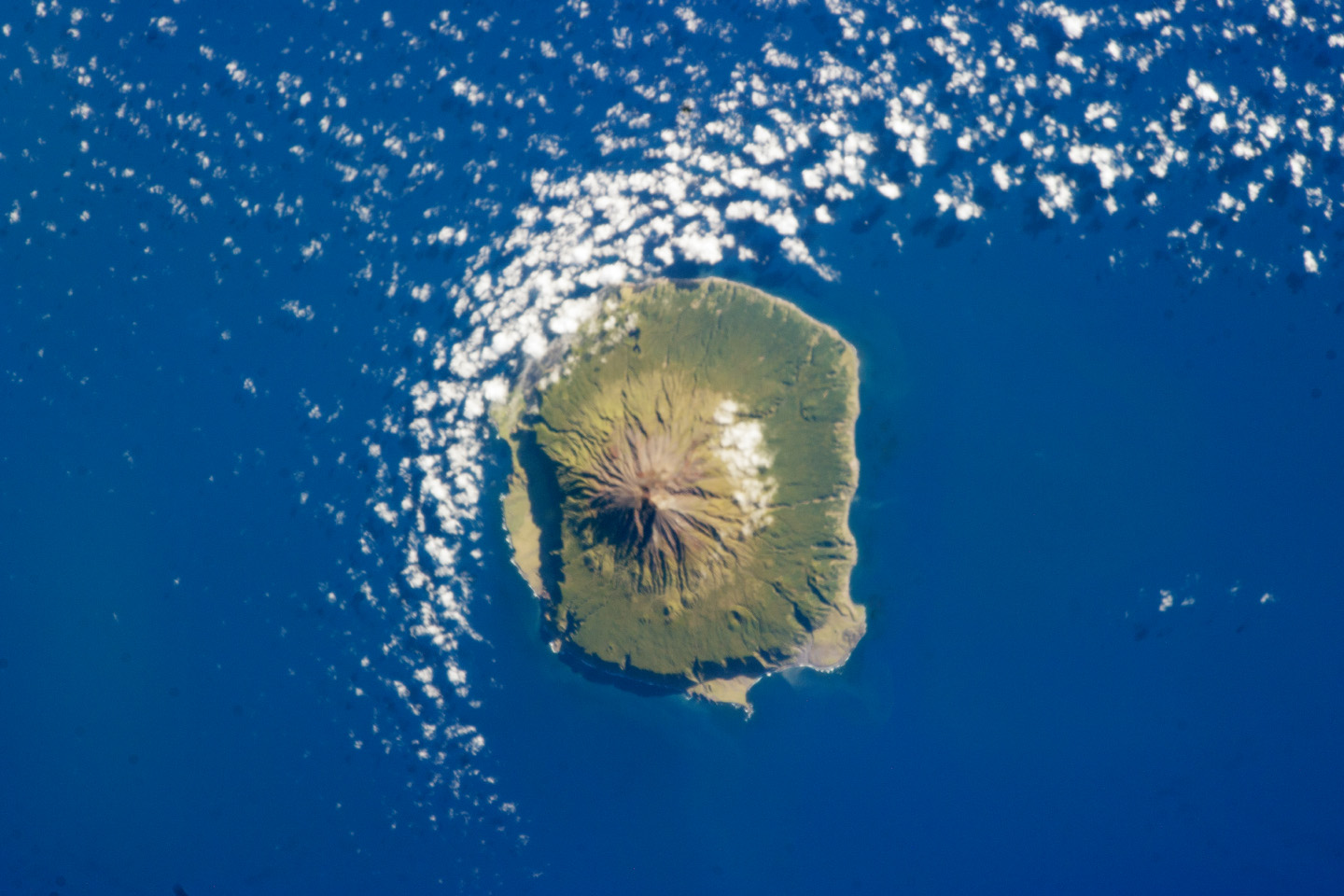
    Image acquired February 6, 2013 download large image (323 KB, JPEG, 1440x960) 
     
     
    The island of Tristan da Cunha is located in the southern Atlantic Ocean—more than 3,700 kilometers (2,300 miles) from the coastline of Antarctica, approximately 2,800 kilometers (1,700 miles) to the southern tip of Africa, and more than 3,000 kilometers (1,900 miles) from the east coast of South America. The island forms part of the British Overseas Territory of Saint Helena, Ascension, and Tristan da Cunha. The shoreline of the 13 kilometer (8 mile) wide island is marked on most sides by steep cliffs, with lower beach areas on the southern and north-northwestern sides. The island is notable for its bird population and includes important breeding grounds for petrels, albatrosses, penguins, and shearwaters.

    Tristan da Cunha is a shield volcano, a volcanic structure with a low, broad profile and composed of silica-poor lavas (such as basalt). The upper surface of this low base appears dark green in this astronaut photograph. Steeper brown to tan colored slopes mark the central cone of the volcano at the island’s center. The summit crater, Queen Mary’s Peak, sits at an elevation of 2,060 meters (6,760 feet) above sea level. While geologic evidence indicates that eruptions have occurred from the central crater, lavas have also erupted from flank vents along the sides of the volcano and from smaller cinder cones.

    The last known eruption of Tristan da Cunha took place in 1961–1962 and forced the evacuation of the only settlement on the island, Edinburgh of the Seven Seas, on the northern coastline (obscured by clouds in this image). The town is considered to be the most remote permanent settlement on Earth, with its nearest neighbor located 2,173 kilometers (1,347 miles) to the northeast on the island of St. Helena.

    source

    ~~~~~~~~~~~~~~~~~~~~~~~~~~~~~~~~~~~~~~~~~~~~~~~~~~~~~~~~~~~~~~~~~~~~~~~~~
    000NORTHROCKHOPPER

    Northern Rockhopper Penguin

    (Eudyptes Moseleyi)

    Written by: Lisa Triggs, Biology 487, Winter 2009
    Eudyptes moseleyi

    StatusEndangered (IUCN)
    The current listing of endangered is appropriate at this time.  Current protection consists of marine protected areas/reserves, montoring of populations, and ecological and demographic studies.

    Conservation Concerns
     
    Past human explotation and introduced predators. Food supplies may be affected by fisheries, climate change and shifts in marine food webs. Increasing disturbance and pollution results from exotourism and fishing. Eggs taken for food and birds taken for oil. Introduced predators may affect breeding success.
    Global changes are causing a decrease in primary productivity and an increase in sea surface temperatures.
    There has been a rapid population decrease over the last 30 years throughout this penguin's range. Precise reasons for the declines are poorly known but changes in sea surface temperature, competition and incidental capture in fisheries and introduced predators are likely to be implicated.

    Possible Actions
     Continue to monitor or start to monitor populations to assess trends. Conduct studies to assist in interpreting population changes. Conduct studies to assess the impacts of interactions with commercial fisheries. Investigate the impact of introduced species at breeding colonies and eradicate introduced species where necessary. Investigate the impact of oil exploration and exploitation. Study the impacts of climate change. Reduce disturbance from ecotourism. Create more marine protected areas. Reduce/exclude large scale commercial fishing from within prescribed distances from penguin breeding locations.

    Distribution

    Descriptive Characteristics
     Adult males and females are similar.  They have a thin, yellow supercillium with longer plumes and red eyes. Juveniles have a faint yellow stripe above their eyes and the red brown bill of adults.  They have a pale, mottled gray chin. The chicks lack the yellow crest and the red-brown bill of adults. Their bills are black.  They have grey-black backs and white fronts. There is a very small degree of sexual dimorphism between the sexes. The females are slightly smaller with an average female to male bill depth ratio of .85. Calls are noisy, aggressive and demonstrative; raucous, braying sounds; more strident, pulsed squeaks, separated by shorter periods of silence; shrill and unmusical. Four types of calls exist - contact, sexual, agonistic and chick.

    Measurements

    Males

    Weight:
    3 kg
    Height: 52 cm
    Beak Length: 4.83 cm
    Flipper Length: 17.40 cm
    Foot Length: 11.70 cm

    Females

    Weight: 2.50 kg
    Height: 52 cm
    Beak Length: 4.16 cm
    Flipper Length: 16.90
    Foot Length: 10.85 cm

    Breeding Biology

    Average Arrival Date: July 30
    Average Egg Laying Date: September 15
    Incubation Period: 32 days
    Chick Rearing Period: 66 days
    Fledging Period: December 01 through December 31
    Average Annual Reproductive Success: 1 chick/nest
    Notes: They lay 2 eggs but usually only one chick survives to fledging.
    Nest: Nests are located on rocky slopes and amongst tussocks; sometimes in small caves and amongst crevices. A small nest is built from tussock, peat and pebbles.
    Age at First Breeding: 4 years
    Maximum Lifespan: 30 years
    Average Lifespan: 10 years
    Egg Weight: 76.50 grams
    Egg Length: 6.21 cm
    Egg Breadth: 5.03 cm
    Second Egg Weight: 108.00 grams
    Second Egg Length: 7.15 cm
    Second Egg Breadth: 5.33 cm

    Molt: The molt is very varied depending on the location of the colony and whether there was a fialed breeding or the animal was a non-breeder.  The length of the molt is approximately 23-30 days.  The adult molt is pre-nuptial on the breeding sites and follows a pre-molt period at sea of 60 gays. Molt normally is in March.

    Predators

    Eggs and chicks are preyed upon by a variety of birds including:  great skuas, brown skuas, striated caracaras, kelp gulls, dolphin gulls and turkey vultures. Adults are preyed upon by fur seals, Southern sea lions, leopard seals, blue sharks and giant petrels Juveniles are preyed upon by fur seals, Southern sea lions, leopard seals, blue sharks and giant petrels. Fledglings are preyed upon by fur seals, Southern sea lions, leopard seals, blue sharks, and giant petrels.

    Prey
     They prefer Crustaceans (euphausids), small fish, and cephalopods (squid). There is a a variability of prey resources at sea for this species and subsequent opportunism of this penguin species to exploit what is differentially available.


    PDF - Rockhopper Penguins (Eudyptes Chrysocome) at Tristan da Cunha