25th August 2014

The African Penguin
population is in freefall, with adult survival rates over the last
decade desperately low. Urgent management action is required to secure
both the prey requirements and future of one of Africa’s most
charismatic seabirds.
Richard B Sherley
Animal Demography Unit and
Marine Research Institute, University of Cape Town, South Africa
Linked IBIS paper
Age-specific survival and movement among major African Penguin Spheniscus demersus colonies. Sherley, R.B., Abadi, F., Ludynia, K., Barham, B.J., Clark, A.E. & Altwegg, R.
Globally, seabirds are in trouble. With 28% of species listed as globally threatened by the
IUCN,
no other similarly sized group of birds has a poorer conservation
status. Seabirds are susceptible to a wide range of anthropogenic
pressures, but some of the most substantial threats they face stem from
the deterioration of their marine environment through unsustainable
fishing practices and climate change.
Penguins may be particularly sensitive to changes in the oceans that
they inhabit compared to flying seabirds, because they must swim to find
their food (
Boersma 2008). The African Penguin
Spheniscus demersus,
endemic to South Africa and Namibia, has decreased by more than 90%
since the 1930s. In South Africa numbers have dropped by more than 10% a
year since 2004, resulting in the species being up-listed to Endangered
in 2010. Off the Namibian coast, heavy commercial fishing collapsed the
stocks of sardine
Sardinops sagax and anchovy
Engraulis encrasicolus (the
penguins’ main prey) in the 1960s and 1970s. The stocks have never
recovered and today penguins in Namibia rely on a diet of junk food (
Ludynia et al. 2010).
In South Africa, large-scale changes in the marine environment
(possibly linked to global climate change) have caused a change in the
spawning grounds of sardine and anchovy. These fish now mostly spawn
further east than they did two decades ago and are out of reach of
penguin colonies on South Africa’s West Coast for much of the year.
However, because many of the fish canning factories are also on the West
Coast and fishing vessels, like birds, are limited in how far they can
go to find fish, the result has been relatively heavy fishing pressure
in areas where the fish have become scarce. This is particularly true
for adult sardine, a valuable commercial fish and a key source of energy
for African penguins when they need to build up body condition to breed
each year (
Sherley et al. 2013a).

Seabirds
will often respond to a scarcity of food by skipping or abandoning
breeding, opting not to re-lay after losing clutches of eggs, or
reducing the amount of food brought to the chicks leading to slow
growth, poor chick condition and mortality through starvation. African
penguins have shown all of these responses in recent years. Over time,
these behavioural responses can lead to population declines through poor
breeding success and juvenile survival, but they usually allow adult
seabirds to buffer periods of poor food availability. Although their
body condition may fall below a critical threshold needed for breeding,
in long-lived animals like seabirds, adult survival is rarely
compromised except in cases of extreme food shortage.
Our work, published this week in
IBIS (Sherley
et al. 2014), demonstrates that this is exactly what has happened with
African penguins breeding in South Africa’s Western Cape. Over the
course of our study period (1994/95 to 2011/12), we noted substantial
decreases in adult survival as the availability of adult sardine
decreased on the West Coast. At what was formerly the largest colony,
Dassen Island,
adult survival dropped from around 80% per year in the late 1990s and
early 2000s to a low of 43% in 2007/08 (Figure 1) and a similar decline
was noted at nearby
Robben Island.
During this period, heavy fishing pressure persisted in areas with low
fish abundance because of the distribution of land-based processing
plants, leading to sardine exploitation rates between 2004 and 2007
which were more than double the long-term average.
 Figure 1.
Time-dependent survival estimates (and 95% confidence intervals) for
adult African Penguins from Dassen Island, Western Cape between 1994/95
and 2011/12.
These poor adult survival rates indicate that the population is
unsustainable and are, in a large part, the reason for the recent
dramatic decline in the number of African penguins breeding in South
Africa. Ecologists working in the country have been recommending spatial
management of the fishery to offset losses of penguins since 2006
and, in response to the species’ worsening conservation status, the
government’s fisheries department has begun to investigate the potential
benefits to penguins of spatial closures. Experimental small-scale
fishing exclusions have been implemented around several breeding
colonies, in the hope that this may take some pressure off of the
penguins during the breeding season, allowing them to balance their
energy budgets more easily.
However, despite the closures having reduced
the energetic costs of foraging at one colony (
Pichegru et al. 2012) and encouraging results from a modelling study (
Weller et al. 2014),
evidence for demographic benefits has been scarce and the experimental
closures may be removed at the end of 2014. Even if they remain in
place, recent biologging studies have demonstrated that non-breeding and
juvenile African penguins travel over hundreds of kilometres and feed
in areas far from their breeding colonies (e.g.
Sherley et al. 2013b).
Thus, these closures as a stand-alone management action will not be
adequate to reverse the rapid decline in Africa’s only endemic
penguin. Rather, a suite of management measures is encouraged to
mitigate the multiple factors contributing to the worrying decline of
African penguins (
Weller et al. 2014,
Ludynia et al. 2014).
Impacts on adult survival, such as those noted in our study, make it
essential that government organizations rapidly implement effective
fisheries management actions over large spatial scales to ensure food
security for marine top predators.
References
Boersma, P. 2008. Penguins as marine sentinels.
Bioscience 58: 597–607.
View
Ludynia, K., Roux, J.-P., Jones, R., Kemper, J. & Underhill, L.G. 2010. Surviving off junk: low-energy prey dominates the diet of African penguins
Spheniscus demersus at Mercury Island, Namibia, between 1996 and 2009.
African Journal of Marine Science 32: 563–572.
View
Ludynia, K., Waller, L.J., Sherley, R.B., Abadi, F., Galada, Y., Geldenhuys, D., Crawford, R.J.M., Shannon, L.J. & Jarre, A. 2014. Processes influencing the population dynamics and conservation of African penguins on Dyer Island, South Africa.
African Journal of Marine Science 36: 253–267.
View
Pichegru, L., Ryan, P.G., van Eeden, R., Reid, T., Gremillet, D. & Wanless, R. Industrial fishing, no-take zones and endangered penguins.
Biological Conservation 156: 117–125.
View
Sherley, R.B., Underhill, L.G., Barham, B.J., Barham, P.J.,
Coetzee, J.C., Crawford, R.J.M., Dyer, B.M., Leshoro, T.M. & Upfold L. 2013a. Influence of local and regional prey availability on breeding performance of African penguins
Spheniscus demersus.
Marine Ecology Progress Series 473: 291–301.
View
Sherley, R.B., Ludynia, K., Lamont, T., Roux, J.-P., Crawford, R.J.M. & Underhill, L.G. 2013b. The initial journey of an endangered penguin: implications for seabird conservation.
Endangered Species Research 21: 89–95.
View
Sherley, R.B., Abadi, F., Ludynia, K., Barham, B.J., Clark, A.E. & Altwegg, R. 2014. Age-specific survival and movement among major African Penguin
Spheniscus demersus colonies.
Ibis. DOI: 10.1111/ibi.12189.
Weller, F., Cecchini, L.-A., Shannon, L., Sherley, R.B., Crawford, R.J.M., Altwegg, R., Scott, L., Stewart, T. & Jarre A.
2014. A system dynamics approach to modelling multiple drivers of the
African penguin population on Robben Island, South Africa.
Ecological Modelling 277: 38–56.
View

About the author
Richard Sherley is a Postdoctoral Researcher with the Animal
Demography Unit and Marine Research Institute at the University of Cape
Town. He has conducted research on seabirds in southern Africa for the
last seven years, focusing on understanding how their productivity,
survival and dispersal are influenced by the anthropogenic and
environmental changes occurring in their marine ecosystem. In
particular, he is interested in research that applies ecological theory
to create tangible conservation benefits and in understanding how the
conditions that animals experience early in life may influence later
fitness and impact on population dynamics.
View full profile
Photo images
TOP: African Penguin © Richard Sherley
BOTTOM: Moulting African Penguin © Davide Gaglio
davygaglio.wix.com
source


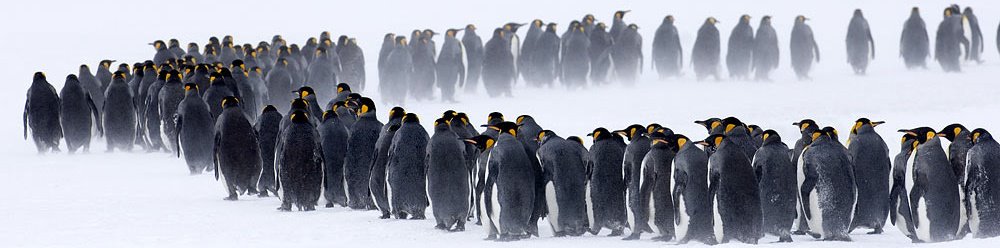
 King penguins.