Friday, November 4, 2011

The Realm of the Red Penguin: Peru's Dead Sea of Fossils


A researcher for Peru's Natural History Museum rests next to the fossilized skeleton of an ancient seal in the Ocucaje Desert in Ica, Peru. 

Moises Saman / The New York Times / Redux


Roberto Penny Cabrera is a former officer in the Peruvian Navy and still loves the sea, but the ocean that now captures his attention is not wet. In fact, it has been one of the driest places on earth for millions of years.

Penny, 55, is a self-trained authority on a strip of Peru's coastal desert in Ica, 180 miles south of the capital, Lima. The desert was once a shallow sea with abundant marine life, but that ended when the Andes Mountains surged upward. The resulting cataclysm created what is the world's largest cemetery of marine fossils, many poking out of the white sand. 

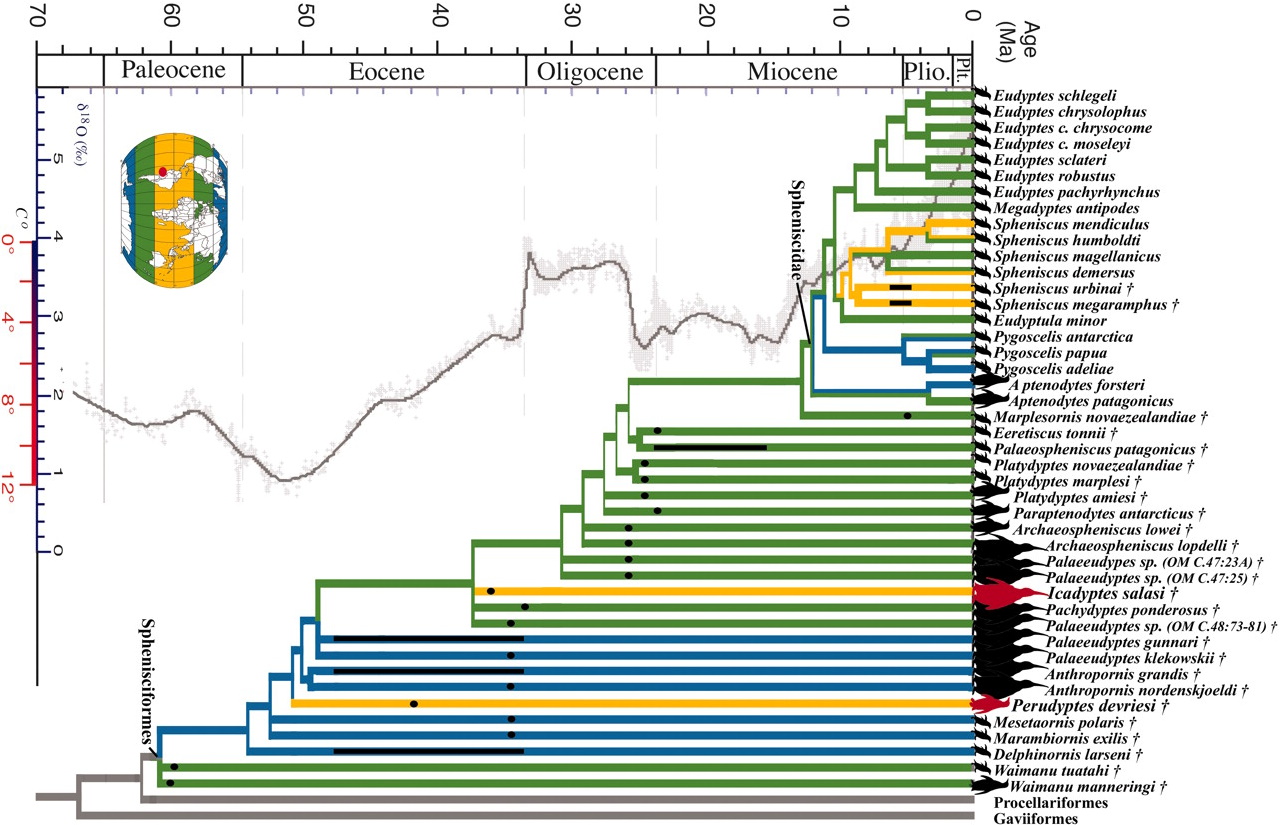
What sets this stretch of Ica desert apart from similar areas is the preservation of more than bone. The discovery last year of a 5-ft.-tall penguin included the first evidence of preserved scales and feathers, letting experts know that the big bird was red instead of black and white like today's smaller version. It died about 36 million years ago. Also recently discovered in this windswept, rolling desert was the skull of a giant whale, dubbed Leviathan melvillei in honor of Moby Dick's creator. The whale stretched nearly 60 ft. and is believed to have fed on other whales. Its jaw is similar to that of modern-day sharks, with rows of top and bottom teeth.

Penny, who calls himself a "finder," said, "It is amazing to see what the ocean was like millions of years ago. I am not a paleontologist, but you don't have to have a degree to know that what we have here can tell us how the ocean worked." He may not have a title, but Penny has the desert in his blood. One of his distant relatives founded the city of Ica in the mid-16th century, and the family has been there since. He first wandered into the desert as a boy, when his parents would take him to a nearby oasis, Huacachina. "We would go to Huacachina, but I was interested in the surrounding desert. It is where I feel free," he said. Those early family excursions turned into a lifelong obsession with Peru's dead sea

Penny's quest today is to protect the desert, not only safeguarding marine fossils but also burial grounds of Nazca and Paracas cultures, which date back more than 2,000 years, and the area's stunning landscape of ancient seabeds and towering, windblown dunes.

It is an uphill battle.

The rolling dunes around Ocucaje, a small town that serves as a gateway to the desert and lends the arid strip its name, are strewn with skeletons tossed aside by looters digging through burial grounds in search of pottery and world-renowned Paracas textiles. Fossil hunters have chipped away at whale skeletons and decimated shell beds looking for the prized teeth of the megalodon (literally "giant tooth"), giant sharks that once prowled here. "The principal problem in Ocucaje right now is the illegal collection of fossils for scientific or commercial purposes," said José Apolín, a specialist at Peru's Culture Ministry, which just celebrated its first anniversary.

But there is also a problem with control. Apolín, who is technically a biologist, is the only paleontological specialist in the ministry, and he is in the unit in charge of preventing theft and controlling items that are seized. In 2010, his first year on the job, police at the international airport in Lima seized 1,962 cultural items protected by law. Fossils accounted for 1,712 of the items seized.

Even if there were many more employees like Apolín, the law protecting cultural heritage is vague when it comes to fossils. "Fossils are in a kind of legal limbo in Peru. There are gaps in the law because there are people who do not want to include fossils as cultural heritage, because they have not been made by human hand," said Blanca Alva, director of the prevention office.
 
The ministry has an archaeological division, but there is no paleontology division. Paleontology falls to a unit of the Energy and Mines Ministry. Still, the Culture Ministry is getting ready in the next few weeks to declare Peru's first protected paleontological site. The area, known as the Inga Bridge, is a small site located just outside Lima. Apolín said it will be the first of its kind among 13,000 protected sites nationwide.

While Penny bristles with anger at fossil hunters digging through the desert to pull out what they can sell, he gets even more worked up about authorities, who he says have done nothing to stop it. He says their inaction makes them complicit. Penny gets madder still when he is lumped in with the fossil traffickers — Apolín points to video of Penny handling fossils — because of a small, bizarre collection, including shark teeth, in a single room he calls home in the old family mansion that has seen much better days. Under Peruvian law, the country's treasures, whether fossils or golden objects looted from tombs, can be held in personal collections. It is only illegal to remove them from the country.

"I have never sold a fossil, and what I have, I have found on the desert floor," he said. "There are amazing things out there, but if I tell anyone, they will be lost." Driving a specially equipped truck that lets him roam the desert, Penny is careful to cover his tracks. He continuously doubles back and drives in circles at times to throw others off his trail, fearful that fossil scavengers will follow him to his sacred spots.

Regional tourism authorities would like to promote the desert but worry that a flood of people could mean rampant destruction. "There is an entire desert with a massive amount of fossils. The desert is an attraction that we cannot promote, because large fossils are being taken away and no one is doing anything to stop it," said Elard Roca of the government's local tourism bureau.


Penny's solution is to declare the desert a protected area, but conservationists say the move would be impractical. Pedro Solano, who runs the conservation program for the Peruvian Environmental Law Society, one of the country's leading environmental groups, said that while there are important fossilized remains in the desert, "it would be wrong to say the entire area holds fossils and should be set aside. These kinds of generalization usually cause problems," he said.

Trying to guard the area is also nearly impossible because of its size. The area that contains fossil remains is about 180 miles long and 40 miles wide. The giant penguin was found in the northern reaches, while the whale skeletons are found from Ocucaje south. The Ocucaje stretch is about one-quarter of the total area. Solano said the goal for the desert "should not be to keep people out but manage the spaces for education and research to demonstrate its value as a resource." The Culture Ministry's Apolín said the best way to protect the area is "guaranteeing that fossils are not taken from the country. If we can improve control of fossils trafficking at the airport and ports, we would protect the site."

source

Sunday, October 30, 2011

Archaeopteryx was first bird after all

October 26, 2011 Archaeopteryx was first bird after allEnlarge
Archaeopteryx fossil (Creative Commons - Wikipedia)
(PhysOrg.com) -- The crown of the famous 150-million-year-old Archaeopteryx fossil as the first bird has been restored by a new evolutionary tree.
 
In a study published today in the journal Biology Letters, Australian researchers say the feathered fossil is indeed of the first known bird, despite another study earlier this year suggesting otherwise.

had been considered for 150 years to be the first known bird since the first complete specimen was found in Germany in 1861, revealing a combination of reptilian and and bird features.  But Chinese researchers asserted recently that a new and closely related fossil, Xiaotingia zhengi, was a bird-like dinosaur - therefore suggesting that Archaeopteryx was also a dinosaur.

However, the new study, led by Dr Michael Lee, of the South Australian Museum, used a more detailed analyis to show that Archaeopteryx was a bird.

"Archaeopteryx is iconic in palaeontology as the basal bird, however the plethora of discoveries of feathered dinosaurs in China, in particular, has progressively eroded the distinction of just what defines a bird," says one of the authors, Dr Trevor Worthy, a palaeontologist in the UNSW School of Biological, Earth and Environmental Sciences.

"This trend came to a head when Xaiotingia was analysed most recently and in the analysis presented Archaeopteryx was found to jump ship as it were from the birds to the dromaeosaurs.

"This sensational result was presented and attracted much publicity, but the very weak statistical support for this new relationship was not given due consideration.

"In our work, Mike Lee has shown quite clearly that methodology is highly significant and that before a paradigm is overturned data needs to be rigorously examined.

"Using a different analytical methodology than that usually used by morphologists, but one always used by analysts of molecular data, we found that Archaeopteryx remains the basal bird and does so with strong statistical support.

"This case demonstrates that multiple analysis methods should be used, each with concordant results before a paradigm breaking result is accepted. And it shows that Archaeopteryx remains the key to understanding the origin of birds."

More information: http://rsbl.royals … tent/current
Provided by University of New South Wales

source

Monday, October 17, 2011

Which NZ coastal species really are native?


Prof Jon Waters takes a close look at a stuffed yellow-eyed penguin at the Otago Museum. Photo: Peter McIntosh
It has been third time lucky for University of Otago zoologist Prof Jonathan Waters as he starts investigating whether some of our native coastal species, including the yellow-eyed penguin, really are native. Prof Waters said it was "great" that an $878,000 grant which he had recently received from the Marsden Fund would enable him to investigate how animals responded to human impacts, and how many of New Zealand's coastal species were actually new arrivals from overseas.
Yellow-eyed penguins, for instance, apparently arrived in New Zealand only in the past 500 years, replacing a prehistoric penguin species, the waitaha, that was wiped out shortly after human settlement, he said.
One of his former Otago PhD students, Dr Sanne Boessenkool, undertook earlier research several years ago and discovered remains of the extinct waitaha penguin.
It is suggested that some yellow-eyed penguins made their way north from their native Auckland Islands and Campbell Island and later established themselves on the Otago Peninsula and elsewhere on the Otago coast after the waitaha penguin became extinct.
Many people would be surprised the yellow-eyed penguin may not have been living in Otago as long as previously believed, he said.
"We tend to think that things that are here now are things that have been here for a long time," Prof Waters said.
The kind of extinction-recolonisation events apparently involved with such penguins may be the rule rather than the exception in coastal New Zealand, including with sea-lions and little blue penguins, he said.
It was "great" to be able to pursue the research, after two earlier recent attempts to gain Marsden funding for the project had been unsuccessful.
The little blue penguins which had now established themselves on the Otago coast, after earlier being largely wiped out by humans, were in fact penguins from Australia.
They were different from endemic little blue penguins found elsewhere on the New Zealand mainland.
New Zealand sea lions found on the Otago coast were also not the same creatures that once previously existed there, but were apparently a replacement population from the subantarctic islands, researchers said.
Collaborators in the project are Prof Lisa Matisoo-Smith, of the Otago anatomy department, and Dr Paul Scofield, of the Canterbury Museum.
The researchers will use carbon dating and state-of-the-art DNA analysis of prehistoric bones to shed further light on the country's "dramatic biological history", and to conduct a biological audit of prehistoric New Zealand.
Archaeologists would be teaming up with geneticists, in order to "reveal exciting aspects of New Zealand's past - stories that were previously impossible to tell," he said.

Source

Wednesday, September 28, 2011

Pigeon 'Milk' Contains Antioxidants and Immune-Enhancing Proteins


Pigeon and chick. (Credit: Dr. Tamsyn Crow


ScienceDaily (Sep. 28, 2011) — Production of crop milk, a secretion from the crops of parent birds, is rare among birds and, apart from pigeons, is only found in flamingos and male emperor penguins. Essential for the growth and development of the young pigeon squab, pigeon 'milk' is produced by both parents from fluid-filled cells lining the crop that are rich in fat and protein.

Research published in BioMed Central's open access journal BMC Genomics uses new technology to study the genes and proteins involved in pigeon 'milk' production and shows that pigeon 'milk' contains antioxidants and immune-enhancing proteins.

Researchers from CSIRO Livestock Industries and Deakin University, Australia, compared the global gene expression profiles of the crops of four 'lactating' and four 'non-lactating' female pigeons. As the pigeon genome has not yet been sequenced, they used a chicken microarray to find the genes involved. Genes predominantly over-expressed in 'lactating' birds were those involved in stimulating cell growth, producing antioxidants and in immune response. They also found genes associated with triglyceride fat production, suggesting the fat in the 'milk' is derived from the pigeon's liver.

Lead author, Meagan Gillespie, says, "It is possible that if antioxidant and immune proteins are present in pigeon 'milk', they are directly enhancing the immune system of the developing squab as well as protecting the parental crop tissue." She continues, "This study has provided a snap-shot view of some of the processes occurring when 'lactation' in the pigeon crop is well established. Due to the unusual nature of 'lactation' in the pigeon it would be interesting to investigate the early stages of the differentiation and development of the crop in preparation for 'milk' production to further ascertain gene expression patterns that characterize crop development and 'lactation' in the pigeon."

She concludes, "This mechanism is an interesting example of the evolution of a system with analogies to mammalian lactation, as pigeon 'milk' fulfills a similar function to mammalian milk."


Story Source:
The above story is reprinted (with editorial adaptations by ScienceDaily staff) from materials provided by BioMed Central, via EurekAlert!, a service of AAAS.

Journal Reference:
  1. Meagan J. Gillespie, Volker R. Haring, Kenneth A. McColl, Paul Monaghan, John A. Donald, Kevin R. Nicholas, Robert J. Moore, Tamsyn M. Crowley. Histological and global gene expression analysis of the 'lactating' pigeon crop. BMC Genomics, 2011; 12: 452 DOI: 10.1186/1471-2164-12-452

BioMed Central (2011, September 28). Pigeon 'milk' contains antioxidants and immune-enhancing proteins. ScienceDaily. Retrieved September 28, 2011, from http://www.sciencedaily.com­ /releases/2011/09/110919074253.htm

Tuesday, September 27, 2011

Feathered Friends Are Far from Bird-Brained When Building Nests


ScienceDaily (Sep. 26, 2011) — Nest-building is not just instinctive but is a skill that birds learn from experience, research suggests.

Scientists filmed male Southern Masked Weaver birds in Botswana as they built multiple nests out of grass during a breeding season. Their findings contrast with the commonly-held assumption among scientists that nest-building is an innate ability.

The researchers found that individual birds varied their technique from one nest to the next. They also saw that some birds build their nests from left to right, and others from right to left.

Also, as the birds gained more experience in building nests, they dropped blades of grass less often, implying that the art of nest building requires learning.

Researchers from the Universities of Edinburgh, St Andrews and Glasgow together with scientists from Botswana say their findings may help to explain how birds approach nest-building and whether they have the mental capacity to learn, or whether their skills are developed through repetition.

Researchers chose the colourful African bird because they build complex nests, which is potentially a sign of intelligence. More importantly, Weaver birds build many nests -- often dozens in a season, allowing the team to monitor differences in nests built by the same bird.

Dr Patrick Walsh of the University of Edinburgh's School of Biological Sciences, who took part in the study, said: "If birds built their nests according to a genetic template, you would expect all birds to build their nests the same way each time. However this was not the case. Southern Masked Weaver birds displayed strong variations in their approach, revealing a clear role for experience. Even for birds, practice makes perfect."

The research was published in the journal Behavioural Processes and was funded by the Leverhume Trust.


Story Source:
The above story is reprinted (with editorial adaptations by ScienceDaily staff) from materials provided by University of Edinburgh, via EurekAlert!, a service of AAAS.

Journal Reference:
  1. Patrick T. Walsh, Mike Hansell, Wendy D. Borello, Susan D. Healy. Individuality in nest building: Do Southern Masked weaver (Ploceus velatus) males vary in their nest-building behaviour? Behavioural Processes, 2011; 88 (1): 1 DOI: 10.1016/j.beproc.2011.06.011

University of Edinburgh (2011, September 26). Feathered friends are far from bird-brained when building nests. ScienceDaily. Retrieved September 27, 2011, from http://www.sciencedaily.com­ /releases/2011/09/110925192704.htm

Thursday, September 22, 2011

Smells may help birds identify their relatives


Researchers at U Chicago and the Chicago Zoological Society found in an experiment at Brookfield Zoo that penguins can recognize the smell of familiar locations, something that may guide them back to their mates. The ability is useful as penguins live in large colonies but remain monogamous. 
Photos by Jim Schulz/Chicago Zoological Society

Smells may help birds identify their relatives

William Harms
Birds may have a more highly developed sense of smell than researchers previously thought, contend scholars who have found that penguins may use smell to determine if they are related to a potential mate.

The research by the University of Chicago and the Chicago Zoological Society, which manages Brookfield Zoo, shows how related birds are able to recognize each other. The study, published Wednesday, Sept. 21 in the article, “Odor-based Recognition of Familiar and Related Conspecifics: A First Test Conducted on Captive Humboldt Penguins (Spheniscus humboldti)” in the journal PLoS ONE, could help conservationists design programs to help preserve endangered species. 

“Smell is likely the primary mechanism for kin recognition to avoid inbreeding within the colony,” said Heather Coffin, lead author of the paper.

Coffin conducted the research while a graduate student at UChicago and was joined in writing the paper by Jill Mateo, associate professor in Comparative Human Development at UChicago, and Jason Watters, director of animal behavior research for the Chicago Zoological Society.

“This is the first study to provide evidence for odor-based kin discrimination in birds,” said Mateo, who is a specialist on kin recognition.

Experts said the work offers important insights into how birds use smell to guide behavior.
“The work by the research group is truly groundbreaking in that it shows for the first time ever in birds how the olfactory sense of captive penguins is both informative and functional in a behaviorally critical context: namely the recognition of friends from foes in general, and relatives from non-relatives in particular,” said Mark E. Hauber, professor of psychology at Hunter College, a specialist on bird social recognition.

Penguins are ideal subjects because they typically live in colonies made up of thousands of birds. They live in monogamous pairs — an arrangement that facilitates rearing of their young, since parents frequently take turns leaving the nest to gather food. Despite the size of the community, mates are able to find each other after traveling for days foraging for food in the ocean.

Research on other sea birds has shown that smell helps guide birds to their home territory and helps them forage for food. Other research has shown that birds could use sound and sight to recognize each other, but no other studies have shown that smell might be used in connection with kin recognition, Mateo said.
In the study conducted at Brookfield Zoo, researchers first sought to determine if the penguins were able to recognize familiar individuals by smell. They constructed an experiment using a dozen penguins, from a group that included breeding pairs, their offspring and nonbreeding individuals. The birds — all Humboldt penguins—endangered natives of Peru—were from groups either on exhibit or off exhibit.

The zoo is an ideal setting for the research, as it has extensive records on which penguins are related and have been housed together, Watters said.

Researchers took odor samples from glands near the penguins’ tails, where an oil that the birds use for preening is secreted. They put the oil on cotton swabs and rubbed the odor inside dog kennels, similar to the enclosures penguins at a zoo use for their nests. They also put the odor on paper coffee filters and placed them under mats inside the kennels.

When the penguins were released to the area containing the kennels, the researchers found that penguins spent more time in the kennels with familiar odors. The penguins were able to distinguish between the odors of birds they spent time with and the odors of unfamiliar penguins.

“What I found particularly notable about the study was that the authors identified the oil secreted from the penguins’ preen gland, which is rubbed on the feathers to make them water repellent, as the odor source used in recognition,” said Bryan D. Neff, professor and associate chairof biology, University of Western Ontario and an expert on kin recognition. “Oils are used in kin recognition by species of other animals, most notably a variety of insect species, including bees and wasps, which when considered with the penguin data provide a wonderful example of convergent evolution.”

“It’s important for birds that live in large groups in the wild, like penguins, to know who their neighbors are so that they can find their nesting areas and also, through experience, know how to get along with the birds nearby,” Watters said.

Because offspring usually return to the same colony for nesting, siblings have the potential of becoming mates, something that can be avoided by their smell mechanism, the new research shows.

Researchers also found that when the birds were exposed to the odors of unfamiliar kin and unfamiliar non-kin, they spent more time in the kennels with odors of unfamiliar non-kin, indicating they were probably able to determine by smell which animals they were related to and were more curious about the novel odors. Being able to make the distinction may help the penguins avoid mating with kin, researchers said.  The discovery also could assist zoos in managing their breeding programs.

“It could also be true that birds do a better job determining who potential mates are than do people in zoos, who spend a great deal of time lining up the appropriate matches,” Watters said.

The ability of birds to be able to recognize familiar scents and thus be guided to their home territory also has potential value to naturalists, he said. “You could imagine that if you were trying to reintroduce birds to an area, you could first treat the area with an odor the birds were familiar with. That would make them more likely to stay.

 source

Wednesday, September 21, 2011

Primitive Birds Shared Dinosaurs' Fate

 
 The bones are from the 17 species of Cretaceous birds which went extinct around the time of the dinosaurs. The two on the far left are foot bones and the rest are shoulder bones. (Credit: Courtesy Yale University)

ScienceDaily (Sep. 21, 2011) — A new study puts an end to the longstanding debate about how archaic birds went extinct, suggesting they were virtually wiped out by the same meteorite impact that put an end to dinosaurs 65 million years ago.

For decades, scientists have debated whether birds from the Cretaceous period -- which are very different from today's modern bird species -- died out slowly or were killed suddenly by the Chicxulub meteorite. The uncertainty was due in part to the fact that very few fossil birds from the end of this era have been discovered.

Now a team of paleontologists led by Yale researcher Nicholas Longrich has provided clear evidence that many primitive bird species survived right up until the time of the meteorite impact. They identified and dated a large collection of bird fossils representing a range of different species, many of which were alive within 300,000 years of the impact.

"This proves that these species went extinct very abruptly, in terms of geological time scales," said Longrich. The study appears the week of Sept. 19 in the journal Proceedings of the National Academy of Sciences.
The team examined a large collection of about two dozen bird fossils discovered in North America -- representing a wide range of the species that existed during the Cretaceous -- from the collections of Yale's Peabody Museum of Natural History, the American Museum of Natural History, the University of California Museum of Paleontology, and the Royal Saskatchewan Museum. Fossil birds from the Cretaceous are extremely rare, Longrich said, because bird bones are so light and fragile that they are easily damaged or swept away in streams.

"The birds that had been discovered hadn't really been studied in a rigorous way," Longrich said. "We took a much more detailed look at the relationships between these bones and these birds than anyone had done before."

Longrich believes a small fraction of the Cretaceous bird species survived the impact, giving rise to today's birds. The birds he examined showed much more diversity than had yet been seen in birds from the late Cretaceous, ranging in size from that of a starling up to a small goose. Some had long beaks full of teeth.
Yet modern birds are very different from those that existed during the late Cretaceous, Longrich said. For instance, today's birds have developed a much wider range of specialized features and behaviors, from penguins to hummingbirds to flamingoes, while the primitive birds would have occupied a narrower range of ecological niches.

"The basic bird design was in place, but all of the specialized features developed after the mass extinction, when birds sort of re-evolved with all the diversity they display today," Longrich said. "It's similar to what happened with mammals after the age of the dinosaurs."

Longrich adds that this study is not the first to suggest that archaic birds went extinct abruptly. "There's been growing evidence that these birds were wiped out at the same time as the dinosaurs," Longrich said. "But this new evidence effectively closes the book on the debate."

Other authors of the paper include Tim Tokaryk (Royal Saskatchewan Museum) and Daniel Field (Yale University).


Story Source:
The above story is reprinted (with editorial adaptations by ScienceDaily staff) from materials provided by Yale University.

Journal Reference:
  1. N. R. Longrich, T. Tokaryk, D. J. Field. Mass extinction of birds at the Cretaceous-Paleogene (K-Pg) boundary. Proceedings of the National Academy of Sciences, 2011; 108 (37): 15253 DOI: 10.1073/pnas.1110395108

Yale University (2011, September 21). Primitive birds shared dinosaurs' fate. ScienceDaily. Retrieved September 21, 2011, from http://www.sciencedaily.com­ /releases/2011/09/110919151315.htm

Friday, September 16, 2011

Trapping time in amber


A feather from the late Cretaceous is trapped in amber. 
 
(Edmonton) Secrets from the age of the dinosaurs are usually revealed by fossilized bones, but a University of Alberta research team has turned up a treasure trove of late Cretaceous feathers, which have been discovered trapped in tree resin.
The resin turned to resilient amber preserving some 80-million-year-old protofeathers, possibly from non-avian dinosaurs, as well as plumage that is very similar to modern birds, including those that can swim under water.

U of A paleontology graduate student Ryan McKellar discovered a wide range of feathers trapped in amber in collections at the Royal Tyrrell Museum and in the private collection of the Leuck family in Medicine Hat.
“Most of the feather specimens were probably blown into contact with the sticky surface of the resin and encapsulated by subsequent resin flows,” said McKellar.
The 11 feather specimens used by the U of A team were all found near the community of Grassy Lake in southern Alberta. The research specimens are described as the richest amber feather find from the late Cretaceous period.

“The amber preserves microscopic detail of the feathers and even their pigment or colour,” said McKellar. “I would describe the colours as typically ranging from brown to black.”
During the late Cretaceous, southern Alberta was a warm coastal region. “The trees that produced the resin were probably comparable to the redwood forests of the Pacific Northwest,” said McKellar.
No dinosaur or avian fossils were found in direct association with the amber feather specimens, but McKellar says comparison between the amber and fossilized feathers found in rock strongly suggest that some of the Grassy Lake specimens are from dinosaurs. The non-avian dinosaur evidence points to small theropods as the source of the feathers.

McKellar says that some of the feather specimens can take on water, enabling the bird to dive more effectively and are very similar to those of modern birds like the Grebe, which are able to swim underwater.
“The preservation of microscopic detail and pigmentation has provided a unique snapshot of feathers and their uses in the late Cretaceous forests of Alberta,” said McKellar.

The U of A team’s research was published Sept. 15, in the journal Science.

source

Tuesday, September 13, 2011

How penguins find a perfect partner

King penguin parents spend about 14 months incubating their egg, then rearing their chick. They take it in turns to find food, so the strength of their bond is crucial. Biologists want to know how they make this important mate selection, and even how the birds tell a male from a female; the two sexes look almost identical.

 
Prof Stephen Dobson from the National Centre for Scientific Research in Montpellier, France, playfully sums up his research: "I'm trying to work out what makes a sexy penguin." His studies of the birds on Kerguelen Island have revealed that penguins often struggle to spot a member of the opposite sex.


Prof Dobson also found that males on the island in the Southern Indian Ocean often had to compete particularly hard to snag a female mate. He and his team noticed that, during mating season, trios of penguins would "parade" around together. DNA analysis showed that the trios were usually two males pursuing a female.
 
 
When the penguins do find a mate that they take a shine to they carry out an intimate dance – stretching their necks from side to side in what appears to be an elaborate embrace. Occasionally, two males will engage in this mating dance, but the pair usually separate when one finds a female partner.


Prof Dobson’s team, which also includes researchers from the Centre for Functional and Evolutionary Ecology in Montpellier, France, has found that the penguins' bright yellow ear patches play an important role in attraction.


The researchers measured the size and colour intensity of these ear patches to find out how they affect penguin attractiveness. They also used black hair dye to artificially reduce the size of the ear patches.
 

Males with artificially-reduced ear patches seemed to have less success finding a female. Females also appeared to choose males with larger ear patches, and the researchers think that larger ear patches might convey a male's ability to defend his chick and his territory in the crowded colony.
 

The scientists hope to unpick the evolutionary mystery of how these birds select a suitable partner who will co-operate in the care of their egg and chick. They also hope to find out more about the penguins' natural behavior to see how they are being affected by environmental change.

 source


Wednesday, September 7, 2011

Macaroni Penguin (Eudyptes chrysolophus): correctly listed as Vulnerable?


BirdLife species factsheet for Macaroni Penguin
Macaroni Penguin Eudyptes chrysolophus breeds in at least 216 colonies at 50 sites in the higher latitudes of the southern hemisphere (Woehler 1993, Woehler and Croxall 1999). The total population is estimated by BirdLife to be c.9 million pairs, although it is argued that this is likely to be an underestimate because of potential underestimates in the South Georgia Island region (USFWS 2008). The species is listed as Vulnerable under criteria A2b,c; A3b,c; A4b,c, on the basis that the global population appears to have declined rapidly, by 30-49% over the preceding three generations, estimated to be c.34 years, and it is projected to decline by 30-49% over the next three generations. As noted in the assessment, however, the current classification is heavily reliant on the extrapolation of small-scale data, thus large-scale surveys are needed to confirm this categorisation.

The current trend estimate is based on recorded local declines. Populations on South Georgia and Bouvet Islands probably increased substantially in the 1960s and 1970s, but have subsequently decreased. Study populations on South Georgia declined by 65% from 1986 to 1998 (J. P. Croxall unpublished data), and the overall South Georgia population probably halved between c.1978 and 1998 (Trathan et al. 1998). Study populations on Marion Island decreased by 50% between 1979 and 1998. In contrast, populations on Kerguelen increased by c.1% per year between 1962 and 1985, and subsequent data from 1998 indicated that the colonies were stable or increasing (H. Weimerskirch per T. Micol in litt. 1999). Populations in South America may be stable, but data are scant.

The validity of the current assessment for this species has been brought into question by a review by the US Fish and Wildlife Services (USFWS 2008). Criticism was levelled at the use of trends at small study colonies to estimate the overall trend for the Prince Edward Islands. Likewise, the conclusion that overall numbers on South Georgia declined by 50% in the last two decades of the 20th century was criticised because it has not been empirically verified in the literature. Although the species is thought to have undergone a recent decline on Bouvet Island, there are apparently no current estimates for the population there. Significant recorded declines in colonies on Marion Island have also been questioned due to changes in survey methodology, and an overall decline of 18% in the island’s estimated total population between 1994-1995 and 2002-2003 is not considered significant by the USFWS (2008) in the context of small fluctuations in the three subsequent three breeding seasons. It has also been asserted that the decline noted on Prince Edward Island between 1976-1977 and 2001-2002, in which the estimated population fell from c.17,000 pairs to c.9,000 pairs (Crawford et al. 2003) was overestimated, and that the overall decline on Marion and Prince Edward Islands combined (c.3.4% of the species’s global population) was 32% between 1979 and 2003 (USFWS 2008).

These criticisms, combined with suggestions that some populations are stable or increasing, or have unknown trends, suggest that the overall estimated rate of decline should be reduced for this species. Comments on the current listing and further information on the species are requested.

References:

Crawford, R. J. M., Cooper, J., Dyer, B. M., Greyling, M., Klages, N. T. W., Ryan, P. G., Petersen, S., Underhill, L. G., Upfold, L., Wilkinson, W., de Villiers, M., du Plessis, S., du Toit, M., Leshoro, T. M. et al. (2003) Populations of surface nesting seabirds at Marion Island, 1994/95-2002/03. Afr. J. Mar. Sci. 25: 427-440.
Trathan, P. N., Croxall, J. P., Murphy, E. J. and Everson, I. (1998) Use of at-sea distribution data to derive potential foraging ranges of macaroni penguins during the breeding season. Mar. Ecol. Prog. Ser. 169: 263-275.
USFWS (2008) Endangered and Threatened Wildlife and Plants; 12-Month Finding on a Petition To List Four Penguin Species as Threatened or Endangered Under the Endangered Species Act and Proposed Rule To List the Southern Rockhopper Penguin in the Campbell Plateau Portion of Its Range. Federal Register, Vol. 73: No. 244.
Woehler, E. J. (1993) The distribution and abundance of Antarctic and Subantarctic penguins. Cambridge, U.K.: Scientific Commission on Antarctic Research.
Woehler, E. J. and Croxall, J. P. (1999) The status and trends of Antarctic and subantarctic seabirds. Mar. Ornithol. 25: 43-66.

source

Monday, September 5, 2011

ANTARCTICA: Long dives for Emperors


04 September 2011
Issue: 187


Emperor penguins fishing at sea and at an experimental dive hole often spend minimal times on the surface even after dives that last far beyond their measured 5.6 minute aerobic dive limit.

Researchers from the US Scripps Institution of Oceanography and the International Coastal Research Center, Atmosphere and Ocean Research Institute at the University of Tokyo went to the Antarctic and attached accelerometer-based data loggers to Emperor penguins diving in the two different situations to evaluate the capacity of the birds to perform such dives without any apparent prolonged recovery periods.

In a report of the study published in the Journal of Experimental Biology, the researchers say the penguins regularly remain submerged for up to 12 minutes by carefully managing their oxygen reserves.

Lead researcher Paul Ponganis from the Scripps Institution says penguins diving from isolated ice holes fuel the dive aerobically for the first 5.6 minutes and supplement the remainder of the dive with anaerobic metabolism.

But when the researchers compared the aerobic dive limit for ice hole diving penguins with estimates of the aerobic dive limit for freely foraging animals, it appeared the free-ranging birds were able to sustain the aerobic portion of a dive for up to eight minutes. From the data loggers, they could see a surge every time the animal strokes with its wings and they could then count the number of peaks per dive to get the stroke rate pattern.

"We expected that stroke rate would be lower in dives at sea and because of that there would be less muscle work and less oxygen consumption and that would explain how these birds dive as long and as frequently as they do," Ponganis says. But the freely diving birds were stroking faster and were not extending their aerobic dive limit by beating their wings more slowly to conserve oxygen.

When the researchers compared the length of time spent by birds at the surface recovering from dives, the free divers spent no more time at the surface than the ice-hole divers.

Assuming the penguins did not exhale while submerged, they found the penguins carried more air as they extended their dives down to 300 metres, apparently anticipating how deep they would dive and adjusted the amount of air they carried down accordingly.

Yet penguins that dived 400 to 500 metres appeared to be carrying less air than the birds that only dived to 300 metres, leading Ponganis to conclude that they probably exhaled prior to the final segment of the dive.

On one occasion, the researchers recorded a dive where an emperor penguin remained submerged for a record-breaking 27.6 minutes although after it emerged from the water, the bird lay on the ice for six minutes before it stood, took another 20 minutes before it started walking and then waited a further eight hours before going back into the water.

Ponganis says the penguin was exhausted and believes the dive was extended when the pack ice shifted above the penguin's head, blocking its escape route. That it survived is a measure of the bird's remarkable capacity to conserve oxygen under water.
 

Wednesday, August 10, 2011

Enormous bird lived alongside dinosaurs

Image: Two possible body shapes for the gigantic Samrukia nessovi
John Conway
Two possible body shapes for the gigantic Samrukia nessovi, with a human and 'normal-sized' Mesozoic bird for scale.
 
By
 8/9/2011 

An enormous prehistoric bird, which might have resembled a very big ostrich, lived alongside dinosaurs around 83 million years ago, according to new research. 

The bird, called Samrukia nessovi after the mythical Kazakh Phoenix, lived in what is now Kazakhstan. It is described in the latest Royal Society Biology Letters.

The discovery confirms "that big birds were living alongside Cretaceous non-avian dinosaurs," lead author Darren Naish said. "In fact, these big birds fit into the idea that the Cretaceous wasn't 'a non-avian dinosaurs-only theme park.' Sure, non-avian dinosaurs were important and big in ecological terms, but there was at least some space for other land animals."

Naish is an honorary research associate in the School of Earth & Environmental Sciences at the University of Portsmouth. He and his team made the discovery after analyzing the fossil for Samrukia, which previously had been modified by someone to resemble an oviraptorosaur (a type of feathered dinosaur).


All that's left of this big bird is its toothless lower jaw. The structure and characteristics of the jaw are associated with birds and not non-avian dinosaurs, the researchers believe.

They conclude that the skull of the bird during its lifetime would have been about a foot long. If flightless, it could have stood close to 10 feet tall. If it flew, its wingspan is likely to have exceeded 13 feet.
The big bird is now the second known large avian from the dinosaur era. The first to be identified was Gargantuavis philoinos, which lived in southern France around 70 million years ago. It too may have been flightless and ostrich-like.

"So we can now be really confident that Mesozoic terrestrial birds weren't all thrush-sized or crow-sized animals," Naish said. "Giant size definitely evolved in these animals, and giant forms were living in at least two distinct regions. This fits into a larger, emerging picture: Mesozoic birds were ecologically diverse, with lots of overlap between them and modern groups."

During its day, Samrukia existed in an ecosystem that included armored dinosaurs, duckbilled dinosaurs, and tyrannosaurs — along with other predatory dinos. Smaller birds are also known from this site, called the Bostobynskaya Formation. Sharks, turtles and salamanders from the bird's time period have also been found in the region.

At present, the site is dry and hot. It's dominated by semi-desert or scrub. Back in the dinosaur era, it was more of a floodplain environment, with a flat plain crisscrossed by big, meandering rivers. Fossil wood suggests forests were nearby.

It remains unclear what the big bird hunted, but the researchers could not find any evidence for obvious specialization, such as dedication to plant consumption or aquatic prey. They therefore suspect it was a generalist, per many modern birds today.

The bird probably also spent a lot of time running or flying away from the numerous meat-eating dinosaurs from the area.


Such distinctions were obviously important to the animals at the time, but paleontologists now must tease apart birds from non-avian dinosaurs. In the case of this latest discovery, a fossil attributed to a dinosaur was determined to be a bird. Recently, however, the supposed "world's oldest known bird," Archaeopteryx, was found to be a non-avian dinosaur. Naish and his team agree with that assessment.

Lawrence Witmer, a professor of anatomy and paleontology at Ohio University, told Discovery News, "We scientists use the cumbersome and seemingly pedantic 'non-avian dinosaurs' (term), but back about 150 million years ago, all these groups were extremely similar. They all kind of looked like feathered dino-birds."
As Naish points out, though, the new findings about Samrukia demonstrate that  modern birds "weren't as distinct from extinct groups of Mesozoic birds as people used to think."

Admiring today's birds therefore provides a hint about what avian diversity looked like millions of years ago, when non-avian dinosaurs were still alive and may have been feasting on these early birds.

Source