Friday, February 13, 2009

Friday Videos-African Penguins!


Spheniscus demersus (The African Penguin)


Facts

Also known as: jackass penguin
Kingdom Animalia
Phylum Chordata
Class Aves
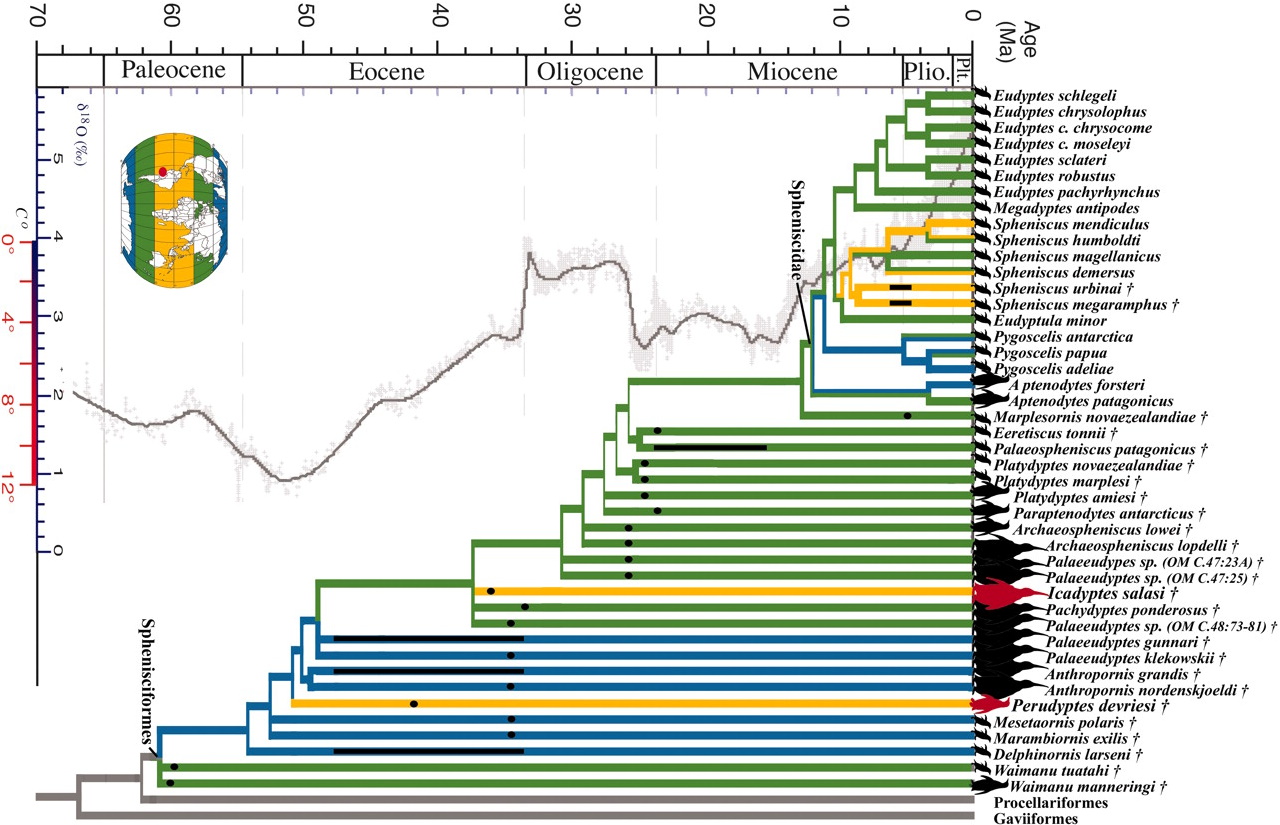
Order Sphenisciformes
Family Spheniscidae
Genus Spheniscus (1)
Size Length: 60 - 70 cm (2)

Status

Classified as Vulnerable (VU) on the IUCN Red List 2007 (1). Listed on Appendix II of CITES (3), and Appendix II of the Convention on Migratory Species (CMS or Bonn Convention) (4).

Description

The African penguin is a medium-sized penguin, and the only species breeding on the African continent (5). Penguins have a robust, heavyset body and this species are black on the back and white below, with variable black markings on the breast and belly (2). Juvenile plumage is slate blue on the upper surface and this gradually turns darker, developing the adult black-and-white facial pattern in the second or third year. Penguins have small muscles at the base of each feather that enable them to be held tightly against the body whilst in water, forming a waterproof layer; alternatively, on land they are held erect, trapping an insulating layer of air around the body (5). These penguins are also known as ‘jackass penguins' due to their loud, braying call (6).


Range


Found in southern Africa, these penguins are known to breed on 24 islands between Hollamsbird Island, Namibia and Bird Island in Algoa Bay, South Africa (2).
UNEP World Conservation Monitoring Centre View a distribution map for this species at UNEP World Conservation Monitoring Centre.
Habitat

African penguins are generally found within 40 kilometres of the coast, emerging onto rocky offshore islands to breed, rest and moult (2).

Biology

African penguins are colonial breeders with pairs returning to the same site year after year. Unusually, there is no fixed breeding season although nesting peaks in Namibia between November and December and in South Africa between March and May. Nests are situated in burrows or depressions under boulders and bushes where they will receive some protection from the potentially harsh temperatures (5). The clutch size is usually two and both parents take it in turns to incubate the eggs for a period of about 40 days; penguins have a bare patch of skin on the lower abdomen (known as the ‘brood patch'), which allows greater transfer of heat to the eggs. Following hatching, the adults will continue to guard the chicks until they are about 30 days old, regurgitating food straight from their stomach following foraging trips. Chicks are then left alone in crèches whilst their parents forage; at between 60 and 130 days old they develop juvenile plumage and leave the colony (5).

These penguins feed on fish such as anchovies (Engraulis capensis) and sardines (Sardinops sagax) (2). Adapted for their aquatic lifestyle, African penguins can reach speeds of 20 kilometres per hour in the water and range from 30 to 70 kilometres in a single trip; average dives last for 2.5 minutes, reaching depths of 60 metres. Penguins have waterproof coats that need to be constantly maintained by preening, when a waxy substance is distributed from the base of the tail. Even with these measures, their plumage is replaced yearly and African penguins come ashore to moult over 20 days between November and January in South Africa and between April and May in Namibia (5).

Threats

The population of African penguins has declined and it is estimated that its current size is a mere 10 percent of what it was at the turn of the 20th Century. Originally the fall in numbers was the result of the over-collection of eggs for food, and disturbance caused by the collection of guano for fertiliser. Today, however, depleted fish stocks due to over-fishing, and the risk of oil pollution are the most pertinent threats to the survival of this species (5); a recent oil spill affected around 40 percent of the population. Predation by Cape fur seals (Arctocephalus pusillus) and competition with them for food and breeding sites, as well as shark predation, has also had severe effects on population numbers (2).

Conservation

The African penguin is protected by its listing on Appendix II of the Convention on International Trade in Endangered Species (CITES) (3), and on Appendix II of the Convention on Migratory Species (CMS) (4). All of the breeding areas in South Africa are protected as National Parks or Nature Reserves and the collection of guano or eggs is no longer permitted. The recovery of rescued oiled birds has also been shown to be successful. Populations need further monitoring and the possibility of conserving fish stocks is under investigation, amongst other measures, if the future of Africa's only penguin is to be secured (2).

For further information on the African penguin see:

* BirdLife International:
www.birdlife.org
* International Penguin Conservation:
www.penguins.cl
* South African Foundation for the Conservation of Coastal Birds:
www.sanccob.co.za/index.htm

Authentication

Authenticated (01/06/05) by Samantha Petersen, Seabird Conservation Programme Manager, BirdLife South Africa.
http://www.birdlife.org.za/index.cfm

References

1. IUCN Red List (September, 2007)
http://www.iucnredlist.org
2. BirdLife International (April, 2003)
http://www.birdlife.org/datazone/species/index.html?action=SpcHTMDetails.asp&sid=3861&m=0
3. CITES (April, 2003)
http://www.cites.org
4. Global Register of Migratory Species (March, 2008)
http://www.groms.de
5. International Penguin Conservation (April, 2003)
http://www.penguins.cl
6. Animal Diversity Web (April, 2003)
http://animaldiversity.ummz.umich.edu/accounts/spheniscus/s._demersus$narrative.html
~~~~~~~~~~~~~~~~~~~~~~~~~~~~~~~~~~~~~~~~~~~~~~~~~~~~~~~~~~~~~~~~~~~~~~~~~
From the IFAW Web Site

Classification:

Scientific Name: Spheniscus demersus
Class: Aves
Order: Sphenisciformes
Family: Spheniscidae
Genus: Spheniscus
Species: demersus


Distribution Map

Physical Description

The African, or jackass, penguin is a medium-sized penguin which stands about 45 centimeters (18 inches) tall and has a total body length of about 60 centimeters (24 inches). Males weigh an average of 3.6 kilograms (8 pounds) and females an average of 3.1 kilograms (7 pounds). However, they look extremely similar in the wild and small males may be smaller than large females.

Like all penguins, African penguins have a short, thick neck, a streamlined body and a short, wedge-shaped tail with small flipper-like wings. They are black on the back and wings, with a black band across the chest, and black cheeks. The bill is black with a light band around it. They have a white belly with black spots or speckles, black webbed feet and black claws. This fast-swimming penguin gets its nickname of "jackass" from the donkey-like call of territorial males.

Natural History

African penguins are endemic to South Africa and Namibia. They are distributed from Transkei to northern Namibia and breed in densely packed groups (colonies or rookeries) from Bird Island, Algoa Bay, to Hollams Bird Island, Namibia.

African penguins return to the same nest site and, usually, to the same partner each year. Because they are ground nesters, they require predator-free breeding areas and are therefore limited by the availability of predator-free islands and mainland areas. They nest in burrows in the sand, under overhanging rocks and bushes, or in the open. They used to nest in guano (bird droppings), but most of the guano was removed for fertilizer in the 19th century, causing destruction of most of this breeding habitat.

The breeding season usually starts in January on the islands and each pair usually lays two eggs, three or four days apart. Eggs are incubated by both parents for 38 days each. One parent guards the nest while the other feeds on anchovy, pilchard, horse mackerel and round herring. Chicks are born with gray down and are fed regurgitated food. Usually only the first chick survives, as there is insufficient food for two. The surviving chick fledges between 80 and 130 days depending on foraging conditions and proficiency of parents in providing food.

African penguins molt each year at their breeding island. As the insulating qualities of their feathers break down, they are no longer able to keep warm, and their feathers must be replaced. For the 21-day molt, the penguins are land-bound, unable to swim or feed. To prepare for it, they feed extensively for about five weeks before the molt begins.

The population of African penguins has crashed from at least 1.2 million in 1930 to 100,000 in 1978. The species is continuing to decline.

Status

Local conservation measures include permit-access-only to breeding islands, control of feral cats, and the restriction of fur seals onto penguin breeding areas.

Cleaning and rehabilitation of oiled birds is carried out by the private South African National Foundation for the Conservation of Coastal Birds (SANCCOB).

The African jackass penguin is listed as Vulnerable by the International Union for the Conservation of Nature and Natural Resources (IUCN). The drastic decline in their numbers is expected to continue and may result in the extinction of this species in 70 years. The African penguin is also listed on Appendix II by the Convention on International Trade in Endangered Species of Wild Fauna and Flora (CITES).

Threats to the Species

Historically, harvesting of eggs for human consumption was a major threat. Although a limited amount of egg collecting continues, the commercial harvest of eggs stopped in 1967 and is illegal today. Today, oil pollution from tankers cleaning their bilges and from oil spills are major threats. African penguins are also threatened by destruction of breeding habitat, competition for breeding space with other animals (e.g. fur seals), disturbance of breeding animals on the mainland by humans, vulnerability to predators such as leopards and dogs, and reduced prey availability due to commercial fishing. Some penguins are still killed and used as bait in certain fisheries.

International Trade

No legal trade.

Sources

CITES. 2001. African penguin. http://www.cites.org.

Enchanted Learning.com. 2001. Jackass penguin. http://www.zoomschool.com.

IUCN. 2001. The 2000 IUCN Red List of Threatened Species—Spheniscus demersus. http://www.redlist.org.

Payne, A.I.L. and R.J.M. Crawford. 1989. Oceans of life off southern Africa. Claeberg Publishers, Cape Town. 380pp.

UWC Enviro Facts. 2001. Jackass penguin. http://www.botany.uwc.ac.za.

First article and pics courtesy of ARKive @
http://www.arkive.org/african-penguin/spheniscus-demersus/info.html

Want to help? Go here, to the second source for the article and map:
http://www.ifaw.org/ifaw_southern_africa/save_animals/other/african_penguin.php

Sunday, February 8, 2009

Tonight on National Geographic


Check listings for your area for accurate times for viewing.

Saturday, February 7, 2009

Wednesday, February 4, 2009

Southern rockhopper penguin (Eudyptes chrysocome)


Southern rockhopper penguin (Eudyptes chrysocome)

Facts:

Kingdom Animalia
Phylum Chordata
Class Aves
Order Sphenisciformes
Family Spheniscidae
Genus Eudyptes (1)
Size Length: 52 cm (2)
Weight 3 kg (2)

Status

Classified as Vulnerable (VU) on the IUCN Red List (1).

Description

Previously classed as a single species, the rockhopper penguin has now been split into a northern (Eudyptes moseleyi) and southern species (Eudyptes chrysocome) (3). Although both species are similar in appearance, the distinctive yellowish plumes extending from the yellow line above the eye are significantly shorter and less dense in the southern rockhopper penguin (2) (3). The body is small but robust, with slate-grey upperparts and white underparts, the bill is short and reddish-brown and the eyes are red. Juveniles can be identified by the lack of adult yellow markings (2).

Range

The southern rockhopper penguin breeds on a number of Southern Ocean islands. Two subspecies are currently recognised, Eudyptes chrysocome chrysocome, which is found in the Falkland Islands, Isla Pinguino, Staten Island, and islands off southern Chile and Argentina, and Eudyptes chrysocome fiholi, which is found on several subantarctic islands to the south of New Zealand and South Africa (4).

Habitat

Nesting occurs on cliffs and rocky gullies, and chosen sites are usually situated near to freshwater, either natural springs or puddles (2).

Biology

A gregarious species, the southern rockhopper penguin breeds in large colonies that may comprise over a hundred thousand nests. Breeding pairs are monogamous, and usually return to the same nest every year. Egg-laying commences around November, with the female usually producing a clutch of two eggs of unequal size (2). Although, in general, only the chick from the larger egg survives to maturity, populations on the Falkland Islands frequently succeed in raising both (5). Incubation takes around 33 days, with both parent birds taking it in turns to sit on the eggs for extended periods of a time, whilst the other forages for food. Incubation is aided by a bare patch of skin on the lower abdomen (known as a 'brood pouch') that allows greater heat transfer to the egg. Once hatched, the male will remain to brood the chick for the first 25 days, whilst the female regularly brings food back to the nest. After this time, the chick is able to leave the nest, and will congregate with other chicks in small groups known as 'crèches' whilst the parent birds forage (2).

In order to maintain its waterproof coat, the southern rockhopper penguin engages in frequent grooming, which helps to flatten the feathers and to spread a waxy substance that is secreted just below the tail. Grooming is also an important social bond between pairs. After breeding the southern rockhopper penguin forages extensively in order to build up fat reserves in preparation for its annual moult. It takes around 25 days for the penguin's coat to be fully replaced, at which point it leaves the land and spends the winter months foraging at sea, before returning to shore to breed in the following spring (2). The diet of the southern rockhopper penguin is composed of a variety of oceanic species, such as crustaceans, squid, octopus and fish (4). Groups may often feed together and dives may be to depths of up to 100 metres (2).

Threats

Some southern rockhopper penguin nesting colonies have recently shown dramatic falls in numbers of breeding pairs. The Falkland Islands once housed the stronghold for southern rockhopper penguins, but over the last 60 years, numbers have declined by 90% (4). The reasons for these declines range from increasing disturbance and pollution, to declining fish stocks as a result of over fishing, failure to provide no-fishing zones around penguin colonies (6) and global warming (4).

Conservation

Many islands that house breeding colonies have been designated as reserves and the populations in the Falklands, Marion, Campbell Islands are regularly monitored and studied (4). Greater investigation of population demographics and of potential threats is required. Following the starvation of over 100,000 rockhopper penguins in the Falkland Islands, the Spheniscus Penguin Conservation Work Group published a report recommending that commercial fishing be excluded within 30 miles of penguin breeding sites (2). These measures have been adopted around southern Chile and Argentina, and these sites are healthy and increasing as a result. The adjacent Falklands have refused to introduce such protection, and populations continue to decline (6).

Further Information

To learn more about penguin conservation visit:

* International Penguin Conservation:
http://www.penguins.cl
* Falklands Conservation:
www.falklandsconservation.com
* Organisation for the Conservation of Penguins: English:
http://www.seabirds.org Spanish:
http://seabirds.org/chile.htm

References

1. IUCN Red List (January, 2009)
http://www.iucnredlist.org
2. International Penguin Conservation (January, 2009)
http://www.penguins.cl
3. Jouventin, P., Cuthbert, R.J. and Ottvall, R. (2006) Genetic isolation and divergence in sexual traits: evidence for the northern rockhopper penguin Eudyptes moseleyi being a sibling species. Molecular Ecology, 15: 3413 - 3423.
4. BirdLife International (January, 2009)
http://www.birdlife.org
5. Poisbleau, M., Demongin, L., Strange, I.J., Otley, H. and Quillfeldt, P. (2008) Aspects of the breeding biology of the southern rockhopper penguin Eudyptes c. chrysocome and new consideration on the intrinsic capacity of the A-egg. Polar Biology, 31: 925 - 932.
6. Bingham, M. (2002) The decline of Falkland Islands penguins in the presence of a commercial fishing industry. Revista Chilena de Historia Natural, 75: 805 - 818. Available at:
http://www.seabirds.org/resume.htm

All images and information courtesy of ARKive @

http://www.arkive.org/southern-rockhopper-penguin/eudyptes-chrysocome/image-G5895.html

See this page's links section for link to ARKive general.

Friday, January 30, 2009

Wednesday, January 28, 2009

Emperors March Toward Extinction?


Science News

Emperor Penguins March Toward Extinction?


ScienceDaily (Jan. 27, 2009) — Popularized by the 2005 movie “March of the Penguins,” emperor penguins could be headed toward extinction in at least part of their range before the end of the century, according to a paper by Woods Hole Oceanographic Institution (WHOI) researchers published in Proceedings of the National Academy of Sciences of the United States of America.

The paper, co-authored by five researchers including WHOI biologists Stephanie Jenouvrier and Hal Caswell, uses mathematical models to predict the effect on penguins of climate change and the resulting loss of sea ice.

The research indicates that if climate change continues to melt sea ice at the rates published in the latest Intergovernmental Panel on Climate Change (IPCC), the median population size of a large emperor penguin colony in Terre Adelie, Antarctica, likely will shrink from its present size of 3,000 to only 400 breeding pairs by the end of the century.

What’s more, the researchers calculate that the probability of a drastic decline (by 95 percent or more) is at least 40 percent and perhaps as much as 80 percent.

Such a decline would put the population at serious risk of extinction.

“The key to the analysis was deciding to focus not on average climate conditions, but on fluctuations that occasionally reduce the amount of available sea ice,” said Hal Caswell, who is noted for his work in mathematical ecology.

Sea ice plays a critical role in the Antarctic ecosystem – not only as a platform for penguins to breed, feed, and molt, but as a grazing ground for krill, tiny crustaceans that thrive on algae growing on the underside of the ice. Krill, in turn, are a food source for fish, seals, whales, and penguins.

One fluctuation and subsequent sea ice reduction in Terre Adelie during the 1970s led to a population decline in emperor penguins of about 50 percent.

The team led by Caswell and Jenouvrier developed a series of models to incorporate the effect of the fluctuations on the penguin life history and population growth or decline. The models used data collected by French scientists working in Terre Adelie beginning in the 1960s. Then, working with climate scientists, Jenouvrier, Caswell and their colleagues looked at IPCC climate models and found that these fluctuations are likely to become much more frequent as the climate changes over the next 100 years.

Because Jenouvrier and Caswell’s models were based on fluctuations rather than smooth trends, and because different IPCC models differ in their forecasts of future Antarctic climate, the results of the analysis incorporate uncertainty in the details of the future population growth, but the conclusions are not uncertain. “If the future behaves anything like the IPCC models predict, the Terre Adelie population will decline, probably dramatically,” said Jenouvrier

Certain predictions even suggested that the geographic range of Antarctic penguins may shrink following climate warming because the continent limits their movement south. Over the last 50 years, climate change has been most pronounced in the Antarctic Peninsula, where Terre Adelie is located. In the future, the Ross Sea—where sea ice actually has increased in recent years—may be the last sanctuary for penguins.

The WHOI research raises several questions for Antarctic researchers and those interested in conservation of penguins. One is what the march of this population toward extinction tells us about the prospects for the emperor penguin throughout its range. “This analysis focuses on a single population—that at Terre Adelie—because of the excellent data available for it. But patterns of climate change and sea ice in the Antarctic are an area of intense research interest now. It remains to be seen how these changes will affect the entire species throughout Antarctica,” said Caswell.

Another is the mechanism by which changes in sea ice affect the penguins. “The mechanisms are complex, and are an active area of research,” added Jenouvrier.

Yet another question is whether the penguins might adapt to changing conditions, perhaps by changing the timing of their breeding cycle. However, this does not seem to be happening. “Unlike some other Antarctic bird species that have altered their life cycles, penguins don’t catch on so quickly,” Jenouvrier said. “They are long-lived organisms, so they adapt slowly. This is a problem because the climate is changing very fast.”

The research was a collaboration between the mathematical ecology group at WHOI, led by Caswell, a group of French scientists from Expeditions Polaires Francaises and Institut Paul Emile Victor, and climate scientists from the National Center for Atmospheric Research and the National Snow and Ice Data Center. “The project was truly interdisciplinary,” said Jenouvrier, “which is critical for this kind of research.”

In the more immediate future, the study even might impact legal protections available for the emperor penguin. In December, the U.S. Fish and Wildlife Service issued a preliminary ruling declining to list the emperor penguin under the Endangered Species Act. Caswell said this ruling is still being evaluated and research presented in this paper will have to be considered.

He added that species threatened by climate change are among the most difficult conservation problems. Improving the situation will require global actions to address a truly global environmental problem.

Support for this work was provided by the UNESCO/L'OREAL Women in Science program and the National Science Foundation.

Journal reference:

1. Jenouvrier et al. Demographic models and IPCC climate projections predict the decline of an emperor penguin population. Proceedings of the National Academy of Sciences, Jan 26, 2009; DOI: 10.1073/pnas.0806638106 (Download HERE)

Adapted from materials provided by Woods Hole Oceanographic Institution.

Need to cite this story in your essay, paper, or report?

MLA
Woods Hole Oceanographic Institution. "Emperor Penguins March Toward Extinction?." ScienceDaily 27 January 2009. 28 January 2009 .

Tuesday, January 27, 2009

Larger Brain Size Saved Birds from Last Major Extinction Event


Birds Survived Mass Extinction That Wiped Out Dinosaurs Because Of Their Larger Brains

CT scan of skull of ancient seabird - the brain is shown in blue and the inner ear in red. (Credit: Image courtesy of Natural History Museum, London)

ScienceDaily (Jan. 27, 2009) — The Cretaceous–Tertiary mass extinction 65 million years ago may have wiped out the dinosaurs, but those that survived – the ancestors of today's birds – may have done so because of their bird brains.

Analysis of computer tomography (CT) scans of fossilised bird skulls shows they had a more developed, larger brain than previously thought.

'Birds today are the direct descendents of the Cretaceous extinction survivors, and they went on to become one of the most successful and diverse groups on the planet,' says Natural History Museum palaeontologist (fossil expert), Dr Stig Walsh.

'There were other flying animals around, such as pterosaurs and older groups of birds,' says Dr Walsh, 'but we've not really known why the ancestors of the birds we see today survived the extinction event and the others did not. It has been a great puzzle for us – until now.'

A larger and more complex brain may have given them a competitive advantage over the other more ancient birds and pterosaurs, helping them to better adapt when the environment changed after the mass extinction event.

Larger brains in living birds

Species of living birds that have larger brains are more likely to live in more socially complex groups and exhibit more complex and flexible behaviour than those with smaller brains.

For instance, members of the crow family have large brains, and some make and use tools, inventing cunning ways to find food.

Previous research has suggested birds with larger brains are more likely to survive if introduced to new environments than those with smaller brains.

These results suggest that this kind of behavioural flexibility was already a characteristic of the ancestors of modern birds before the Cretaceous–Tertiary extinction event.

Surviving the aftermath

'In the aftermath of the extinction event, life must have been especially challenging,' says Dr Walsh.

'Birds that were not able to adapt to rapidly changing environments and food availability did not survive, whereas the flexible behaviour of the large-brained individuals would have allowed them to think their way around the problem.'

Fossil skulls from Isle of Sheppey

The team studied 2 fossil seabirds, found in the London Clay Formation on the Isle of Sheppey in England.

These deposits are famous for the huge range of preserved fossils, from molluscs, fishes, birds and even mammals.

These ancient creatures lived in the warm, semi-tropical conditions of southern England 55 million years ago.

CT scans of seabirds

Natural History Museum palaeontologist and team leader, Dr Angela Milner explains how they worked out the brain size. 'The shape of the brain is imprinted on the inside of the braincase of birds and represents a reasonably accurate approximation of the original shape and volume of the brain'.

'Using CT analysis, we were able to create a virtual cast of this cavity so that the shape and detail of the brain and its nerves could be analysed.' You can see a virtual cast of a crow at the top of the page.

Ancient seabirds

Odontopteryx toliapica belonged to an extinct group of large, gliding seabirds called Odontopterygiformes, or bony-toothed birds. The largest had a wing span of up to 7m.

Prophaethon shrubsolei was an extinct relative of the modern tropic birds that live in tropical areas around the world.

Unexpected results

'We did not expect the brains of Odontopteryx toliapica and Prophaethon shrubsolei to be so much like those of living birds,' says Dr Walsh.

'The brain of the oldest-known flying bird, Archaeopteryx, is very bird-like, but not as large as in the fossil seabirds or living bird species.'

'The parts of the brain that control sight, flight and high-level functions, including the ability to learn and remember information, turned out to be every bit as expanded in the 55-million-year-old fossils as they are in living species.'

'This proves that the avian brain was already rather modern in appearance and organisation.'

This research is published in the Linnean Society's Zoological Journal of the Linnean Society
Adapted from materials provided by Natural History Museum, London.

Story courtesy of Science Daily @
http://www.sciencedaily.com/releases/2009/01/090127165505.htm

Special thanks to Krissa in CA, USA for the heads up on this article.

Monday, January 26, 2009

Pygoscelis papua


Facts
Kingdom Animalia
Phylum Chordata
Class Aves
Order Sphenisciformes
Family Spheniscidae
Genus Pygoscelis (1)
Size Height: 73 – 81 cm (2)
Male weight: 4.9 – 8.5 kg (3)
Female weight: 4.5 – 8.2 kg (3)
Status

Classified as Near Threatened (NT) on the IUCN Red List 2007 (1).

Description


This charismatic marine bird is easily distinguished from other penguins by its bright orange-red bill and the conspicuous white patches above each eye (3). These white patches, which usually meet across the crown, contrast highly with the black head and throat, but there may also be a scattering of white feathers on the head. The white underparts are sharply separated from the penguin's bluish-black back, which appears browner as the feathers become worn (3). The gentoo penguin has pale whitish-pink webbed feet and a fairly long tail - the most prominent tail of all penguins (2) (3) (4). As the gentoo penguin waddles along on land, its tail sticks out behind, sweeping from side to side, hence the scientific name Pygoscelis, which means ‘brush-tailed' (4). The gentoo penguin calls in a variety of ways, but the most frequently heard is a loud trumpeting which is emitted with its head thrown back (5).

Range

The gentoo penguin has a circumpolar distribution, breeding on sub-Antarctic Islands and the Antarctic peninsula (3). Two subspecies of the gentoo penguin are recognised (2): Pygoscelis papua papua breeds mainly on the Falkland Islands and South Georgia, Kerugulen, Heard, Macquarie and Staten Islands, while Pygoscelis papua ellsworthi breeds on the Antarctic Peninsula, South Shetland Island, South Orkney and South Sandwich Island (3). The gentoo's non-breeding range is not fully known, but they have been found as far north as New Zealand, Australia and Argentina (3).

Habitat

This marine bird can be found searching for food in inshore waters (2). When breeding, the gentoo penguin favours flat ground (2), either close to the coast or a considerable distance inland (3), where it nests in rocky areas, sometimes amongst vegetation (2).

Biology

A gregarious bird, but less so than some other penguin species (2), the gentoo can form breeding colonies ranging from thirty to thousands of pairs (5). Arriving at suitable nesting ground between June and November (the exact date depending on the location) (2), each pair of penguins will set about the task of constructing a nest from stones, tussock grass and moss (2). The penguins tear up plants to use as nest material and fertilise the ground with their droppings, resulting in grass growing well the subsequent year, hence their favourable reputation with sheep farmers (5).

Into these nests two white, spherical eggs are laid, which are incubated by both the male and female for 31 to 39 days (2). The penguin chicks fledge after 85 to 117 days, but continue to be fed by their parents for a further 5 to 50 days. Gentoo penguins, which reach sexual maturity at the age of two years (2), are not only faithful to certain nest sites, with most returning to the previous year's nest, but they are also loyal to breeding partners, with many forming long-lasting pair bonds (3).

Walking with a rather comedic, waddling gait on land, the gentoo penguin shows its true talents when in the water. With its stream-lined body and ‘flippers' that provide effective propulsion through the water (6), the gentoo penguin dives deep into the ocean in pursuit of its prey, and is capable of reaching impressive depths of up to 170 metres (3). The exact diet of the gentoo penguin varies depending on location, but can include Atlantic krill, other crustaceans, fish, cephalopods and polychaetes (2).

Threats

Although not globally threatened with extinction, some gentoo penguin colonies have declined (1). While those on the Antarctic Peninsula appear to be increasing overall, populations on sub-Antarctic islands may have decreased considerably (1). For example, populations on Bird Island (South Georgia) have decreased by around 67 percent since 1980 (1). In the past, some colonies were affected by the collection of eggs for human consumption and the hunting of adults for their oil (2). Today, possible reasons behind population declines include local pollution, interaction with fisheries, and disturbance by humans (1); colonies on Kerguelen Island and Possession Island are said to have been disturbed by the presence of scientific bases (2).

Conservation


The gentoo penguin breeds in a number of protected areas, including MacQuarie Island and Heard Island, which are both Natural World Heritage Sites (7), and Prince Edward Islands Special Nature Reserve (8). To prevent the charming gentoo becoming threatened with extinction, the global bird conservation organization BirdLife International have recommended that efforts need to be made to avoid any disturbance of breeding colonies, and that colonies should be subject to long-term monitoring (8).


Further Information

For further information on the conservation of penguins see:

* International Penguin Conservation Work Group:
www.penguins.cl

References

1. IUCN Red List (June, 2008)
http://www.iucnredlist.org
2. del Hoyo, J., Elliott, A. and Sargatal, J. (1992) Handbook of the Birds of the World. Volume 1: Ostrich to Ducks. Lynx Edicions, Barcelona.
3. Williams, T.D. (1995) Bird Families of the World: The Penguins. Oxford University Press, Oxford.
4. British Antarctic Survey (June, 2008)
http://www.antarctica.ac.uk/about_antarctica/wildlife/birds/penguins/gentoo.php
5. Woods, R.W. (1975) The Birds of the Falkland Islands. Anthony Nelson, Shropshire, UK.
6. Burnie, D. (2001) Animal. Dorling Kindersley, London.
7. World Database on Protected Areas (July, 2008)
http://www.unep-wcmc.org/wdpa
8. BirdLife International (July, 2008)
http://www.birdlife.org/datazone/species/index.html?action=SitHTMDetails.asp&sid=7176&m=0

Info courtesy of ARKive@
http://www.arkive.org/gentoo-penguin/pygoscelis-papua/info.html

Pix from Flickr

Sunday, January 25, 2009

Friday Videos (yes, it's Sunday-sigh!)

This poor penguin has been thwarted by an inability to connect to the net... so, I'm catching up.... now! :)

wiinterrr