Sunday, April 25, 2010

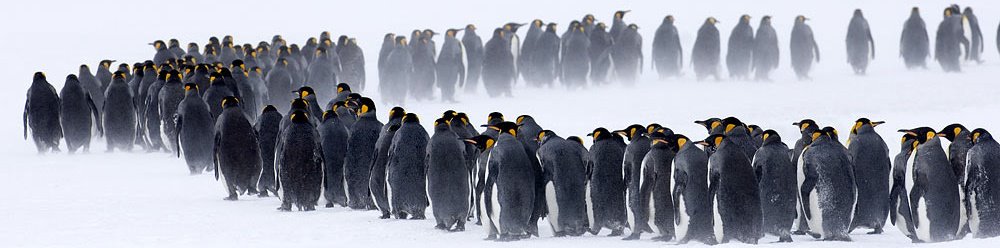
Happy World Penguin Day!


Each year, on or about the 25th of April, the Adelie penguins of Ross Island leave their brooding grounds and swim to their winter sanctuary northwest of the Balleny Islands. Some decided to mark the occasion by including all penguins and dubbing the day World Penguin Day.


Most penguins do participate in migratory habits. Why they favor some places more than others as their destination is the current  work of biologists. Current belief is that the Adelies favor a place that has more pack ice, thereby providing more protection.  This appears to be true, as the Davis Station Adelies migrate north, then west, staying close to the Antarctic continent. The Magellanic penguins of South America travel to Mar del Plata, where usually there is more food and less harsh conditions; however, in the past few years, the Magels have suffered many losses due to inadequate food. The Falkland Island Rockhopper Penguins have traditionally migrated to coastal South America, and the northernmost of the colonies favored the areas along the Patagonian Shelf.  The Macaronis stay in the sub-Antarctic area, mostly at sea, during their migration from their breeding grounds.


These are just a few instances of penguin migration; the point is that they do migrate and when they do, this action initiates the end of the breeding season and the beginning of a new life in the vast southern ocean for thousands of newly molted juveniles. Welcome to your world, little guys. Bon voyage!!!


wiinterrr


Image by Flickr/Benjamin Fox

Monday, April 19, 2010

A Satellite Census For Penguins

For Penguins, a Satellite Census

Biologists Count Hard-to-Find Birds With Photos Supplied by Intelligence Agency

[PENGUIN1] Minden
Emperor penguin colonies, like this one on Cape Roget, are widely spaced in Antarctica, making it difficult to conduct a census of the birds.

MCMURDO, Antarctica—Bird-watcher Philip Trathan is counting the emperor penguins here—from space.
In the first complete census of these well-known birds, the British wildlife ecologist and his colleagues are scanning high-resolution satellite photos of Antarctica for penguins, like military analysts searching for Iranian rocket sites. In fact, their precision imagery comes from the U.S. National Geospatial Intelligence Agency. The photos are part of the roughly $25 million of commercial satellite images the agency buys every month for use by the Central Intelligence Agency and the Defense Department.

Tracking Penguins in Antarctica from 400 Miles Up

3:32
Researchers are using satellite data to track penguins and seals across the coldest region on earth without disturbing them - and without leaving home. WSJ's Robert Lee Hotz reports.

"You can count individual birds," said Dr. Trathan, a penguin ecologist at the British Antarctic Survey, who is part of an international census team.

Their penguin census, which will be completed later this year, is the latest application of satellite mapping techniques that are transforming perceptions of Antarctica, where millions of square miles of ice blend into a wilderness of white, and only penguins are truly at home. In many ways, this shifting snowscape is as uncharted as the day explorers first sighted its mainland almost 200 years ago.

"Until last year, we had better maps of Mars than of Antarctica," said Paul Morin, director of the University of Minnesota's Antarctic Geospatial Information Center, which is funded by the U.S. National Science Foundation to use the unclassified intelligence imagery in science projects like the penguin survey. "We can now see one of the most inaccessible places on Earth, on demand," Mr. Morin said.

Landsat Image Mosaic of Antarctica, USGS, NASA
A Landsat image of Cape Washington in Antarctica shows a brownish smudge at center that is guano from large emperor penguins.
Landsat Image Mosaic of Antarctica, USGS, NASA
A Landsat image shows a guano stain at upper right from large emperor penguins in Antarctica.
With the newest high-resolution imagery, researchers can detect anything on the continent larger than an end table. At that scale, a four-foot-tall, 90-pound emperor penguin is just large enough to show up in a single pixel. Dressed by nature in darkly formal feather-wear, an emperor penguin stands out in high contrast against the ice, even when viewed by a camera moving at four miles a second in an orbit 423 miles overhead.

Still, the emperor penguins complicate the count by huddling together for warmth. On an especially cold day, as many as 10 of them can cram together on a square meter of ice—a space slightly larger than a single pixel. "If you have so many pixels of penguins," said mapping expert Peter Fretwell at the British Antarctic Survey, "you have to decide how many penguins per pixel." Wildlife biologists estimate the count will turn up between 200,000 and 400,000 breeding pairs.

Living across the continent's 5.4 million square miles of polar ice, the emperor penguins are a bellwether that can help researchers detect subtle changes in climate and ocean conditions affecting all of Antarctica. Other penguin species wax and wane in response to changing regional winds, temperature trends and commercial fishing. But so far, no one knows how emperor penguins have responded to the changes, because there has been no easy way to find them all.

"Emperors are a really tricky species to get a handle on," said Dr. Trathan. "At the moment, nobody really knows how threatened emperor penguins really are."
It's no wonder. The birds make themselves at home in two of Earth's most inaccessible environments. No other bird dives deeper underwater, as far as 1,500 feet. No other creature breeds on the sea ice during Antarctica's winter darkness, when temperatures drop to 80 degrees below zero and winds top 100 mph.

Penguins Under Pressure

Robert Lee Hotz/The Wall Street Journal
An international team of scientists is researching how Adélie penguins in Antarctica are coping with rapidly changing ice conditions and commercial fishing.
For years, field biologists based here at the U.S. McMurdo Station have tracked meandering emperors, bobbing like off-balance bowling pins, as they slip, slide and belly-flop over ridges of wind-rippled snow.
They have stood on stepladders to count the birds in congested formations, and hung cameras from helium-filled balloons to record their numbers more reliably.

They have bugged penguins with radio transmitters and shadowed them by jet with airborne infrared sensors that could detect a birds' body heat at a distance. Such techniques proved too intrusive and expensive for a systematic census.

The new census is not the first time penguin watchers have tried satellites. By chance, researchers last year discovered they could detect vast stains of penguin excrement on the ice using older low-resolution satellite images. That revealed the locations of 38 emperor colonies, 10 of them never seen before, Dr. Trathan and his colleagues reported last June in the journal Global Ecology and Biogeography.

Still, they couldn't actually see any penguins until they gained access to the newest images, which the intelligence agency buys from commercial satellite operators DigitalGlobe Inc. in Longmont, Colo., and GeoEye Inc. in Dulles, Va..

Scientists hope the newest images will allow them to study emperor penguins without disturbing them—and without leaving their home laboratories.

"If you can do it from space," said Dr. Trathan, "you can do it from your desk."

Write to Robert Lee Hotz at sciencejournal@wsj.com

Source 

New Paper on King Penguins

Original Paper

Do penguins dare to walk at night? Visual cues influence king penguin colony arrivals and departures
Anna P. Nesterova1 Contact Information, Céline Le Bohec2, 3, David Beaune3, Emeline Pettex1, Yvon Le Maho3 and Francesco Bonadonna1
(1)  Behavioural Ecology Group, CEFE–CNRS, 1919 route de Mende, 34293 Montpellier, Cedex 5, France
(2)  Centre for Ecological and Evolutionary Synthesis, Department of Biology, University of Oslo, PO Box 1066, Blindern, 0316 Oslo, Norway
(3)  Département d’Ecologie, Physiologie, et Ethologie, IPHC–CNRS, 23 rue Becquerel, 67087 Strasbourg, Cedex 2, France
Received: 15 June 2009  Revised: 8 February 2010  Accepted: 10 February 2010  Published online: 9 March 2010
Communicated by C. Brown
Abstract  
Orientation based on visual cues can be extremely difficult in crowded bird colonies due to the presence of many individuals. We studied king penguins (Aptenodytes patagonicus) that live in dense colonies and are constantly faced with such problems. Our aims were to describe adult penguin homing paths on land and to test whether visual cues are important for their orientation in the colony. We also tested the hypothesis that older penguins should be better able to cope with limited visual cues due to their greater experience. We collected and examined GPS paths of homing penguins. In addition, we analyzed 8 months of penguin arrivals to and departures from the colony using data from an automatic identification system. We found that birds rearing chicks did not minimize their traveling time on land and did not proceed to their young (located in crèches) along straight paths. Moreover, breeding birds' arrivals and departures were affected by the time of day and luminosity levels. Our data suggest that king penguins prefer to move in and out of the colony when visual cues are available. Still, they are capable of navigating even in complete darkness, and this ability seems to develop over the years, with older breeding birds more likely to move through the colony at nighttime luminosity levels. This study is the first step in unveiling the mysteries of king penguin orientation on land.
Keywords  Short-range navigation - King penguins - Seabirds - Visual landmarks - Nocturnal movements -  Aptenodytes patagonicus

Friday, April 16, 2010

Revised ASPA plan for Cape Hallett preserves huge Adélie colony

Kevin Pettway counts penguins.
Photo Credit: Jessie Jenkins
Kevin Pettway, the lead environmental specialist at Raytheon Polar Services Co., counts penguins on Seabee Hook to collect data for a revised Cape Hallett ASPA plan, as well as for ongoing Adélie research in Antarctica. Pettway's team conducted the most thorough assessment ever of an ASPA.

Added protection

Revised ASPA plan for Cape Hallett preserves huge Adélie colony

Kevin Pettway will be the first person to tell you it’s not easy to get to Cape Hallett. But he’ll also tell you the trip is well worth the effort to help protect one of Antarctica’s biological gems.
The journey required the support of a nearby Italian research station, Terra Nova, and a couple of extra nights stuck in a “bare bones” tent camp thanks to the continent’s unpredictable weather.
“Getting out to Hallett is very difficult because it is so far away [from McMurdo Station],” said Pettway, the lead environmental specialist at Raytheon Polar Services Co. (RPSC) External Non-U.S. government site.
Adelie penguin colony on Seabee Hook.
Photo Credit: Jessie Jenkins
The northern limit of the Adélie penguin colony.
Kevin Pettway tends to a scientific experiment.
Photo Credit: Jessie Jenkins
Kevin Pettway downloads data from a New Zealand Antarctica soil experiment.
“Having the Italian support was absolutely key to the success of this project,” he added, explaining that the crew at Terra Nova, located about halfway between McMurdo and Cape Hallett, helped move people and cargo by helicopter to the cape, a spit of land surrounded by sea ice eight months of the year.
Site of a former joint U.S. and New Zealand research station, Cape Hallett is home to a huge colony of Adélie penguins, and a diverse range of lichens, moss and tiny invertebrates. It’s also become a new model for how the U.S. Antarctic Program (USAP) External U.S. government site would like to approach conservation of Antarctic resources in the future.
Cape Hallett first gained special protection under the Antarctic Treaty External Non-U.S. government site system in 1966 at the request of the United States. Following the 1998 implementation of a comprehensive plan called the Protocol on Environmental Protection to the Antarctic Treaty, Cape Hallett became an Antarctic Specially Protected Area (ASPA) External Non-U.S. government site. Each ASPA is associated with a plan designed to manage access and to minimize impacts to the environment.
Pettway and his three-person team spent a week at Cape Hallett to redefine the ASPA boundaries and to survey the various animal populations. The USAP plans to submit a revised ASPA plan for Cape Hallett at the next meeting of the member nations to the Antarctic Treaty in Uruguay later this year.
“We probably did the most thorough site assessment of an ASPA that’s been done,” said Nate Biletnikoff, manager of RPSC’s environmental engineering department. RPSC provides much of the logistical support for the USAP, which is managed by the National Science Foundation (NSF) External U.S. government site.
Seabee Hook at Cape Hallett
Photo Credit: Kevin Pettway
Seabee hook at Cape Hallett.
RPSC hired a subcontractor, Environmental Research & Assessment (ERA) External Non-U.S. government site, which specializes in creating management plans in polar environments, to help develop the ASPA plan. Two ERA members, Colin Harris and Rachel Carr, used high-precision GPS technology from Boulder, Colo.-based UNAVCO External Non-U.S. government site to map the boundaries of the penguin colony, which boasts about 64,000 breeding pairs.
“We basically surveyed the entire area,” Biletnikoff said. “This is first time we’ve ever surveyed the spatial extent of a penguin colony to this level of detail.”
Tourism is partly the reason behind the detailed survey, according to Biletnikoff. The International Association of Antarctic Tour Operators External Non-U.S. government site said 322 tourists visited Cape Hallett during the 2008-09 season.
Helicopter and crew with the Italian Antarctic program.
Photo Credit: Jessie Jenkins
The Italian Antarctic program assisted the USAP environmental team with helicopter support.
“It is of high value to Antarctic tour operators in the Ross Sea region because of its high aesthetic values and accessibility,” Biletnikoff said.
While environmental protection has long been a fixture in the management of Antarctica, people have not always treaded so lightly on the continent. The original establishment of Cape Hallett Station on a site dubbed Seabee Hook in 1956 involved the “eviction” of more than 7,500 penguins, including some 3,300 chicks, to clear space for construction.
The colony declined from 62,900 pairs in 1959 to a low of 37,000 pairs in 1968. It has since recovered its former numbers and has started to re-occupy the site of the station, which ceased operations in 1973. The area itself has been cleaned up, and the last structures removed by the Italians in January 2010. Many of the historical artifacts from the station are located at the Canterbury Museum External Non-U.S. government site in Christchurch, New Zealand.
“The colony just keeps creeping forward. [ERA is] anticipating that the colony will fill into the coastline for the most part,” Biletnikoff said.
The new site map for tourist access proposes additional landing sites for boats, he said, to help minimize disturbances to the colony by ensuring operators come ashore at recognizable landmarks.

By the Numbers
Square kilometers of updated Cape Hallett ASPA: 0.53 square kilometers
Adélie penguins: 64,000 breeding pairs
South polar skuas: About 232 birds and 250 numbered nests
Other wildlife in the region: Emperor penguins, chinstrap penguins, Wilson’s storm petrels, snow petrels, southern giant petrels, Weddell seals, leopard seals and minke whales.
Number of invertebrates: Eight species of mites and three species of springtails
Vegetation: Five species of moss and 18 lichens
Total ASPA sites: 71
Number of ASPA sites under U.S. management: 13

The ASPA plan also includes a smaller restricted area that has been the site of a comparative study of flora since the 1960s. The site contains five different moss and 18 kinds of lichens. Pettway said the team found the stakes that defined the boundary and then built rock cairns to better delineate the area so visitors would not accidently disturb the sensitive vegetation.
“That was difficult — figuring out where it was and moving the rocks without disturbing the moss and lichens,” he said.
The environmental team also played scientist on behalf of several researchers who have interests in the ecosystem. For instance, they counted penguins and eggs for David Ainley External Non-U.S. government site, a principal investigator on a long-term study of the tuxedoed seabirds around the Ross Sea.
“It was a lot harder to count penguins than you would think,” said Pettway, who, along with Jessie Jenkins, field center supervisor, spent most of the week tallying penguins, skuas and seals.
He also repaired an automatic weather station for the University of Wisconsin-Madison External Non-U.S. government site and downloaded data for Antarctica New Zealand External Non-U.S. government site from a long-term soil experiment that is part of the Latitudinal Gradient Project External Non-U.S. government site.
“It goes beyond the ASPA management plan. We helped Ainley out. We helped Antarctica New Zealand out. … There are a lot of other things that we did out there,” Biletnikoff noted.

Source

Friday, March 26, 2010

New Bird Fossil Hints at More Undiscovered Chinese Treasures


Life reconstruction of Longicrusavis houi in what was probably its favored habitat, shallow lake waters. A reconstruction of the fossil specimen itself is reflected in the water. (Credit: Illustration by Stephanie Abramowicz, Dinosaur Institute, Natural History Museum of Los Angeles County.)

New Bird Fossil Hints at More Undiscovered Chinese Treasures

ScienceDaily (Mar. 25, 2010) — The study of Mesozoic birds and the dinosaur-bird transition is one of the most exciting and vigorous fields in vertebrate paleontology today. A newly described bird from the Jehol Biota of northeast China suggests that scientists have only tapped a small proportion of the birds and dinosaurs that were living at that time, and that the rocks still have many secrets to reveal.


"The study of Mesozoic birds is currently one of the most exciting fields; new discoveries continue to drastically change how we view them," said Jingmai O'Connor, lead author of the study. The article appeared in the March issue of the Journal of Vertebrate Paleontology.

The new bird, named "Longicrusavis houi," belongs to a group of birds known as ornithuromorphs (Ornithuromorpha), which are rare in rocks of this age. Ornithuromorphs are more closely related to modern birds than are most of the other birds from the Jehol Biota.

"Longicrusavis adds to the magnificent diversity of ancient birds, many of them sporting teeth, wing claws, and long bony tails, that recently have been unearthed from northeastern China," said Luis Chiappe, a co-author of the study.

Along with a bird described five years ago, Longicrusavis provides evidence for a new, specialized group of small birds that diversified during the Early Cretaceous between about 130 and 120 million years ago.
"The new discovery adds information not only on the diversity these birds, but also on the possible lakeshore environment in which this bird lived," said co-author Gao Ke-Qin.

The legs of this new species are unusually long, suggesting that it spent much of its time wading in the shallows of ancient lakes. The name "Longicrusavis" means "long-shin bird," highlighting this important aspect of the new specimen. The presence of ancient birds in this habitat suggests that modern birds might have originated from an ancestor that was adapted for life near rivers and lakes.

Previously undescribed feather impressions from a closely related species suggest that both it and Longicrusavis had a long, fan-shaped tail. These are the oldest species to have such a tail, which likely increased flying performance.

The rocks of the Yixian Formation of northeast China have produced a spectacular array of fossils in recent years including fishes, birds, mammals, invertebrates, and dinosaurs. These fossils are collectively are known as the Jehol Biota and they are remarkable because, in many instances, they preserve soft tissues such as feathers or hair in addition to teeth and bones. "The Jehol Biota never fails to stop giving, and the research to be done on these fossils is virtually endless!" said O'Connor.

Story Source:
Adapted from materials provided by Society of Vertebrate Paleontology.

Journal Reference:
  1. O'Connor, J. K., K-Q Gao, and L. M. Chiappe. A New Ornithuromorph (Aves: Ornithothoraces) Bird from the Jehol Group Indicative of Higher-Level Diversity. Journal of Vertebrate Paleontology, 2010; 30 (2): 311-321 DOI: 10.1080/02724631003617498
Society of Vertebrate Paleontology. "New Bird Fossil Hints at More Undiscovered Chinese Treasures." ScienceDaily 25 March 2010. 26 March 2010 <http://www.sciencedaily.com­ /releases/2010/03/100324233003.htm>.

Thursday, March 11, 2010

Suit Filed to Save Penguins at Risk From Global Warming and Fisheries


For Immediate Release, March 9, 2010

Contact:  Catherine Kilduff, Center for Biological Diversity, (415) 644-8580
Todd Steiner/Teri Shore, Turtle Island Restoration Network, (415) 663- 8590 x 103/104 
  

Suit Filed to Save Penguins at Risk From Global Warming and Fisheries

SAN FRANCISCO— The Center for Biological Diversity and Turtle Island Restoration Network (TIRN) today sued the Obama administration for illegally delaying protection of penguins under the Endangered Species Act. The Interior Department failed to meet its December 19, 2009 deadline to list seven penguin species at risk of extinction due to climate change and commercial fisheries. These penguins will not receive desperately needed Endangered Species Act protections until Interior finalizes the listings.

“While sea ice melts and oceans warm, the Obama administration is stuck like a deer in the headlights. Instead of saving penguins from the leviathan of global warming while it still can,” said Catherine Kilduff, a Center attorney, “our government is dragging its feet.”

“Penguins should be marching toward recovery, not extinction. These amazing species face a double whammy from the threats brought by climate change and industrial fisheries that deplete the penguins’ food supply and entangle and drown the penguins in longlines and other destructive fishing gear. They deserve protection under the Endangered Species Act,” said Todd Steiner, biologist and executive director of TIRN.

In 2006 the Center filed a petition to list 12 penguin species under the U.S. Endangered Species Act. In December 2008, the Interior Department proposed listing seven of those species as threatened or endangered – African, Humboldt, yellow-eyed, white-flippered, Fiordland crested, and erect-crested penguins as well as a few populations of the southern rockhopper – while denying listing to emperor and northern rockhopper penguins despite scientific evidence that they also are threatened by climate change.
Today’s lawsuit challenges the Interior Department’s illegal delay in finalizing the listing of the seven proposed penguin species; the Center and TIRN also intend to file suit against Interior for denying protections to emperor and rockhopper penguins. Warming oceans, melting sea ice, and fishery harvests have wreaked havoc on penguins’ food supply: krill, an essential nutrient for penguins, whales, and seals, has declined by up to 80 percent since the 1970s over large areas of the Southern Ocean. Reduced food supply has diminished populations of species ranging from southern rockhoppers and Humboldt penguins of South American islands to the African penguin in southern Africa.

Endangered Species Act listing would protect penguins from multiple threats, raise awareness of their plight, and increase research funding. Federal approval of fishing permits for U.S.-flagged vessels on the high seas, for example, would require analysis and minimization of impacts on penguins. The Act also has a key role in managing greenhouse gas pollution by compelling federal agencies to look at the impact of the emissions generated by their activities on listed species and reduce those impacts.

For more information on penguins, please see: http://www.biologicaldiversity.org/species/birds/penguins/index.html.

Sunday, March 7, 2010

Jellyfish to replace penguins thanks to global warming

Penguins in Antarctica to be replaced by jellyfish due to global warming

Rising temperatures in the oceans around Antarctica could lead to the continent's penguins being replaced by jellyfish, scientists have warned.


A Gentoo penguin feeding her young krill: A Gentoo penguin feeding her young krill
A Gentoo penguin feeding her young krill Photo: ALEX BENWELL
  
The results of the largest ever survey of Antarctic marine life reveal melting sea ice is decimating krill populations, which form an integral part of penguins' diets. The six-inch-long invertebrates, also eaten by other higher Southern Ocean predators such as whales and seals, are being replaced by smaller crustaceans known as copepods.
These miniscule copepods, measuring just half a millimetre long, are too small for penguins but ideal for jellyfish and other similarly tentacled predators. Huw Griffiths, a marine biologist, said the shifting food web, coupled with shrinking ice sheet breeding grounds, could seriously affect the world's favourite Antarctic animal. Mr Griffiths, of British Antarctic Survey (BAS), said: ''Marine animals spent millions of years adapting to the freezing, stable conditions of the Antarctic waters and they are highly sensitive to change.

''The polar oceans are rich in biodiversity. But if species are unable to move or adapt to new conditions they could ultimately die out. Copepods are 120 times smaller than krill, which is inevitably going to affect all the things that feed in that area. Penguins, sea birds, whales are all used to catching large items of prey. But creatures with tentacles - like jellyfish are going to have more food value out of smaller prey.This kind of predator will do better in this warmer environment. We already have huge numbers of amazing looking jellyfish. They are not quite invading but numbers will go up to the point where they become the dominant group. And if the waters continue to warm there will not only be a shift between species that are already there, but new species will be able to come into the area.''

Mr Griffiths said species of small invertebrates, fish and crabs that cannot currently tolerate the -2C temperatures in the Antarctica waters might start soon start to appear. Any decrease in sea ice will inevitably affect the delicate balance of the Antarctic marine food chain. For creatures such as penguins who lives on the melting sea ice, a rise in temperatures will also shrink the size of their breeding grounds.

Mr Griffith's research is based ON the Census of Antarctic Marine Life (CAML) and he presented his findings at the American Association for the Advancement of Science (AAAS) in San Diego on Thursday.
The census began in 2005 and will provide the benchmark for future studies on how the diverse sea-floor creatures living in Antarctica's waters will respond to predicted climate change.

More than 6,000 different species living on the sea-floor have been identified so far and more than half of these can only be found on the icy continent. Mr Griffith's work also describes certain creatures such as sea spiders flourish in the Antarctic waters because of the unique environment. The stunning sea spiders in Antarctica are roughly the size of dinner plates, whereas their delicate cousins around the UK coast are no bigger than a little fingernail.

Mr Griffiths added: ''This is a group that has done really well in the cold. Around 20 per cent of the world's population of sea spiders are from Antarctica. ''They are bigger than anywhere else in the world and this is probably because the environment happens to be ideal for them. It makes you realise if the waters warm and other species or predators move in these unique animals will come under competition.''


Source

Wednesday, February 17, 2010

A Solution for Saving the Penguin


African penguin. (Credit: Copyright David Grémillet)

Marine Protected Areas: A Solution for Saving the Penguin

ScienceDaily (Feb. 16, 2010) — Researchers from the Centre d'écologie fonctionnelle et évolutive (CNRS/Universités Montpellier 1, 2, 3/Montpellier SupAgro/CIRAD/EPHE) and the University of the Cape in South Africa (1) have shown that closing fishing zones in the ocean has a beneficial effect on Cape penguins, an endangered species endemic to Southern Africa that feeds exclusively on fish. This result comes from a unique experiment carried out by the researchers on two penguin colonies, with the collaboration of government authorities and the South African fishing industries.


These results are published on 10 February 2010 on the website of the journal Biology Letters.
The Cape penguin Spheniscus demersus (the only African penguin) is endangered as a result of the 60% decline in its worldwide population between 2001 and 2009. This decline can be attributed to a dearth of food, due to displacement of the banks of sardines and anchovies which these birds feed on. Competition with the fisheries which exploit the last remaining fish around the South African penguin colonies exacerbates the threat to the species. Faced with this crisis situation, and working with researchers and the South African fish industries, the South African governmental agency overseeing fisheries (Marine and Coastal Management) closed to fishing in January 2009 a 20-km radius ocean area around the largest Cape penguin colony (on the island of St Croix, Algoa Bay). A "witness" zone around another penguin colony (Bird Island), 50 km east of St Croix in the same bay, has remained open to fishing in order to enable researchers to compare penguin feeding behaviors.

The researchers studied the food-seeking behavior of 91 birds in these two colonies, thanks to GPS recorders, in 2008 and 2009, namely before and after the area was closed to fishing. The miniature recorders, in watertight hydrodynamic boxes, were attached to the feathers at the base of the birds' backs with adhesive. The goal was to record the latitude and longitude of the birds every minute, and the hydrostatic pressure (diving depth) every second. These data made it possible to calculate the effort each bird expended in searching for food, in terms of the length of time spent traveling, the distance covered, the number, depth and location of dives.

The results are striking: In 2008, before the area was closed to fishing, the St Croix penguins mainly fished (75% of dives) more than 20 km from their colony, covering up to 150 km in two days in their search for food. In 2009, on the other hand, only 3 months after the area had been closed to fishing, 70% of dives were less than 20 km away, within the protected marine area. The time devoted to searching for food also decreased by 30%, which reduced their daily energy expenditure by 40%. By way of comparison, the area within which the Bird Island penguins (the control colony) searched for food remained the same both years, with the penguins even expending more energy searching for food in 2009.

This experiment shows the immediate benefits of the creation of a Marine Protected Area for the preservation of an endangered top marine predator species. The study confirms the negative impact of industrial fishing on feeding conditions for African penguins and also demonstrates the crucial importance of Marine Protected Areas (2) on endangered species conservation. When appropriately defined, these areas can facilitate the restoration of ocean ecosystems (3) damaged by the combined effects of climate change and overfishing.

Notes:
(1) Of the Percy FitzPatrick Institute of African Ornithology.
(2) The 1992 Rio convention stipulates that 10% of marine surfaces be protected. Nonetheless, only 0,8% of these surfaces is currently reserves. In this context, the creation of Marine Protected Areas (MPA) which help preserve marine predators which feed on mobile prey such as ocean fish, is urgent. This strategy is nonetheless controversial, as it is difficult, in open water, to clearly delimit PMAs which aim to preserve species as mobiles as superior predators and their prey. The general principle is that these reserves must be very large in order to encompass the vast habitats of marine predators; this makes it more difficult to set them up and manage them.
(3) Plankton, both phytoplankton and zooplankton, fish (notably sardines and anchovies), all living organisms in the water column between the ocean surface and bottom and which play a central role in the marine ecosystem.

Story Source:
Adapted from materials provided by CNRS (Délégation Paris Michel-Ange).


CNRS (Délégation Paris Michel-Ange). "Marine Protected Areas: A Solution for Saving the Penguin." ScienceDaily 16 February 2010. 17 February 2010 <http://www.sciencedaily.com­ /releases/2010/02/100211090755.htm>.

Thursday, February 11, 2010

Bird-from-Dinosaur? OR Was It the Other Way Around?


An image drawn in 1915 by naturalist William Beebe suggests a hypothetical view of what early birds may have looked like, gliding down from trees - and it bears a striking similarity to a fossil discovered in 2003 that is raising new doubts about whether birds descended from ground-dwelling theropod dinosaurs.

Bird-from-Dinosaur Theory of Evolution Challenged: Was It the Other Way Around?

ScienceDaily (Feb. 10, 2010) — A new study just published in the Proceedings of the National Academy of Sciences provides yet more evidence that birds did not descend from ground-dwelling theropod dinosaurs, experts say, and continues to challenge decades of accepted theories about the evolution of flight.

A new analysis was done of an unusual fossil specimen discovered in 2003 called "microraptor," in which three-dimensional models were used to study its possible flight potential, and it concluded this small, feathered species must have been a "glider" that came down from trees. The research is well done and consistent with a string of studies in recent years that pose increasing challenge to the birds-from-dinosaurs theory, said John Ruben, a professor of zoology at Oregon State University who authored a commentary in PNAS on the new research.

The weight of the evidence is now suggesting that not only did birds not descend from dinosaurs, Ruben said, but that some species now believed to be dinosaurs may have descended from birds.
"We're finally breaking out of the conventional wisdom of the last 20 years, which insisted that birds evolved from dinosaurs and that the debate is all over and done with," Ruben said. "This issue isn't resolved at all. There are just too many inconsistencies with the idea that birds had dinosaur ancestors, and this newest study adds to that."

Almost 20 years of research at OSU on the morphology of birds and dinosaurs, along with other studies and the newest PNAS research, Ruben said, are actually much more consistent with a different premise -- that birds may have had an ancient common ancestor with dinosaurs, but they evolved separately on their own path, and after millions of years of separate evolution birds also gave rise to the raptors. Small animals such as velociraptor that have generally been thought to be dinosaurs are more likely flightless birds, he said.
"Raptors look quite a bit like dinosaurs but they have much more in common with birds than they do with other theropod dinosaurs such as Tyrannosaurus," Ruben said. "We think the evidence is finally showing that these animals which are usually considered dinosaurs were actually descended from birds, not the other way around."

Another study last year from Florida State University raised similar doubts, Ruben said. In the newest PNAS study, scientists examined a remarkable fossil specimen that had feathers on all four limbs, somewhat resembling a bi-plane. Glide tests based on its structure concluded it would not have been practical for it to have flown from the ground up, but it could have glided from the trees down, somewhat like a modern-day flying squirrel. Many researchers have long believed that gliders such as this were the ancestors of modern birds.

"This model was not consistent with successful flight from the ground up, and that makes it pretty difficult to make a case for a ground-dwelling theropod dinosaur to have developed wings and flown away," Ruben said. "On the other hand, it would have been quite possible for birds to have evolved and then, at some point, have various species lose their flight capabilities and become ground-dwelling, flightless animals -- the raptors. This may be hugely upsetting to a lot of people, but it makes perfect sense."

In their own research, including one study just last year in the Journal of Morphology, OSU scientists found that the position of the thigh bone and muscles in birds is critical to their ability to have adequate lung capacity for sustained long-distance flight, a fundamental aspect of bird biology. Theropod dinosaurs did not share this feature. Other morphological features have also been identified that are inconsistent with a bird-from-dinosaur theory. And perhaps most significant, birds were already found in the fossil record before the elaboration of the dinosaurs they supposedly descended from. That would be consistent with raptors descending from birds, Ruben said, but not the reverse.

OSU research on avian biology and physiology has been raising questions on this issue since the 1990s, often in isolation. More scientists and other studies are now challenging the same premise, Ruben said. The old theories were popular, had public appeal and "many people saw what they wanted to see" instead of carefully interpreting the data, he said.

"Pesky new fossils...sharply at odds with conventional wisdom never seem to cease popping up," Ruben wrote in his PNAS commentary. "Given the vagaries of the fossil record, current notions of near resolution of many of the most basic questions about long-extinct forms should probably be regarded with caution."

Story Source:
Adapted from materials provided by Oregon State University, via EurekAlert!, a service of AAAS.


Oregon State University. "Bird-from-Dinosaur Theory of Evolution Challenged: Was It the Other Way Around?." ScienceDaily 10 February 2010. 11 February 2010 <http://www.sciencedaily.com­ /releases/2010/02/100209183335.htm>.

Saturday, February 6, 2010

Dinosaur Had Vibrant Colors


A water color illustration of Anchiornis huxleyi, an extinct, non-avian dinosaur. (Credit: By Michael DiGiorgio/Courtesy Yale)

Dinosaur Had Vibrant Colors, Microscopic Fossil Clues Reveal

ScienceDaily (Feb. 5, 2010) — Deciphering microscopic clues hidden within fossils, scientists have uncovered the vibrant colors that adorned a feathered dinosaur extinct for 150 million years, a Yale University-led research team reports online Feb. 4 in the journal Science.

Unlike recently published work from China that inferred the existence of two types of melanin pigments in various species of feathered dinosaurs, the Science study analyzed color-imparting structures called melanosomes from an entire fossil of a single animal, a feat which enabled researchers to reveal rich color patterns of the entire animal.

In fact, the analysis of melanosomes conducted by Yale team was so precise that the team was able to assign colors to individual feathers of Anchiornis huxleyi, a four-winged troodontid dinosaur that lived during the late Jurassic period in China. This dinosaur sported a generally gray body, a reddish-brown, Mohawk-like crest and facial speckles, and white feathers on its wings and legs, with bold black-spangled tips.
"This was no crow or sparrow, but a creature with a very notable plumage," said Richard O. Prum, chair and the William Robertson Coe Professor of Ornithology, Ecology and Evolutionary Biology at Yale and a co-author of the study. "This would be a very striking animal if it was alive today."

The color patterns of the limbs, which strongly resemble those sported by modern day Spangled Hamburg chickens, probably functioned in communication and may have helped the dinosaur to attract mates, suggested Prum.

The transformation of mankind's view of dinosaurs from dull to flamboyant was made possible by a discovery by Yale graduate student Jakob Vinther in the Department of Geology and Geophysics. Vinther was studying the ink sac of an ancient squid and realized that microscopic granular-like features within the fossil were actually melanosomes -- a cellular organelle that contains melanin, a light-absorbing pigment in animals, including birds.

While some scientists thought these granules were remnants of ancient bacteria, Vinther, Prum and Derek E.G. Briggs, the Frederick William Beinecke Professor of Geology and Geophysics and director of the Yale Peabody Museum of Natural History, disagreed. First, they tested Vinther's theory on a 112 million year old feather from Brazil and later inferred the colors of an extinct 47 million-year-old bird.

The latest research team -- which also included scientists from the University of Texas at Austin, University of Akron, Peking University and the Beijing Museum of Natural History -- decided to use the same procedures to closely examine a fossil of Anchiornis huxleyi, recently described in Liaoning Province, People's Republic of China. The area has been a gold mine for paleontologists and, among other things, provided abundant evidence confirming a once-controversial theory that modern birds are descendants of theropod dinosaurs.
The Yale team and Julia Clarke, an associate professor of paleontology at the University of Texas at Austin's Jackson School of Geosciences, worked closely with Gao Keqin of Peking University and Li Quanguo and Meng Qingjin of the Beijing Museum of Natural History to select, sample and evaluate the anatomy and feathering of Anchiornis huxleyi, important in its own right as a new feathered dinosaur. The team's effort was funded by a special grant from the National Geographic Society and by the National Science Foundation.
The team closely examined 29 feather samples from the dinosaur and did an exhaustive measurement and location of melanosomes within the feathers. The team then did a statistical analysis of how those melanosomes compared to the types of melanosomes known to create particular colors in living birds, using data compiled by Matt Shawkey and colleagues at the University of Akron. The analysis allowed scientists to discern with 90 percent certainty the colors of individual feathers and, therefore, the colorful patterns of an extinct animal.

The research adds significant weight to the idea that dinosaurs first evolved feathers not for flight but for some other purposes. "This means a color-patterning function -- for example, camouflage or display -- must have had a key role in the early evolution of feathers in dinosaurs, and was just as important as evolving flight or improved aerodynamic function," Clarke said.

The new discoveries provide a wealth of insights into the compelling history of feather evolution in dinosaurs prior to the origin of modern birds. The study documents that color patterning within feathers and among feathers evolved earlier than previously believed. Further, these results indicate dinosaur feathers may have evolved for communication. "Writing the first scientifically-based 'field guide' description of the appearance of an extinct dinosaur was a exciting and unforgettable experience -- the ultimate dream of every kid who was ever obsessed with dinosaurs," Prum said. "Now that dream is really possible."


Story Source:
Adapted from materials provided by Yale University.

Journal Reference:
  1. Quanguo Li, Ke-Qin Gao, Jakob Vinther, Matthew D. Shawkey, Julia A. Clarke, Liliana D'alba, Qingjin Meng, Derek E. G. Briggs, Long Miao, Richard O. Prum. Plumage Color Patterns of an Extinct Dinosaur. Science, Online February 4, 2010 DOI: 10.1126/science.1186290

Yale University. "Dinosaur Had Vibrant Colors, Microscopic Fossil Clues Reveal." ScienceDaily 5 February 2010. 6 February 2010 <http://www.sciencedaily.com­ /releases/2010/02/100204144422.htm>.

Monday, February 1, 2010

Antarctica: A frozen hotbed of climate research for hardy scientists

 Antarctica: A frozen hotbed of climate research for hardy scientists
Ornithologist Kristen Gorman has been working in Antarctica for five years to learn more about how bird populations in the area are changing. Day after day, she hikes through penguin breeding grounds, weighing the eggs, examining the young and documenting the declining numbers.
ANVERS ISLAND, Antarctica | Roald Amundsen attacked this frozen nowhere-land as a racing explorer, determined to be fastest, to be first, to be remembered.
His determination and savvy got him to the South Pole before any other, and made him a hero in an age when Antarctica existed in the human imagination as a final conquest.
Mostly for show, he brought along a scientist.
Just shy of a century later, the conquerors have given way to the curious.

Now scientists such as geologist David Barbeau and ornithologist Kristen Gorman, rugged individuals of another age, shuttle in rubber Zodiac boats from remote research stations and ice-breaking research ships. They bump aside small floes, bend against brutal polar winds and scramble up cliffs in search of their own discoveries.

They search not for fame, but for answers about the same climate that once tortured and killed their polar adventuring forebears. Around this continent, the weather has mellowed alarmingly. Giant glaciers and tiny creatures are threatened as this tip of our global iceberg warms faster than anywhere else on earth.
These modern-day researchers come not to conquer, but to understand.

Almost by accident, Barbeau’s career as a geologist has been swept up, and upward, on the wave of interest about what makes parts of the planet freeze and thaw, and what that says about climate change.
He leads Antarctic expeditions hatched and financed entirely on the strength of theories about how the continent broke off from South America and iced over.

Gorman, meanwhile, tracks how dwindling Adelie penguin colonies connect to the retreat of sea ice. She navigates guano-slick boulders.

She teams with researchers steering remote-control submersibles into undersea canyon feeding grounds to measure how the birds fare as Antarctica’s glacial edges crumble into the sea.

“We’re asking simple questions about food ecology in this larger framework,” she said of fish and shrimplike krill and their feathered hunters. “How do you better predict how climate will affect predators?”
It wasn’t so much that science drew her to the wilds of Antarctica. It was an overwhelming need to work in wild places that sucked her into ornithology.

Though Barbeau ends up climbing mountains and skiing across glaciers, he recognizes that the strain and danger don’t compare to what the men of Amundsen’s age knew. But they were just looking for fame and national bragging rights.

“The first to do this, the first to do that,” he said dismissively. “We’re just trying to understand things. … With climate science, you’re talking about something that’s critical.”

He and Gorman are just two among scores building careers in modern-day Antarctica, where climate studies promise academic status and grant money.

At the South Pole, researchers take core samples of ice, measuring the gases trapped in them to see what Earth’s atmosphere was like thousands of years ago. In the Drake Passage, measurements taken by ship and satellite reveal how much carbon dioxide is absorbed by sea life.

Observations made over decades on the Ross Ice Shelf and along the Antarctic Peninsula look at changes in temperature and ice levels, and what that’s meant to whales, seals, penguins and the krill at the nexus of the food chain.

For six weeks, late last year, electrical engineers from the University of Kansas flicked switches and toggled computer controls in a DC-8 jet sweeping back and forth over the frozen wastes. Their purpose: to peer through the continent’s miles-deep blanket of ice.

Ross MacPhee, a curator at the American Museum of Natural History, sees a particular personality in the researchers drawn south of the Polar Front. He is both a paleontologist and a scholar of polar exploration, and traveled on his own Antarctic expedition in 2009.

While the great breakthroughs of the Digital Age typically appear in laboratories using fast-developing technology, he said, a breed of scientist survives that still prefers to work in the wild. It may be as much that their science delivers them outdoors, as that they need to go the wilderness to advance their science.

“We’re talking about someone who doesn’t mind being too cold or too wet or too sweaty,” MacPhee said, “someone who actually enjoys tough conditions.”
•••
Antarctica is a hotbed of new climate patterns that serve as a nifty laboratory for understanding what’s happening to the Earth as a whole.

Its long, dark winters make it the best place on Earth for observing the heavens. Its air is the cleanest on the planet, giving researchers a baseline to compare with other regions. Some 70 percent of the world’s fresh water is locked into 30 million cubic kilometers of Antarctic ice.

The United States alone spends more than $300 million a year on research here — supply flights to the globe’s most forbidding landscapes, icebreakers plowing the seas for oceanographic research, delivering people like Gorman and Barbeau to remote coasts.

Barbeau is the point man on a $700,000 grant that has brought him here for three years running and paid for nearly 20 other researchers either to accompany him or to perform lab analysis back in the United States.
All the modern work feeds, and is driven by, findings like those of the Nobel-decorated Intergovernmental Panel on Climate Change that carbon dioxide levels are at a 650,000-year high and climbing. Such buildup of gas in the atmosphere — the IPCC attributes the steep rise chiefly to industrialization — could explain why nine out of every 10 glaciers in the world are shrinking.

Global warming remains a controversial concept, made more so when the hacking of e-mails from researchers at East Anglia’s Climate Research Unit last year revealed that they toyed with data to make for more dramatic results. Skeptics also like to point out how most of Antarctica has not warmed appreciably.

Scientists in Antarctica, though, say the climate here has changed quickly and profoundly. Shifting atmospherics mean more ice is piling up in the Ross Sea and around the South Pole — evidence of an extraordinarily dry place seeing slightly more snow.

The Antarctic Peninsula, the northernmost spit of land jutting up toward South America, is rapidly thawing. Since 1950, average midwinter temperatures there have climbed almost 11 degrees Fahrenheit and now range around 14 degrees.

Such data, goes the mainstream consensus, suggest the planet’s climate is changing faster than ever before.
The first decade of the 21st century was the warmest on record, a fact that was not missed at December’s international talks at Copenhagen. Although little came from that climate summit, political pressure to slash carbon emissions is only mounting.

Meanwhile, sea ice — formed on the ocean surface in the coldest temperatures — floats off the northern peninsula for 80 fewer days a year than it did a quarter-century ago. In 2002, a chunk of ice the size of Rhode Island broke from the peninsula’s eastern shore. In 2008, more than 150 square miles more fell off its west side.

 The warming here is the fastest on the planet, five times that of the rest of the globe.
•••
Apsley Cherry-Garrard, who barely survived a trek to collect penguin eggs in 1911 on Robert Falcon Scott’s doomed British run to the pole, described Antarctic exploration as “at once the cleanest and most isolated way of having a bad time which has been devised.”

Times have changed.

“Hi, guys!” Gorman cheerily greets her subjects on Cormorant Island.

She talks to the birds: big-footed, Technicolor cormorants; hovering, scavenging skuas; squawking, knee-high, feces-mottled penguins.

While she labors to keep her scientist’s detached powers of observation, Gorman can’t avoid an affinity for the grandeur of giant petrels or the chubby adorability of a downy penguin chick.

After five years on the Antarctic peninsula, she said, “I still think the penguins are cute.”

Sitting indoors in flip-flops and a down jacket patched with duct tape, Gorman looks younger than her 35 years.

In a schoolgirl voice, the doctoral candidate at Simon Fraser University punctuates conversations with “cool” and “super cool” — typically in appreciation of the look of a bird or the power of isotopes to reveal an animal’s diet.

Day after Antarctic day, she hikes through penguin breeding grounds, weighing the eggs, examining the young, documenting the declining numbers.

She sees the penguins arrive in the spring. Watches them tend eggs, many of which are devoured by predators. She studies their hatchlings, sees them snatched away under the rough law of this frozen jungle.
Increasingly and problematically less frozen.

That’s bad news for the Adelie penguin.

In 1975, 15,000 pairs nested along the peninsula and its scores of small islands. Now there are fewer than 4,000.

Gorman has tracked the phenomenon for the last five years while working out of the U.S.-run Palmer Station. The pace and stamina of her and her research companion, Jennifer Blum, awe even the hardy folks drawn down here.

Nearly every day of the sun-saturated Antarctic summer, the two lace hiking boots, yank on layers of fleece and Gore-Tex and climb into a tiny Zodiac outboard. They motor from one small island to the next well into the evenings.

The sea at times pounds their bow, or surrounds them in ice. Each landing requires one researcher to climb boulders with wet rope in hand while the other fights wind and current to anchor the boat out of harm’s way. Then they trek among two-ton elephant seals and irritated penguins.

Penguins look sweet enough, but they are tight bundles of muscle. With beaks. Pick one up, it will resist. Gorman’s forearms bear a constellation of penguin scars.

“They’re less cool,” she said, “when you have to handle them.”

Rain still makes her uneasy — not because she can get soaked in the cold, but because it makes for a dangerously slick slime when it mixes with bird guano on the rocky islands.

The Adelies feed in spots where the churning of warmer and cooler water stirs up nutrients and promotes the growth of fish and krill.

The birds need winter sea ice to launch their daytime hunts. As that ice has receded, the Adelies are forced farther south in the winter. Scientists call that climate migration. For the penguins, it means shorter days and less feeding time.

While Gorman’s job is to collect the sober data of science, she concedes some feeling for her subjects.
One evening in December as she plucked a guitar with friends and someone sang “Orphan Girl” (I have no mother no father/No sister no brother), Gorman put on a half-acted frown.

“This makes me think,” she said sadly, “of the penguin chicks.”
•••
Antarctica holds 91 percent of the Earth’s ice.

So KU scientists have a whole lot of measuring to do.

For six weeks, the electrical engineers peered through ice sheets so thick that only in recent years have scientists found entire mountain ranges hidden below the surface.

For much of the last two decades, the chief way to monitor ice in Antarctica was with satellite readings. But the man-moon operated by the National Aeronautics and Space Administration over the pole soon will fall out of service.

In stepped CReSIS, the Center for Remote Sensing of Ice Sheets, a collection of climate and technological experts. As a result, NASA’s “Ice Bridge” observation project will run until a replacement satellite goes into orbit in 2014.

The DC-8 is packed with gear made by engineers from KU and elsewhere especially for the job of teasing out new detail about how much ice is stored in the Earth’s natural freezers and how it’s changing.
The flights, which also go over Greenland in the summer of the Northern Hemisphere, tend to be low-altitude, ground-hugging affairs often fighting some of the strongest winds on the planet.

“You really have to hold on,” said Chris Allen, a professor in KU’s Department of Electrical Engineering and Computer Science and an associate director for CReSIS.

“It got kind of scary a couple of times. But sometimes that’s what it takes to get the job done.”
In its 11 hours aloft, the plane passed from Punta Arenas, Chile, soaring over the Antarctic sea where Ernest Shackleton’s Endurance crew was stuck for more than a year, the trail Amundsen blazed, the ice where Scott perished.

Radar signals bounce back from the gleaming white below; terabytes of data feed into the flying lab’s humming computers, enough data each day to fill more than 1,000 pickup trucks with books. This season, the plane logged enough miles to circle the planet four times.

“There was always something to deal with” — software glitches, fidgety hard drives, turbulent skies — “but that’s what makes the challenge interesting,” Allen said.
•••
Even at 35, the geologist Barbeau possesses the persona of a brainy hippie backpacking between hostels rather than that of a professor leading polar expeditions.

His work in the slow-moving field of geology plays into the rush to understand climate change by looking at a critical question: Did glaciers take over Antarctica after it split free from South America, or before?

We know the glaciers arrived 35 million years ago. But the land mass had been sitting at the pole for 100 million years before the chill set in.

The continent is cut off today by the Polar Front, an ocean current and prevailing winds circling the continent from west to east, the water moving with a force 100 times greater than that of all the world’s rivers combined.

If the breakup of the Andes mountain chain — which opened the Drake Passage between South America and the Antarctic Peninsula — occurred before the cold arrived, that suggests it was the seclusion enforced by the Polar Front that later froze it over.

But if the opening of the Drake Passage took place after the glaciers came, then it was probably a gas thing.
It would have been a reversal of what is happening today. The planet would have been experiencing a sudden flourish of plant and animal life, with great quantities of carbon absorbed. Less carbon dioxide in the atmosphere meant less greenhouse effect trapping the sun’s warming energy.

Barbeau’s polar field work could be as vital to his career as Amundsen’s conquest of the South Pole was to his. Both set off with the blessings of their patrons — the Norwegian government and sundry benefactors for Amundsen, principally the National Science Foundation for Barbeau — who had placed bets on their success.

Amundsen beat the British and got a sea named after him.

There will never be a Barbeau Bay, but Barbeau’s discovery landed the geologist a prestigious NSF grant — a huge boon to his research and important to his standing on campus. It meant hundreds of thousands of dollars for his university’s overhead. That success, Barbeau is certain, is the reason he learned while in Antarctica in December that he had achieved tenure at the University of South Carolina.

“It’s a matter of stumbling on the right problem,” Barbeau said, recognizing that by feeding the chic niche of climate science, his work stands much more likely to draw grants and prestige.

At work, he is a wiry prospector wielding a small pickax and an undersized sledge hammer and toting as much as 80 pounds of rocks over miles of snow. Where Amundsen used a compass and a sextant, Barbeau marks his finds with a Garmin satellite navigator.

And where Amundsen learned the value of dogs and fur garments, Barbeau has come to appreciate that less is more. Just enough clothing to keep an active man from shivering, just enough gear to pry rocks loose from a mountainside.

“Every minute on the ground is precious,” he said. “Fewer trips back and forth from the boat mean more time at work, more energy and more focus.”

While he feels pressure to push his science forward, to scope out possibilities for the next grant, Barbeau is constantly aware that he makes a living going to spectacular places.

The Antarctic coast is surely that. Mountaintops jut from the ocean. Glaciers show their alabaster cliffs to the shore. Whales lumber by the research ship that hauls him along the coast, penguins torpedo past its bow, albatrosses glide above it — all in a landscape painted in arresting whites, grays and blues.

“A simple glance around or a thought of how few people have been able to do geology in such a place,” he said, “can lighten a pack by 20 pounds or more.”

Editor’s note
Kansas City Star reporter Scott Canon spent five weeks at Palmer Station on the Antarctica Peninsula and on the Southern Ocean late last year. His travels there and in 2008 to Toolik Lake, Alaska, inside the Arctic Circle, were made possible by a science journalism fellowship awarded by the Marine Biological Laboratory and funded by the National Science Foundation. Photographs for this series are by Canon. Darryl Levings edited the story. The graphics are by Dave Eames. A blog of Canon’s trips to the Antarctic and Arctic is at scottcanon.blogspot.com.

Source