Wednesday, December 23, 2009

First Report of Venom in Bird Lineage

This image of fossilized Sinornithosaurus shows the raptor's long, grooved fangs. It lived in prehistoric forests of northeastern China that were filled with a diverse assemblage of animals including other primitive birds and dinosaurs. (Credit: David A. Burnham, PhD, University of Kansas, Biodiversity Institute)

Poisonous Prehistoric 'Raptor' Discovered in China

ScienceDaily (Dec. 22, 2009) — A group of University of Kansas researchers working with Chinese colleagues have discovered a venomous, birdlike raptor that thrived some 128 million years ago in China. This is the first report of venom in the lineage that leads to modern birds.


"This thing is a venomous bird for all intents and purposes," said Larry Martin, KU professor and curator of vertebrate paleontology at the Natural History Museum and Biodiversity Institute. "It was a real shock to us and we made a special trip to China to work on this."

The KU-China team's findings will be published in the early edition of the Proceedings of the National Academy of Sciences during the week of Dec. 21. "We think it's going to make a big splash," said Martin.
The article's authors are Enpu Gong, geology department at Northeastern University in Shenyang, China, and researchers Martin, David Burnham and Amanda Falk at the KU Natural History Museum and Biodiversity Institute.

The dromaeosaur or raptor, Sinornithosaurus (Chinese-bird-lizard), is a close relative to Velociraptor. It lived in prehistoric forests of northeastern China that were filled with a diverse assemblage of animals including other primitive birds and dinosaurs.

"This is an animal about the size of a turkey," said Martin. "It's a specialized predator of small dinosaurs and birds. It was almost certainly feathered. It's a very close relative of the four-winged glider called Microraptor."
The venom most likely sent the victim into rapid shock, shrinking the odds of retaliation, escape or piracy from other predators while the raptor manipulated its prey.

"You wouldn't have seen it coming," said Burnham. "It would have swooped down behind you from a low-hanging tree branch and attacked from the back. It wanted to get its jaws around you. Once the teeth were embedded in your skin the venom could seep into the wound. The prey would rapidly go into shock, but it would still be living, and it might have seen itself being slowly devoured by this raptor."

The genus had special depressions on the side of its face thought by the investigators to have housed a poison gland, connected by a long lateral depression above the tooth row that delivered venom to a series of long, grooved teeth on the upper jaw. This arrangement is similar to the venom-delivery system in modern rear-fanged snakes and lizards. The researchers believe it to be specialized for predation on birds.
"When we were looking at Sinornithosaurus, we realized that its teeth were unusual, and then we began to look at the whole structure of the teeth and jaw, and at that point, we realized it was similar to modern-day snakes," Martin said.

Sinornithosaurus is represented by at least two species. These specimens have features consistent with a primitive venom-delivery system. The KU-China research team said it was a low-pressure system similar to the modern Beaded lizard, Heloderma, however the prehistoric Sinornithosaurus had longer teeth to break through layers of feathers on its bird victims.

The discovery of features thought to be associated with a venom-delivery system in Sinornithosaurus stemmed from a study of the anatomy and ecology of Microraptor by the joint Chinese-KU team. They now are seeking to discover if Microraptor may have possessed a similar poison-delivery system.


Story Source:
Adapted from materials provided by University of Kansas, via EurekAlert!, a service of AAAS.


University of Kansas. "Poisonous Prehistoric 'Raptor' Discovered in China." ScienceDaily 22 December 2009. 23 December 2009 <http://www.sciencedaily.com­ /releases/2009/12/091221212630.htm>.

Monday, December 14, 2009

Scientists make penguin DNA discovery

 
Scientists make penguin DNA discovery at ZSL 

Monday, 14, Dec 2009 12:01

By Sarah Garrod.

Scientists have developed a new penguin DNA profiling technique which is being used for the first time to study how they migrate between colonies.

Researchers from the Zoological Society of London (ZSL) and the University of Sheffield have identified genetic markers that can be used to track the movement of penguins.

They say ultimately the discovery could determine whether Antarctica's changing climate is driving penguins from their favoured breeding sites.

ZSL's own penguinologist, Tom Hart said: "Knowing how penguins are responding to climate change is vital to conservation efforts.

"If we understand how their populations are changing, we can do something about it, such as making sure that our protected areas are in the right place for penguins in 100 years time."

The researchers say penguins are not only threatened by climate change, but are also under increasing pressure from direct competition with fisheries.

Studying them is notoriously difficult because they live in very harsh environments and are hard to track, therefore this new monitoring tool enables scientists to follow their populations and address the threats that they face.

Source

Tuesday, November 17, 2009

Penguins and Sea Lions Help Produce New Atlas

Southern elephant seals were fitted with GPS collars to help provide data for the new atlas. (Credit: Valeria Falabella/Wildlife Conservation Society)

Penguins and Sea Lions Help Produce New Atlas

ScienceDaily (Nov. 16, 2009) — Recording hundreds of thousands of individual uplinks from satellite transmitters fitted on penguins, albatrosses, sea lions, and other marine animals, the Wildlife Conservation Society (WCS) and BirdLife International have released the first-ever atlas of the Patagonian Sea -- a globally important but poorly understood South American marine ecosystem.

The atlas contains the most accurate maps ever assembled for this ecosystem revealing key migratory corridors that span from coastlines to deep-sea feeding areas off the continental shelf hundreds of miles away.

Data for the atlas was gathered by a team of 25 scientists working over a 10-year period -- many of them supported by the National Research Council of Argentina (CONICET). The team tracked 16 species of marine animals, which produced some 280,000 individual uplinks of data over the Patagonian Sea, a huge area ranging from southern Brazil to southern Chile.

Called Atlas of the Patagonian Sea: Species and Spaces, the 300-page book was edited by Valeria Falabella and Claudio Campagna of the Wildlife Conservation Society, and John Croxall of Birdlife International.

The atlas, which is in English and Spanish, will be used to help inform potential policy decisions in the region such as managing fisheries and charting transportation routes of oil tankers. This vast region, which spans 3 million square kilometers (1.1 million square miles), is becoming increasingly threatened by burgeoning development and overfishing.

"This unprecedented atlas was essentially written by the wildlife that live in the Patagonian Sea," said Dr. Claudio Campagna who runs the Wildlife Conservation Society's "Sea and Sky" initiative. "The atlas helps fill in many gaps of knowledge and should serve as a blueprint for future conservation efforts in this region."

"This is an exceptional collaborative achievement; now that we know where some of the region's most important marine areas are, they need to receive appropriate protection and management," said John Croxall, Chair of BirdLife's Global Seabird Programme.

The atlas underscores the need to establish a new network of marine protected areas that would include open-sea environments that are linked to key coastal areas. Many of the species tracked travel vast distances between coastal breeding grounds and feeding areas. For example, satellite data revealed that southern elephant seals travel more than 10,000 kilometers (6,200 miles) during an average season at sea, and an additional 10,000 kilometers in repeated vertical dives for food.

"The Patagonian Sea is a remarkable intersection of global physics, marine biodiversity, and climate and economic change," said Dr. Steven E. Sanderson, President and CEO of the Wildlife Conservation Society. "The Atlas of the Patagonian Sea will advance conservation of this region and can serve as a roadmap for the creation and management of future marine protected areas -- of which there are precious few worldwide."

The list of species tracked for the atlas includes five species of albatross, three species of petrel, four varieties of penguin, two fur seal species, the South American sea lion, and the southern elephant seal.

The completion of the Atlas of the Patagonian Sea is due in large part to the generosity and long-standing support of the Liz Claiborne and Art Ortenberg Foundation for the WCS "Sea and Sky" initiative. Additionally, WCS's conservation work in this region has been supported by the Mitsubishi Foundation for the Americas and Mr. and Mrs. James M. Large, Jr.
Adapted from materials provided by Wildlife Conservation Society, via EurekAlert!, a service of AAAS.

Wildlife Conservation Society. "Penguins and sea lions help produce new atlas." ScienceDaily 16 November 2009. 17 November 2009 .

Thursday, November 12, 2009

News: Penguin DNA

Adelie penguins have survived in Antarctica for thousands of years and are invaluable for genetic research. (Credit: Image courtesy of Oregon State University)


Ancient Penguin DNA Raises Doubts About Accuracy Of Genetic Dating Techniques

ScienceDaily (Nov. 10, 2009) — Penguins that died 44,000 years ago in Antarctica have provided extraordinary frozen DNA samples that challenge the accuracy of traditional genetic aging measurements, and suggest those approaches have been routinely underestimating the age of many specimens by 200 to 600 percent.

In other words, a biological specimen determined by traditional DNA testing to be 100,000 years old may actually be 200,000 to 600,000 years old, researchers suggest in a new report in Trends in Genetics, a professional journal.

The findings raise doubts about the accuracy of many evolutionary rates based on conventional types of genetic analysis.

"Some earlier work based on small amounts of DNA indicated this same problem, but now we have more conclusive evidence based on the study of almost an entire mitochondrial genome," said Dee Denver, an evolutionary biologist with the Center for Genome Research and Biocomputing at Oregon State University.

"The observations in this report appear to be fundamental and should extend to most animal species," he added. "We believe that traditional DNA dating techniques are fundamentally flawed, and that the rates of evolution are in fact much faster than conventional technologies have led us to believe."

The findings, researchers say, are primarily a challenge to the techniques used to determine the age of a sample by genetic analysis alone, rather than by other observations about fossils. In particular, they may force a widespread re-examination of determinations about when one species split off from another, if that determination was based largely on genetic evidence.

For years, researchers have been using their understanding of the rates of genetic mutations in cells to help date ancient biological samples, and in what's called "phylogenetic comparison," used that information along with fossil evidence to determine the dates of fossils and the history of evolution. The rates of molecular evolution "underpin much of modern evolutionary biology," the researchers noted in their report.

"For the genetic analysis to be accurate, however, you must have the right molecular clock rate," Denver said. "We now think that many genetic changes were happening that conventional DNA analysis did not capture. They were fairly easy to use and apply but also too indirect, and inaccurate as a result."

This conclusion, researchers said, was forced by the study of many penguin bones that were well preserved by sub-freezing temperatures in Antarctica. These penguins live in massive rookeries, have inhabited the same areas for thousands of years, and it was comparatively simple to identify bones of different ages just by digging deeper in areas where they died and their bones piled up.

For their study, the scientists used a range of mitochondrial DNA found in bones ranging from 250 years to about 44,000 years old.

"In a temperate zone when an animal dies and falls to the ground, their DNA might degrade within a year," Denver said. "In Antarctica the same remains are well-preserved for tens of thousands of years. It's a remarkable scientific resource."

A precise study of this ancient DNA was compared to the known ages of the bones, and produced results that were far different than conventional analysis would have suggested. Researchers also determined that different types of DNA sequences changed at different rates.

Aside from raising doubts about the accuracy of many specimens dated with conventional approaches, the study may give researchers tools to improve their future dating estimates, Denver said.

Collaborators on the research included scientists from OSU, Griffith University in Australia, the University of Auckland in New Zealand, Massey University in New Zealand, University of North Carolina in Wilmington, the Scripps Research Institute, and Universita' di Pisa in Italy.

The studies were supported by the National Science Foundation, National Geographic Society, and other agencies.
Adapted from materials provided by Oregon State University.

Oregon State University. "Ancient Penguin DNA Raises Doubts About Accuracy Of Genetic Dating Techniques." ScienceDaily 10 November 2009. 12 November 2009 <http://www.sciencedaily.com­ /releases/2009/11/091110135411.htm>.

Monday, November 2, 2009

Changing Diet

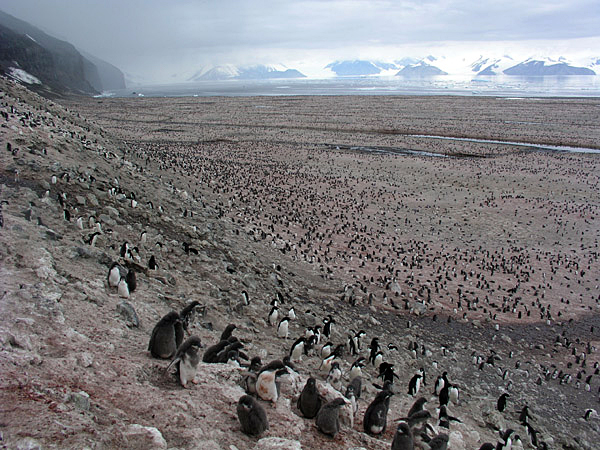
Cape Adare is home to the largest Adélie penguin colony in Antarctica. Until about 200 years ago, when humans decimated whale and seal populations, the penguins subsisted mainly on fish. But the ensuing surplus of krill created by the dearth of top predators caused a shift in diet. Photo Credit: Steve Emslie


Photo Credit: Michael Polito
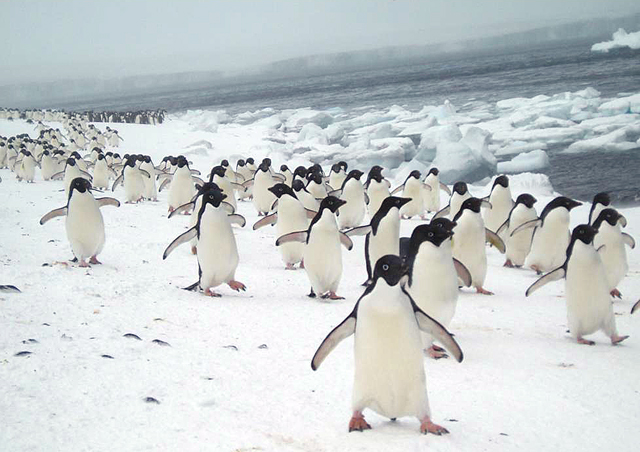
Adélie penguins march along Brown Bluff at the northern end of the Antarctic Peninsula.

Changing diet
Krill surplus 200 years ago may have caused penguins to shift prey preferences
By Peter Rejcek, Antarctic Sun Editor
Posted October 30, 2009

Most of us have heard the oft-repeated phrase, “You are what you eat.” Turns out it’s not just a way for your mother to nag you about your poor eating habits.

By studying the tissue remains of penguins in Antarctica, scientists are not only learning more about the modern diet of the continent’s iconic seabird but also what was on the menu thousands of years ago. And that information can provide insight into past climate and penguin behavior, as well as how the species could respond to future climate changes.

Steve Emslie External Non-U.S. government site, a marine ornithologist in the Department of Biology and Marine Biology External Non-U.S. government site at the University of North Carolina Wilmington External Non-U.S. government site, and his team are in the midst of a five-year grant from the National Science Foundation (NSF) External U.S. government site to determine how changes in climate and penguin prey dynamics have influenced the seabird population.

Much of their work involves collecting tissue samples, such as eggshells and feathers, from existing penguin colonies and long-extinct ones around the Antarctic Peninsula and the Ross Sea regions. Then they analyze the samples in the lab, looking at the ratios of carbon and nitrogen stable isotopes, which can provide important clues to what’s been on the dinner plate throughout the year.

“It’s mainly based on the fact that you are what you eat,” explained Emslie, who will return to McMurdo Station External U.S. government site and Ross Island this summer season to continue his fieldwork as the principal investigator (PI) on the project. “Whenever you eat something, you’re absorbing the carbon and nitrogen isotopes that are stored in that food. That ratio of carbon and nitrogen isotopes will be a part of your tissues as long as you’re eating that food.”

For example, shifts in carbon isotope ratios can indicate if a bird feeds inshore or in the marine environment. Nitrogen isotope ratios indicate how far up or down an animal feasts on the food chain.

“We look at that as a way to assess diet and how it has shifted through time as well with the Pygoscelis penguins, and also through space by the different colonies in the different regions of the Antarctic,” Emslie said.

In a study published two years ago in the journal Proceedings of the National Academy of Sciences, Emslie and collaborator William Patterson suggested that the krill-centric diet of today’s Adélie penguin is a recent phenomenon, a shift that occurred maybe 200 years ago. Their suggestion is based on a change in the nitrogen stable isotope ratio in penguin tissue.

Two hundred years ago is about the time when whalers began decimating the waters around Antarctica of krill-eating whales and seals, creating what Antarctic scientists in the 1960s and 1970s labeled as a “krill surplus,” Emslie said.

“It makes sense,” he said. “Krill per gram are just as rich in protein as fish but during a krill swarm, you can gather a lot more food a lot more quickly than you could in a school of fish. We think that’s probably why they did that switch — when krill became more abundant — even though fish were probably still available.”

Now the scientists are testing the idea further by looking at gentoos, another Pygoscelis penguin, a mostly subantarctic bird that is pushing its way across the northern end of the Antarctic Peninsula as the climate there warms and the Adélie population declines.

“We’re not sure it will show up because gentoos are known to eat a lot more fish and squid in their diet anyway compared to Adélies,” Emslie said.

The scientists know the shift in diet for the Adélies in the Ross Sea region is relatively recent because tissue samples dating back at least 40,000 years from extinct colonies in the region suggest a diet richer in fish. “Surprisingly, there weren’t any noticeable shifts [in diet] between warm and cold [periods] that are known from ice core records,” Emslie said.

“That was kind of a surprise as to why there would be a sudden shift in diet historically that wasn’t related with these climate intervals,” he said, referring to the krill surplus that resulted from whaling.

Emslie said it’s difficult to pin down an exact date on when Adélies began to prefer krill, but it was certainly happening by the beginning of the 20th century based on an analysis of Adélie eggs stored in explorer Robert F. Scott’s Hut on Cape Evans that were collected from a nearby colony sometime between 1911-1917.

“They became a nice historical sample to run isotope analysis on to see if the dietary switch had occurred by the early 1900s, and the data suggest that it had,” Emslie said. “On the peninsula you would expect it to occur first because it was hit hard first by the sealers and whalers.”

Research suggests modern Adélie diet not as krill-centric as scientists once thought

Michael Polito External Non-U.S. government site, a graduate student in Emslie’s lab External Non-U.S. government site and co-principal investigator on the project, has been working around the Antarctic Peninsula collecting penguin tissue samples from extant, or existing, colonies. By comparing the data from the stable isotope analysis to what other penguin researchers have found by physically looking at the stomach contents of the penguins, Polito hopes to refine the isotope methodology.

“They’re both useful, especially when you can use them together you can get more information than you could get just by one method alone,” he said.

For instance, it’s possible to determine the exact species of fish from stomach contents, but underestimate the mass of fish consumed, as fish digest rapidly in a penguin’s stomach, Polito said. In contrast, the stable isotope method can’t readily determine what fish species the penguins are eating, but it can provide a good estimate on how much fish the penguins consume versus krill and other prey in the ocean.

In addition, stomach content data are limited to when the penguins are on land rearing their chicks. The isotope method can also provide information about penguin diets outside of the breeding season.

And based on early results, it appears the Adélies aren’t always as reliant on krill as one might suppose from looking at what’s in their bellies during the austral summer.

“We’re definitely finding that the isotopes in general do predict a higher composition of fish in the diet than the stomach content do. It still looks like during the chick-rearing period krill are still dominant,” Polito said. “Based on the isotope data, fish appear to be relatively more important to penguins during the pre-breeding period than the breeding period.”

That finding is important but puzzling. Researchers working along the Antarctic Peninsula have reported that Adélie colonies are disappearing, their fate apparently linked to the diminishing sea ice in the region from warming temperatures. Krill also use sea ice as a key habitat. Hence, the Adélies face a double climate whammy — loss of their sea ice habitat and loss of a primary prey.

But if fish still remain a staple, why are Adélie numbers declining so dramatically? Scientists don’t really have an answer at this point. Emslie noted that part of the problem is that fish have become highly depleted as well from fisheries. “That means they have no other choices left,” he said of the Adélies.

Polito’s work to improve the isotope methodology also involves determining what other variables may be at work influencing the carbon and nitrogen ratios. For example, it turns out the size of the krill — from the juvenile stage to the adulthood — might affect their stable isotope ratio.

“Once we know how variable krill is and why it’s variable, that’s going to allow us to predict with greater accuracy the penguin diet itself.

“The modern work that we do is really designed to gain more insight about the past as well as the future,” Polito added. “We want to know how penguins respond to changes in their environment, be it climate or food availability.”

NSF-funded research in this story: Steven Emslie, Michael Polito and William Patterson, University of North Carolina Wilmington, Award No. 0739575

Source:
http://antarcticsun.usap.gov/science/contentHandler.cfm?id=1938

Penguins on the Edge

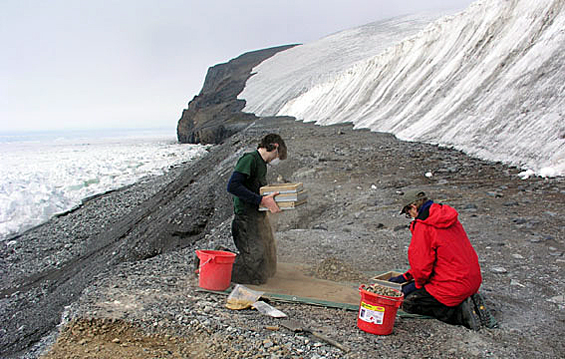
Scientists use screens to sift through dirt on Beaufort Island, searching for remains of ancient penguin colonies. Ornithologist Steve Emslie has found remains as old as 40,000 years on Beautfort Island.


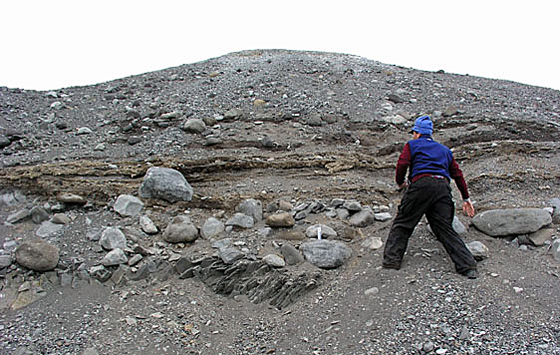
A scientist examines molt layers in a glacial moraine on Beaufort Island.

Penguins on the edge
Location of ancient colonies follow the ebb and flow of Antarctic ice
By Peter Rejcek, Antarctic Sun Editor
Posted October 30, 2009

Location, location, location. For marine ornithologist Steve Emslie External Non-U.S. government site, the long-abandoned homes of Adélie penguins in Antarctica are markers in time that help define how far the continent’s ice sheets advanced and retreated for the last 45,000 years.

“The whole pattern of the colonies coming in and out of the Ross Sea fits really nicely with the forward and backward movement of the ice sheet,” said Emslie, the principal investigator on a National Science Foundation External U.S. government site grant to study how population dynamics of the three Pygoscelis penguin species in Antarctica relate to changes in prey availability and climate.

Scientists have a pretty good idea of what the climate in Antarctica was like over the last 45 millennia thanks largely to the atmospheric record from ice cores. Less well known is the location of the ice sheet edge as the atmosphere alternately warmed and cooled.

By locating and dating Adélie penguin colonies, mainly in the Ross Sea region, Emslie has been able to interpret how the ice moved. That’s because penguins re-establish their seasonal colonies in the same ice-free areas every year unless conditions force them to move.

For instance, in a study published in Geology in 2007, Emslie and his colleagues, geologists Larry Coats and Kathy Licht, determined from the existence of former colonies along the Victoria Land coast that open water existed in the southern Ross Sea from about 40,000 to 27,000 years ago. Then the ice began to advance, reaching as far as Coulman Island, about 300 kilometers north of the current edge of the Ross Ice Shelf External U.S. government site.

The climate pendulum began to swing the other away about 13,000 years ago with the start of the warmer Holocene. As the ice retreated back south, the penguins returned and re-colonized the coast, especially the Scott Coast in the southern Ross Sea, Emslie said.

Then, about 2,000 years ago, a cold snap or perhaps the presence of too much sea ice, caused the penguins to leave their colonies for a thousand years, most apparently retreating to Cape Adare far to the north, where radiocarbon dates indicate that occupation began there at that time.

“Cape Adare is now the largest Adélie penguin colony in the Antarctic, but it is definitely not the oldest,” Emslie noted.

Even after ice conditions became more favorable for the Adélies to return south, they didn’t, except for some apparently intrepid birds that founded the large colonies around Ross Island today, according to Emslie.

“So far, the data indicate that Adélie penguins, even though they’re super abundant on Ross Island today, that only occurred in the last 500 years,” he said. “They still have not reoccupied the Scott Coast, probably because of persistent annual sea ice that blocks access to that shoreline.”

Emslie and members of his research team, including a geologist from China, will revisit previous sites at Cape Bird and Cape Crozier to collect more tissue samples such as feathers, eggshells and even mummified bodies. The scientists use the organic material for radiocarbon dating — measuring the radioactive decay of radioisotope carbon-14 — to determine the age of the remains.
Molt layers in a glacial moraine.
Photo Credit: Steve Emslie
A scientist examines molt layers in a glacial moraine on Beaufort Island.

The field plan also calls for searching for more remains on Beaufort Island, which hosts the oldest samples, dating back more than 40,000 years.

Emslie’s group is one of very few using the historical location of animals like penguins to interpret ice conditions in the past. Another team, led by Brenda Hall External Non-U.S. government site with the University of Maine External Non-U.S. government site, has done similar work in the region using abandoned elephant seal colonies. [See previous article: Cradle to grave.]

Any differences? Well, it sounds like it’s much easier to locate lost penguin colonies than elephant seal colonies, where there are no definite signs to mark the remains, requiring the researchers to get down on hands and knees to search for bits of tissue from skin and hair.

Not so with Adélie penguin colonies, where the birds stack pebbles into little mounds to make a nest.

“Once you have an eye for what an abandoned colony looks like, they stand out pretty well. You can often see them from a distance away,” Emslie said. “I scan large areas with binoculars and tell whether or not abandoned sites are possible.”

Then it’s a matter of digging into the ground in tightly controlled increments, screening for samples. “You excavate them like an archaeological site,” he explained.

“There’s no other place in the world where you can have such good preservation of the same species through time that is also a good indicator of environmental change like the Adélie penguin. There’s nothing in the Arctic that we can use like that,” Emslie said.

“I think it’s pretty remarkable, pretty unique to be able to do this in the Antarctic with these preserved, ancient colonies, some as old as 40,000 years looking like they were abandoned yesterday.”

Source:
http://antarcticsun.usap.gov/science/contentHandler.cfm?id=1941

Wednesday, October 14, 2009

Penguin Food: How 'superswarms' of krill gather


Krill swarm from above
An extraordinary gathering


Antarctic krill (Euphausia superba)


How 'superswarms' of krill gather
By Matt Walker
Editor, Earth News


When krill come together, they form some of the largest gatherings of life on the planet.

Now scientists have discovered just how these small marine crustaceans do it.

Huge 'superswarms' containing trillions of krill are formed by juveniles not adults, and these swarms are even denser than experts supposed.

That suggests that all krill in the Southern Ocean are more vulnerable to overfishing than previously thought, the scientists warn.

Krill are small shrimp-like crustaceans that gather in huge numbers.

Previous research has found that some gatherings of Antarctic krill (Euphausia superba) can stretch for tens of kilometres.

It was astonishing how much biomass could be concentrated into such a small area
British Antarctic Survey scientist Dr Geraint Tarling

But while huge swarms are known to exist, scientists did not really understand why some swarms are bigger than others, and what drives krill to gather in this way.

So researchers working for the British Antarctic Survey (BAS) decided to investigate the phenomenon.

Led by Dr Geraint Tarling, a BAS researcher based in Cambridge, UK, the research team studied the composition and structure of 4525 separate krill swarms in the Scotia Sea, a vast expanse of water in the Southern Ocean.

The team used echo-sounding equipment, which works much like underwater radar, to find the krill across an area of water equivalent to the eastern half of the Atlantic Ocean.

What they found surprised them.

Krill tend to gather into two distinct types of swarm.

Some krill gather into smaller swarms, no longer than 50m long and up to 4m deep.

These swarms are not very tightly packed, with just ten individual krill per cubic metre, on average.
Antarctic krill (Euphausia superba)
A lone shrimp

However, other much bigger swarms also occur.

Dubbed "superswarms", these are an order of magnitude larger in area, often stretching over one kilometre in length, and averaging almost 30m deep.

What is more, these superswarms are much more densely packed, containing up to ten times greater density of animals.

"I was coming at it thinking there might be small swarms tightly packed, and then large swarms that were a bit more diffuse," says Dr Tarling.

"But what we actually found was the opposite. There were small swarms that were quite diffuse and large swarms that were tightly packed."

That means that the majority of krill living in the Antarctic Ocean at any one time will exist within a few, huge superswarms.

"We talking trillions of krill in one aggregation," explains Dr Tarling.

"Ten or 12 swarms could explain 60 or 70% of the biomass in an area the size of the eastern Atlantic."

"It was astonishing how much biomass could be concentrated into such a small area."

Youthful gathering

The scientists then searched for reasons why such superswarms form.

Certain factors made superswarms more likely.

"The factors we identified included whether there was more likely to be a lot of food around or not, and when there wasn't that much food around, they tended to form larger swarms," says Dr Tarling.
Acoustic image of krill swarm
A superswarm of krill located by echosounder (swarm shown in red)

The small, diffuse swarms are usually formed by mature, adult krill, the researchers discovered.

However, the huge superswarms are formed by juvenile krill.

"Where the animals were less mature, they were more likely to form the larger swarms," says Dr Tarling.

"Why they do that I don't know."

Nightime mystery

One possible explanation could be that swarming together offers individual krill protection against marine predators such as whales or seals.

"All types of swarms are probably to a greater or lesser extent an antipredator response. There is safety in numbers, the predator confusion affect," Dr Tarling says.

But swarming comes at a cost, as each individual shrimp has to compete with millions of others for food.

Adult krill are quite negatively buoyant, and have to keep swimming to stay afloat. That takes a lot of energy, which must be supplied by food, so adult krill likely want to avoid competing with millions of others for their next meal.

But juvenile krill are more buoyant, and need to eat less. So they can afford to gather into huge superswarms for protection.

Another reason could be that researchers have previously shown it is more energetically efficient to be in swarm than be isolated.

"For a juvenile that wants to grow very quickly, saving energy could be a bonus for them," says Dr Tarling.

One mystery to emerge from the research, which is published in the journal Deep Sea Research I, is that superswarms are more likely to gather at night.

"That is more puzzling for us to explain," says Dr Tarling.

"Up until this point, most polar biologists believed that the swarms dispersed [at night], because that's the time they feed."

"When daylight comes they get back into the swarm again for the antipredator benefit. But we found the opposite to that."

Vulnerable to overfishing

The discovery that most krill in the Southern Ocean can be found gathered into just a few superswarms has significant implications for how the animals are fished, Dr Tarling warns.

Fishing fleets can efficiently locate and scoop up whole swarms of krill.

But by fishing out just a few huge superswarms, they may be removing the majority of krill living in the entire ocean.

"Focusing on large swarms can have a much larger effect on the environment than you would predict."

Source:
http://news.bbc.co.uk/earth/hi/earth_news/newsid_8299000/8299690.stm

Saturday, October 10, 2009

Archaeopteryx Was Not Very Bird-like


Archaeopteryx Was Not Very Bird-like: Inside The First Bird, Surprising Signs Of A Dinosaur

ScienceDaily (Oct. 9, 2009) — The raptor-like Archaeopteryx has long been viewed as the archetypal first bird, but new research reveals that it was actually a lot less "bird-like" than scientists had believed.

In fact, the landmark study led by paleobiologist Gregory M. Erickson of The Florida State University has upended the iconic first-known-bird image of Archaeopteryx (from the Greek for "ancient wing"), which lived 150 million years ago during the Late Jurassic period in what is now Germany. Instead, the animal has been recast as more of a feathered dinosaur -- bird on the outside, dinosaur on the inside.

That's because new, microscopic images of the ancient cells and blood vessels inside the bones of the winged, feathered, claw-handed creature show unexpectedly slow growth and maturation that took years, similar to that found in dinosaurs, from which birds evolved. In contrast, living birds grow rapidly and mature in a matter of weeks.

Also groundbreaking is the finding that the rapid bone growth common to all living birds but surprisingly absent from the Archaeopteryx was not necessary for avian dinosaur flight.

The study is published in the Oct. 9, 2009, issue of the journal PLoS ONE. In addition to Erickson, an associate professor in Florida State's Department of Biological Science and a research associate at the American Museum of Natural History, co-authors include Florida State University biologist Brian D. Inouye and other U.S. scientists, as well as researchers from Germany and China.

"Living birds mature very quickly," Erickson said. "That's why we rarely see baby birds among flocks of invariably identical-size pigeons. Slow-growing animals such as Archaeopteryx would look foreign to contemporary bird-watchers."

Erickson said evidence already confirms that birds are, in fact, dinosaurs. "But just how dinosaur-like -- or even bird-like -- was the first bird?" he asked. "Almost nothing had been known of Archaeopteryx biology. There has been debate as to how well it flew, if at all. Some have suggested that early bird physiology may have been very different from living birds, but no one had tested fossils that were close to the base of bird ancestry."

Fossilized remains of Archaeopteryx were found in Germany in 1860, one year after Charles Darwin's "Origin of Species" was published. With its combination of bird-like features, including feathers and a wishbone, and reptilian ones -- teeth, three-fingered hands, a long bony tail -- the skeleton made evolutionary theory more credible. The 1860s evolutionist Thomas Henry Huxley saw the Archaeopteryx as a perfect transition between birds and reptiles. Erickson calls it "the poster child for evolution."

"For our study, which required tremendous collaboration, we set out to determine how Archaeopteryx grew and compare its growth to living birds, closely related non-avian dinosaurs, and other early birds that came after it," Erickson said. "I went to Munich with my colleague Mark Norell from the American Museum of Natural History, and we met with Oliver Rauhut, curator of the Bavarian State Collection for Palaeontology and Geology, which houses a small juvenile Archaeopteryx that is one of 10 specimens discovered to date. From that specimen, we extracted tiny bone chips and then examined them microscopically."

Surprisingly, the bones of the juvenile Archaeopteryx were not the highly vascularized, fast-growing type, as in other avian dinosaurs. Instead, Erickson found lizard-like, dense, nearly avascular bone.

"It led us to ask, 'Did Archaeopteryx grow in a unique way?'" he said.

To explain the strange bone type, the researchers also examined different-size species of dinosaurs that were close relatives of Archaeopteryx, including Deinonychosaurs, the raptors of "Jurassic Park" fame. They then looked to colleagues in China for specimens of two of the earliest birds: Jeholornis prima, a long-tailed creature, and the short-tailed Sapeornis chaochengensi, which had three fingers and teeth.

"In the smallest dinosaur specimens, and in an early bird, we found the same bone type as in the juvenile Archaopteryx specimen," Erickson said.

Next, the research team plugged bone formation rates into the sizes of the Archaeopteryx femora (thigh bones) to predict its rate of growth.

"We learned that the adult would have been raven-sized and taken about 970 days to mature," Erickson said. "Some same-size birds today can do likewise in eight or nine weeks. In contrast, maximal growth rates for Archaeopteryx resemble dinosaur rates, which are three times slower than living birds and four times faster than living reptiles.

"From these findings, we see that the physiological and metabolic transition into true birds occurred millions of years after Archaeopteryx," he said. "But, perhaps equally important, we've shown that avians were able to fly even with dinosaur physiology."

Inouye added, "Our data on dinosaur growth rates and survivorship are bringing modern physiology and population biology to a field that has historically focused more on finding and naming fossil species."

Funding for the study came from the National Science Foundation (NSF); Germany's Deutsche Forschungsgemeinschaft (DFG); and The Major Basic Research Projects of the Ministry of Science and Technology of China.

In addition to Gregory Erickson (first author) and Brian Inouye of Florida State University's Department of Biological Science in Tallahassee, Fla., co-authors of the PLoS ONE paper are Oliver W. M. Rauhut, Bavarian State Collection for Palaeontology and Geology, LMU Munich, Munich, Germany; Zhonghe Zhou, Institute of Vertebrate Paleontology and Paleoanthropology, Chinese Academy of Sciences, Beijing, China; Alan Turner, Department of Anatomical Sciences, Stony Brook University, Stony Brook, N.Y.; Dongyu Hu, Paleontological Institute, Shenyang Normal University, Shenyang, China; and Mark Norell, Division of Paleontology, American Museum of Natural History, New York, N.Y.

Journal reference:

1. Erickson et al. Was Dinosaurian Physiology Inherited by Birds? Reconciling Slow Growth in Archaeopteryx. PLoS ONE, 2009; 4 (10): e7390 DOI: 10.1371/journal.pone.0007390

Adapted from materials provided by Florida State University, via EurekAlert!, a service of AAAS.

Florida State University. "Archaeopteryx Was Not Very Bird-like: Inside The First Bird, Surprising Signs Of A Dinosaur." ScienceDaily 9 October 2009. 10 October 2009 <http://www.sciencedaily.com­ /releases/2009/10/091009090436.htm>.

Wednesday, September 30, 2009

Feathery Four-winged Dinosaur Fossil Found In China Bridges Transition To Birds


Feathery Four-winged Dinosaur Fossil Found In China Bridges Transition To Birds

ScienceDaily (Sep. 29, 2009) — A fossil of a bird-like dinosaur with four wings has been discovered in northeastern China. The specimen bridges a critical gap in the transition from dinosaurs to birds, and reveals new insights into the origin evolution of feathers.

The transition from dinosaurs to birds is poorly understood because of the lack of well-preserved fossils, and many scientists argue that bird-like dinosaurs appear too late in the fossil record to be the true ancestors of birds.

In the journal Nature this week, Xing Xu and colleagues describe an exceptionally well-preserved fossil of Anchiornis huxleyi from the province of Liaoning, China. Long feathers cover the arms and tail, but also the feet, suggesting that a four-winged stage may have existed in the transition to birds.

Anchiornis huxleyi was previously thought to be a primitive bird, but closer inspection reveals that it should be assigned to the Troodontidae — a group of dinosaurs closely related to birds.

The authors date the fossil to the earliest Late Jurassic, meaning that it is the oldest bird-like dinosaur reported so far, and older than Archaeopteryx, the earliest known bird.

They conclude that the presence of such a species at this time in the fossil record effectively disputes the argument that bird-like dinosaurs appeared too late to be the ancestors of birds.

Journal reference:

1. Dongyu Hu, Lianhai Hou, Lijun Zhang, Xing Xu. A pre-Archaeopteryx troodontid theropod from China with long feathers on the metatarsus. Nature, 2009; DOI: 10.1038/nature08322

Adapted from materials provided by Nature.

Nature. "Feathery Four-winged Dinosaur Fossil Found In China Bridges Transition To Birds." ScienceDaily 29 September 2009. 30 September 2009 <http://www.sciencedaily.com­ /releases/2009/09/090928205415.htm>.

Monday, September 28, 2009

King penguins make a comeback


Posted Mon Sep 28, 2009 5:34am AEST

King Penguins re-populating in Southern Ocean

King Penguins were virtually wiped out on Macquarie Island about 100 years ago.
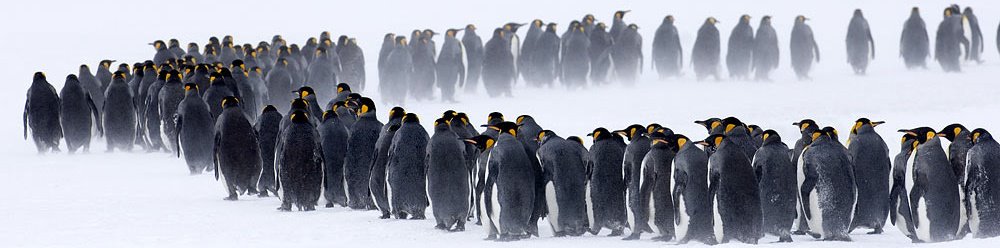
Scientists are celebrating the re-colonisation of king penguins on Macquarie Island in the Southern Ocean.

When Macquarie Island was discovered in 1810, it was teeming with king penguins, but by the turn of the century, hundreds of thousands of birds had been slaughtered for blubber oil.

Only a small colony of the birds survived at Lusitania Bay on the island.

Almost 100 years later, John van den Hoff from the Australian Antarctic Division says he is surprised to find King Penguins at the Macquarie Island isthmus where a century ago they had been exterminated.

"Without having read the historical accounts, we had no idea there were ever birds on the isthmus," he said.

He believes the population at Lusitania Bay has grown to the point that penguins are looking for more real estate.

"There are now 250 chicks in that colony and growing," he said.

"We hope it will continue to grow and perhaps the numbers will reach such a point on the isthmus that they'll have to move on to colonise other parts of the island as well."

Penguin biologist Barbara Wienecke says finding the population has recovered is a rare occurrence.

"There are only very few documented examples where colonies have popped up again," she said.

"All species have an extraordinary affinity to the colonies from which they would have left as fledglings, so to hear that a brand new colony is popping up on an island ... is really fantastic news."

Source:
http://www.abc.net.au/news/stories/2009/09/28/2697885.htm

Tuesday, September 15, 2009

Dee Boersma wins Heinz Award


September 15, 2009
Dee Boersma wins Heinz Award

Dee Boersma is among 10 recipients of the Heinz Family Foundation awards given to people whose achievements have fostered a cleaner, greener and more sustainable world.

Each recipient will receive $100,000 and a medallion inscribed with the image of the late Sen. John Heinz, R-Pa., whose environmental legacy is commemorated by the awards.

Boersma, a UW biology professor, and holder of the Wadsworth Endowed Chair in Conservation Science is being honored for her extensive field study of penguins and other sea birds to promote conservation and understanding human impact on marine environments. In an effort to better communicate issues of the natural world to the public, she launched Conservation Magazine a publication for cutting -edge science and smarter conservation (www.conservationmagazine.org). For more than 25 years she and her students, working with the Wildlife Conservation Society, have studied Magellanic penguins at the Punta Tombo reserve in Argentina. She has dubbed the penguins "marine sentinels" for their warning signs about the ocean environment. Her recent work has shown that, because of climate change and other factors, during the critical period of egg incubation the penguins at Punta Tombo must swim an average of 25 miles further in search of food than they did just 10 years ago.

The awards, announced Sept. 15, were established in 1993 to honor Heinz's legacy on environmental issues.

Learn more at the Heinz Awards website:
http://www.heinzawards.net/recipients/

Source:
http://mesh.biology.washington.edu/penguinProject/home/

Saturday, July 18, 2009

How Penguins & Seals Survive Deep Dives

How Penguins & Seals Survive Deep Dives
By Jessica Meir , Scripps Institution of Oceanography (UCSD)

posted: 17 July 2009 08:48 am ET


(1)Juvenile northern elephant seals on the beach at Ano Nuevo. Credit: Jessica Meir, Scripps Institution of Oceanography at UCSD


(2)Jessica Meir scanning for the radio transmission of a seal Jessica Meir scanning for the radio transmission of a seal in our study that has returned from sea (Ano Nuevo Island). Credit: Jessica Meir, Scripps Institution of Oceanography at UCSD
Emperor penguins diving

(3)Emperor penguins diving beneath the dive holes at the Penguin Ranch. Credit: Kathi Ponganis, Scripps Institution of Oceanography at UCSD
emperor penguin colony

(4)Self portrait at the Cape Crozier emperor penguin colony. Credit: Jessica Meir, Scripps Institution of Oceanography at UCSD


This Behind the Scenes article was provided to LiveScience in partnership with the National Science Foundation.

My main research interest is physiology in extreme environments, particularly those with low levels of oxygen.

Animals that thrive in such "hypoxic" environments are ideal species to investigate for how their physiology responds. In addition, studying adaptations to hypoxia in animals at high altitude, during hibernation, or in diving environments may provide insight for understanding and treating human medical issues, such as heart attack and stroke.

My recent Ph.D. dissertation focused on the diving physiology of some of the most accomplished diving animals: emperor penguins and elephant seals. Emperor penguins can dive for almost 30 minutes on a single breath, and the record dive of a northern elephant seal is almost two hours!

Both species can dive to great depths — greater than 1,500 feet for the emperor penguin — and almost 5,000 feet (nearly a mile!) for the elephant seal. It is well-documented that animals that can dive well have enhanced oxygen-storage capability in their bodies, a feat accomplished by increased blood volumes and higher levels of the proteins that carry oxygen in the blood and muscle (hemoglobin and myoglobin).

In the lab of my thesis advisor, Paul Ponganis of the Scripps Institution of Oceanography at UC San Diego, we use various approaches to study how these animals manage their oxygen stores to achieve such extraordinary dives.

In the Antarctic, we set up the Penguin Ranch on the sea-ice of McMurdo Sound. During our study, we drilled two dive holes in the ice at our camp site, enabling the emperor penguins to dive freely in the ocean below.

In northern California, we study elephant seals while they are diving at sea. We deploy backpack-style recorders on these animals to document their physiological responses while diving.

Our work, funded by the National Science Foundation (NSF), has revealed extraordinary physiological responses and adaptations that contribute to the diving ability of these animals.

For example, one study revealed that diving emperor penguins have heart rates significantly lower than that of their heart rates at rest. During one emperor penguin’s impressive 18-minute dive, its heart rate decreased to as low as three beats per minute, with a rate of six beats per minute lasting for over five minutes during the dive. As heart rate is a very good indicator of how much oxygen is utilized, decreased heart rates during dives correspond to conservation of oxygen, enabling the animals to dive for a longer time.

To provide a direct look at oxygen depletion, we also measured the levels of oxygen in the blood during the dive using an oxygen electrode. This electrode continuously measured the amount of oxygen in the blood, documenting the rate and extent of oxygen depletion during the dive and providing us with knowledge of how these animals manage their oxygen stores.

Both emperor penguins and elephant seals can tolerate exceptionally low levels of oxygen in their blood, far below the limits of humans and other animals. This assists them in managing oxygen efficiently and contributes to their ability to dive and obtain food. Combined with their enhanced oxygen stores, other physiological responses like reduced heart rates, and factors such as swimming styles and their hydrodynamic body shape, these animals are well adapted to flourish in underwater environments.

Now that I have completed my Ph.D. work with diving animals, I will embark upon studies with another remarkable species: the high-flying bar-headed goose. This bird accomplishes the extraordinary feat of flying directly over the Himalayan mountain range during its semi-annual migration from wintering grounds in India to breeding grounds in Tibet.

Although other migratory birds use alternative, lower altitude routes through mountain passes, flocks of these exceptional high-flying geese have been sighted above the summits of Mt. Everest (29,000 feet) and Annapurna I (26,500 feet). Exercise at these altitudes during the migration may be completed in a single, non-stop flight, with no allowance for acclimatization, flying from near sea level in India to altitudes approaching 9,000 meters in less than one day.

Oxygen levels at this altitude are only about one fifth that at sea level, yet the bar-headed goose increases its oxygen consumption 10- to 20-fold during flight. Birds are generally more tolerant of high altitude than mammals, but sustained flight at these reduced levels of oxygen is certainly exceptional.

The goal of this project is to explore the physiological adaptations in this species, with the overarching purpose of understanding tissue and cellular hypoxia tolerance in an animal that has evolved specifically to maintain performance in hypoxia.

With support of an NSF International Research Fellowship, I will initiate this work in the fall of 2009 in collaboration with researchers at the University of British Columbia in Vancouver, Canada. We will investigate oxygen transport from the respiratory system to the tissue during flight in the bar-headed goose, with specific focus on delivery to the heart.

The next natural question after documenting what these impressive physiological responses are in any of these species, is of course to ask how they are achieved. We will address the mechanisms of hypoxia tolerance in the heart of the bar-headed goose using a variety of physiological, morphological and intracellular approaches.

This work may also provide clues about adaptations in these animals that could benefit humans in the future. For example, tolerance to hypoxia has implications for better methods of harvesting and preserving organs for transplant, and treatment of heart attack and stroke victims.

These animals somehow withstand seriously low levels of oxygen in the blood and tissues that are catastrophic to humans. The issue of reperfusion injury — tissue damage caused by oxygen free radicals when blood flow resumes to an organ which has been deprived of blood — is also relevant. This is applicable to a variety of issues in human medicine, though diving animals appear immune to such concerns.

A complete understanding of the physiology of these organisms is also essential to interpreting their role within ecosystems. Such knowledge has clear ecological and conservation implications and is particularly relevant in the face of global climate change.

Editor's Note: This research was supported by the National Science Foundation (NSF), the federal agency charged with funding basic research and education across all fields of science and engineering. See the Behind the Scenes Archive.

Source:
http://www.livescience.com/animals/090717-bts-extreme-physiology.html