|
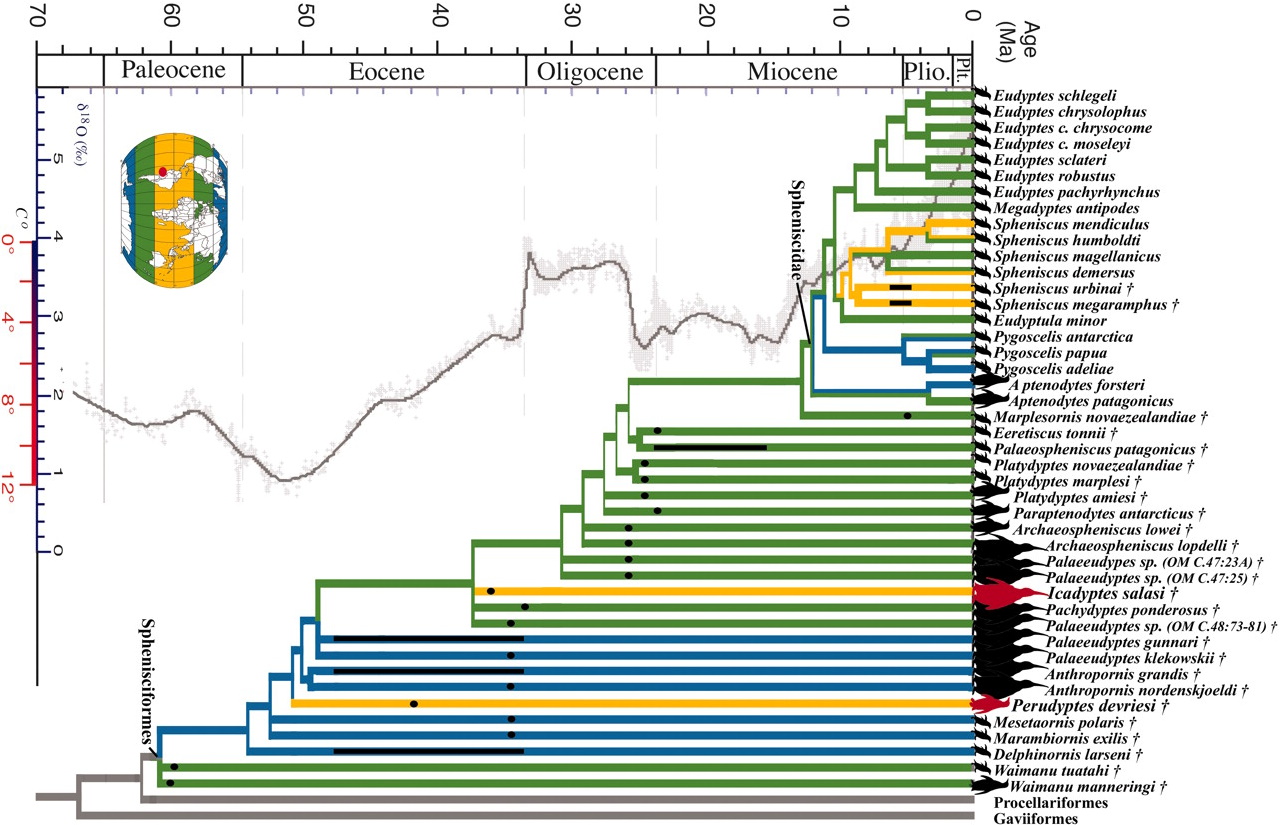
| Stratigraphically
calibrated phylogeny of Sphenisciformes correlated with tectonic
movements and changing ocean circulation in the southern hemisphere
showing how: (1) the Australian taxa are dispersed across the phylogeny
temporally; (2) the Australian continent becomes progressively more
isolated from other southern continents; and (3) a strengthened ACC
(indicated by the black arrows) provides a new dispersal vector to
Australia despite the presence of a strengthening Antarctic Polar Front
(APF). The bottom palaeomaps are based on reconstructions in Lawver
& Gahagan [9]. Penguin silhouettes show overall trend for decreasing
body size in penguin evolution: Top, archaic giant stem penguin taxa;
middle medium-sized stem penguin taxa; bottom, smaller crown penguin
taxa (silhouette credit: Fir0002/Flagstaffotos (original photo), John E.
McCormack, Michael G. Harvey, Brant C. Faircloth, Nicholas G. Crawford,
Travis C. Glenn, Robb T. Brumfield & T. Michael Keesey, used under a
CC BY 3.0 Attribution Unported Licence
(http://creativecommons.org/licenses/by/3.0/))). Palaeoceanographic
reconstructions after [9,72-74]. Palaeoceanographic abbreviations: EAC =
East Australian Current, pEAC = palaeo-East Australian Current, pRG =
palaeo-Ross Sea Gyre/Tasman Current, RG = Ross Sea Gyre. The relative
strength of the ACC and APF is shown by thickening arrows and lines
though time. Black arrow = cold currents, red arrows = warm currents. Credit: Park et al.; CCAL |
Only the little penguin remains today, and pre-Quarternary evidence of this species and its ancestors in Australia is lacking. To update our understanding of Australian penguin evolutionary history, the authors of the study analysed recently collected penguin fossils and compared them to known species, including now-extinct 'giant penguins,' and presented a new phylogenetic tree in the context of biogeographical events on the Australian continent.
The authors propose that Australia's unique biogeographical history allowed for multiple dispersals of penguins to the continent during the Cenezoic or Age of Mammals, and that ancestors of the modern little penguins arrived in Australia with the help of a strengthened Antarctic Circumpolar Current.
While evolutionary trees are constructed as best estimates based on sometimes-limited fossil records, the authors suggest these findings shed new insights into the evolutionary trajectory of penguins in Australia.
Reference:
Travis Park, Erich M. G. Fitzgerald, Stephen J. Gallagher, Ellyn Tomkins, Tony Allan. New Miocene Fossils and the History of Penguins in Australia. PLOS ONE, 2016; 11 (4): e0153915 DOI: 10.1371/journal.pone.0153915
Note: The above post is reprinted from materials provided by PLOS.
source


 AsianScientist (Mar. 8, 2016) - Have you ever wondered
how penguins stay warm and dry despite their sub-zero living
environments? Now, researchers from Beihang University have identified
microstructures on penguin feathers responsible for their anti-icing
properties, and have even designed a feather-inspired nanofiber membrane
that can be used as an ice-proof material. Their results have been
published in The Journal of Physical Chemistry C.
AsianScientist (Mar. 8, 2016) - Have you ever wondered
how penguins stay warm and dry despite their sub-zero living
environments? Now, researchers from Beihang University have identified
microstructures on penguin feathers responsible for their anti-icing
properties, and have even designed a feather-inspired nanofiber membrane
that can be used as an ice-proof material. Their results have been
published in The Journal of Physical Chemistry C.


 Under
the microscope, the polyimide replica feather (top) has a radial
density distribution (bottom) similar to a real penguin feather ©
American Chemical Society
Under
the microscope, the polyimide replica feather (top) has a radial
density distribution (bottom) similar to a real penguin feather ©
American Chemical Society
 More than 600,000 Adelie penguins nest on Cape Adare, Antarctica.Steve Emslie, UNCW