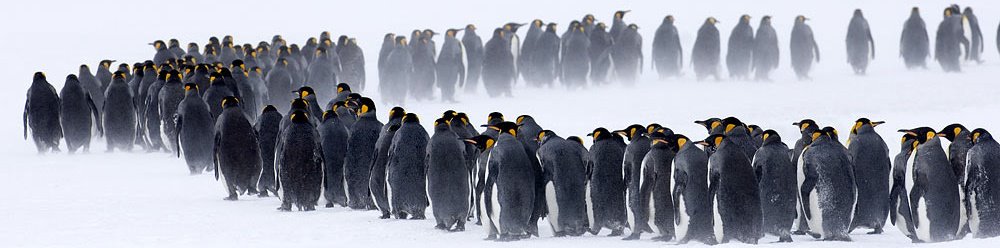
With its spiky head plumage and intense red eyes, the southern rockhopper penguin (Eudypteschrysocome,
seen above) looks more like a slightly predatory guy at a college party
than a committed monogamous partner. But these males mate for life,
reuniting with the same female year after year during mating season.
Despite their monogamous mating patterns, however, the birds really
don’t spend much time together, according to a new study. Using GPS
trackers mounted to the penguins’ legs, scientists monitored 16 birds
from a colony in the Falkland Islands over the course of a mating
season. The data show that males arrived at the nesting site
approximately 6 days before their female counterparts and stayed about 6
days longer. However, the short mating season means the pairs are only
united for about 20 to 30 days a year. And when they were separated, it
was usually by a large distance: During the winter months, partners were separated by an average distance of about 600 km, and one pair was observed as far as 2500 km apart, the team reports online today in Biology Letters.
Despite the large spatial segregation, their habitats were quite
similar, ruling out the possibility that partners are spending the
winter months apart because of sex-based differences in habitat or food
preference. So why don’t the birds just stick together? So far it’s
still a mystery, but the team speculates that if the birds arrived at
and left the nesting site at the same time, they’d be much more likely
to spend the winter together. But because the females show up late and
leave early, the cost of finding one another after a week of dispersing
through the open ocean might not be worth it—it’s easier to just meet
back at the nesting site next year.
This Eocene Antarctic fossil penguin skull was discovered at La Meseta Formation at Seymour Island. Credit: Journal of Vertebrate PaleontologyWhen they're not being the stars of various
animated movies, penguins are playing an important role in evolutionary
studies. Penguins are unique among modern birds in that they 'fly'
through the water. Although flightless in air, penguins have a number of
adaptations which allow them glide effortlessly through the water. And
some of these adaptations are in an unlikely part of their anatomy -
their brains. Recent finds of fossil penguins from 35 million year old
sediments in Antarctica have begun to shed light on the changes in
penguin brains that accompanied their transition to water.
"Comparing multiple species (extinct and living penguins
and living birds that both fly and dive), in the way our study does,
brings us closer to the answers of two major questions about penguin
brain evolution: (1) what major morphological changes have occurred, (2)
when did these changes occur?" said lead author Claudia Tambussi. The
new finds, which are described in the latest issue of the Journal of Vertebrate Paleontology, include skulls which are so well-preserved that they could be CT-scanned to analyze their internal structure.
These scans revealed some interesting traits of these early penguins
that speak to their transitional nature. Many of these findings have to
do with the sensory abilities of these fossil species. For instance, one
area, the Wulst, which is associated with complex visual functions, is
enlarged. "The Antarctic fossils reveal that the neuroanatomy of
penguins was still evolving roughly 30 million years after the loss of
aerial flight, with trends such as the expansion of the Wulst and
reduction of the olfactory bulbs still in progress", said co-author
Daniel Ksepka.
In addition to the increase in visual complexity, and reduction in
olfaction, findings in the ear region shed light on the head position
and equilibrium-maintaining abilities of the fossil penguins. All
together, the findings show that these early penguins had many of the
adaptations of living forms, while having a few unique traits not seen
in the modern ones. Not only that, but some of these adaptations are
found in modern flying birds, attesting to penguins' unique mode of
swimming.
In this gif, one of the Antarctic Eocene skulls is featured. The virtual brain
is in blue: in red the right inner ear and carotids; in yellow the
olfactory bulbs and some nerves. Credit: Journal of Vertebrate Paleontology
Said Ksepka, "Penguins are considered flightless, but when it comes
to wing-propelled diving they are essentially practicing underwater
flight. The brain morphology reflects this as penguins retain an overall
"flight-ready" brain."
On Seymour Island emerges the La Meseta Formation, the most
prolific localities for fossil penguin remains worldwide in terms of raw
abundance. Credit: Journal of Vertebrate Paleontology
satellite image of the Galápagos Islands in 2002. Almost all of
the Galápagos penguins live along the western coasts of Isabela and
Fernandina, and two–thirds of the birds reside along the southwestern
bulge of Isabela. Credit: Imagery NASA
Shifts in trade winds and ocean currents powered a resurgence of
endangered Galápagos penguins over the past 30 years, according to a new
study. These changes enlarged a cold pool of water the penguins rely on
for food and breeding - an expansion that could continue as the climate
changes over the coming decades, the study's authors said.
The Galápagos Islands, a chain of islands 1,000 kilometers (600 miles) west of mainland Ecuador, are home to the only penguins
in the Northern Hemisphere. The 48-centimeter (19-inch) tall black and
white Galápagos penguins landed on the endangered species list in 2000
after the population plummeted to only a few hundred individuals and are
now considered the rarest penguins in the world.
Most of the penguins live on the archipelago's westernmost islands,
Isabela and Fernandina, where they feed on fish that live in a cold pool
of water on the islands' southwestern coasts. The cold pool is fed by
an ocean current,
the Equatorial Undercurrent, which flows toward the islands from the
west. When the current runs into Isabela and Fernandina, water surges
upward, bringing cold, nutrient-rich water to the surface.
New research suggests shifts in wind currents over the past three
decades, possibly due to climate change and natural variability, have
nudged the Equatorial Undercurrent north. The changing current expanded
the nutrient-rich, cold water
farther north along the coasts of the two islands, likely bolstering
algae and fish numbers in the cold pool. This allowed the penguin
population to double over the past 30 years, swelling to more than 1,000
birds by 2014, according to the new study.
Climate change could further shift wind patterns and ocean currents,
expanding cold water further north along the coasts of Isabela and
Fernandina and driving fish populations higher, according to the new
study.
Penguins, as well as other animals like fur seals and marine iguanas
that feed and reproduce near the cold waters, may increase in numbers as
the northwestern coasts of the islands become more habitable, said the
study's authors. They noted that wind and ocean currents could also
return to earlier conditions, leading to a decline in penguin
populations.
"The penguins are the innocent bystanders experiencing feast or
famine depending on what the Equatorial Undercurrent is doing from year
to year," said Kristopher Karnauskas, a climate scientist who performed
the research while at Woods Hole Oceanographic Institution in Cape Cod,
Massachusetts, and lead author of the new study recently accepted in Geophysical Research Letters, an American Geophysical Union journal.
The new findings could help inform conservation efforts to save the
endangered penguins, said the study's authors. Increasing efforts on the
northern coasts of the islands and expanding marine-protected areas
north to where the penguins are now feeding and breeding could support
population growth, the study's authors said.
Karnauskas notes that the vast majority of marine organisms will be
negatively affected by the rise in ocean temperatures and acidification
that are expected to occur across the globe as a result of climate
change.
"With climate change, there are a lot of new and increasing stresses
on ecosystems, but biology sometimes surprises us," said Karnauskas.
"There might be places—little outposts—where ecosystems might thrive
just by coincidence."
(Photo : Flickr: Aaron Logan)
Penguin population changes
The Galápagos penguin population tenuously hangs onto the islands
that so enthralled Charles Darwin during his visit in 1835. The penguins
once numbered around 2,000 individuals, but in the early 1980s a strong
El Niño - a time when sea surface temperatures in the tropical Pacific
are unusually warm - brought their numbers down to less than 500 birds.
Dogs, cats and rats introduced to the islands also stymied the penguin
population by attacking the birds, disturbing their nests, and
introducing new diseases, according to previous research.
Despite these setbacks, the penguins gradually increased in number in
the following decades, according to local bird counts. Researchers,
interested by the increase in penguins, noted that the birds remained
near the coldest stretches of water. Nearly all of the Galápagos
penguins live on the western coasts of Isabela and Fernandina, and
two-thirds of them huddled near the coldest waters at the southern tips
of the islands, according to previous research.
The study's authors wanted to know whether the growing numbers of
penguins were related to local changes in ocean temperature. They
combined previously-collected penguin population data from 1982 to 2014
with sea surface temperature data from satellites, ships and buoys for
the same time period.
They found that the cold pool, where sea surface temperatures are
below 22 degrees Celsius (71 degrees Fahrenheit), expanded 35 kilometers
(22 miles) farther north than where it was located at the beginning of
the study period. In the 1980s the cold water pocket reached only the
southern halves of the western coasts of Isabela and Fernandina. By
2014, the cold water pocket extended across the entire western coasts of
the islands.
Varying trade winds, ocean currents
A shift in trade winds and underwater ocean currents likely caused the Galápagos cold pool expansion, propose the authors.
Trade winds blow surface ocean waters from the southern side of the
equator to the northern side of the equator. As surface waters pile up
in the north, the water at the bottom of the pile is squished south,
nudging the Equatorial Undercurrent - a cold current that flows roughly
50 meters (160 feet) under the ocean surface - south of the equator.
Likely due to a combination of natural variation and human-caused
climate change, trade winds west of the Galápagos slackened during the
study period, lessening the pressure pushing the Equatorial Undercurrent
south, according to the new study. Consequently, the ocean current
gradually shifted north, increasing the amount of cold water coming to
the Galápagos Islands, according to the study's authors.
Satellite images showed that this expanded pool of cold water likely
encouraged the growth of phytoplankton, according to the new study. This
increase in ocean algae attracted fish to the area - the main entrée
for Galápagos penguins, suggest the authors. The largest pulses of cold
water reached the islands from July through December, coinciding with
the penguins' breeding season. The bountiful fish helped the birds
successfully reproduce and feed their young, according to the new study.
Models indicate trade winds will continue to abate in the future as
the climate warms, Karnauskas said. This could cause the undercurrent to
continue to move north, expanding the Galápagos cold pool and possibly
further raising penguin populations, he said. Other animal populations
like the endangered Galápagos fur seal and the marine iguana also may
profit from the prolific amount of food in the Galápagos cold pool,
according to the study's authors.
Wind and ocean currents could also possibly return to where they were
in the 1980s, compressing the cold pool and possibly leading to a
decline in penguins, Karnauskas added.
The new study shows how large-scale changes in the climate can act
locally, said Michelle L'Heureux, a climate scientist with the National
Oceanic and Atmospheric Administration's Climate Prediction Center in
College Park, Maryland, and not an author on the new paper.
"While it is important that we focus on the big picture with climate change, it's really the small scale that matters to the animals and plants that are impacted," she said.
Survival of endangered African penguin chicks
increased by 18 percent following a trial three-year fishery closure
around Robben Island in South Africa, a new study has found.
Survival of endangered African penguin
chicks increased by 18% following a trial three-year fishery closure
around Robben Island in South Africa, a new study from the University of
Exeter has found.
The results, which are published in the Royal Society Journal Biology Letters, indicate that even small 'no-take zones' can dramatically improve the survival chances of endangered species.
The African penguin population is in freefall, with adult survival
rates over the last decade desperately low. Although the ban on
commercial fishing off Robben Island has boosted chick survival, the
long term prospect for the species remains gloomy.
Dr Richard Sherley from the University of Exeter said: "One of the
major challenges of conserving a mobile species like the African penguin
is that once they leave a protected area they are subject to outside
pressures and dangers, including poor prey availability.
"Our study shows that small no-take zones can aid the survival of
African penguin chicks, but ultimately commercial fishing controls must
be combined with other management action if we are to reverse the
dramatic decline of this charismatic species."
African penguins feed on sardines and anchovies but fishing of these
species off Cape Town is considered to have contributed to a 69%
reduction in penguin numbers between 2001 and 2013.
The species' worsening conservation status led to experimental
fishing closures around four colonies between 2008 and 2014. These were
earlier found to reduce penguin foraging effort but a beneficial impact
on demographic parameters had not been demonstrated before this study
and so the benefits of the closures have been the subject of much
debate.
Although this study has shown that the fishery closure around Robben
Island has improved chick survival, if the current fishing pressure
exerted on sardine in particular continues on the west coast there will
still not be sufficient food to allow the penguin population to recover.
Seabirds will often respond to a scarcity of food by skipping or
abandoning breeding, opting not to re-lay after losing clutches of eggs,
or reducing the amount of food brought to the chicks leading to slow
growth, poor chick condition and mortality through starvation. African
penguins have shown all of these responses in recent years.
1501 nests were monitored at Robben Island between 2001 and 2013 to
determine chick survival rates and a hydro-acoustic survey was carried
out to estimate sardine and anchovy biomass.
Story Source:
The above post is reprinted from materials provided by University of Exeter. Note: Materials may be edited for content and length.
Journal Reference:
Richard B. Sherley, Henning Winker, Res Altwegg, Carl D. van der Lingen, Stephen C. Votier, Robert J. M. Crawford. Bottom-up effects of a no-take zone on endangered penguin demographics. Biology Letters, July 2015 DOI: 10.1098/rsbl.2015.0237
In a comprehensive assessment of Antarctic
biodiversity scientists have revealed the region is more diverse and
biologically interesting than previously thought. The team noted several
unusual ways in which patterns of biodiversity are produced in the
region. Geothermal, heated areas, such as volcanoes, have played an
important role as refuges from icy, glacial conditions on land. At sea,
wind has an especially significant effect on diversity. Windier areas
have more seabird species.
South Georgia at Sea.
Credit: Steven Chown
In a comprehensive assessment of Antarctic biodiversity, published in Nature this week, scientists have revealed the region is more diverse and biologically interesting than previously thought.
The team of scientists, led by Monash University, along with
colleagues from the British Antarctic Survey, University of Waikato in
New Zealand, and Australian National University, looked at how recent
investigations have revealed the continent and surrounding ocean is rich
in species. They are also very highly diversified into a variety of
distinct ecological regions that differ greatly from each other.
Lead author, Professor Steven Chown, School of Biological Sciences at
Monash, said the team explicitly focussed on demonstrating the
diversity of various areas of the Antarctic continent and Southern
Ocean. "Most people think of the continent as a vast, icy waste, and the sea
as uniformly populated by whales, seals and penguins. But that's simply
not true," he said. "There's much biodiversity on land, especially among the
micro-organisms, such as bacteria, and the seafloor is very rich in
larger unusual species, such as sea spiders and isopods (the marine
equivalents of slaters or wood lice). More than 8000 species are known
from the marine environment."
Dr Ceridwen Fraser, co-author from the Australian National University
said: "Each area of the Antarctic also has very different groupings of
species; while initially they may look the same, they are actually very
different."
The team also noted several unusual ways in which patterns of
biodiversity are produced in the region. Geothermal, heated areas, such
as volcanoes, have played an important role as refuges from icy, glacial
conditions on land. At sea, wind has an especially significant effect
on diversity. Windier areas have more seabird species.
Professor Chown said: "Increasing wind speeds, associated with the
ozone hole, have, quite unusually, improved conditions for wandering
albatrosses, reducing their travel time and enabling them to become much
heavier as adults."
Professor Craig Cary, co-author from the University of Waikato, New
Zealand, added: "Antarctica and the Southern Ocean have much more
biodiversity, structured in more interesting ways than ever previously
thought. Sub-glacial micro-organismal life provides an excellent example
of a surprising recent discovery."
Conservation
Professor Chown said the team also made a brief assessment of the conservation status of biodiversity in the region. "We found that in some cases conservation measures are excellent,
such as in the case of the prevention of invasive alien species,"
Professor Chown said.
For others, work by the Antarctic Treaty Parties is still required.
For example, the area covered by special protection on land (the
equivalent of national parks), and by marine protected areas at sea, is
still too small, when measured by global targets such as those of the
Strategic Plan on Biodiversity 2011-2020.
The team drew particular attention to the need for comprehensive protection of the Ross Sea.
Professor Andrew Clarke, co-author from the British Antarctic Survey
said: "This is one of the planet's last, relatively intact, large marine
ecosystems. It is unusual in this respect, and thus provides a suite of
globally significant conservation benefits and scientific insights."
The work reported in this paper is part of a larger, global effort to
further understand the biodiversity of the Antarctic region, its
conservation needs, and the science that will be needed to progress
understanding in the area.
Professor Melodie McGeoch, co-author from Monash University said:
"Ultimately, the region will require a dedicated plan for biodiversity
conservation, similar to those being developed for most other regions of
the planet. We think there's plenty of appetite for developing it."
Key findings from the review:
- The Antarctic has very
distinct biogeographic regions, each with different groups of species;
it's not simply one homogeneous area. - Terrestrial and marine
diversity has relied on a variety of refugia (shelters), including
geothermal refuges, while life has also persisted sub-glacially.
-
Antarctic micro-organismal systems can be among the most diverse
globally, but also highly specialised to arid, low nutrient conditions.
- There are good reasons to improve efforts to conserve biodiversity in the region.
Story Source:
The above post is reprinted from materials provided by Monash University. Note: Materials may be edited for content and length.
Journal Reference:
Steven L. Chown, Andrew Clarke, Ceridwen I. Fraser, S. Craig Cary, Katherine L. Moon, Melodie A. McGeoch. The changing form of Antarctic biodiversity. Nature, 2015; 522 (7557): 431 DOI: 10.1038/nature14505
Monday, 8 June 2015
Press Release: Hamilton City Council
The giant
penguin fossil
A 28 million year old
giant penguin fossil found at Kawhia in 2006 will be shown
for the first time alongside its 3D scanned profile in a new
exhibition opening at Waikato Museum on Saturday 13
June.
Waikato Museum collaborated with Massey University
to develop the exhibition, Giant in the North, and put into
context the fossil’s relevance and significance in the
scientific world. Massey University palaeontologist, Dr
Daniel Thomas scanned the 3D profile of the fossil and hopes
the resulting image can help researchers in the future
formally identify the Kawhia penguin.
“This is the
largest and most complete fossil bird from a very important
time in the history of the North Island.
“It is my hope
that we have the opportunity to formally describe the
specimen and discover the species it belongs to. There are
so few fossil penguins known from the North Island, and it
would be great to know how this specimen compares to the
giants from the South Island, and from elsewhere,” said Dr
Thomas.
Giant in the North celebrates the discovery of the
Kawhia giant penguin fossil in January 2006 by members of
the Hamilton Junior Naturalist Club (JUNATs). Other fossils
from the same geological time of the Kawhia giant penguin
(24 – 28 million years ago) will also be on display,
including a specimen of an ancient shark, found by JUNATs
patron and archaeology enthusiast Chris Templer.
Scanning
technology is now more accessible and proving to be integral
in museum collection work. In the field of palaeontology,
detailed bone features can be examined from the other side
of the world.
“The collaboration with Massey
University has been a fantastic opportunity to apply current
technology in collection research. We can now share more
detail with our visitors and involve them in the journey to
uncover the mystery surrounding this extraordinary
fossil,” said Waikato Museum Director Cherie
Meecham.
Giant Penguin Specialist
Talk
Dr Daniel Thomas will give a free public
lecture on penguin evolution and the Kawhia giant penguin at
Waikato Museum on Saturday 13 June from 2pm –
2.45pm.
For more information on the Kawhia giant penguin
and the JUNAT’s discovery, visit waikatomuseum.co.nz.
A new study of some primitive birds from the
Cretaceous shows how several separate lineages evolved adaptations for
diving. Living at the same time as the dinosaurs, Hesperornithiform bird
fossils have been found in North America, Europe and Asia in rocks
65-95 million years old. This research shows that separate lineages
became progressively more adept at diving into water to catch fishes,
like modern day loons and grebes.
Evolution of diving specializations within the Hesperornithiformes. Credit: Image courtesy of Taylor & Francis
A new study of some primitive birds from the Cretaceous shows how several separate lineages evolved adaptations for diving.
Living at the same time as the dinosaurs, Hesperornithiform bird
fossils have been found in North America, Europe and Asia in rocks 65-95
million years old. Dr Alyssa Bell and Professor Luis Chiappe of the
Dinosaur Institute, Natural History Museum of Los Angeles County,
publishing in the Journal of Systematic Palaeontology, have
undertaken a detailed analysis of their evolution, showing that separate
lineages became progressively more adept at diving into water to catch
fishes, like modern day loons and grebes.
The Hesperornithiformes are a highly derived but very understudied
group of primitive birds from the Cretaceous period. This study is the
first comprehensive phylogenetic analysis, or evaluation of evolutionary
relationships, to ever be undertaken on the entire group.
The results of this study confirm that the Hesperornithiformes do
form a single group (or clade), but that within this group the
inter-relationships of the different taxa are more complex than
previously thought. Additionally, this study finds that anatomical
changes were accompanied by enlargement in overall body size, which
increased lung capacity and allowed deeper diving.
Overall, this study provides evidence for understanding the evolution
of diving adaptations among the earliest known aquatic birds.
Story Source:
The above story is based on materials provided by Taylor & Francis. Note: Materials may be edited for content and length.
Journal Reference:
Alyssa Bell, Luis M. Chiappe. A species-level phylogeny of
the Cretaceous Hesperornithiformes (Aves: Ornithuromorpha): implications
for body size evolution amongst the earliest diving birds. Journal of Systematic Palaeontology, 2015; 1 DOI: 10.1080/14772019.2015.1036141
Photo:
Kangaroo Island is one of the few sites in Australia where penguin colonies from the east and west intermingle. (Supplied: Taronga Zoo)
Little penguins from islands off the south-eastern
and south-western coastlines of Australia tend to stick to their own, a
10-year study has found, with one exception - colonies on Kangaroo
Island. The scientists from the University of Tasmania, Deakin
University in Melbourne, University College London and the Phillip
Island Nature Park set out to examine how often little penguins leave
and join different colonies.
University of Tasmania zoology
lecturer Dr Chris Burridge said they wanted to find out whether penguins
would travel from one colony to another to breed. "If a colony was wiped out by a predator, would penguins from other colonies come to help replenish it?" she said.
Over
10 years they took DNA profiles from penguins in colonies along
Australia's southern coast from Sydney to Perth and around Tasmania. The
researchers found penguins from south-eastern colonies were genetically
similar, indicating a high rate of interbreeding among colonies there. The same was true of penguin colonies on the south-west coast.
Around the area of Kangaroo Island you can move only 30
kilometres between two different colonies and they'll be genetically
different. ~~~
University of Tasmania zoology lecturer Dr Chris Burridge
Dr Burridge said colonies on Kangaroo Island were
different, indicating populations there resulted from breeding between
penguins from eastern and western coast colonies."So in
south-east Australia we found quite a lot of movement, you can go from
Sydney to southern Tasmania to Phillip Island and the penguin colonies
are all genetically indistinguishable," she said. "But then around
the area of Kangaroo Island you can move only 30 kilometres between two
different colonies and they'll be genetically different."
She said there were several possible explanations for the genetic mixing. "It
could be just because that's where the penguins have happened to meet,
as they've expanded back out from the east and the west," she said. "Alternatively
there could be some activity in that part of the world that removed
penguins, maybe anthropogenic and now they've only recently
recolonised."
Dr Burridge said the interbreeding on Kangaroo Island had likely begun hundreds or even thousands of years ago. The research has been published in the Journal of Heredity.
Images looked at by 1.5 million online volunteers flagged up images to aid scientists in the discovery.
Louis Doré
Sunday 26 April 2015
A citizen science project has found that penguins use their faeces to melt rocky breeding sites in order to lay their eggs.
The project of 1.5 million online volunteers, organised by the
University of Oxford, clicked through 175,000 images of penguins and
flagged up images showing strange or surprising behaviour in order to
aid scientific discovery.
It suggests penguins form large groups
before they start to breed with the dark colour of their faeces
attracting heat faster than the lighter colours of the surrounding snow,
causing the area to melt faster.
The video below shows one year of the Cuverville Island Gentoo penguin colony on the Antarctic Peninsula.
Researchers hope that over the coming year, with 500,000 new images for
volunteers to look at, and cameras that will take photos every minute
during the breeding season, that they will learn more about the animals
through Penguin Watch.
Scientists synthesized
decades of scientific discoveries to illuminate the common and unique
patterns driving the extraordinary transitions that whales, dolphins,
seals and other species underwent as they moved from land to sea.
Drawing on recent breakthroughs in diverse fields such as paleontology,
molecular biology and conservation ecology, their findings offer a
comprehensive look at how life in the ocean has responded to environmental change from the Triassic to the Anthropocene. ___________________________________________________
Modern dolphins
(pictured) and extinct marine reptiles called ichthyosaurs descended
from distinct terrestrial species, but independently converged on
an extremely similar fish-like body plan although they were separated
in time by more than 50 million years. In April 2015, a team of
Smithsonian scientists synthesized decades of scientific discoveries to
illuminate the common and unique patterns driving the extraordinary
transitions that whales, dolphins, seals and other species underwent as
they moved from land to sea, offering a comprehensive look at how life
in the ocean has responded to environmental change from the Triassic to
the Anthropocene. Credit: Courtesy of NOAA
For more
than 250 million years, four-limbed land animals known as tetrapods have
repeatedly conquered the Earth's oceans. These creatures--such as
plesiosaurs, penguins and sea turtles--descended from separate groups of
terrestrial vertebrates that convergently evolved to thrive in aquatic
environments.
In a new scientific review, a team of Smithsonian scientists
synthesized decades of scientific discoveries to illuminate the common
and unique patterns driving the extraordinary transitions that whales,
dolphins, seals and other species underwent as they moved from land to
sea. Drawing on recent breakthroughs in diverse fields such as
paleontology, molecular biology and conservation ecology, their findings
offer a comprehensive look at how life in the ocean has responded to
environmental change over time. The paper also highlights how
evolutionary history informs an understanding of the impact of human
activities on marine species today. More information is available in the
April 17 issue of Science.
Marine tetrapods represent a diverse group of living and extinct
species of mammals, reptiles, amphibians and birds that all play--or
played--a critical role as large ocean predators in marine ecosystems.
The repeated transitions between land and sea have driven innovation,
convergence and diversification against a backdrop of changing marine
ecosystems and mass extinctions dating back to the Triassic period. In
this way, they provide ideal models for testing hypotheses about the
evolution of species over long periods of time. Modern species of marine
tetrapods now face a suite of human-driven impacts to their
environment, including climate change, habitat degradation, ship
collisions and underwater noise.
"We know from the fossil record that previous times of profound
change in the oceans were important turning points in the evolutionary
history of marine species," said Neil Kelley, a Peter Buck post-doctoral
researcher in the National Museum of Natural History's department of
paleobiology and lead author in the study. "Today's oceans continue to
change, largely from human activities. This paper provides the
evolutionary context for understanding how living species of marine
predators will evolve and adapt to life in the Anthropocene."
Recent investigations in the fossil record have provided new insight
into the evolution of traits that allowed marine tetrapods to thrive in
the sea. In some cases, similar anatomy evolved among lineages that
adapted to marine lifestyles. For example, modern dolphins and extinct
marine reptiles called ichthyosaurs descended from distinct terrestrial
species, but independently converged on an extremely similar fish-like
body plan although they were separated in time by more than 50 million
years.
The repeated transformation of legs adapted for walking on land
into fins is another classic example of convergent evolution. Species
ranging from seals to mosasaurs independently developed streamlined
forelimbs as they transitioned from living on land to the ocean,
allowing them to move quickly and efficiently in the water. This
transformation may have been achieved by parallel changes at the genome
level.
"Land to sea transitions have happened dozens of times among
reptiles, mammals and birds, across major mass extinctions," said
Nicholas Pyenson, the museum's curator of fossil marine mammals. "You
often get similar looking results but convergence is more than skin
deep. It can be seen on a broad range of scales, from molecules to food
webs, over hundreds of millions of years."
In the case of deep divers such as beaked whales and seals, these
species have independently evolved to have positively charged
oxygen-binding proteins called myoglobin in their muscles, allowing them
to survive underwater for long periods of time. Scientists also have
found identical genetic sequences in different marine species, such as
whales, seals and sea cows. Whether these invisible molecular
similarities account for larger-scale visible patterns of convergent
evolution, or whether convergent anatomy follows different genetic
pathways in different groups, remains an important open question to be
tackled as genomic sequences become available for more species.
Not all adaptations observed in marine tetrapods can be attributed to
convergent evolution. For instance, as baleen whales evolved to live
underwater, they developed a unique filter-feeding system that depends
on hair-like plates instead of teeth. In contrast, toothed whales
evolved to catch and feed on prey by emitting calls and using
echolocation, a kind of sonar, to process the echoes from these noises
and detect objects in the sea.
Kelley and Pyenson synthesized research from existing studies and
referenced the Smithsonian's paleobiology collections during the course
of their research. They intend that this comprehensive review will
encourage future collaboration between researchers across scientific
fields and lead to new insights about evolutionary biology, paleontology
and marine conservation.
Story Source:
The above story is based on materials provided by Smithsonian. Note: Materials may be edited for content and length.
Journal Reference:
Neil P. Kelley, Nicholas D. Pyenson. Evolutionary innovation and ecology in marine tetrapods from the Triassic to the Anthropocene. Science, 2015 DOI: 10.1126/science.aaa3716
Warmer waters off the coast of California are likely driving away sea lions’ prey such as squid, anchovies, and sardines,
said Justin Viezbicke, stranding services coordinator for the National
Oceanic and Atmospheric Administration (NOAA). As a result, mother sea
lions are having to go further from birthing grounds — usually around
the Channel Islands
— to forage for food, meaning that pups probably don’t get enough
nutrients from their mothers when they return. The pups then wean off
their mothers earlier and are underweight when they leave the island,
likely to find food of their own.
“They’re leaving with a low tank of gas and there’s really not much
out there to help them out,” said Viezbicke. “They’re jumping into … a
challenging environment and then they’re ending up washing ashore on the
mainland, starving.”
Organizations like NOAA and other animal rescue programs have been
taking in pups and feeding them — but that’s only a stopgap measure.
“This is something that’s naturally occurring out there, so there’s
really not much we can do other than watch and learn from the
situation,” Viezbicke said. “We can’t really prevent or stop it,
unfortunately.”
Left to their own devices, these stranded sea lion pups probably
wouldn’t make it. (No judgement if you need a tissue here. I’ll wait.) Fred Hochstaedter
As sad as it sounds, starvation events and mass mortality events (in
which vast numbers of animals die), are becoming more and more common in
this wacky, warming world. Thanks to a number of large-scale, systemic
alterations (lookin’ at you, El Niño and warming ocean temps), the world’s ecosystems hang in a delicate balance.
Meet the Cassin auklet — a pudgy, fist-sized seabird with crescent-shaped eye markings and pale blue feet. They’re pretty dang cute. And thousands of them are washing up dead along the West Coast — all the way from Northern California to British Columbia.
“My volunteers alone … have found 7,000 carcasses [over the last four
months],” said Julia Parrish, executive director of the Coastal
Observation and Seabird Survey Team (COASST) at the University of
Washington. “It’s a scary big number.”
Like the sea lions, auklets are literally dying for a meal. The birds
primarily feed on zooplankton or krill. However, in the last year, a
mass of warm water — very scientifically named “the blob” — drove the
usual Pacific krill into deeper waters and brought in a host of
zooplankton that the auklets don’t eat, reported Audubon Magazine.
When a high number of birds wash ashore dead, the events are called
“wrecks.” Generally speaking, smaller wrecks are fairly normal, Parrish
explained. If there’s a storm out at sea, it’s not unusual for seabirds
caught in its path to die, whether from starvation or storm conditions,
and later wash up on beaches. That’s just how it goes.
But this time, something is different. “This is the biggest wreck
we’ve ever seen in the 16 years we’ve been doing this work,” Parrish
said. “I think it’s probably the largest wreck we’ve seen on West Coast …
That makes me sit up and take notice.”
This winter’s wreck could be especially bad if enough of the dead
auklets turn out to be adults, because an entire reproductive group may
have been wiped out. They won’t know for sure until the birds return to
their breeding grounds. Until then, it’s a lot of waiting and counting
dead birds. D. Derickson/COASST
So is this climate change at play? Scientists are hesitant to say.
Dee Boersma, a conservation scientist and founder of the Penguin Sentinels Project
at UW, compares the vulnerability of seabirds to weather and climate to
the vulnerability of a human crossing a busy street: You could
get hit by a truck, but it doesn’t happen every time. And just as it’s
hard to predict exactly how likely you are to survive a street-crossing
as a human, the same goes for storms and their effects on Magellanic penguins, she said.
In 2014, Boersma and other penguin researchers published a study in PLOS ONE which found that climate change was directly responsible for the deaths of more than 200 Magellanic penguin chicks from 1983 to 2010 in Punta Tombo,
Argentina. There, climate change is increasing the intensity and
frequency of storms, while lowering the reproductive success of
Magellanic penguins, the study reported.
During the 27-year-long study, young penguins perished at a high rate
due to a combination of starvation and overexposure during
exceptionally rainy and hot seasons. The chicks’ feather coats keep them
cozy when they are dry, but that changes when they get wet: The fluffy
down isn’t waterproof, like adult penguin feathers. So if a penguin
chick gets caught in the rain during a storm, it’s like a human “being
stuck outside and naked in a wet sleeping bag … the penguins basically
die of hypothermia like you or I would,” said Boersma.
Plus, a lack of food leaves the chicks unprepared to cool themselves
down when things heat up, since they rely on the food their parents
bring them for all of their water. Without adequate hydration, the
chicks can’t depend on evaporation to keep cool and become vulnerable to
heat stress.
It’s a lethal combination: Over the course of the study, an average
of 65 percent of the Punta Tombo chicks died every year, with about 40
percent dying of starvation. Chicks that died of hypothermia after a rainstorm.Dee Boersma / University of WashingtonSo what was that about climate change
again? Mass animal die-offs and starvation epidemics are shocking no
matter what, even to hardened scientists. Climate change is just
exacerbating these kinds of things.
“The fact is that we have populations responding to warming events,
whether the warming is temporary or inexorable,” said Parrish, the
researcher studying the dying auks.
The world’s ecosystems are hanging on as best they can, but small
things can throw them out of balance. It’s unfair to compare the
temperatures that a wild ecosystem can withstand to the temperatures
humans can, because we have tools and technology on our side. “Wildlife
needs habitat,” Parrish said. “In today’s crowded world, habitat only
exists in certain places — places that we protect. And when the climate
warms, those places change.”
“[Even one degree] is a huge deal,” Parrish points out. To understand
and support conservation efforts, humans need to “think like a fish, a
clam, or an oyster, and not like a person.”
Guess it’s time to get in touch with your inner oyster or auklet — getting hungry yet?
17 March 2015 By Rebecca MorelleScience Correspondent, BBC News
A penguin's waddle is one of nature's weirdest walks
"Come on Puddle… You can do it!" yells Prof John Hutchinson.
Puddle - a Humboldt penguin - seems more than a little bemused.
And with good reason.
***
A team of scientists have come
to Penguin Beach at London Zoo, installed a hi-tech track and are now
trying to lure Puddle and his penguin pals across it.
"Go Puddle, go!" encourages Prof Hutchinson, from the Royal Veterinary College (RVC).
And at last - with a fishy treat to help him along the way - the little bird waddles along the runway.
It is this distinctive walk that scientists from RVC and University of Texas at Austin are here to study.
Beneath the track lie force plates loaded with sensors, which allow the researchers to analyse how these birds get around.
"Penguins move in a really weird way," explains Prof Hutchinson.
"They have a very upright posture like a human, but they also have very short, crouched legs - it is very comical."Prof John Hutchinson on the eccentricity of the penguin's walk
He adds: "But when I see an animal do something weird, as an
evolutionary biologist, I want to know how that evolved, how it got that
way.
"And with these experiments, we're trying to tie what we know about penguin evolution with penguin physics."
Foot swing
Previous studies of the penguin's ungainly gait have revealed
that the waddle is in fact the most energy efficient way for them to
get about on land.
But these experiments will reveal exactly how they are doing this.
"They are applying forces left and right as they swing their bodies from side to side," says Prof Hutchinson.
"But what is not known about penguins is how the legs do
that, how big are the sideways forces on penguin legs and how that
compares to other waddling birds.
"And that's why we need these force platforms to measure the forces in the legs individually."
The Waimanu is one of the oldest penguins discovered - and most likely had a more horizontal posture
But it turns out that penguins didn't always waddle. Fossils reveal that their ancient ancestors moved in a different way.
"We have all kinds of fossils as far back as 60 million years
ago from the Southern Hemisphere," says palaeobiologist James Proffitt,
who has come from Texas to study the birds.
"That gives us a chance to
understand how these unusual anatomies and behaviours have evolved in
deep time and how we have all these bizarre things we see today."
The bird bones show that the first penguins were a varied
bunch: some were tiny, but others grew as tall as humans, hunting large
fish with their spear-like beaks.
James Proffitt is particularly interested in a genus of penguins known as Waimanu.
These birds, unearthed in New Zealand, are the oldest-known penguins, living between 58-60 million years ago.
Mr Proffitt explains: "We know that penguins such as Waimanu were also flightless, wing-propelled divers based on things like their wing proportions and their relative size.
"But in many ways they were different, and they probably
moved about differently on land based on the anatomy of their legs and
hip bones."
The team believes that these proto-penguins had a more
horizontal posture, and their walk would have looked similar to that of a
modern-day albatross.
Today's penguins most likely evolved their unusual anatomy
and resulting waddle as they became better and better adapted to
swimming.
As their body shape changed to help them fly through the water with ease, they became more and more clumsy on land.
Penguins use their wings to fly through the water
Back at the running track, and the penguins seem to be enjoying not quite doing what they are told.
But Zuzana Matyasova, London Zoo's deputy team leader for the bird department, has found a way to attract their attention.
A combination of some dangling string, a tennis ball on a stick - or some fish - is proving hard for some penguins to resist.
"Some of the youngsters are really inquisitive: anything new
in their enclosure is almost like a challenge and they want to be the
first ones to try it out," she explains.
She's hoping all this hard work will shed light on these birds.
"I work with them every day, and I wonder about their way of moving - their distinctive waddle is just amazing."
While not every bird fancies taking a waddle down the runway,
after several days, the scientists manage to collect enough data to
begin their analysis.
And by comparing this with their studies of ancient penguins,
they hope to establish how and when one of nature's most distinctive
walks evolved.


 Evolution of diving specializations within the Hesperornithiformes. Credit: Image courtesy of Taylor & Francis