Thursday, September 30, 2010

Penguin Expert Grant Ballard Relates the Current State of Penguins

September 28, 2010

Long Nights and Thin Ice: A Penguin’s Tale

A conversation with penguin expert Grant Ballard on the short-term wins and long-term losses facing one of the world’s most charismatic animals.


It is the best of times, it is the worst of times — for penguins.

By Michael Todd


But like the French populace careening to apocalypse in Dickens’ “Tale of Two Cities,” the final outcome for the Adèlie penguins that ecologist Grant Ballard studies will be dire.

Ballard, the director of the Informatics Program at PRBO Conservation Science in Point Reyes, Calif., has been studying the Adélies on Antarctica’s Ross Island since 1996. (A nonprofit, PRBO started in 1965 as Point Reyes Bird Observatory and now studies biodiversity conservation on land and sea.)

His research has determined that some colonies of Adèlies, those living near Ross Island, are going to be near-term winners of how climate change affects the world’s seventh continent. This will occur even as their peers on the Antarctic Peninsula 2,000 miles away face a punishing slog toward probable localized extinction.
“The colonies I study are doing very well right now,” Ballard explains, “and that’s nice, because they’re not doing so well in other parts of Antarctica, so it’s good that they’re doing well somewhere. We expect them to do so for a little time to come, but again, that depends on what climate model you choose. It could be as short as 20 years before they start facing some real challenges.”

Those challenges affect how they feed and breed, and in a land that really has no constituency among policymakers despite the charisma of its (few) denizens. But Adèlies are tough old birds, and they’ve survived past advances and retreats of the Antarctic ice sheet in the last 40 millennia or so.

“They’ve been able to adapt to large scale change previously,” Ballard notes. “If we could just give them a break, they may be able to do it again.” But the accelerated pace of anthropogenic climate change, and a newfound interest in Antarctic fisheries by humankind, may be a double whammy the Adèlies can’t avoid.
Grant Ballard’s mentor, the renowned penguin expert David G. Ainley, has dubbed Adèlies the “bellwether of climate change,” in part because they are completely dependent on the continued existence of sea ice and in part because they have been well studied and so provide a good baseline for observing change. (Ainley even used the “Tale of Two Cities” analogy in discussing differing fates of colonies just on Ross Island.)

Penguins Antarctica
Click to enlarge

And while they too troop across ice fields, Adélies are not the marquee bird in the popular documentary The March of the Penguins; that role went to their tuxedoed cousin, the Emperor penguin. “Well studied” isn’t an easy proposition in the Antarctic, Ballard says, and no one had ever looked the Adelies’ entire migratory cycle before. “The fact that they’re out at sea, in the middle of pack ice, and it’s really dark, dangerous and expensive to study them at that time means that it hasn’t been done.”

The research he was part of — conducted between 2003 and 2005 by PRBO along with H.T. Harvey and Associates, Stanford University, NASA and the British Antarctic Survey, and funded by the National Science Foundation, Antarctic Organisms and Ecosystems Program in the Antarctic Sciences Division— involved fitting the birds with geolocator tags on their legs so the researchers could determine what the birds were up to, based on light levels and time, year-round, and not just in seasons congenial to human scientists. The results appear in the journal Ecology.

Modern technology helps, but is no panacea. You can rig the birds with satellite transmitters, as the researchers also did, but they’re big, bothersome to the bird, difficult to attach, often don’t work after a while and often pecked off or molted away. The much smaller geolocator tags are easier on the birds, and as long as they’re black and white they don’t automatically get pecked off, but they also require finding the same birds a year or two down the line to retrieve the tag and download its data. (The researchers are heading back this year for a closer look at individual bird behavior based on age and experience.)

Beyond the existential concerns, the research has uncovered some interesting information about the birds. Using ocean currents, Adèlies may make annual roundtrips of more than 8,000 miles, behavior the scientists think evolved as recently as the last ice age. And like many travelers, the birds hustle home on the return leg of the trip, moving about twice as fast as they go from their wintering location to their breeding spots.
“There’s a real urgency in what they did — they never waste any time,” says Ballard. “They’re at limits of what they can do — really in a hurry to get started, “to look for last year’s mate, to seek premium nest site. “Yeah,” he concludes, “I think they’re in a hurry to get home.”

That migration is the focus of concerns about the penguins’ long-term prospects in a warmer world.
The birds’ entire ecosystem revolves around ice, where it is and where it ain’t. When they’re foraging at sea, they need the ice as a place to rest and as a jumping-off and -in point for the buffet. These areas of open sea water surrounded by ice might, in summertime, see 15 to 20 percent ice cover; in the wintertime, as much as 80 percent.

But Adèlies raise their families on land, building nests of small stones on rocky outcrops and plains.
“It’s kind of a paradox for them,” Ballard acknowledges. “They reside in Antarctica, where there’s hardly any ice-free terrain, and yet they require that to nest.”

While that all suggests a rather fiddly species, Adèlies have shown themselves pretty robust.
Some boom-and-bust in their colonies has always occurred, and the birds’ natural curiosity, their tendency to explore, has served them well. “There’s a certain percentage of the population that’s always out there looking for a new opportunity, and they will settle in a place that looks like a good idea even if there are no penguins there,” Ballard says, adding, “and there’s usually a reason there’s no penguins there.”

However, those “test” colonies may be well placed for changing times.

While such flexibility may sound sensible to people, it surprised scientists. In another recent paper looking at Adèlies at Ross, researchers — including Ballard  from PRBO, Ainley with H.T. Harvey, Oregon State University and Landacre Research New Zealand — documented penguins abandoning their traditional nesting sites when times there grew too hard.

“Witnessing large numbers of adult birds who have already successfully nested in one location switching to a new site in the face of environmental change has rarely been documented and is indeed surprising,” Oregon State’s Kate Dugger is quoted in a release.

While that sounds reassuring for penguins and their partisans, there’s a caveat. “Like animals living near the tops of mountains,” Dugger cautions, “polar animals have limited options if the planet warms beyond a certain point.”

In that vein, researchers are watching these adventuresome penguins wend their way south, toward the South Pole.

With warming, he said, those that are moving farther south will be the ones that find a new place that’s got the newest open water and the least competition for food and they’ll probably thrive. … “At some point — and it might be very close to where they are now, but we don’t know — they won’t be able to overcome that difference that they have to cover to get back to the wintering ground.”

Ballard says he thinks the birds could waddle the distance, but the associated risks and effort of jumping in and out of sea ice will create a limit. “They won’t adapt endlessly — I believe they’ve never ever been more than 20 or 30 kilometers south of where they are now,” he says, using mummified remains dating back 35,000 to 40,000 years as his boundary line.

The distance south also creates another problem for the birds — wintertime darkness in a place where the night is half a year long. The penguins on the Antarctic Peninsula are moving south to find sea ice in the winter, which puts them in longer and longer periods of darkness.

“But they also require light,” Ballard says. “They require light for navigating, and we think they require it for some aspects of foraging, although we don’t know for sure exactly why they need light because they forage very deep where it’s very dark. It seems they need to initiate dives when there’s at least some light.
“We know from other studies that they don’t move around at all when it’s dark or seriously overcast, so it seems they require some amount of sun or some concept of where the sun is to make long-distance migrations.”
“Ultimately penguins around Antarctica will face darkness or lack of ice — they’ll just reach that boundary from different directions,” he has said.

But in the Ross Sea, these are actually pretty good times for Adèlies since the hole in the ozone layer — remember that? — creates upper atmosphere cooling, which increases winds, which increases sea ice. Ballard calls it a “giant ice generator,” and as long as temperatures remain above freezing, it will likely remain one.

“People expect the ice to be going away, and fast, but in the Ross Sea it isn’t — yet. However, we do expect to in 20 years, or it could be 40 years, depending on which models you look at, we expect we’ll start seeing a decline in sea ice again, in the Ross Sea.”

The Antarctic, a continent, is not the Arctic, an oceanic system, despite their shared frigidity. Antarctica is holding a huge amount of landlocked ice, which is mostly reflecting sunlight back, which slows the rate of loss. The peninsula, however, is already seeing loss of sea ice.

“It’s a situation much more similar to the Arctic, and in those areas Adèlie penguins are disappearing already.” Flooding caused by warmer temperatures has been especially harmful for penguin chicks, which can’t yet “thermo-regulate” when they’re wet. In one case, a 2001 snowfall — although cold as heck, Antarctica is usually pretty dry and therefore not particularly snowy — was so big it buried thousands of adults on their nests. A similar freakish blizzard came in 2006, but it was later in the season and less devastating.

Although freakish, the historical record — based on mummified penguins — shows that weird weather like giant blizzards and giant icebergs and even localized appearances and disappearances of Adèlies has occurred before. Disappearances on the Antarctic Peninsula, at least of small colonies struggling in less optimal places, are occurring now, as ecologist Bill Fraser has documented (and The New Yorker‘s Fen Montaigne reported on in December.)

But climate change isn’t the only human-caused woe for the birds.
“They have other challenges with fisheries coming in more and more now, too,” Ballard says. “There’s sort of the double whammy of climate change and increased human extraction, especially with fisheries. The penguins [which eat krill, small fish and squid] don’t necessarily compete directly with the fishermen, but the ecosystem as a whole does. We’re concerned about what happens to the system when you start removing — as we have everywhere — the top predators, the big fish.”

Ballard and the other researchers are providing information to a member of the Convention on the Conservation of Antarctic Marine Living Resources, the one organization with the statutory authority to create non-fishing areas off Antarctica. The convention is planning to examine that possibility in the spring. The researchers have also provided information to the nongovernmental organization the Antarctica and South Ocean Coalition, which supports a marine protected area for the Ross Sea, as this video titled “The Ross Sea, Antarctica” suggests.*

While Ballard isn’t taking a public position on what the convention should do, because the Antarctic is pretty much the last accessible place on Earth that hasn’t been completely altered by humanity, he is concerned about a potential loss that echoes beyond Adèlie colonies.

“From a scientific perspective, it’s a tragedy to lose this place, last reference point.” Ballard laments. “From a cultural perspective, a human value perspective, I think people can understand it’s probably not a good idea to destroy every ecosystem on the planet.”

*The Antarctica and South Ocean Coalition supports marine protected area status for the Ross Sea ice shelf. An earlier version of this story incorrectly said they had not yet taken a stand.

Source

Friday, September 10, 2010

Most Penguin Populations Continue to Decline, Biologists Warn


Adele penguins jumping off of iceberg. Antarctica. (Credit: iStockphoto/Keith Szafranski)

Most Penguin Populations Continue to Decline, Biologists Warn

ScienceDaily (Sep. 9, 2010) — Penguin biologists from around the world, who are gathered in Boston the week of September 6, warn that ten of the planet's eighteen penguin species have experienced further serious population declines. The effects of climate change, overfishing, chronic oil pollution and predation by introduced mammals are among the major factors cited repeatedly by penguin scientists as contributing to these population drops. Prior to the conference, thirteen of these penguin species were already classified as endangered or threatened. Some penguin species may face extinction in this century.

More than 180 penguin biologists, government officials, conservation advocates, and zoo and aquarium professionals from 22 nations have convened in Boston for the five day International Penguin Conference, which is being hosted this year by the New England Aquarium. The conference is held every three to four years, and this is the first time that it has been held in the Northern Hemisphere.

Penguins are found exclusively in the Southern Hemisphere with a single species on the Galapagos Islands at the Equator to four Antarctic penguin species that are most well known to the public, yet 13 other species also live in South America, southern Africa, Australia, New Zealand, and on the many sub-Antarctic islands. Throughout their ranges, nearly all of penguin species are in significant decline or under duress due to a host of common factors.


Climate Change Concerns

The effects of climate change on different penguin species has been the topic of many of the scientists's papers and presentations. Many penguin species are highly dependent on small schooling fish for food. These masses of anchovies, sardines and other small finfish are seasonally brought to many penguin habitats by cold water currents. In years with El Nino events in the Pacific, there has been a dramatic warming of sea surface temperatures which effectively blocked cold water currents coming up the western coast of South America. Consequently, Galapagos penguins and Humboldt penguins, which are found on the coasts of Peru and Chile, have suffered due to reduced food availability, which principally affects the survival of the young. Galapagos penguins stand a 30% probability of becoming extinct in this century and Humboldt penguins have been classified by the Peruvian government as endangered.

Earlier this year, African penguins, found in Namibia and South Africa, were reclassified internationally as endangered as many breeding colonies in the western part of their range have disappeared. Important food bearing cold water currents have shifted and are now routinely found much further offshore. The increased roundtrip commuting distance for African penguins to obtain food has been devastating to their population.
Scientists are closely watching the potential effects on several Antarctic penguin species that are highly dependent on the presence of sea ice for breeding, foraging and molting. Emperor penguins, which were the subject of "March of the Penguins," could see major population declines by 2100, if they do not adapt, migrate and change the timing of their growth stages.

Adelie penguin colonies in the Antarctic's Ross Sea have coped for several years with two super-sized icebergs that have grounded there and created an enormous physical barrier. It has resulted in lower breeding rates and the migration of many animals out of the area.

Sea ice also creates an important nursey cover for juvenile krill which feed on ice algae. Krill is the primary fuel at the base the Antarctic food chain. Reduced sea ice cover has led to a dramtic decline in krill and will likely lead to a decline in many wildlife populations further up the food chain that relies on krill as its foundation food source.

The effects of climate change on penguins are very real. Many environmental conditions are changing and much less predictable. For penguins living in harsh conditions, the ability to properly time when to migrate, nest, mate and seek food are critical decisions often with a very small margin for error, both for both individual animals and entire species.

 Overfishing and Bycatch 

As fishing efforts around the globe have multipled several fold over the last few decades, penguins are now competing with people for enough food. The large scale harvesting of anchovy and sardine stocks have directly reduced the prey available to many penguin species including Macaroni and Chinstrap penguins in the South Atlantic. Combined with the effects of climate change on the locations of fish stocks, reduced food availability leads to higher starvation rates, increased vulnerabilty to disease and lower breeding success.
Thousands of penguins are also killed annually when caught in fixed fishing nets.
Chronic Oiling

Large scale oil spills make worlwide headlines, but chronic petroleum pollution has killed thousands of penguins particularly off the coasts of South America and South Africa. The most common sources are illegal operational dumping from ships, long term leaks from sunken ships and some land-based discharges. Better legislation and law enforcement efforts can yield positive results. The incidence of oiling of Magellanic penguins off the coast of Argentina has decline signficantly in recent years due to increased public awareness and enforcement.

Introduced Mammalian Predators

Many penguin species evolved in extremely remote settings devoid of any mammal predators.. Prior to the arrival of humans, New Zealand's only mammals were bats. Now, introduced weasels have had a large impact on the the small populations of Yellow-Eyed and Fiordland penguins. In Australia and Argentina, the arrival of foxes have had impacts while feral cats in the Galapagos have reduced penguin populations there.
The goal of the 7th International Penguin Conference is to present ongoing research, identify current and emerging conservations issues and create action plans that will help create a strategic global effort on behalf of these threatened species.

Story Source:
The above story is reprinted (with editorial adaptations by ScienceDaily staff) from materials provided by New England Aquarium, via Newswise.


New England Aquarium. "Most Penguin Populations Continue to Decline, Biologists Warn." ScienceDaily 9 September 2010. 10 September 2010 <http://www.sciencedaily.com­ /releases/2010/09/100906145115.htm>.

Hump-backed dinosaur may yield clues to origin of birds

Hump-backed dinosaur may yield clues to origin of birds

Artist's impression (Ortega/Sanz)  
 
The dinosaur had a hump over its pelvis and attachment bumps for feathers on its forearms
Spanish palaeontologists have uncovered a new dinosaur with what may be the earliest evidence of feather follicles.
The researchers, whose findings are published in Nature, located the fossils near Cuenca, central Spain.
They named the reptile Concavenator corcovatus, meaning "meat eater from Cuenca with a hump". The type of dinosaur that was found is known as a theropod.
Theropods are mainly known from the ancient southern landmass, Gondwana.
Over time, Gondwana and other ancient landmasses broke up, forming the continents we see today.

Fossil and modern bones (Ortega/Sanz)  
 
Five bumps were found on the fossil arm bones (top) whereas modern birds such as the turkey vulture (bottom) have eight to 10.
Recently a team from Cambridge, UK, and the US showed that the theropods may have originated in the Northern landmass, Laurasia.
The most primitive forms have been found in England and now Spain. These finds date from the Lower Cretaceous, somewhere between 100 and 146 million years ago
Theropods are a very important group of dinosaurs because it is from this group that birds are known to originate. Most theropods, like the one found in Spain, are meat-eaters, though some were omnivores.
"They are a very important group of dinosaurs because within this group there are the birds. This world would not be the same without birds. Birds are really a kind of specialised winged and flying theropod dinosaur," said Professor Jose Sanz of the Universidad Autonoma de Madrid.
The dinosaur's unusual skeleton included a hump over the ilium - where the hind legs join the spine - and around five bumps on the forearm.

"This world would not be the same without birds. Birds are really a kind of specialised winged and flying theropod dinosaur” said Professor Jose Sanz Universidad Autonoma de Madrid.

These bumps closely resemble the attachment points for feathers found in modern birds, and might present evidence that feathers are much older, in evolutionary terms, than previously thought.
The fossil dates from a time period when feathers or feather-like appendages have been seen, but the dinosaur is from a branch of the evolutionary tree that is more primitive.
Although these bumps have been seen in dinosaurs before - including Velociraptor, it is interesting and new to find this characteristic in a dinosaur that is so far removed from either birds or previous known feathered dinosaurs.
The bumps are very similar to those in present-day birds, with just two differences. There are fewer bumps in the Concavenator and they are not in such a regular arrangement.
The team interpret these differences in evolutionary terms. They suggest that over evolutionary time the bumps could have evolved into the feather attachments that are found in modern birds.
The hump found on the dinosaur's spine is more of a mystery, however. Humps are common in dinosaurs, and can be used for heat regulation - when they might look like a kind of sail - for display, or for food storage.

Scientists and fossil (Ortega/Sanz)  
 
The scientists from Madrid uncovered the bones in Cuenca, central Spain
The team cannot work out what this hump might be for, though.
It is probably not for heat regulation, since normally a hump of this type would need an extensive blood supply, and there would be evidence within the surrounding bone - the team did not find this.
Also, most previous dinosaur humps have been found around the shoulders or the centre of the back - this hump is further towards the tail.


Source

Saturday, September 4, 2010

Penguin Project Milestones

Penguin_Update
Hi penguin lovers-

The penguins will be returning starting about September 7th to Punta Tombo so the field crew will be taking off to meet the penguins shortly. We are starting the 28th year of following the penguins and their lives. I thought you might enjoy seeing some of the milestones that we have passed along the way. None of this would be possible without the long-term support of people that care about penguins, The Wildlife Conservation Society, and all our volunteers.

Thanks,
Dee

P. Dee Boersma Ph.D
Wadsworth Endowed Chair in Conservation Science
Dept of Biology
University of Washington
24 Kincaid Hall
Box 351800
Seattle WA 98195-1800  USA

CLICK ON IMAGE FOR LARGER VIEW
penguin project milestones

Friday, August 27, 2010

Book Review--The Tourist Trail by John Yunker

Yunker, John. The Tourist Trail. Byte Level Books, 2010. Reviewed by Lin Kerns August 27, 2010.


______________________________________________________________________________


I feel privileged.

A while back, I became acquainted with one John Yunker through his online short story, "The Tourist Trail." I was impressed with his thoughtful prose, even then. When John told me that he was expanding the short story into a novel, I became excited. Finally--someone who can write and who knows their penguins. Truly a novel mix.

A couple weeks ago, John sent me a copy of his new novel and although I had other commitments at the time, I eyed the book, trailed my hand along the cover, peeked at John's autograph on the first page... I allowed the book to tease me with anticipation. At the first opportunity, I grabbed the book, made a pot of coffee, put the computer on "sleep," and then settled in on the couch to indulge in, what I hoped, was a good read.

Consensus: I couldn't put the book down; I devoured it in two days.

The plot: The story is populated by 4 major characters--Angela, Aeneas, Robert/Jake, and Ethan. Angela studies, counts, and tags Magellanic Penguins at the Punte Verde Preserve; although she loves her profession, she doesn't realize the vastness of the void in her life until she meets a raft-wrecked Aeneas. She follows Aeneas back to his ship and learns the largest lesson of her life. Robert/Jake works for the FBI and he is hot on the trail of Aeneas, who roves the seas in order to cause havoc and mayhem to would be whalers. Robert has a past, which becomes significant as the story moves towards a convergence of all the characters. Ethan is the young man who searches for meaning and purpose in his life; what he discovers will alter his life irrevocably.


Of course, the backdrop of the main storyline is inhabited by penguins and whales. Be prepared for a lump in your throat and a tear in your eye as your read how horrible the conditions are when these creatures meet their end at the hands of fishermen and whalers.John's perspective is a personal one and you are right there with him to see it all.


Overall, The Tourist Trail is a testament to how humans and the inhabitants of the sea interact and affect one another. As the characters learn and adapt, so does the reader. I promise that you will finish the book with a different perspective regarding our responsibility to life in the sea. John's prose is effective, succinct, and definitive. You will know these characters he has created and you will live their lives until the final page.


Let us hope that John Yunker will continue to write and gift us with his thoughtful insight; he is decidedly an author to watch. I also hope that The Tourist Trail will garner the eye of a Hollywood producer. I eagerly anticipate this novel converted to the big screen. Indeed, the book would be perfect for a big budget flick and the message within would touch so many more lives.


If that happens, I'll buy the popcorn.


PS

(You can purchase this book HERE)

Wednesday, August 18, 2010

Prehistoric Penguins

Waimanu, the first penguin


How long have penguins been around?  I suspect that most people would respond that they seem relatively young, in the grand scheme of things.  Penguins are so unique, and they seem particularly modern because of their constant presence in ads and movies.  There is also that constant mental association with icy environments that makes it hard to picture them along a steamy Paleocene coastline.

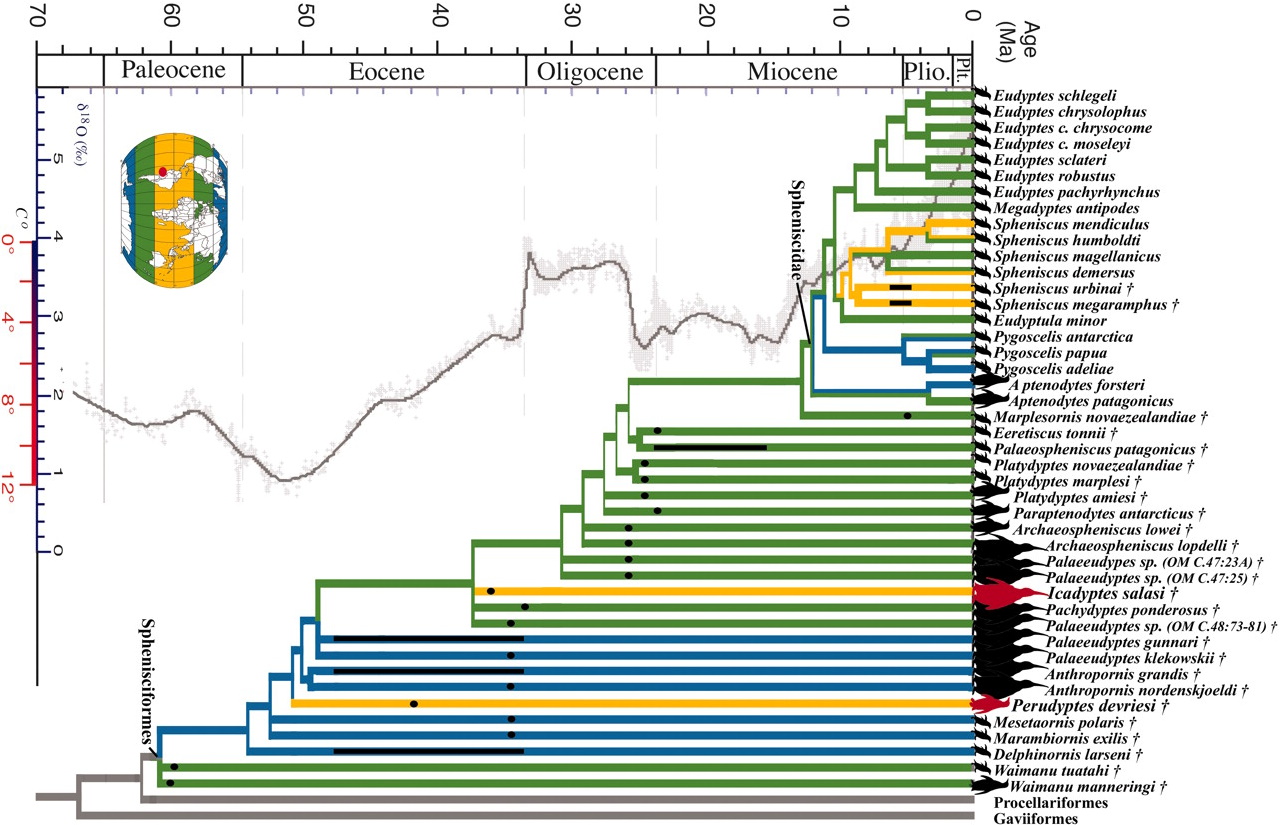
Waimanu is currently the oldest known penguin, and it is an ancient taxon indeed.  The rocks containing the Waimanu manneringi holotype skeleton are an astounding 61.6 million years old, far and away the oldest to produce penguin bones. A close relative, the smaller Waimanu tuatahi is found in rocks 58-60 million years old. To put this in perspective, these penguins lived just 4-5 million years after the mass extinction that killed off the dinosaurs (except for birds of course).
The first fossils of this taxon were collected almost 20 years ago by Al Mannering, in whose honor the first species is named.  Both come from the Waipara Greensand, a unit of sedimentary rocks laid down in nearshore waters during the Paleocene in present down North Canterbury.  During the Paleocene, this area of the South Island of New Zealand was submerged, and penguins, plankton and shellfish often became entombed in the dark sandy sediments upon death. Millions of years later, these rocks and their trove of fossils were exposed as tectonic forces lifted the ancient seafloor up to the sun and the Waipara River cut away the overlying layers.

These early penguins inherited a world in which a reset button had been firmly pressed. It was warm, rather homogenous in temperature across most of the latitudinal gradient, and most importantly, nearly every major niche was hung generously with “help wanted” signs.  For much of the Mesozoic, dinosaurs dominated terrestrial ecosystems and large marine reptiles occupied the aquatic tetrapod predator niche.  Mosasaurs, plesiosaurs and pliosaurs swam the seas worldwide.  But at the end of the Cretaceous, an asteroid impact wiped out all of these groups.  Even sharks were decimated, though of course some survived to re-supply our oceans and imaginations with toothed nightmares.

This extinction spelled opportunity for many groups.  Mammals radiated into the void left by dinosaurs, and some dinosaurs got a new opportunity.  The volant (flying) ancestors of penguins had a window in which the seas were free of largely free of competitors and low on predators.  This was a perfect time to drop flight altogether.  By 60million years ago, Waimanu manneringi and Waimanu tuatahi, two closely related species, had reached this critical stage in penguin evolution.

A reconstruction of Waimanu tuatahi from Slack et al. (2006).

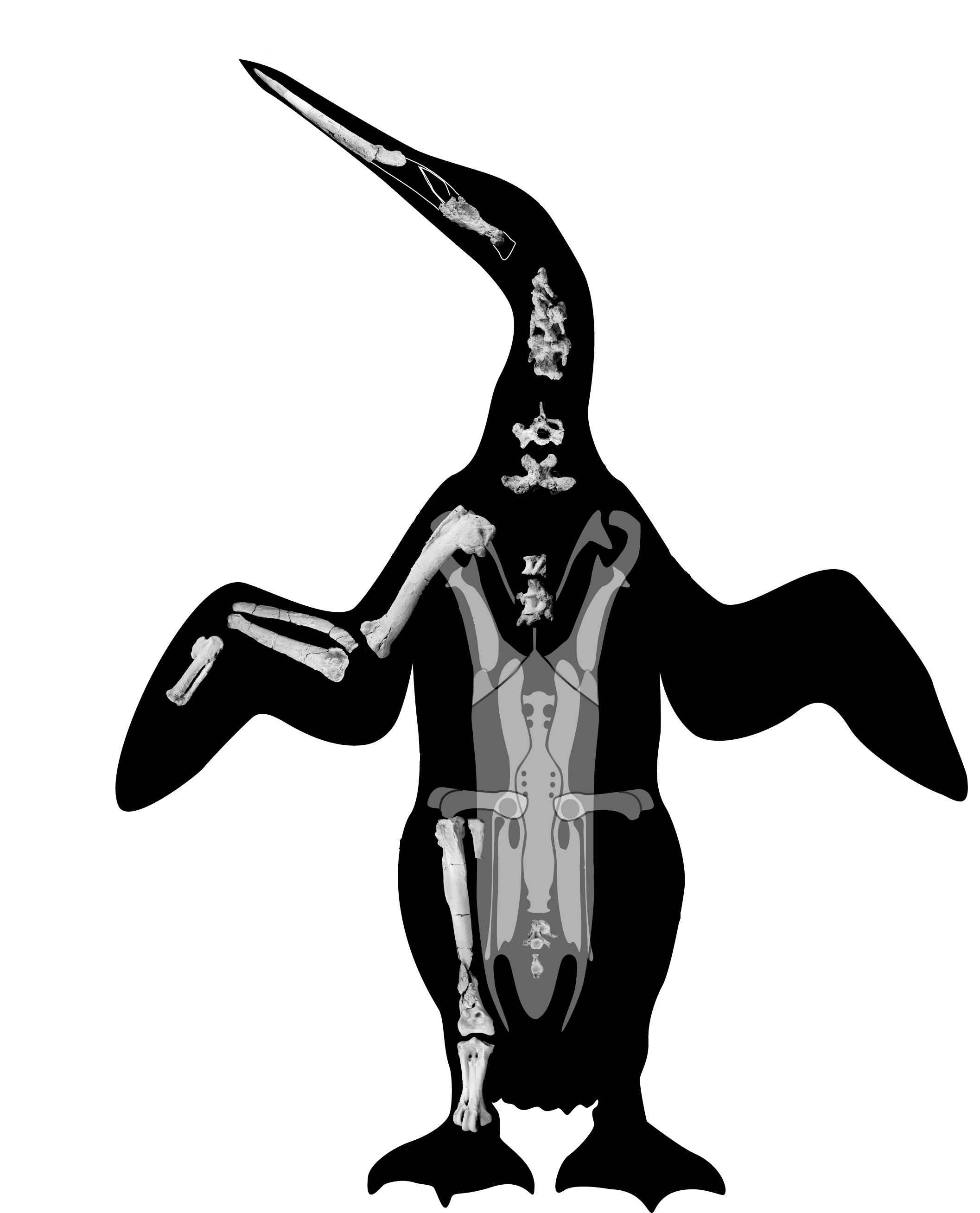
Waimanu is both amazingly penguin-like and amazingly primitive.  Waimanu manneringi was a healthy size, about halfway between a King Penguin and an Emperor Penguin in standing height, while Waimanu tuatahi was a bit smaller, about 2 1/2 feet (80cm) tall. Waimanu manneringi is only known from a single hindlimb and pelvis, while specimens of Waimanu tuatahi is much more complete – multiple specimens together combine to give us almost the entire skeleton.  From head to toe, the skeleton of Waimanu combines primitive and derived characters.  The skull exhibits the long, narrow beak seen in other early fossil penguins rather than a stubbier modern penguin beak.  The flipper is much shorter than the wing of a flighted bird, but significantly longer relative to the body than in living penguins (indicating it would have a lower wing load).  The bones are also more flattened than flighted birds but less flattened than living penguins, which have highly compressed bones to form a more knife-like wing profile.  In the hindlimb, Waimanu is very close to modern penguins.  The shape of the limb bones indicate an upright posture like modern penguins employ, and the feet are short and stubby.  So Waimanu walked like a penguin on land, swam like a less-efficient penguin in the water, and probably ate the same basic foods (perhaps a little fish heavy).  There is a lot more to say about these fascinating species, but I will await some upcoming work by the Waimanu team to cover that story.

In closing, I should point out that the title of this post is actually a bit inaccurate. Waimanu manneringi is in fact the oldest penguin we know of. But, it is highly unlikely it was actually the first penguin.  The rock record is incomplete, and there is a roughly 10 million year gap between Waimanu tuatahi and the next oldest penguin fossil, showing we are missing big pieces of penguin history – probably on both sides of the 60 million year mark.

The closest relatives of penguins that are alive today are the Procellariiformes, the group that includes albatrosses and petrels.  These birds are commonly called tubenoses because their nostrils take the form of short tubes instead of flat openings. Most likely, the penguin lineage and the tubenose lineage split off from one another and started on their own evolutionary paths deeper in time, perhaps even during the Cretaceous Period. At this deep split, the birds heading off along the evolutionary trajectories to modern penguins and modern petrel probably looked a lot more like a petrel than a penguin – certainly volant (capable of flight) and probably with a similar ecology to some modern tubenose birds.  Whether we would call the bird on the penguin side of the split a “penguin” is debatable – it would probably be very hard for us to recognize a fossil penguin in the rock record until, like Waimanu, they evolved  a flightless lifestyle.  So, pending the discovery of a mind-bending fossil of a flying penguin, we’ll let Waimanu revel in its place in the sun.

References: Slack, K.E., C.M. Jones, T. Ando, G.L. Harrison, R.E. Fordyce, U. Arnason, and D. Penny. 2006. Early Penguin Fossils, Plus Mitochondrial Genomes, Calibrate Avian Evolution. Molecular Biology and Evolution 23: 1144-1155.

Source


Fossil Penguins

Waimanu - 60-million year old penguins from New Zealand

R Ewan Fordyce

An online article recently published in the journal Molecular Biology and Evolution (March 2006) recognises a new genus of ancient penguin (Waimanu) from New Zealand rocks some 60-62 million years old. The ancient penguins lived in shallow seas off eastern New Zealand in Paleocene times, only a few million years after the extinction of dinosaurs. These "proto" penguins were about the size of living yellow-eyed penguins. They probably looked a bit like shags (cormorants), but had compressed and dense wing bones, allowing wings to be used to swim underwater. It is most unlikely that the Waimanu penguins could fly in air. These fossils are a little older than archaic penguins from Tierra del Fuego, documented by Dr Julia Clarke and coauthors (2003), and are the oldest fossil penguins reported from New Zealand.

Waimanu Paleocene_penguin
The reconstruction shown here, by Chris Gaskin, is © Geology Museum, University of Otago.
Waimanu humerus
Ewan Fordyce shows the position of the humerus, or upper wing bone, on a reconstruction of Waimanu tuatahi.
Photo by R Ewan Fordyce; reconstruction ©Geology Musuem, University of Otago.
Waimanu reconstruction
Reconstruction by G. Gaskin, showing 3 individuals of Waimanu tuatahi on a New Zealand beach in Paleocene times, 58-60 million years ago. Reconstruction ©Geology Museum, University of Otago.

Because the Waimanu penguins are well dated in terms of geological age, it is possible to use that known age to calibrate a new molecular phylogeny - or pattern of relationships - for living birds. The phylogeny shows a branching pattern of bird relationships based on study of genetic material from a range of living birds such as storks, albatrossses, ducks and moas. By using the dates from the fossil Waimanu penguins as a calibration point, we can then predict how far back in time the other groups of living birds originated. If early penguins lived in southern seas not long after the extinction of dinosaurs, then other bird groups more distantly related to penguins must have been established even earlier.

The study suggests that many groups of living birds originated well back in Cretaceous times, when dinosaurs were thriving - thus, many modern lineages had ancient origins. Such a notion conflicts with an idea suggested by Professor Alan Feduccia (1995, 2003), who suggested that many living bird groups are geologically young, and mostly represent groups that arose after dinosaurs went extinct.

Feduccia argued that most birds from Cretaceous times - from the age of dinosaurs - were ancient lineages not related to living forms. He suggested that those ancient bird groups disappeared, along with dinosaurs, in a turnover at the catastrophic "KT boundary" extinction 65 million years ago. Feduccia also suggested that there was a complete new evolutionary radiation of "modern" birds following the KT extinction.

Now, the new study which combines fossils and molecular approaches, predicts that "modern" birds thrived in the age of dinosaurs. We expect that the fossil record will continue to produce the hard evidence of those birds.

Details of title and authorship

Early Penguin Fossils, plus Mitochondrial Genomes, Calibrate Avian Evolution Kerryn E. Slack1 , Craig M. Jones2 , Tatsuro Ando3 , G. L. (Abby) Harrison4, R. Ewan Fordyce3, Ulfur Arnason5, and David Penny4
  1. Allan Wilson Center for Molecular Ecology and Evolution Institute of Molecular BioSciences Massey University Palmerston North New Zealand; Division of Evolutionary Molecular Systematics Department of Cell and Organism Biology University of Lund Solvegatan 29 S-223 62 Lund Sweden
  2. Institute of Geological and Nuclear Sciences Lower Hutt New Zealand
  3. Department of Geology, University of Otago Dunedin New Zealand
  4. Allan Wilson Center for Molecular Ecology and Evolution Institute of Molecular BioSciences Massey University Palmerston North New Zealand
  5. Division of Evolutionary Molecular Systematics Department of Cell and Organism Biology University of Lund Solvegatan 29 S-223 62 Lund Sweden
Abstract
PDF
The first specimen of Waimanu was found in the 1980s, by Brad Field (then of NZ Geological Survey), and was passed to Ewan Fordyce for study. Craig Jones prepared the specimen - now curated in the Geology Museum of University of Otago - while working for Fordyce as a technician. Fordyce and Jones (1990) later published some details of the first fossil. Subsequently, Al Mannering (of Christchurch, affiliated with Canterbury Museum) discovered more Paleocene penguins (Jones and Mannering 1997) which Mannering prepared; those fossils are curated in Canterbury Museum, Christchurch. Most recently, the Waimanu fossils have been studied in detail by Geology graduate student Tatsuro Ando, as part of his PhD studies at University of Otago. Al Mannering's sterling efforts of collecting and preparation are honoured in the name of one of the species, Waimanu manneringi.
For details of molecular studies, contact Professor David Penny of Massey University.

References

Clarke, J. A., Olivero, E. B., and Puerta, P. 2003. Description of the earliest fossil penguin from South America and first Paleogene vertebrate locality of Tierra del Fuego, Argentina. American Museum Novitates (3423): 1-18.
Feduccia, A. 1995. Explosive evolution in Tertiary birds and mammals. Science 267 (5198): 637-8.
Feduccia, A. 2003. 'Big bang' for tertiary birds? Trends in Ecology & Evolution 18 (4): 172-176.
Fordyce, R. E. and Jones, C. M. 1990. The history of penguins, and new fossil penguin material from New Zealand. Pages 419-446 in Davis, L. S. and Darby, J. D. (editors), Penguin biology. Academic Press, San Diego. 467 p.
Jones, C. M. and Mannering, A. 1997. New Paleocene fossil bird material from the Waipara Greensand, North Canterbury, New Zealand. Geological Society of New Zealand miscellaneous publication 95a: 88.
Simpson, G. G. 1971. A review of the pre-Pliocene penguins of New Zealand. Bulletin of the American Museum of Natural History 144: 321-378.

Source

The first fossil penguin – Palaeeudyptes antarcticus Huxley 1859, from Kakanui, North Otago

By R.Ewan Fordyce

The first fossil penguin recognised to science was an incomplete but dramatically large ankle bone from Kakanui, in coastal Otago. The bone was acquired by Government Agent Walter Mantell during his travel along the Otago coast in late 1848, and was sent to Britain where it was studied by the pre-eminent paleontologist T.H. Huxley. Huxley announced the find in the Quarterly Journal of the Geological Society in March 1859. There he identified the bone as from a new genus and species of penguin which he named Palaeeudyptes antarcticus – literally, ancient winged diver of the south. The ankle bone or tarsometatarsus is perhaps the single most distinctive bone in penguins and, had he been presented with some other bone, Huxley might have found it more difficult to convince people that the fossil was from a penguin.

Huxley woodcut 1859
Huxley's original illustration of the ankle bone is reproduced here. The left figure shows a front view; the right figure, the back view. One trochlea, or projection for a toe, is missing – from the right side of the front view.

penguin bones
Illustrations of penguin bones produced for James Hector's 1872 article on fossil penguins.
Within a few decades, other fossil penguin bones were reported from New Zealand, both from North Otago and from Westland. Again, the bones clearly represented species larger than those of today. Because of their size, the fossils were thought to represent more individuals of Huxley's new species, Palaeeudyptes antarcticus. However, no ankle bones were known amongst the new specimens, and it could not be confirmed that all the fossils really did represent the one species. Indeed, despite 150 years of field work, no more material of Huxley's species has been found – the species Palaeeudyptes antarcticus is indeed known from one incomplete bone. So, the name can be used confidently only for the one fossil which resides in a drawer in the Natural History Museum, London. Finally, we aren’t even sure of the age of the fossil; it is probably from the soft white Ototara Limestone which, at Kakanui, spans the Eocene/Oligocene boundary – in the range 32-34 M years. However, the bone could be from the harder and younger Otekaike Limestone, with an age of perhaps 23-24 M years.

The lack of complete specimens was not going to spoil a good story. The early finds quickly led to speculation that ancient penguins were giants, with body heights perhaps reaching "eight feet" (about 2.4 m). In 1975, renowned fossil penguin expert G.G. Simpson reviewed penguin body size, and concluded that even the most massive New Zealand penguin, Pachydyptes ponderosus, was much smaller - at 1.43-1.62 m.

Other new discoveries from the Waitaki Valley region show that there was quite a range of body size represented amongst penguins – not all were giants. Species of Platydyptes, for example, probably stood a little taller than a living yellow-eyed penguin (Megadyptes antipodes), and several fossils of tiny penguins – the size of little blues (Eudyptula minor) are known.

Our collections of penguin fossils are under study by PhD student Tatsuro Ando, as part of his research on the origin of penguin flight.

Remarkably complete skeletons of Palaeeudyptes-like penguins are sometimes on display in the Geology Museum, University of Otago. (The Geology Museum is open to the public 9am – 5 pm weekdays; access is via the Quadrangle.) Less complete but equally large specimens also may be seen at Otago Museum.

There are significant displays in North Otago that relate to fossil penguins. A poster reviewing these birds is in the Blue Penguin Visitor Centre in Oamaru. Interpretive graphics, casts and original fossils are displayed in the Vanished World Centre, Duntroon.


Tatsuro Ando studying fossil and modern penguin skulls.

Cast of Mantell's original ankle bone on the left; original fossil of a Palaeeudyptes-like penguin on the right. Both specimens from Geology Museum, University of Otago.

References for further reading

  • Fordyce, R.E. and Jones, C.M. 1990. The history of penguins…. Pages 419-446 in Davis, L.S. and Darby, J.D. (editors), Penguin biology. Academic Press, San Diego. 467 p.
  • Gaskin, C. and Peat, N. 1991. The world of penguins. Hodder and Stoughton, Auckland. 48 p. (Non-technical.)
  • Hector, J. 1872. On the remains of a gigantic penguin (Palaeeudyptes antarcticus, Huxley) from the Tertiary rocks on the west coast of Nelson. Transactions and proceedings of the New Zealand Institute 4: 341-346.
  • Huxley, T.H. 1859. On a fossil bird and a fossil cetacean from New Zealand. Quarterly journal of the Geological Society of London 15: 670-677.
  • Marples, B.J. 1952. Early Tertiary penguins of New Zealand. New Zealand Geological Survey paleontology bulletin 20: 66 p.
  • Peat, N. 1992. Penguins from the past. Forest and bird 23 (1, February): 32-34. (Non-technical.)
  • Simpson, G.G. 1975. Fossil penguins. Pages 19-41 in Stonehouse, B. (editor), The biology of penguins. MacMillan, London. 555 p.
  • Simpson, G.G. 1976. Penguins past and present, here and there. Yale University Press, New Haven. 150 p. (This is an excellent introductory text.)
Source

Researchers follow Adélie penguin winter migration for the first time

Two penguins on a rock nest.
Photo Credit: Viola Toniolo
Two Adélie penguins, with the one in the foreground sporting a satellite tag used to track its migration from its southern breeding grounds at Ross Island to the north in the winter and back again.

On the move

Researchers follow Adélie penguin winter migration for the first time

Adélie penguins living at the far southern extreme of their geographic range migrate an average of about 13,000 kilometers during the year as they follow the sun from their breeding colonies to winter foraging grounds and back again.
“They’re definitely making a longer distance migration than we thought,” said Grant Ballard External Non-U.S. government site, lead author of a study recently published in the journal Ecology that examined the birds’ past and present migration patterns, and how changes in climate and sea ice extent might affect migration patterns in the future.
The researchers tracked penguins from two colonies on Ross Island using geolocation sensor tags between 2003 and 2005. The birds came from Cape Royds, a small colony of about 2,500 breeding pairs and the farthest south congregation of penguins in the world, and Cape Crozier, a much larger colony of 150,000 breeding pairs.
Project Web site
Ballard and his colleagues, including long-time polar research and co-author David Ainley with H.T. Harvey and Associates External Non-U.S. government site, already knew the Adélies ventured north during the winter because they need light and some amount of open water to forage in the ocean.
But the tags revealed many surprises about where the birds went and how quickly they moved. Data collected by the tags also showed that while Adélies need light for navigation and fishing for food, they can operate under extremely low light conditions.
“This is the first time we know where the Adélies go and the environmental conditions they encounter during the winter,” said Ballard, a staff scientist at PRBO Conservation Science External Non-U.S. government site, a California-based wildlife conservation and research non-profit organization.
And while the birds venture far north in the winter, following the setting sun and the twilight conditions they need to survive, they stop about 500 kilometers from the edge of the ice and the open ocean.
“We assumed that they went all the way out to the ice edge. They actually stay fairly well inside,” Ballard said.
The scientists believe the flightless birds save energy on their northbound trip by moving with the ice floes, which follow ocean currents in a clockwise gyre around the Ross Sea. The return trip to their breeding colonies, where they need ice-free land to make nests and breed, is not as leisurely. Ballard said the penguins double-time it back to Ross Island in the spring.
Scientist working outside of tent.
Photo Credit: Emily Stone/Antarctic Photo Library
Scientist David Ainley at Cape Royds.
Penguins floating on an iceberg
Photo Credit: Nate Biletnikoff/Antarctic Photo Library
Adélie penguins float on an iceberg near Cape Crozier.
Penguins
Photo Credit: Emily Stone/Antarctic Photo Library
A penguin preens its feathers at Cape Royds.
“They’re coming back as early as they can,” he said. “They probably need the sun for navigation. We think that’s the main way they navigate. The study strongly suggests that is what is going on.”
The distances covered by the Ross Island penguins, with the longest trek of 17,600 kilometers, represent the longest migration of the species, according to the Ecology paper. In comparison, the most well-traveled seabird in the world, the Arctic Tern, makes a pole-to-pole return journey of 44,000 kilometers.
The ability to migrate over long distances may be an ongoing adaptation in the evolution of the species, the authors suggest.
During the Last Glacial Maximum (LGM) about 20,000 years ago, the West Antarctic Ice Sheet covered almost the entire Ross Sea, meaning most of today’s colonies didn’t exist. However, the authors speculate that one colony might have persisted through the LGM at northerly Cape Adare, which historically has been ice-free during previous glaciations.
Over the last 12,000 years, the ice sheet has retreated, and the Adélies have penetrated farther south to their current location, developing a strategy to move to and fro between summer breeding colonies and winter foraging areas.
However, the authors warn that as climate change finally hits the Ross Sea region in the coming decades, as predicted by some climate models, the Adélies of Ross Island will face difficult challenges.
In such a scenario, winter sea ice — a habitat for the Adélies, as well as key prey like krill and silverfish — will retreat south, as it has in the already-warming Antarctic Peninsula. At some point, the edge of the ice could peel back far enough south that the penguins won’t be within reach of twilight in the winter.
Ballard said it’s possible the Adélies could go extinct locally. The species is notoriously “hard-wired” by its biology, and individuals rarely abandon their birth colony.
However, in a different paper published in June 2010 in the journal Proceedings of the National Academy of Sciences by some of the same scientists, researchers reported that Adélie penguins can indeed move when conditions for raising young deteriorate.
That study was based on a natural experiment that occurred when giant icebergs that calved off the Ross Ice Shelf in 2000 locked in hundreds of additional square kilometers of sea ice for several years. That meant a long, long trek for the Cape Royds penguins to reach open water to forage food for their chicks each summer.
Some birds eventually moved to new nesting sites, choosing colonies that had access to better feeding sites, regardless of the size of the colony. 
The same instinct for survival could come into play in the future. After all, the Adélies have survived the ebb and flow of ice ages for hundreds of thousands of years. The question is whether they can adapt in time.
“We still don’t understand all of the dynamics of the Adélies and the ice, but we’re getting closer,” Ballard said.
NSF-funded research in this story: Grant Ballard, PRBO Conservation Science, Award No. 0439759 External U.S. government site; and David Ainely, H.T. Harvey and Associates, Award No. 0440643 External U.S. government site. Other co-authors on the Ecology paper include Viola Toniolo, Stanford University; Claire L. Parkinson, NASA/Goddard Space Flight Center; Kevin R. Arrigo, Stanford University; and Phil N. Trathan, British Antarctic Survey.

Source 

Friday, August 13, 2010

More on Mapping Penguin Colonies


Mapping penguin colonies from space


2 August 2010

A QuickBird satellite image of islands in the study area with bright areas of guano highlighted in red, green and yellow.
Photo: QuickBird/AADC
Penguin poo, or 'guano', can provide scientists with a wealth of information, especially when viewed from space. For example, using high resolution satellite images, the spatial extent of a penguin colony – which could extend for kilometres – can be discerned by the guano's distribution. For biologists such as the Australian Antarctic Division's Dr Colin Southwell, this offers a way of developing maps of habitat occupied by penguin colonies. Such maps, used in combination with an estimate of penguin numbers within smaller parts of the habitat, could enable accurate estimates of penguin numbers across very broad regions; such as the whole of East Antarctica.
'Currently, penguin populations can be surveyed in relatively accessible areas using traditional methods, but the most remote regions remain difficult and costly to access,' Dr Southwell says.
'If we can develop accurate habitat maps using satellite imagery of guano deposits, we could design truly large scale surveys that could be applied consistently across very broad regions.'
The feasibility of using satellite images to map penguin habitat over broad scales was recently explored in a pilot study by remote sensing analyst, Angela Bender, of the Australian Antarctic Data Centre.
Angela used QuickBird satellite images covering islands along the Mawson coast, some of which were surveyed for Adélie penguin colonies in 2007 and 2009. The QuickBird satellite has a spatial resolution of 60 cm and collects 'multispectral' imagery by detecting different wavelengths of light, including visible and near infra-red, reflected by different land cover, such as rocks and vegetation (it also collects black and white images). Guano appears as bright areas in multispectral images, due to its high near-infrared reflectance.
Map of the Rookery Islands study area. The area within the green box is covered by one satellite image.
Photo: AADC
 
Map showing the location of Rookery Islands off the Mawson coast.
Location of Rookery Islands off the Mawson coast.
Photo: AADC
 

'Rookery Island and Giganteus Island, two of the larger islands within the Rookery Islands Group, were used to test the feasibility of using satellite images,' Angela says.
'We used these islands because the bright areas in the satellite images, which are assumed to be guano and are clearly discernable from the surrounding rocks and ice, also fall within the colony boundaries that were surveyed using a handheld GPS in 2007.'
Definiens Developer 7 software was used to extract and analyse the guano using 'object-based image analysis' (OBIA). This technique aims to simulate the way humans visually analyse imagery. It uses the spectral reflectance, shape, size, texture and contextual properties of objects, such as rocks, vegetation, or areas of guano, to classify them as such. This allowed Angela to separate and gradually refine areas of guano, from other objects. She was also able to classify areas of guano into 'dense, thin and sparse'.
The dense and thin areas of guano extracted using OBIA aligned well with a guano map of the area that had been manually digitised from the satellite images. However, the 'sparse' guano was not visibly discernable in the manual mapping.

Manually digitised guano on Giganteus Island - bright areas assumed to be guano were hand-traced and appear here outlined in green.
Photo: QuickBird/AADC
Areas of guano extracted by Object Based Image Analysis correlate well with the manually digitised map of guano on Giganteus Island.
Photo: QuickBird/AADC
Angela says that the results of the pilot study showed that OBIA is a feasible method for separating and extracting environmental data from a small number of satellite images. However, broader scale mapping with many images would require significantly more computing power. On-the-ground measurements of actual guano (density and spectral reflectance) would also help to answer other questions raised by the study.
'The time limitations of the pilot study precluded some important questions being answered; for example, is guano more or less detectable with krill or fish diets; are new or small colonies less detectable because there's less guano; can old guano be mistaken for fresh guano; and does satellite imagery give consistently reliable results across these variations?' Angela says.

An Adélie penguin colony stained pink from eating krill.
This colony of Adélie penguins has been enjoying a diet rich in krill (pink staining).
Photo: Louise Emmerson
An aerial photograph of penguins, which have a visible 'texture', on Giganteus Island.
Photo: AADC
Angela hopes to incorporate spectral reflectance data from actual guano in the field ('ground-truth data') into future analyses. She is also keen to test the usefulness of satellite imagery and aerial photos to count individual penguins based on 'texture'.
'Texture based algorithms could potentially be used to identify the texture of penguin colonies when the birds are on their nests,' she says.

Source 

Thursday, August 12, 2010

Penguin poo gives clues from space

Penguin poo gives clues from space


A pink "carpet" of penguin poo is allowing Australian researchers to track the birds by satellite.
SATELLITES ARE USED to spy on many things on our planet, but now Australian scientists are using one to hone in on penguin poo. The images are being used to determine accurate population numbers of Antarctic Adélie penguins.
Although individual penguins can't be seen from space, the pink stains of their poo - coloured from the planktonic krill that they eat - are clearly visible.
"Because they congregate to breed in very dense populations it is like a [pink] carpet of poo - not just a bit here and a bit there," says biologist Colin Southwell from the Australian Antarctic Division (AAD) in Hobart.
Adélie penguins (Pygoscelis adeliae) are habitual, returning annually to the same rocks to breed. As a result, each year the poo - also called guano - builds up under a colony and remains visible for long periods of time. Colin says this makes it harder to spot guano from Adélie penguins, compared with other penguins whose breeding grounds are on the ice  - like emperor penguins which breed on ever-changing sea ice.

'Quickbird' technology

The AAD team aim to survey a much larger area of Antarctica than they have already have, including those regions difficult to reach by foot. "If we can develop accurate habitat maps using satellite imagery of guano deposits, we could design truly large-scale surveys that could be applied consistently across very broad regions," says Colin.
Satellite imaging was used in 2009 by researchers from the British Antarctic Survey to discover new colonies of emperor penguins from their guano. The Australian researchers, however, are using the latest "QuickBird satellite" technology, which is capable of taking higher resolution images of a smaller area. It offers better quality pictures, which can precisely target penguin guano, the researchers say (see image below).
Satellite imaging is a cheaper alternative method to track penguin numbers, something previously done with the aid of helicopters. "Only so much field work can be done due to the hostility and remoteness of the region," says ecologist Iain Field from Macquarie University in Sydney. "It's one more tool we can use to gather information about the broader scale of the distribution of penguins."
The team hope to use the satellite images over a number of years to monitor the effects of climate change on the penguins.

LINKSAdélie penguins

Below: A satellite image of the "pink carpet" of Adélie penguin poo seen from space (credit: Australian Antarctic Data Centre/DigitalGlobe).


Tuesday, August 3, 2010

Penguin pics track Antarctic changes

Penguin pics track Antarctic changes

Updated Tue Aug 3, 2010 7:31pm AEST
An Adelie penguin on the ice in Antarctica
Australian scientists have developed a new camera to help them monitor Antarctica's Adelie penguins. (Australian Antarctic Division)
Tasmanian scientists have developed technology to help improve the monitoring of an important species of penguin in Antarctica.
For 20 years, scientists have studied the breeding habits of Adelie penguins on Bechervaise Island near Mawson Station.
They have been monitoring the impacts of fishing and climate change.
Colin Southwell from the Australian Antarctic Division in Hobart says the remote, extreme conditions have been a challenge.
"We send a two-person team down every summer but they work on an island that is isolated from the mainland," he said.
The high cost of sending scientists to remote areas had prevented the program being expanded.
Researchers wanted a cost-effective way to monitor more sites, so electronics engineer Kym Newbery developed a camera that could withstand the Antarctic elements.
"The winds are up to 200 kilometres an hour, they're very dry and cold," Mr Newbery said.
Colin Southwell says the new camera means researchers can now monitor multiple locations, without having to put researchers on-site.
"We're monitoring in the Davis region as well as the Mawson region, and this summer we plan to be monitoring by deploying more cameras in the Casey region as well.
"So what we're able to start doing now is to develop a network of monitoring sites, not a single monitoring site... and we're able to see how much variation there is from site to site.
"Hopefully this can extend right across east Antarctica," he said.

'International interest'

Kym Newbery says a number of countries including Japan, France and England are keen to use the camera in their own monitoring programs.
"If we make a method that other countries can adopt then it becomes a standard, almost a no-brainer, for everyone to use: the same mechanism, the same method, to monitor the same species at lots of different sites.
"Having common data recording techniques is really important to be able to compare what you're measuring."

Source

Five Penguins Win U.S. Endangered Species Act Protection


For Immediate Release, August 2, 2010
Contact:  Shaye Wolf, Center for Biological Diversity, (415) 632-5301

Five Penguins Win U.S. Endangered Species Act Protection

SAN FRANCISCO— Five penguin species will get U.S. Endangered Species Act protections after a 2006 petition by the Center for Biological Diversity and two lawsuits filed jointly with Turtle Island Restoration Network. Today’s Interior Department decision will list the Humboldt penguin of Chile and Peru and four New Zealand penguins, the yellow-eyed, white-flippered, Fiordland crested and erect-crested, as threatened.
“Protecting these penguins under the Endangered Species Act gives them a chance at survival,” said Center biologist Shaye Wolf. “Sadly, in today’s finding the Obama administration failed to acknowledge climate change as a threat. It won’t be able to help penguins survive the climate crisis if it doesn’t admit that it’s a problem.”

The penguins face serious threats from climate change, ocean acidification and commercial fishing. Today’s designation will raise awareness about the penguins’ plight, increase research and conservation funding, and provide additional oversight of activities approved by the U.S. government that could harm penguins and their habitat, including development projects and high seas fisheries. 

Warming oceans, melting sea ice and overfishing have depleted the penguins’ food supply of krill and fish. As sea ice melt has melted, krill has declined by up to 80 percent since the 1970s over large areas of the Southern Ocean where penguins forage. Ocean acidification is also inhibiting the growth of organisms at the base of the food web. What’s more, these penguins also drown in commercial fishing gear, die in oil spills and are killed by introduced predators at their breeding colonies.

“Finally the government is throwing penguins a lifeline to recovery by protecting them under the Endangered Species Act,” said Todd Steiner, executive director of Turtle Island Restoration Network. “Industrial fisheries and ocean warming are starving the penguins. Longlines and other destructive fishing gear entangle and drown them. Now they will have a fighting chance to survive.”

The Center filed a petition to list 12 penguin species under the Act in 2006. In December 2008, the Interior Department proposed listing seven penguins, including the five given official protection today. By court order, final decisions for the African and southern rockhopper penguins are due in September 2010 and January 2011. The Center and TIRN plan to file suit against Interior for denying listing to emperor and northern rockhopper penguins despite scientific evidence that they are jeopardized by climate change and commercial fisheries.

For more information on penguins, see: http://www.biologicaldiversity.org/species/birds/penguins/index.html.
The Center for Biological Diversity is a national, nonprofit conservation organization with more than 255,000 members and online activists dedicated to the protection of endangered species and wild places.

Friday, July 30, 2010

More on the Adelie Penguin/Climate Change Dilemma

July 29, 2010 

Thaw deal: Climate change could leave penguins in the dark

 
Adélie penguinsFew animals can live totally in the dark, and penguins are no exception. But new research shows that climate change could soon rob Adélie penguins (Pygoscelis adeliae) of the sunlight they need to survive, and that could drive them into extinction.
The problem comes from melting sea ice, according to the report in the July 2010 issue of Ecology. As the climate changes and more of Antarctica's Ross Ice Shelf melts, Adélie penguins will be forced farther inland. This will take the birds away from the small amount of sunlight they have during certain parts of the year at current latitudes, leaving them unable to see, hunt or endure.

The study followed two Adélie penguin colonies on Antarctica's Ross Island for three years, using geolocation sensor tags to track them as they migrated. As winter approached, the researchers found that the penguins always stayed in areas where there was a high concentration of sea ice and where there was at least two hours of twilight a day. (As one travels farther south, there are long daylight hours in summer, but as the season advances toward winter, daylight hours grow steadily shorter until in many parts of Antarctica the sun doesn't rise above the horizon at all.) The researchers then used the migration patterns they had observed to conjecture on how those patterns have changed as the Ross Ice Shelf has retreated across the Ross Sea, off the coast of Antarctica, over the past 12,000 years (as illustrated in this animation), and in more recent decades as well as how it could change in the future.

"As sea ice extent in the Ross Sea sector decreases in the near future, as predicted by climate models, we can expect further changes in the migration patterns of the Ross Sea penguins," according to the paper's abstract.

"Ultimately, penguins around Antarctica will face darkness or lack of ice," lead author Grant Ballard of PRBO Conservation Science said in a prepared statement.

"From studying the long-term history of this species in Antarctica, we know that animals are actually very good at adapting to fluctuating conditions in their environment," Ballard said." They do this by changing their migration routes or altering other feeding behaviors. In this case, however, ice conditions are changing so rapidly the penguins may not be able to adapt in time."

The research was funded by the National Science Foundation and the U.S. Antarctic Program.
Photo: Adélie penguins, via Wikipedia

Source