Monday, November 16, 2015

The dinosaur ankle re-evolved amphibian-like development in birds


Date:
November 13, 2015
Source:
Universidad de Chile
Summary:
In the 19th century, Darwin's most vocal scientific advocate was Thomas Henry Huxley, who is also remembered as a pioneer of the hypotheses that birds are living dinosaurs. He noticed several similarities of the skeleton of living birds and extinct dinosaurs, among them, a pointed portion of the anklebone projecting upwards onto the shank bone (aka drumstick). This "ascending process" is well known to specialists as a unique trait of dinosaurs. However, until the late 20th century, many scientists were doubtful about the dinosaur-bird link. Some pointed out that the ascending process in most birds was a projection of the neighbouring heel bone, rather than the anklebone. If so, it would not be comparable, and would not support the dinosaur-bird link. 

 
Like modern amphibians, the remote ancestors of birds once had three bones in their upper ankle. When these evolved into landegg-laying animals, only two bones were present in this region. In dinosaurs, one of these, the anklebone, presents a pointed upward projection, the "ascending process". This trait is also present in birds, which are living dinosaurs. A new detailed embryological study in birds reveals that their ankle has re-evolved an amphibian-like developmental pattern, with three separate elements, one of which becomes the dinosaurian ascending process
Credit: Image courtesy of Universidad de Chile
 
In the 19th century, Darwin's most vocal scientific advocate was Thomas Henry Huxley, who is also remembered as a pioneer of the hypotheses that birds are living dinosaurs. He noticed several similarities of the skeleton of living birds and extinct dinosaurs, among them, a pointed portion of the anklebone projecting upwards onto the shank bone (aka drumstick). This "ascending process" is well known to specialists as a unique trait of dinosaurs. However, until the late 20th century, many scientists were doubtful about the dinosaur-bird link. Some pointed out that the ascending process in most birds was a projection of the neighbouring heel bone, rather than the anklebone. If so, it would not be comparable, and would not support the dinosaur-bird link.

Some argued that in bird embryos, the ascending process develops from the anklebone in dinosaur-like fashion, while others considered that its development in birds is unique and different from dinosaurs. Nowadays, the dinosaur-bird link is mainstream science, thanks to new methods of data analysis, and a dense series of intermediate fossils (including feathered dinosaurs). However, the disagreements about the composition and embryology of the avian ankle were never clarified fully. A new study in Nature Communications by Luis Ossa, Jorge Mpodozis and Alexander Vargas, from the University of Chile, provides a careful re-examination of ankle development in 6 different major groups of birds, selected specifically to clarify conditions in their last common ancestor. It also utilizes new techniques that allow three-dimensional analysis of fluorescent embryonic skeletons, using advanced spin-disc confocal microscopy and software.

This work has revealed that the ascending process does not develop from either the heel bone or the ankle bone, but from a third element, the intermedium. In the ancient lineage of paleognath birds (such as tinamous, ostriches and kiwis) the intermedium comes closer to the anklebone, producing a dinosaur-like pattern. However, in the other major avian branch (neognaths), which includes most species of living birds, it comes closer to the heel bone; that creates the impression it is a different structure, when it is actually the same. "It puts the final nail in the anti-dinosaur coffin" says Jacques Gauthier, a vertebrate paleontologist and professor at Yale University "The dinosaurian ascending process is retained in all birds, though it has changed its association from ankle to heel bones in neognath birds."

More remarkably, however, this finding reveals an unexpected evolutionary transformation in birds. In embryos of the landegg-laying animals, the amniotes (which include crocodilians, lizards, turtles, and mammals, who secondarily evolved live birth) the intermedium fuses to the anklebone shortly after it forms, disappearing as a separate element. This does not occur in the bird ankle, which develops more like their very distant relatives that still lay their eggs in water, the amphibians. Since birds clearly belong within landegg-laying animals, their ankles have somehow resurrected a long-lost developmental pathway, still retained in the amphibians of today -- a surprising case of evolutionary reversal. The study also presented fossil evidence from juvenile specimens of toothed birds from the Cretaceous period. These show that, at this early stage of bird evolution, the ascending process already developed separately.

Evolutionary reversions have always generated much discussion among scientists, because ancient traits can occasionally re-appear in a highly transformed context. A recent paper in BMC Evolutionary Biology (Diaz and Trainor, 2015) has revealed that chameleons also re-evolved an independent intermedium, in the specialized functional context of a climbing reptile. The reappearance of this long-lost developmental pattern in highly evolved organisms like birds and chameleons could be compared to finding primitive clockwork gears inside your latest smartphone. These intriguing discoveries are bound to renew discussion about the interplay between the evolution of new functions and the resurrection of old developmental patterns.


Story Source:
The above post is reprinted from materials provided by Universidad de Chile. Note: Materials may be edited for content and length.

Journal Reference:
  1. Luis Ossa-Fuentes, Jorge Mpodozis, Alexander O Vargas. Bird embryos uncover homology and evolution of the dinosaur ankle. Nature Communications, 2015; 6: 8902 DOI: 10.1038/ncomms9902


Universidad de Chile. "The dinosaur ankle re-evolved amphibian-like development in birds." ScienceDaily. ScienceDaily, 13 November 2015. <www.sciencedaily.com/releases/2015/11/151113105924.htm>.

Friday, November 13, 2015

Flying under the radar: Seabirds hold the key to healthy fisheries

Seabirds are being severely threatened by fisheries, pollution and invasive species. Scientist and conservationalist Ross Wanless explains to DW why the birds of the sea could be pivotal for survival of the planet.


The African-Eurasian Waterbird Agreement (AEWA) met in Bonn, Germany, November 9 through 13 to discuss conservation of seabirds. In addition to aiming for an agreement from AEWA member countries on changing fishery management to benefit migratory seabirds, researchers and conservationists also worked together on managing other seabird threats.

DW caught up with Ross Wanless of BirdLife International toward the end of the conference in Bonn.

DW: What is the state of seabirds globally?

Ross Wanless: Seabirds are among the most threatened group of birds in the world, in fact their conservation status has decreased faster than any equivalent group of birds, so they are really not in good shape.

What is the biggest threat to seabirds?

There are two main threats, one is fisheries and a whole range of things within that - so accidental mortality and overfishing - and the other is invasive species on islands.

About 30 years ago, people discovered that when they counted up the number of birds that had been caught up in tuna longline fishing hooks and extrapolated that to the whole fishery, they realized that one or two birds on each boat every day translated into tens of thousands of albatrosses. That broke open a huge issue that we have been battling with ever since: how to stop birds from being caught on longlines.

Ross Wanless ist der Seabird Conservation Programme Manager BirdLife International Marine Programme
Solving the problems of seabird conservation, Wanless says, is not an easy job

What, if any, solution exists to address the impact of fisheries on sea birds?

There are many solutions, some of them are quite simple and straightforward, don't cost a lot and allow fishing to continue really essentially unchanged. Like just minor modifications to their gear, or how fishers work.

There are other, probably more problematic solutions, such as reduction in fishing and area closures to fishing. There is a whole suite of things that can be done.

If we focus on your home country, South Africa, what would you say is needed there to help seabirds?

BirdLife South Africa has done some amazing work in preventing bycatch, or the incidental catching of seabirds in our fisheries, and our fisheries are some of the best in the world in terms of having solved these enormous problems almost completely.

But, we're really grappling with the problem of the lack of food and the role that fisheries play in causing the collapse of, for example, African penguin populations. So, while we have been good at solving some problems, we are still really coming to grips with some of the other problems.

Through your work, you have initiated some large-scale conservation programs to help the African penguin and other seabirds at risk of low trophic level fisheries impacts, what has that entailed?

Low trophic level fisheries, or forage fisheries, are fisheries that target the small things in the sea, like krill, or sardine or anchovy. They tend to be at the base of the ecosystem, the base of the food chain, so if you overfish those stocks, everything else that feeds on them - the whales, the dolphins, the seals, the seabirds, the other fish that are also commercially exploited - all take strain. It's a real problem and that's the kind of fishing we have to manage very carefully, and that is what we think is behind some of the African penguin collapse.

Silbermöwe Skelett
We need to look at seabirds to understand how other marine life are faring, says Wanless
There is no question that overfishing happened in our waters in the 1960s. The stocks of fish have changed dramatically, and the penguin numbers collapsed along with that.

How can people live harmoniously with seabirds? 

I think to many people, there is a false dichotomy. It's not seabirds or fisheries - actually, fisheries should be using seabirds. We believe that penguins, for example in the southwestern part of Africa, are a real sentinel: They are a signal that the marine system is under stress and that if we don't pay attention, the fisheries could collapse.

What we are trying to convince people is: Use the penguins, the information they are telling you is valuable, and you should maybe think seriously about changing your fishing practices.
Pitting penguins or other seabirds against fisheries is really the wrong way to look at it. When the penguins recover, you will probably have a healthy ecosystem again.

I challenge you to answer the question "how many fish are in the sea" with any degree of accuracy - but I can tell you exactly how many penguins there are in southern Africa. We have really good data that we can use, and if we could just change our mindset about that, I think everyone would be in a better space.

The average person may possibly say "seabirds don't concern me" - why should we care about them? 

Seabirds in many respects are an important tool for helping manage our impact on the marine environment. The interconnectedness of the ocean is dynamic and different from terrestrial environments, and we don't really have a good understanding or ability to mange it. If we let the seabirds go, if we forget about them and say we don't care, we can live without them - maybe we are right, maybe we are wrong. If we are wrong, have we lost something we can never recover, and everyone suffers at the end of the day? We are playing a high-risk game by ignoring critical components of ecosystems such as seabirds.

If we destroy those species, future generations will never forgive us - we have a responsibility to look after those things.

Ross Wanless ist der Seabird Conservation Programme Manager BirdLife International Marine Programme
Fishers, government and individuals need to work together to ensure seabird survival, Wanless tells DW

What recent developments have been made to protect seabirds? 

Seabirds are probably the most international birds of all birds, because the high seas occupy about 60 percent of the surface of the Earth. No one owns the high seas, so they are not in any one country's waters for much of their lives. So we have to be joined up and work collaboratively to protect them.
We have created the World Seabird Union, which brings together 90 percent of seabird

conversationalists and researchers, and that gives us a united voice where we can discuss and plan around issues and hold conferences. This allows us to pull things together in a joint way that is so much more powerful than people or countries working individually.

What has come out of the Bonn conference?

The conference has really shown the willingness of countries to grapple with issues and to find effective, efficient ways of addressing problems - not duplicating existing initiatives or existing programs - and that is really encouraging.

That means we are not throwing money at problems. Everyone is really conscious of finding ways where an agreement can be used to do things that no one else is doing, and we don't need to bother with where others are doing them - that, to me, is a really encouraging sign.

Dr. Ross Wanless is the Africa Coordinator for the BirdLife International Marine Programme, and the Seabird Conservation Programme manager for BirdLife South Africa.

The interview was conducted by Jessie Wingard.

source

Friday, November 6, 2015

Shape of bird wings depends on ancestors more than flight style

Date:
November 5, 2015
Source:
University of Texas at Austin
Summary:
In a finding that could change the way scientists think about bird evolution, researchers have found that the shape of bird wings is influenced more by how closely related species are to one another than by flight style.The research challenges scientific beliefs that assume the way a bird species flies -- whether it primarily dives, glides or flaps, for instance -- plays the primary role in the evolution of its wing shape.

Samples of the dorsal (middle column) and ventral (left column) sides of wings from bird specimens analyzed by the researchers. The right column depicts a consensus wing shape generated by analyzing the wing shape of 105 bird taxon (figure f), a figure depicting how various wing shapes differed from the consensus wing (figure g), and the magnitude of variation across different parts of the consensus wing ( figure h). Credit: Xia Wang.

In a finding that could change the way scientists think about bird evolution, researchers have found that the shape of bird wings is influenced more by how closely related species are to one another than by flight style.

The research challenges scientific beliefs that assume the way a bird species flies--whether it primarily dives, glides or flaps, for instance--plays the primary role in the evolution of its wing shape. It also indicates that it may be more difficult than previously thought to infer flying behaviors of early birds and the first flying dinosaurs from fossils alone.

Julia Clarke, an associate professor in the Department of Geological Sciences at The University of Texas Jackson School of Geosciences, conducted the work with Xia Wang, a post-doctoral researcher who led the study. Their research was published in the journal Proceedings of the Royal Society B: Biological Sciences in October.

Bird wings, unlike stiff airplane wings, are flexible and change shape during flight. So, their geometry and wing outline may not tell the whole story of a particular flight style or environment, Clarke said. "We've taken a lot for granted. Birds are not airplanes," Clarke said.

By comparing geometry across species and clades -- groups of organisms that evolved from a common ancestor -- the researchers found that birds that are closely related evolutionarily have similar wing structures, even if the birds show very different flight styles. For example, albatrosses, penguins and loons, despite looking very different from one another, all belong to the clade Aequornithes and have a wing shape that is very similar.

The study is the first to analyze wing geometry across all major groups of birds. Researchers
analyzed over 100 photographs of wings from different bird species.

In general, the analysis of species from across nine major avian clades showed that wing shape became more varied as different clades diverged from early ancestors, Clarke said. The researchers found an interesting exception to this trend in the wings of Passerines --a clade that includes songbirds. Instead of a wing shape that resembles more closely related relatives, their shape resembles that of Galliformes, a distantly related order that includes birds, such as chickens and turkeys, whose direct ancestors were among the first birds on the planet. "Those little songbirds share aspects of wing geometry, especially the relative length of the covert feathers, with some of early bird species but have very different body sizes, ecologies and flight styles," Clarke said.

Clarke and Wang also studied covert feathers in these birds. They found that across clades these feathers, which cover the base of the flight feathers, are about the same length whether they are on the top or underside of a wing. The similarity of covert feathers both on a single wing and across clades, brings into question their function, Clarke said.

It's been proposed that some of the upper coverts may play a sensory role, and the lower or underwing coverts, a role in aerodynamics. But the similarity in the distribution and organization of covert feathers on both sides of the wings suggests that such distinct roles may not be the case, Clarke said. "There's no existing hypothesis to explain that pattern," Clarke said. "So a question now is why the length of these feathers tends to be similar and why they show similar trends across birds. We could be looking for a developmental explanation or a functional one."

Story Source:
The above post is reprinted from materials provided by University of Texas at Austin. Note: Materials may be edited for content and length.

Journal Reference:
  1. Xia Wang, Julia A. Clarke. The evolution of avian wing shape and previously unrecognized trends in covert feathering. Proceedings of the Royal Society B: Biological Sciences, 2015; 282 (1816): 20151935 DOI: 10.1098/rspb.2015.1935


University of Texas at Austin. "Shape of bird wings depends on ancestors more than flight style." ScienceDaily. ScienceDaily, 5 November 2015. <www.sciencedaily.com/releases/2015/11/151105103041.htm>.

Thursday, October 29, 2015

Wednesday, October 28, 2015

El Niño is bad news for #penguins

Dramatic changes in climate force birds to swim more than 80 miles further in search of fish

  • Between 1992 and 2010, researchers fitted king penguins with trackers 
  • This allowed them to track their movements in the Indian Ocean
  • A climate anomaly of just 1°C (34°F) can shift the limit of the polar front 
  • This increases how far birds swim to find fish by up to 83 miles (130km)
Weather forecasters have been warning us to prepare for a 'monster' El Niño this winter and now experts believe it could also have a devastating effect on penguin numbers. 

By tracking a group of king penguins, researchers have discovered that a climate anomaly of just 1°C (34°F) can increase how far they have to swim in search of fish by up to 83 miles (130km).

During the last major El Niño event in 1997, penguin populations fell by a third and this year's event threatens to be similarly harmful.

Over a 16-year period researchers  discovered that a climate anomaly of just 1°C (34°F) can increase how far king penguins (pictured) have to swim in search for fish by up to 83 miles (130km). During the last major El Niño event in 1997, penguin populations fell by a third and this year's event could be similarly devastating
Over a 16-year period researchers discovered that a climate anomaly of just 1°C (34°F) can increase how far king penguins (pictured) have to swim in search for fish by up to 83 miles (130km). During the last major El Niño event in 1997, penguin populations fell by a third and this year's event could be similarly devastating

Between 1992 and 2010, a group of 15 breeding penguins from the king penguin colony of the Baie du Marin, Possession Island, Crozet were fitted with satellite transmitters.  

During summer, these penguins were tracked swimming from the Crozet Islands to forage for fish in the Antarctic polar front. 
A polar front is an area where cold polar air meets warm tropical air and this boundary can measure thousands of miles long. 

King penguins, as well as other predators, get the majority of their food from this region because the conditions are suitable for high concentrations of zooplankton and fish.
The penguins were tracked swimming from the Crozet Islands (represented by the orange dot) to forage for fish in the Antarctic polar front (marked by the green lines). This distance remained relatively stable until 1997, the year of the strongest El Niño on record, when the southern limit shifted dramatically

During this year, sea surface temperatures (pictured) in the southern Indian Ocean rose 1°C (34°F) above average and this caused the polar front to shift by around 83 miles (130 km)

During this year, sea surface temperatures (pictured) in the southern Indian Ocean rose 1°C (34°F) above average and this caused the polar front to shift by around 83 miles (130 km)

The Crozet penguins (pictured) were each fitted with satellite transmitters

The southern limit of this front can shift in response to changes in climate, and significant climatic events such as El Niño can cause it to move significantly. 
By following the penguins' movements, the researchers obtained a total of 124 tracks they could use to analyse climate changes and foraging distances. 

Each track corresponded to the 'at-sea movements' of a penguin during one foraging trip off the colony.  
Each year, over the 16-year tracking period, the penguins were seen leaving the Crozet Islands and typically heading south.

This distance remained relatively stable until 1997, the year of the strongest El Niño on record.

During this year, sea surface temperatures in the southern Indian Ocean rose 1°C (34°F) above average and this caused the southern limit of the polar front to shift by around 83 miles (130 km). 

This doubled the length of time the penguins were at sea and away from the safety of the group.

'During a climatically-extreme year, a strong southward shift of the polar front produced a doubling of the mean distance that penguins travelled on foraging trips, coinciding with a 34 per cent decline in the archipelago’s breeding population the following year,' explained the researchers. 

'Future climatic scenarios predict that the polar front may shift even further southwards, posing a potentially serious threat to the persistence of diving predators in the region.'

The findings are published in the journal Nature Communications.  


El Niño is caused by a shift in the distribution of warm water in the Pacific Ocean around the equator. The National Oceanic Atmospheric Administration recently issued its official winter forecast and said 'the driver of this winter's outlook is El Niño'. It warned this year's event (right) is likely to equal the event of 1997  (left)

El Niño is caused by a shift in the distribution of warm water in the Pacific Ocean around the equator. The National Oceanic Atmospheric Administration recently issued its official winter forecast and said 'the driver of this winter's outlook is El Niño'. It warned this year's event (right) is likely to equal the event of 1997 (left)

The shift in the polar front was found to double the length of time the penguins (pictured) were at sea and away from the safety of the group. Predictions suggest that the polar front may shift even further southwards in the future, which would pose a potentially serious threat to the colonies in the region

WHAT IS EL  NIÑO

El Niño is caused by a shift in the distribution of warm water in the Pacific Ocean around the equator.

Usually the wind blows strongly from east to west, due to the rotation of the Earth, causing water to pile up in the west of the Pacific.

This pulls up colder water from the deep ocean in the eastern Pacific. 

However, in an El Niño, the winds pushing the water get weaker and cause the warmer water to shift back towards the east.

This causes the eastern Pacific to get warmer.

But as the ocean temperature is linked to the wind currents, this causes the winds to grow weaker still and so the ocean grows warmer, meaning the El Niño grows.

This change in air and ocean currents around the equator can have a major impact on the weather patterns around the globe by creating pressure anomalies in the atmosphere. 

El Niño is caused by a shift in the distribution of warm water in the Pacific Ocean around the equator.

Usually the wind blows strongly from east to west, due to the rotation of the Earth, causing water to pile up in the western part of the Pacific.

This pulls up colder water from the deep ocean in the eastern Pacific. 

However, in an El Niño the winds pushing the water get weaker and cause the warmer water to shift back towards the east.

This causes the eastern Pacific to get warmer.

But as the ocean temperature is linked to the wind currents, this causes the winds to grow weaker still and so the ocean grows warmer, meaning the El Niño grows.

This change in air and ocean currents around the equator can have a major impact on the weather patterns around the globe by creating pressure anomalies in the atmosphere. 

The National Oceanic Atmospheric Administration recently issued its official winter forecast and said 'the driver of this winter's outlook is El Nino.'

It warned that this year's El Niño is already strong and appears likely to equal the event of 1997 and 1998. 


Monday, October 26, 2015

New Paper on Adélie Penguin Populations (free download as PDF)

Spatially Extensive Standardized Surveys Reveal Widespread, Multi-Decadal Increase in East Antarctic Adélie Penguin Populations 


PLOS
  • Published: October 21, 2015
  • DOI: 10.1371/journal.pone.0139877 

Abstract

Seabirds are considered to be useful and practical indicators of the state of marine ecosystems because they integrate across changes in the lower trophic levels and the physical environment. Signals from this key group of species can indicate broad scale impacts or response to environmental change. Recent studies of penguin populations, the most commonly abundant Antarctic seabirds in the west Antarctic Peninsula and western Ross Sea, have demonstrated that physical changes in Antarctic marine environments have profound effects on biota at high trophic levels. Large populations of the circumpolar-breeding Adélie penguin occur in East Antarctica, but direct, standardized population data across much of this vast coastline have been more limited than in other Antarctic regions. We combine extensive new population survey data, new population estimation methods, and re-interpreted historical survey data to assess decadal-scale change in East Antarctic Adélie penguin breeding populations. We show that, in contrast to the west Antarctic Peninsula and western Ross Sea where breeding populations have decreased or shown variable trends over the last 30 years, East Antarctic regional populations have almost doubled in abundance since the 1980’s and have been increasing since the earliest counts in the 1960’s. The population changes are associated with five-year lagged changes in the physical environment, suggesting that the changing environment impacts primarily on the pre-breeding age classes. East Antarctic marine ecosystems have been subject to a number of changes over the last 50 years which may have influenced Adélie penguin population growth, including decadal-scale climate variation, an inferred mid-20th century sea-ice contraction, and early-to-mid 20th century exploitation of fish and whale populations.


Tuesday, October 13, 2015

Threat to Penguins, Part II: Melting of Antarctic ice shelves set to intensify

Date:
October 12, 2015
Source:
Woods Hole Oceanographic Institution
Summary:
New research projects a doubling of surface melting of Antarctic ice shelves by 2050 and that by 2100 melting may surpass intensities associated with ice shelf collapse, if greenhouse gas emissions from fossil fuel consumption continue at the present rate.

The study's lead author, Luke Trusel, standing in front of sea ice covered in melt ponds in December 2010 outside of McMurdo Station, Antarctica.
Credit: Photo courtesy of Luke Trusel

New research published today projects a doubling of surface melting of Antarctic ice shelves by 2050 and that by 2100 melting may surpass intensities associated with ice shelf collapse, if greenhouse gas emissions from fossil fuel consumption continue at the present rate.

Ice shelves are the floating extensions of the continent's massive land-based ice sheets. While the melting or breakup of floating ice shelves does not directly raise sea level, ice shelves do have a "door stop" effect: They slow the flow of ice from glaciers and ice sheets into the ocean, where it melts and raises sea levels.

"Our results illustrate just how rapidly melting in Antarctica can intensify in a warming climate," said Luke Trusel, lead author and postdoctoral scholar at Woods Hole Oceanographic Institution (WHOI).

"This has already occurred in places like the Antarctic Peninsula where we've observed warming and abrupt ice shelf collapses in the last few decades. Our model projections show that similar levels of melt may occur across coastal Antarctica near the end of this century, raising concerns about future ice shelf stability."

The study, published Oct. 12, 2015, in Nature Geoscience, was conducted by Trusel, Clark University Associate Professor of Geography Karen Frey, WHOI scientists Sarah Das and Kristopher Karnauskas, Peter Kuipers Munneke and Michiel R. van den Broeke of the Institute for Marine and Atmospheric Research Utrecht University, and Erik van Meijgaard of the Royal Netherlands Meteorological Institute.

To study how melting evolves over time and to predict future ice sheet melting along the entire Antarctic coastline, the scientists combined satellite observations of ice surface melting with climate model simulations under scenarios of intermediate and high levels of greenhouse gas emissions until the year 2100.

The results indicate a strong potential for the doubling of Antarctica-wide ice sheet surface melting by 2050, under either emissions scenario. However, between 2050 and 2100, the models reveal a significant divergence between the two scenarios. Under the high-emissions climate scenario, by 2100 ice sheet surface melting approaches or exceeds intensities associated with ice shelf collapse in the past. Under the reduced-emissions scenario, there is relatively little increase in ice sheet melting after the doubling in 2050.

"The data presented in this study clearly show that climate policy, and therefore the trajectory of greenhouse gas emissions over the coming century, have an enormous control over the future fate of surface melting of Antarctic ice shelves, which we must consider when assessing their long-term stability and potential indirect contributions to sea level rise," said Frey.

Funding for the research was provided by NASA, the Doherty Postdoctoral Scholarship Program at WHOI, the Netherlands Earth System Science Centre, the Polar Program of the Netherlands Organization of Scientific Research, and the Dutch Ministry of Infrastructure and the Environment.

Story Source:
The above post is reprinted from materials provided by Woods Hole Oceanographic Institution. Note: Materials may be edited for content and length.

Journal Reference:
  1. Luke D. Trusel, Karen E. Frey, Sarah B. Das, Kristopher B. Karnauskas, Peter Kuipers Munneke, Erik van Meijgaard & Michiel R. van den Broeke. Divergent trajectories of Antarctic surface melt under two twenty-first-century climate scenarios. Nature Geoscience, 2015 DOI: 10.1038/ngeo2563

Woods Hole Oceanographic Institution. "Melting of Antarctic ice shelves set to intensify." ScienceDaily. ScienceDaily, 12 October 2015. <www.sciencedaily.com/releases/2015/10/151012115711.htm>.

Threat to Penguins: Global marine analysis suggests food chain collapse

Date:
October 12, 2015
Source:
University of Adelaide
Summary:
A world-first global analysis of marine responses to climbing human carbon dioxide emissions has painted a grim picture of future fisheries and ocean ecosystems.

Bleached coral colony, no fish.
Credit: © ead72 / Fotolia

A world-first global analysis of marine responses to climbing human CO2 emissions has painted a grim picture of future fisheries and ocean ecosystems.

Published today in the journal Proceedings of the National Academy of Sciences (PNAS), marine ecologists from the University of Adelaide say the expected ocean acidification and warming is likely to produce a reduction in diversity and numbers of various key species that underpin marine ecosystems around the world.

"This 'simplification' of our oceans will have profound consequences for our current way of life, particularly for coastal populations and those that rely on oceans for food and trade," says Associate Professor Ivan Nagelkerken, Australian Research Council (ARC) Future Fellow with the University's Environment Institute.

Associate Professor Nagelkerken and fellow University of Adelaide marine ecologist Professor Sean Connell have conducted a 'meta-analysis' of the data from 632 published experiments covering tropical to artic waters, and a range of ecosystems from coral reefs, through kelp forests to open oceans.

"We know relatively little about how climate change will affect the marine environment," says Professor Connell. "Until now, there has been almost total reliance on qualitative reviews and perspectives of potential global change. Where quantitative assessments exist, they typically focus on single stressors, single ecosystems or single species.

"This analysis combines the results of all these experiments to study the combined effects of multiple stressors on whole communities, including species interactions and different measures of responses to climate change."

The researchers found that there would be "limited scope" for acclimation to warmer waters and acidification. Very few species will escape the negative effects of increasing CO2, with an expected large reduction in species diversity and abundance across the globe. One exception will be microorganisms, which are expected to increase in number and diversity.

From a total food web point of view, primary production from the smallest plankton is expected to increase in the warmer waters but this often doesn't translate into secondary production (the zooplankton and smaller fish) which shows decreased productivity under ocean acidification.

"With higher metabolic rates in the warmer water, and therefore a greater demand for food, there is a mismatch with less food available for carnivores ─ the bigger fish that fisheries industries are based around," says Associate Professor Nagelkerken. "There will be a species collapse from the top of the food chain down."

The analysis also showed that with warmer waters or increased acidification or both, there would be deleterious impacts on habitat-forming species for example coral, oysters and mussels. Any slight change in the health of habitats would have a broad impact on a wide range of species these reefs harbour.

Another finding was that acidification would lead to a decline in dimethylsulfide gas (DMS) production by ocean plankton which helps cloud formation and therefore in controlling Earth's heat exchange.

Story Source:
The above post is reprinted from materials provided by University of Adelaide. Note: Materials may be edited for content and length.

Journal Reference:
  1. Ivan Nagelkerken and Sean D. Connell. Global alteration of ocean ecosystem functioning due to increasing human CO2 emissions. PNAS, October 12, 2015 DOI: 10.1073/pnas.1510856112


University of Adelaide. "Global marine analysis suggests food chain collapse." ScienceDaily. ScienceDaily, 12 October 2015. <www.sciencedaily.com/releases/2015/10/151012181037.htm>.

Friday, October 9, 2015

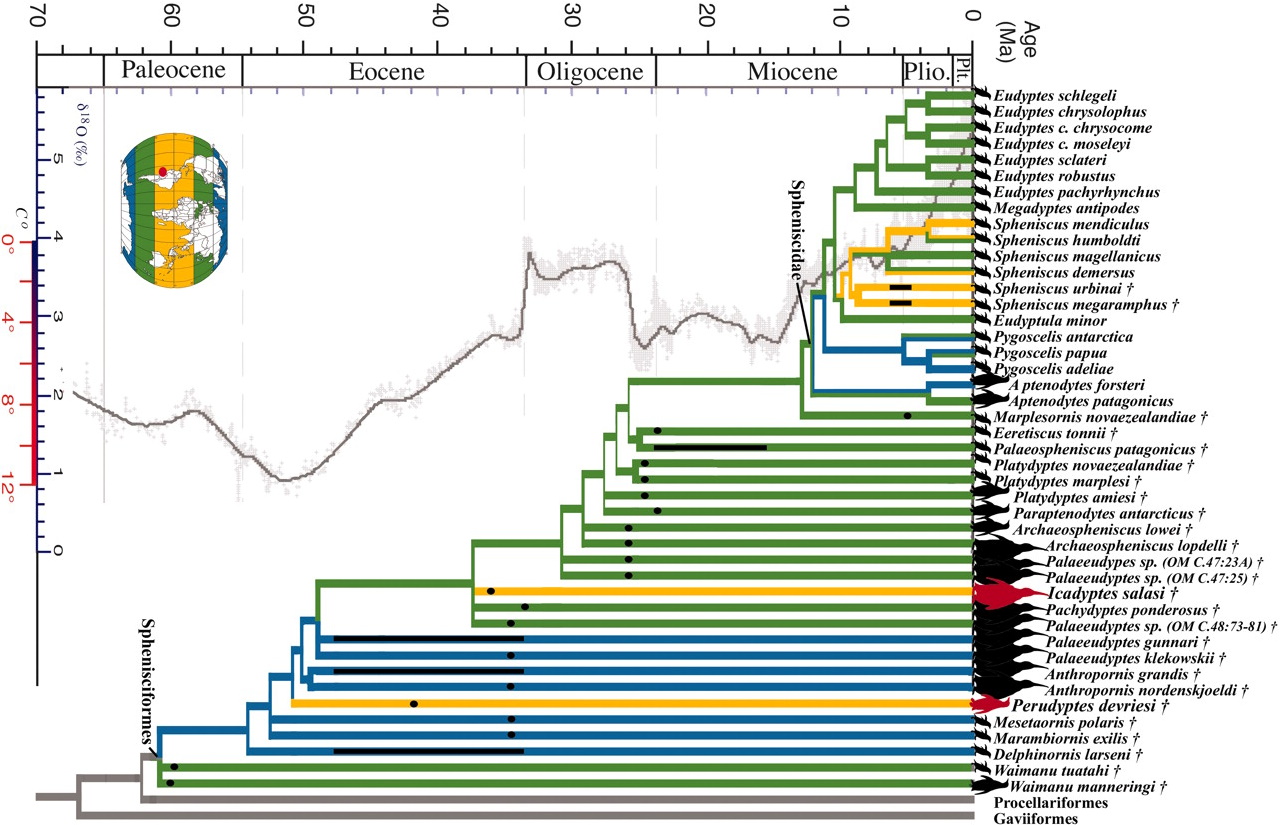
This Extinct Penguin Was the Best Animal To Waddle the Earth


Esther Inglis-Arkell
This Extinct Penguin Was the Best Animal To Waddle the Earth 

There are many advantages to being alive today, but there is one disadvantage—we missed out on seeing the best animal ever. Thirty-seven million years ago, the oceans and land were patrolled by a 6’8” penguin.

Today, Antarctic penguins are struggling. Thirty-seven million years ago, life was good. The coast of the continent was home to many different species of penguin, some of which would look familiar to us today. Others, not so much. 
This Extinct Penguin Was the Best Animal To Waddle the Earth

One penguin in particular would make us look twice—and possibly run. Palaeeudyptes klekowskii was sized up as the result of two different finds. Neither was a complete skeleton, but both provided multiple wing bones and foot bones that allowed scientists to estimate the penguin’s size.

Assuming it had the same proportions as modern penguins, this extinct megapenguin was a little over six-and-a-half feet tall. Before the discovery, the largest penguin species to ever have existed was thought to be only about five feet tall, just a foot taller than the Emperor penguin. Palaeeudyptes klekowskii would have stood out, even among the other penguins waddling around with it in its own time. It also would have dived down lower than other penguins, or at least stayed underwater longer. 

A larger body means a larger lung capacity, so these penguins would probably have been able to stay under water for 40 minutes between breaths. Imagine a basketball-player-sized penguin coming at you from out of the darkness.

Adorable.

source

Friday, October 2, 2015

Poop on a Stick Tests #Penguins’ Sense of Smell

By Elizabeth Preston | October 2, 2015
penguin poop stick

Who doesn’t enjoy waking to a pleasant smell wafting past? Unfortunately for them, the penguins in a recent study woke up not to pancakes frying nearby, but to less appetizing aromas—for example, feces on a stick. But scientists promise the experiment taught them valuable lessons about a penguin’s capabilities. Besides, they let the birds go right back to sleep.

“Research into the sense of smell in birds has a bit of a dubious history,” says Gregory Cunningham, a biologist at St. John Fisher College. In recent decades, scientists have begun to get a better grasp on what birds can smell, but there’s still a lot to learn.

With king penguins (Aptenodytes patagonicus), researchers have focused more on sound than smell. The birds form monogamous pairs to breed; parents take turns caring for the egg or chick and foraging for food. When a penguin returns from the sea, it uses the sound of its partner’s squawk to find it among the huge breeding colony.

Penguins seem to use their sense of smell to help them hunt for fish, so it’s possible the birds also use smell to find each other. Maybe they can sniff out the colony when they’re getting close; maybe they can even recognize the individual scent of a partner. The first step toward finding out is to see how penguins react to the smell of other penguins. Do they notice the smell of penguin feces or feathers?

Cunningham and his coauthor, Francesco Bonadonna, studied a king penguin colony in the Kerguelen Islands. (Coincidentally, the scientists shared a beach with some other researchers you may have read about here, who were studying whether penguins find each other’s beaks sexy.) To test the birds’ sensitivity to smells, Cunningham and Bonadonna would use a very simple test: could the smell wake a sleeping penguin?

The researchers wrapped duct tape around the ends of metal dowels, sticky side out. Then they rolled the tape in one of three materials: ordinary sand, recently molted penguin feathers, or fresh penguin poop. Cunningham says the feathers and feces were both easily detectable to a human nose. (The feces “did not smell very good,” he notes, while the feathers had a more subtle, “perhaps musky” odor.)

On the beach, they looked for penguins that were asleep, standing with their beaks tucked under one wing. They tested 108 sleeping birds. Each time, a researcher crept up to the penguin and held one of the odor sticks about an inch beneath its beak. After 15 seconds, they scored the bird’s reaction. A penguin got a score of zero if it kept dozing, 1 if it moved its head a little or clacked its beak, 2 if it twitched, and 3 if it woke up outright.


Penguins reacted significantly more to feces or feathers than they did to sand. The bird in the video below, for example, was presented with a feces stick.

It may not be shocking that an animal can smell a blob of poop. But Cunningham says this preliminary experiment will eventually help us understand how penguins use scent to get around. He’s shown that the birds can detect the smell of other penguins; the next step will be to learn whether they use these smells to rendezvous with their colonies or partners.

“We’re taking a species that has long been thought to use primarily acoustic cues to identify each other,” Cunningham says, “and adding another layer of complexity to their umwelt, their sensory world.” Meanwhile, the animals probably wish the scientists would add a layer of something between those poop sticks and their beaks.

source

Researchers struggle to understand shifts in the migratory patterns of #penguins in the SW Atlantic

Ocean Sentinels

By | October 1, 2015
ELIZABETH FIEDLER
It’s an early August morning on a nearly deserted beach in southern Brazil, and 23 Magellanic penguins (Spheniscus magel­lanicus) are tottering toward the water. These penguins are survivors. About two months ago, birds that should have been swimming and feeding offshore started washing up on the beaches of the Brazilian state of Santa Catarina, primarily near the city of Florianopolis. More than 120 have come ashore this year, but most were too weak to survive. The birds now heading toward the Atlantic waves lapping Moçambique Beach were rehabilitated by a group of veterinarians and volunteers who stand gathered on the shore, watching their avian charges disappear into the water.

Each year around April, as the Southern Hemisphere winter approaches, the Magellanic penguins, also known as Patagonian penguins, leave their breeding grounds in southern Argentina. They migrate northward to wintering grounds in the coastal waters of northern Argentina, Uruguay, and southern Brazil in search of food. (Some southernmost breeders also head along Chile’s Pacific shores, but that route is less well studied.) It’s a monumental journey: a round-trip of up to 4,000 kilometers that coincides with the seasonal spawning of anchovies, a staple of the penguins’ diets. The birds face many challenges along the way, and some run out of strength, winding up on Brazil’s beaches in serious need of help.

Birds like these appear every year, while others continue their travels even farther north. Researchers are still trying to understand exactly why some birds end up farther from home than ever before.
These temperate penguin species demonstrate that new challenges are confronting their populations.—P. Dee Boersma,
University of Washington


Cristiane Kolesnikovas is a veterinarian with Associação R3 Animal, an NGO that does wildlife rehabilitation for the Santa Catarina State government. Sitting in her office at Parque Estadual do Rio Vermelho, the state park where the penguins are rehabilitated, Kolesnikovas says each year the penguins swim north until they find sufficient food. Most of the birds that show up here are not injured—just weak.

“Most of them are juveniles that we think cannot eat as well as the adults, so they beach,” she says. “And some are caught by nets.” But for the most part, the circumstances that lead to the penguins’ arrival on Brazilian beaches are still mysterious.

Recent years have been tough for Magellanic penguins along the Atlantic coast of South America. In 2008, more than 3,000 birds were found stranded along the coast of Brazil—almost all of them juveniles. Nearly 15 percent of the birds were smothered in oil, and about a third were dead.

Pablo García Borboroglu, a researcher at Argentina’s National Research Council and president of the Global Penguin Society, and collaborators studied what happened with the penguins in 2008 and reported their findings in a 2010 Marine Pollution Bulletin article: the penguins had strayed far north of their normal winter migration path (60:1652-57). A few nearly reached the Equator. Most of the birds that went as far as northern Brazil were juveniles. Many were dehydrated, anemic, hypothermic, and emaciated, García Borboroglu says. He notes one factor that may have contributed to the anomalous migration is that year’s unusually cold sea-surface temperatures around the time that the anchovy were spawning, which may have depleted the penguins’ key prey base.
PENGUIN KINDERGARTEN: Veterinarian Cristiane Kolesnikovas checks on juvenile Magellanic penguins at the Parque Estadual do Rio Vermelho the day before some of them would be released into the wild.ELIZABETH FIEDLER
García Borboroglu is tracking the birds to better understand the challenges they face. He’s used satellite trackers attached to their backs and bands on their feet, but he says he is still searching for a system that can withstand months in salt water and has a suitably long battery life.

García Borboroglu says he believes climate change is causing the birds to modify their migration route, but it is difficult to know for certain. He adds that most climate–change models predict increased anomalies, such as swings in temperature, throughout Earth’s oceans.

P. Dee Boersma, a collaborator of García Borboroglu who heads the University of Washington’s Center for Penguins as Ocean Sentinels, says that temperate-zone penguins, even while pairs are incubating eggs and taking turns feeding at sea, are swimming 60 km farther north from their nests than they did a decade ago. This change likely reflects “shifts in prey in response to climate change and reductions in prey abundance caused by commercial fishing,” she says. “These temperate penguin species, marine sentinels for southern oceans, demonstrate that new challenges are confronting their populations.”

Knowing what is going on with penguins could prove useful for understanding the changing nature of marine ecosystems in a broader sense. Those changes include increases in precipitation and reductions in sea ice associated with climate warming. In a 2008 BioScience article, Boersma wrote that as “ocean samplers, penguins provide insights into patterns of regional ocean productivity and long-term climate variation” (58: 597-607). Boersma says that after more than 30 years of studying temperate penguins, her research suggests that marine systems now face “a new era of unprecedented challenges.”    


source

Wednesday, September 9, 2015

‘Monogamous’ penguins spend most of their year apart

‘Monogamous’ penguins spend most of their year apart
Tui De Roy/Minden Pictures/Corbis
With its spiky head plumage and intense red eyes, the southern rockhopper penguin (Eudyptes chrysocome, seen above) looks more like a slightly predatory guy at a college party than a committed monogamous partner. But these males mate for life, reuniting with the same female year after year during mating season. Despite their monogamous mating patterns, however, the birds really don’t spend much time together,  according to a new study. Using GPS trackers mounted to the penguins’ legs, scientists monitored 16 birds from a colony in the Falkland Islands over the course of a mating season. The data show that males arrived at the nesting site approximately 6 days before their female counterparts and stayed about 6 days longer. However, the short mating season means the pairs are only united for about 20 to 30 days a year. And when they were separated, it was usually by a large distance: During the winter months, partners were separated by an average distance of about 600 km, and one pair was observed as far as 2500 km apart, the team reports online today in Biology Letters. Despite the large spatial segregation, their habitats were quite similar, ruling out the possibility that partners are spending the winter months apart because of sex-based differences in habitat or food preference. So why don’t the birds just stick together? So far it’s still a mystery, but the team speculates that if the birds arrived at and left the nesting site at the same time, they’d be much more likely to spend the winter together. But because the females show up late and leave early, the cost of finding one another after a week of dispersing through the open ocean might not be worth it—it’s easier to just meet back at the nesting site next year.

Science| DOI: 10.1126/science.aad1726