Thursday, January 28, 2010

More evidence for bird-dino link

An illustration depicting dinosaur Sinosauropteryx in true color, with a striped tail and orange back feathers
Sinosauropteryx is the first fossil dinosaur to have its color scientifically established.
Illustration courtesy James Robins
Chris Sloan
Published January 27, 2010

Pigments have been found in fossil dinosaurs for the first time, a new study says.


The discovery may prove once and for all that dinosaurs' hairlike filaments—sometimes called dino fuzz—are related to bird feathers, paleontologists announced today. (Pictures: Dinosaur True Colors Revealed by Feather Find.)

The finding may also open up a new world of prehistoric color, illuminating the role of color in dinosaur behavior and allowing the first accurately colored dinosaur re-creations, according to the study team, led by Fucheng Zhang of China's Institute for Vertebrate Paleontology.

The team identified fossilized melanosomes—pigment-bearing organelles—in the feathers and filament-like structures of fossil birds and dinosaurs from northeastern China.

Found in the feathers of living birds, the nano-size packets of pigment—a hundred melanosomes can fit across a human hair—were first reported in fossil bird feathers in 2008.

That year, Yale graduate student Jakob Vinther and colleagues, using a scanning electron microscope, discovered melanosomes in the dark bands of a hundred-million-year-old feather. In 2009 Vinther's group went on to show that another fossilized feather would have been iridescent in a living bird, due to microscopic light-refracting surfaces created by stacked melanosomes.

These earlier findings proved it was possible for melanosomes from dinosaur times to survive in fossils.
But until now no one had found the pigments in dinosaurs—other than birds, which many paleontologists consider to be dinosaurs. And no one had used melanosome shape and density to infer color.

End of Dinosaur-Bird Debate?

Even as the hundred-million-year-old bird melanosomes were being announced in 2008, the team behind the January 2010 report was using a scanning electron microscope to study minute details of feathered birds and dinosaurs found in Liaoning Province, China, a region famous for yielding thousands of exquisitely preserved animals that lived between 131 and 120 million years ago (prehistoric time line).

The Liaoning project put the team in a unique position to attempt the first melanosome discovery in dinosaurs.
"When we saw the Vinther paper, we said, Hey, look at this—and we found melanosomes immediately," said study co-author Mike Benton, a paleontologist at the University of Bristol in England.

The new study, published online today by the journal Nature, is "scientifically sound," said Hans Dieter-Sues, a paleontologist at the Smithsonian Institution's National Museum of Natural History in Washington, D.C., who was not involved in the research.

"I think the researchers really are looking at the fossilized remnants of melanosomes," he added in his email.
Among the fossil dinosaurs studied were several that were preserved with dino fuzz, such as the turkey-size carnivore Sinosauropteryx.

Some researchers argue that these controversial hairlike filaments, each about the width of a human hair, are fossilized internal collagen and not related to feathers.

The results reported today show that the filaments are packed with melanosomes in the same way as modern feathers.

"These filaments are probably the evolutionary precursors of true feathers," Benton said.

The Smithsonian's Sues added, "I think that one can safely say that this find invalidates some recent attempts to deny the existence of protofeathers in birdlike dinosaurs by claiming (without compelling evidence) that they are degraded collagen fibers."

University of Maryland paleontologist Thomas Holtz agreed, saying it's now up to skeptics "to either prove that internal collagen structures have melanosomes or melanosome-like elements—or to accept that dinosaurs had protofeathers."

Will this end the controversy about dino fuzz?

"It will definitely help end the debate," said Zhonghe Zhou, director of the Institute for Vertebrate Paleontology and a participant in the study.

"But there are still many issues that need to be further investigated," Zhou said. "What we've done here is to provide another line of evidence that the fiberlike filaments found in some dinosaurs are indeed protofeathers."
As for whether the discovery more securely establishes the evolutionary connection between dinosaurs and modern birds, the University of Maryland's Holtz said that, for him, previous, nonfeather discoveries had already settled the debate.

"I don't see that bonds already as strong as diamond links need any strengthening," said Holtz, who was not involved in the study.

(Related: "New Feathered Dinosaur Found; Adds to Bird-Dino Theory.")

A New World of Dinosaur Color
The discovery of melanosomes in fossil feathers also opens a window onto the previously unknown world of prehistoric color, because melanosomes contain the color-associated pigment melanin.
The two most common types of melanin found in modern birds are eumelanin, associated with black and grey feathers, and phaeomelanin, found in reddish brown to yellow feathers.

Melanosomes of both types were found during the new study, providing "the first empirical evidence for reconstructing the colors and color patterning" in dinosaurs and Chinese fossil birds, Zhang and his colleagues write.

For example, the 125-million-year-old early bird Confuciusornis was found to have color variation between blacks and browns in a single feather. And dark areas in Sinosauropteryx's tail were "absolutely packed with phaeomelanosomes," said Benton—a finding that led the team to propose that the dinosaur's tail was striped with "chestnut to rufous [reddish brown] tones."

The University of Maryland's Holtz said, "It seems reasonable to infer that the same size and shape melanosomes in dinosaurs would have resulted in the same colors as in modern birds."

But while melanosomes produce many feather colors, they can't make them all. Many bright feather colors, such as flamingo pink and canary yellow, are related to the foods birds eat.

And Sues, of the Smithsonian, said, "I would perhaps caution about direct inferences concerning coloration because the coloration on many present-day animals quickly changes after death as the color pigments degrade chemically."

Despite these limitations, the melanosome discoveries appear to mark the dawn of a new era for understanding the role of color in prehistoric worlds. Feather color in dinosaurs, for example, may reveal whether color patterns were useful for camouflage or peacock-like courtship displays, and if there were color differences between the sexes, as in many modern birds.

By searching for melanosomes and melanin not only in fossil feathers but also in other melanin-rich tissues, such as skin and hair, scientists, for the first time, won't have to guess at the colors of extinct creatures.
"All of the color reconstructions we made in the past were speculative," study co-author Zhou said. "Now we can add color to the ancient world and provide truly scientific reconstructions of extinct animals."

The University of Maryland's Holtz is "looking forward to the first really well-supported painting" of the many dinosaurs, lizards, and mammals of Liaoning. Still, he said, "I feel a little bit sorry for the paleo-artists, who've had a relatively open book as to how they colored dinosaurs.

"Now we've moved this idea of dinosaur color out of the realm of art and into the realm of science."

Wednesday, January 27, 2010

Dinosaur Extinction Grounded Ancient Birds, New Research Finds


Emus. New research suggests that ancestors of the African ostrich, Australasian emu plus cassowary, South American rheas and New Zealand moa became flightless independently, in close association with the extinction of the dinosaurs about 65 million years ago. (Credit: iStockphoto/John Carnemolla)

Dinosaur Extinction Grounded Ancient Birds, New Research Finds

ScienceDaily (Jan. 26, 2010) — An abundance of food and lack of predators following the extinction of dinosaurs saw previously flighted birds fatten up and become flightless, according to new research from The Australian National University.

The study, led by Dr Matthew Phillips, an ARC Postdoctoral Fellow at the ANU Research School of Biology, looked at the mitochondrial genome sequences of the now-extinct giant moa birds of New Zealand. To their surprise, the researchers found that rather than having a flightless relative, their closest relatives are the small flying tinamous of South America.

Their molecular dating study suggests that the ancestors of the African ostrich, Australasian emu plus cassowary, South American rheas and New Zealand moa became flightless independently, in close association with the extinction of the dinosaurs about 65 million years ago.

"Many of the world's largest flightless birds, known as ratites, were thought to have shared a common flightless ancestor. We followed up on recent uncertainty surrounding this assumption," said Dr Phillips.
"Our study suggests that the flighted ancestors of ratites appear to have been ground-feeding birds that ran well. So the extinction of the dinosaurs likely lifted predation pressures that had previously selected for flight and its necessary constraint, small size. Lifting of this pressure and more abundant foraging opportunities would then have selected for larger size and consequent loss of flight."

The finding of independent origins of flightlessness also solves a mystery of how these flightless birds dispersed across the world over marine barriers -- their ancestors flew. "Ratite birds have been thought of as relics of the former Gondwanan supercontinent, which combined Africa, South America, Australia, Antarctica, New Zealand, India and Madagascar," said Dr Phillips. "Not only have we shown that the separate ratite lineages evolved too recently to have been on Gondwana before its continents drifted apart, but from our analyses we infer that at least ostriches, and possibly ratites as a whole, have their origins in the northern continents."

The researchers' paper is published in this month's issue of the journal Systematic Biology.
 Story Source:
Adapted from materials provided by Australian National University.

Journal Reference:
  1. Phillips et al. Tinamous and Moa Flock Together: Mitochondrial Genome Sequence Analysis Reveals Independent Losses of Flight among Ratites. Systematic Biology, 2010; 59 (1): 90 DOI: 10.1093/sysbio/syp079

Australian National University. "Dinosaur Extinction Grounded Ancient Birds, New Research Finds." ScienceDaily 26 January 2010. 27 January 2010 <http://www.sciencedaily.com­ /releases/2010/01/100126105429.htm>.

Wednesday, January 20, 2010

Happy Penguin Awareness Day!!!!

Penguin Cupcakes
Originally uploaded by *kimmie*

Celebrate! 

Wear something black and white!
Read a book on penguins!
Donate to your favorite penguin charity!
Visit a penguin at the zoo or aquarium! 
Make a post about your favorite penguin!


See the penguin---be the penguin. ;-)


Penguin Cupcakes by *kimmie*.

Saturday, January 16, 2010

Alligators Breathe Like Birds


Computerized tomographic (CT) X-ray images of side and top views of a 24-pound American alligator, with 3-D renderings of the bones and of airways or bronchi within the lungs. The windpipe and first-tier of bronchi are not shown. A University of Utah study found that air flows in one direction through a gator's lungs. It flows from the first-tier bronchi through second-tier bronchi (blue), then through tube-like third-tier parabronchi (not shown) and then back through other second-tier bronchi (forest green). (Credit: C.G. Farmer and Kent Sanders, University of Utah.)

Alligators Breathe Like Birds, Study Finds

ScienceDaily (Jan. 15, 2010)University of Utah scientists discovered that air flows in one direction as it loops through the lungs of alligators, just as it does in birds. The study suggests this breathing method may have helped the dinosaurs' ancestors dominate Earth after the planet's worst mass extinction 251 million years ago.
Before and until about 20 million years after the extinction -- called "the Great Dying" or the Permian-Triassic extinction -- mammal-like reptiles known as synapsids were the largest land animals on Earth.
The extinction killed 70 percent of land life and 96 percent of sea life. As the planet recovered during the next 20 million years, archosaurs (Greek for "ruling lizards") became Earth's dominant land animals. They evolved into two major branches on the tree of life: crocodilians, or ancestors of crocodiles and alligators, and a branch that produced flying pterosaurs, dinosaurs and eventually birds, which technically are archosaurs.
By demonstrating one-way or "unidirectional" airflow within the lungs of alligators, the new study -- published in the Jan. 15 issue of the journal Science -- means that such a breathing pattern likely evolved before 246 million years ago, when crocodilians split from the branch of the archosaur family tree that led to pterosaurs, dinosaurs and birds.
That, in turn, means one-way airflow evolved in archosaurs earlier than once thought, and may explain why those animals came to dominance in the Early Triassic Period, after the extinction and when the recovering ecosystem was warm and dry, with oxygen levels perhaps as low as 12 percent of the air compared with 21 percent today.
"The real importance of this air-flow discovery in gators is it may explain the turnover in fauna between the Permian and the Triassic, with the synapsids losing their dominance and being supplanted by these archosaurs," says C.G. Farmer, the study's principal author and an assistant professor of biology at the University of Utah. "That's the major reason this is important scientifically."
Even with much less oxygen in the atmosphere, "many archosaurs, such as pterosaurs, apparently were capable of sustaining vigorous exercise," she adds. "Lung design may have played a key role in this capacity because the lung is the first step in the cascade of oxygen from the atmosphere to the animal's tissues, where it is used to burn fuel for energy."
Farmer emphasized the discovery does not explain why dinosaurs, which first arose roughly 230 million years ago, eventually outcompeted other archosaurs.
Farmer conducted the study -- funded by the National Science Foundation -- with Kent Sanders, an associate professor of radiology at the University of Utah School of Medicine. They performed CT scans of a 4-foot-long, 24-pound alligator.
'The Great Dying' -- Decline of the Synapsids, Rise of the Archosaurs

The synapsids -- which technically include modern mammals -- occupied ecological niches for large animals before the Permian-Triassic extinction.
"Some got up to be bear-sized," says Farmer. Some were meat-eaters, others ate plants. They were four-footed and had features suggesting they were endurance runners. Their limbs were directly under their body instead of sprawling outward like a lizard's legs. There is evidence they cared for their young.
The cause of the mass extinction 251 million years ago is unknown; theories include massive volcanism, an asteroid hitting Earth and upwelling of methane gas that had been frozen in seafloor ice.
"A few of the synapsids survived the mass extinction to re-establish their dominance in the early Triassic, and the lineage eventually gave rise to mammals in the Late Triassic," says Farmer. "However, the recovery of life in the aftermath of the extinction involved a gradual turnover of the dominant terrestrial vertebrate lineage, with the archosaurs supplanting the synapsids by the Late Triassic."
From then until the dinosaurs died out 65 million years ago, any land animal longer than about 3 feet was an archosaur, says Farmer, while mammal-like synapsid survivors "were teeny little things hiding in cracks. It was not until the die-off of the large dinosaurs 65 million years ago that mammals made a comeback and started occupying body sizes larger than an opossum."
No one knows much about the archosaur that was the common ancestor of crocodilians and of pterosaurs, dinosaurs and birds, Farmer says.
It probably was "a small, relatively agile, insect-eating animal," Farmer says. Illustrations of early archosaurs look like large lizards.
"Our data provide evidence that unidirectional flow [of air in the lungs] predates the origin of pterosaurs, dinosaurs and birds, and evolved in the common ancestor of the crocodilian and bird [and pterosaur and dinosaur] lineages," Farmer says.
Cul-de-sacs or Loops for Airflow

In the lungs of humans and other mammals, airflow is like the tides. When we inhale, the air moves through numerous tiers of progressively smaller, branching airways, or bronchi, until dead-ending in the smallest chambers, cul-de-sacs named alveoli, where oxygen enters the blood and carbon dioxide moves from the blood into the lungs.
It long has been known that airflow in birds is unidirectional, and some scientists suggest it also was that way in dinosaurs.
In modern birds, the lungs' gas exchange units are not alveoli, but tubes known as "parabronchi," through which air flows in one direction before exiting the lung. Farmer says this lung design helps birds fly at altitudes that would "render mammals comatose."
Some researchers have argued that unidirectional airflow evolved after crocodilians split from the archosaur family tree, arising among pterosaurs and theropod dinosaurs, the primarily meat-eating group that included Tyrannosaurus rex. Others have argued it arose only among coelurosaurs, a group of dinosaurs that also includes T. rex and feathered dinosaurs.
Unidirectional air flow in birds long has been attributed to air sacs in the lungs. But Farmer disagrees, since gators don't have air sacs, and says it's due to aerodynamic "valves" within the lungs. She believes air sacs help birds redistribute weight to control their pitch and roll during flight. Farmer says many scientists simply assume air sacs are needed for unidirectional airflow, and have pooh-poohed assertions to the contrary.
"They cannot argue with this data," she says. "I have three lines of evidence. If they don't believe it, they need to get an alligator and make their own measurements."
Assessing Airflow in Alligators

Farmer did three experiments to demonstrate one-way airflow in alligators' lungs:
  • She performed surgery on six anesthetized alligators and inserted flow meters called thermistors into the lungs to measure airflow speed and direction.
  • Farmer pumped air in and out of lungs removed from four dead alligators sent to her by a wildlife refuge in Louisiana. The flow was monitored, showing the air kept going the same direction to loop through various tiers of bronchi and back to the trachea.
  • Using lungs from another dead gator, she pushed and pulled water with tiny fluorescent beads through the lungs, making movies showing the unidirectional flow.
Farmer says the fact gator lungs still had unidirectional flow after being removed shows unidirectional airflow is caused by aerodynamic valves within the lungs, and not by some other factor, like air sacs or the liver, which acts like a piston to aid breathing.
How does air loop through an alligator's multichambered lungs?
Inhaled air enters the trachea, or windpipe, and then flows into two primary bronchi, or airways. Each of those primary bronchi enters a lung.
From those primary airways, the bronchi then branch into a second tier of narrower airways. Inflowing air jets past or bypasses the first branch in each lung because the branch makes a hairpin turn away from the direction of airflow, creating an aerodynamic valve. Instead, the air flows into other second-tier bronchi and then into numerous, tiny, third-tier airways named parabronchi, where oxygen enters the blood and carbon dioxide leaves it.
The air, still moving in one direction, then flows from the parabronchi into the bypassed second-tier bronchi and back to the first-tier bronchi, completing a one-way loop through the lungs before being exhaled through the windpipe.
  

Story Source:
Adapted from materials provided by University of Utah.


University of Utah. "Alligators Breathe Like Birds, Study Finds." ScienceDaily 15 January 2010. 16 January 2010 <http://www.sciencedaily.com­ /releases/2010/01/100114143014.htm>.

Wednesday, January 13, 2010

Wednesday, December 23, 2009

First Report of Venom in Bird Lineage

This image of fossilized Sinornithosaurus shows the raptor's long, grooved fangs. It lived in prehistoric forests of northeastern China that were filled with a diverse assemblage of animals including other primitive birds and dinosaurs. (Credit: David A. Burnham, PhD, University of Kansas, Biodiversity Institute)

Poisonous Prehistoric 'Raptor' Discovered in China

ScienceDaily (Dec. 22, 2009) — A group of University of Kansas researchers working with Chinese colleagues have discovered a venomous, birdlike raptor that thrived some 128 million years ago in China. This is the first report of venom in the lineage that leads to modern birds.


"This thing is a venomous bird for all intents and purposes," said Larry Martin, KU professor and curator of vertebrate paleontology at the Natural History Museum and Biodiversity Institute. "It was a real shock to us and we made a special trip to China to work on this."

The KU-China team's findings will be published in the early edition of the Proceedings of the National Academy of Sciences during the week of Dec. 21. "We think it's going to make a big splash," said Martin.
The article's authors are Enpu Gong, geology department at Northeastern University in Shenyang, China, and researchers Martin, David Burnham and Amanda Falk at the KU Natural History Museum and Biodiversity Institute.

The dromaeosaur or raptor, Sinornithosaurus (Chinese-bird-lizard), is a close relative to Velociraptor. It lived in prehistoric forests of northeastern China that were filled with a diverse assemblage of animals including other primitive birds and dinosaurs.

"This is an animal about the size of a turkey," said Martin. "It's a specialized predator of small dinosaurs and birds. It was almost certainly feathered. It's a very close relative of the four-winged glider called Microraptor."
The venom most likely sent the victim into rapid shock, shrinking the odds of retaliation, escape or piracy from other predators while the raptor manipulated its prey.

"You wouldn't have seen it coming," said Burnham. "It would have swooped down behind you from a low-hanging tree branch and attacked from the back. It wanted to get its jaws around you. Once the teeth were embedded in your skin the venom could seep into the wound. The prey would rapidly go into shock, but it would still be living, and it might have seen itself being slowly devoured by this raptor."

The genus had special depressions on the side of its face thought by the investigators to have housed a poison gland, connected by a long lateral depression above the tooth row that delivered venom to a series of long, grooved teeth on the upper jaw. This arrangement is similar to the venom-delivery system in modern rear-fanged snakes and lizards. The researchers believe it to be specialized for predation on birds.
"When we were looking at Sinornithosaurus, we realized that its teeth were unusual, and then we began to look at the whole structure of the teeth and jaw, and at that point, we realized it was similar to modern-day snakes," Martin said.

Sinornithosaurus is represented by at least two species. These specimens have features consistent with a primitive venom-delivery system. The KU-China research team said it was a low-pressure system similar to the modern Beaded lizard, Heloderma, however the prehistoric Sinornithosaurus had longer teeth to break through layers of feathers on its bird victims.

The discovery of features thought to be associated with a venom-delivery system in Sinornithosaurus stemmed from a study of the anatomy and ecology of Microraptor by the joint Chinese-KU team. They now are seeking to discover if Microraptor may have possessed a similar poison-delivery system.


Story Source:
Adapted from materials provided by University of Kansas, via EurekAlert!, a service of AAAS.


University of Kansas. "Poisonous Prehistoric 'Raptor' Discovered in China." ScienceDaily 22 December 2009. 23 December 2009 <http://www.sciencedaily.com­ /releases/2009/12/091221212630.htm>.

Monday, December 14, 2009

Scientists make penguin DNA discovery

 
Scientists make penguin DNA discovery at ZSL 

Monday, 14, Dec 2009 12:01

By Sarah Garrod.

Scientists have developed a new penguin DNA profiling technique which is being used for the first time to study how they migrate between colonies.

Researchers from the Zoological Society of London (ZSL) and the University of Sheffield have identified genetic markers that can be used to track the movement of penguins.

They say ultimately the discovery could determine whether Antarctica's changing climate is driving penguins from their favoured breeding sites.

ZSL's own penguinologist, Tom Hart said: "Knowing how penguins are responding to climate change is vital to conservation efforts.

"If we understand how their populations are changing, we can do something about it, such as making sure that our protected areas are in the right place for penguins in 100 years time."

The researchers say penguins are not only threatened by climate change, but are also under increasing pressure from direct competition with fisheries.

Studying them is notoriously difficult because they live in very harsh environments and are hard to track, therefore this new monitoring tool enables scientists to follow their populations and address the threats that they face.

Source

Tuesday, November 17, 2009

Penguins and Sea Lions Help Produce New Atlas

Southern elephant seals were fitted with GPS collars to help provide data for the new atlas. (Credit: Valeria Falabella/Wildlife Conservation Society)

Penguins and Sea Lions Help Produce New Atlas

ScienceDaily (Nov. 16, 2009) — Recording hundreds of thousands of individual uplinks from satellite transmitters fitted on penguins, albatrosses, sea lions, and other marine animals, the Wildlife Conservation Society (WCS) and BirdLife International have released the first-ever atlas of the Patagonian Sea -- a globally important but poorly understood South American marine ecosystem.

The atlas contains the most accurate maps ever assembled for this ecosystem revealing key migratory corridors that span from coastlines to deep-sea feeding areas off the continental shelf hundreds of miles away.

Data for the atlas was gathered by a team of 25 scientists working over a 10-year period -- many of them supported by the National Research Council of Argentina (CONICET). The team tracked 16 species of marine animals, which produced some 280,000 individual uplinks of data over the Patagonian Sea, a huge area ranging from southern Brazil to southern Chile.

Called Atlas of the Patagonian Sea: Species and Spaces, the 300-page book was edited by Valeria Falabella and Claudio Campagna of the Wildlife Conservation Society, and John Croxall of Birdlife International.

The atlas, which is in English and Spanish, will be used to help inform potential policy decisions in the region such as managing fisheries and charting transportation routes of oil tankers. This vast region, which spans 3 million square kilometers (1.1 million square miles), is becoming increasingly threatened by burgeoning development and overfishing.

"This unprecedented atlas was essentially written by the wildlife that live in the Patagonian Sea," said Dr. Claudio Campagna who runs the Wildlife Conservation Society's "Sea and Sky" initiative. "The atlas helps fill in many gaps of knowledge and should serve as a blueprint for future conservation efforts in this region."

"This is an exceptional collaborative achievement; now that we know where some of the region's most important marine areas are, they need to receive appropriate protection and management," said John Croxall, Chair of BirdLife's Global Seabird Programme.

The atlas underscores the need to establish a new network of marine protected areas that would include open-sea environments that are linked to key coastal areas. Many of the species tracked travel vast distances between coastal breeding grounds and feeding areas. For example, satellite data revealed that southern elephant seals travel more than 10,000 kilometers (6,200 miles) during an average season at sea, and an additional 10,000 kilometers in repeated vertical dives for food.

"The Patagonian Sea is a remarkable intersection of global physics, marine biodiversity, and climate and economic change," said Dr. Steven E. Sanderson, President and CEO of the Wildlife Conservation Society. "The Atlas of the Patagonian Sea will advance conservation of this region and can serve as a roadmap for the creation and management of future marine protected areas -- of which there are precious few worldwide."

The list of species tracked for the atlas includes five species of albatross, three species of petrel, four varieties of penguin, two fur seal species, the South American sea lion, and the southern elephant seal.

The completion of the Atlas of the Patagonian Sea is due in large part to the generosity and long-standing support of the Liz Claiborne and Art Ortenberg Foundation for the WCS "Sea and Sky" initiative. Additionally, WCS's conservation work in this region has been supported by the Mitsubishi Foundation for the Americas and Mr. and Mrs. James M. Large, Jr.
Adapted from materials provided by Wildlife Conservation Society, via EurekAlert!, a service of AAAS.

Wildlife Conservation Society. "Penguins and sea lions help produce new atlas." ScienceDaily 16 November 2009. 17 November 2009 .

Thursday, November 12, 2009

News: Penguin DNA

Adelie penguins have survived in Antarctica for thousands of years and are invaluable for genetic research. (Credit: Image courtesy of Oregon State University)


Ancient Penguin DNA Raises Doubts About Accuracy Of Genetic Dating Techniques

ScienceDaily (Nov. 10, 2009) — Penguins that died 44,000 years ago in Antarctica have provided extraordinary frozen DNA samples that challenge the accuracy of traditional genetic aging measurements, and suggest those approaches have been routinely underestimating the age of many specimens by 200 to 600 percent.

In other words, a biological specimen determined by traditional DNA testing to be 100,000 years old may actually be 200,000 to 600,000 years old, researchers suggest in a new report in Trends in Genetics, a professional journal.

The findings raise doubts about the accuracy of many evolutionary rates based on conventional types of genetic analysis.

"Some earlier work based on small amounts of DNA indicated this same problem, but now we have more conclusive evidence based on the study of almost an entire mitochondrial genome," said Dee Denver, an evolutionary biologist with the Center for Genome Research and Biocomputing at Oregon State University.

"The observations in this report appear to be fundamental and should extend to most animal species," he added. "We believe that traditional DNA dating techniques are fundamentally flawed, and that the rates of evolution are in fact much faster than conventional technologies have led us to believe."

The findings, researchers say, are primarily a challenge to the techniques used to determine the age of a sample by genetic analysis alone, rather than by other observations about fossils. In particular, they may force a widespread re-examination of determinations about when one species split off from another, if that determination was based largely on genetic evidence.

For years, researchers have been using their understanding of the rates of genetic mutations in cells to help date ancient biological samples, and in what's called "phylogenetic comparison," used that information along with fossil evidence to determine the dates of fossils and the history of evolution. The rates of molecular evolution "underpin much of modern evolutionary biology," the researchers noted in their report.

"For the genetic analysis to be accurate, however, you must have the right molecular clock rate," Denver said. "We now think that many genetic changes were happening that conventional DNA analysis did not capture. They were fairly easy to use and apply but also too indirect, and inaccurate as a result."

This conclusion, researchers said, was forced by the study of many penguin bones that were well preserved by sub-freezing temperatures in Antarctica. These penguins live in massive rookeries, have inhabited the same areas for thousands of years, and it was comparatively simple to identify bones of different ages just by digging deeper in areas where they died and their bones piled up.

For their study, the scientists used a range of mitochondrial DNA found in bones ranging from 250 years to about 44,000 years old.

"In a temperate zone when an animal dies and falls to the ground, their DNA might degrade within a year," Denver said. "In Antarctica the same remains are well-preserved for tens of thousands of years. It's a remarkable scientific resource."

A precise study of this ancient DNA was compared to the known ages of the bones, and produced results that were far different than conventional analysis would have suggested. Researchers also determined that different types of DNA sequences changed at different rates.

Aside from raising doubts about the accuracy of many specimens dated with conventional approaches, the study may give researchers tools to improve their future dating estimates, Denver said.

Collaborators on the research included scientists from OSU, Griffith University in Australia, the University of Auckland in New Zealand, Massey University in New Zealand, University of North Carolina in Wilmington, the Scripps Research Institute, and Universita' di Pisa in Italy.

The studies were supported by the National Science Foundation, National Geographic Society, and other agencies.
Adapted from materials provided by Oregon State University.

Oregon State University. "Ancient Penguin DNA Raises Doubts About Accuracy Of Genetic Dating Techniques." ScienceDaily 10 November 2009. 12 November 2009 <http://www.sciencedaily.com­ /releases/2009/11/091110135411.htm>.

Monday, November 2, 2009

Changing Diet

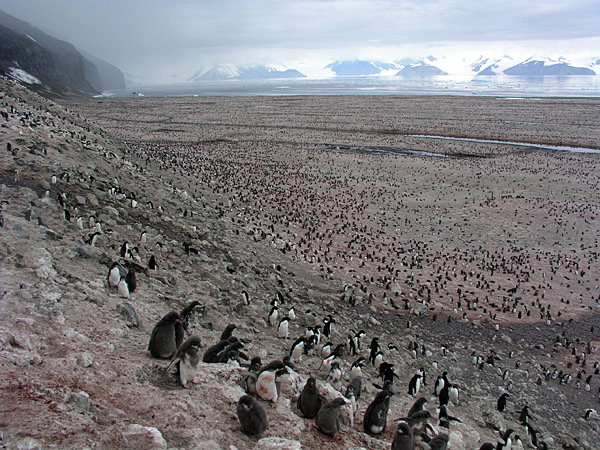
Cape Adare is home to the largest Adélie penguin colony in Antarctica. Until about 200 years ago, when humans decimated whale and seal populations, the penguins subsisted mainly on fish. But the ensuing surplus of krill created by the dearth of top predators caused a shift in diet. Photo Credit: Steve Emslie


Photo Credit: Michael Polito
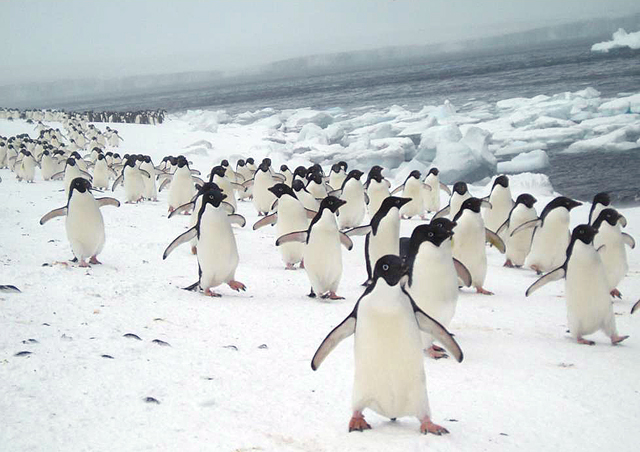
Adélie penguins march along Brown Bluff at the northern end of the Antarctic Peninsula.

Changing diet
Krill surplus 200 years ago may have caused penguins to shift prey preferences
By Peter Rejcek, Antarctic Sun Editor
Posted October 30, 2009

Most of us have heard the oft-repeated phrase, “You are what you eat.” Turns out it’s not just a way for your mother to nag you about your poor eating habits.

By studying the tissue remains of penguins in Antarctica, scientists are not only learning more about the modern diet of the continent’s iconic seabird but also what was on the menu thousands of years ago. And that information can provide insight into past climate and penguin behavior, as well as how the species could respond to future climate changes.

Steve Emslie External Non-U.S. government site, a marine ornithologist in the Department of Biology and Marine Biology External Non-U.S. government site at the University of North Carolina Wilmington External Non-U.S. government site, and his team are in the midst of a five-year grant from the National Science Foundation (NSF) External U.S. government site to determine how changes in climate and penguin prey dynamics have influenced the seabird population.

Much of their work involves collecting tissue samples, such as eggshells and feathers, from existing penguin colonies and long-extinct ones around the Antarctic Peninsula and the Ross Sea regions. Then they analyze the samples in the lab, looking at the ratios of carbon and nitrogen stable isotopes, which can provide important clues to what’s been on the dinner plate throughout the year.

“It’s mainly based on the fact that you are what you eat,” explained Emslie, who will return to McMurdo Station External U.S. government site and Ross Island this summer season to continue his fieldwork as the principal investigator (PI) on the project. “Whenever you eat something, you’re absorbing the carbon and nitrogen isotopes that are stored in that food. That ratio of carbon and nitrogen isotopes will be a part of your tissues as long as you’re eating that food.”

For example, shifts in carbon isotope ratios can indicate if a bird feeds inshore or in the marine environment. Nitrogen isotope ratios indicate how far up or down an animal feasts on the food chain.

“We look at that as a way to assess diet and how it has shifted through time as well with the Pygoscelis penguins, and also through space by the different colonies in the different regions of the Antarctic,” Emslie said.

In a study published two years ago in the journal Proceedings of the National Academy of Sciences, Emslie and collaborator William Patterson suggested that the krill-centric diet of today’s Adélie penguin is a recent phenomenon, a shift that occurred maybe 200 years ago. Their suggestion is based on a change in the nitrogen stable isotope ratio in penguin tissue.

Two hundred years ago is about the time when whalers began decimating the waters around Antarctica of krill-eating whales and seals, creating what Antarctic scientists in the 1960s and 1970s labeled as a “krill surplus,” Emslie said.

“It makes sense,” he said. “Krill per gram are just as rich in protein as fish but during a krill swarm, you can gather a lot more food a lot more quickly than you could in a school of fish. We think that’s probably why they did that switch — when krill became more abundant — even though fish were probably still available.”

Now the scientists are testing the idea further by looking at gentoos, another Pygoscelis penguin, a mostly subantarctic bird that is pushing its way across the northern end of the Antarctic Peninsula as the climate there warms and the Adélie population declines.

“We’re not sure it will show up because gentoos are known to eat a lot more fish and squid in their diet anyway compared to Adélies,” Emslie said.

The scientists know the shift in diet for the Adélies in the Ross Sea region is relatively recent because tissue samples dating back at least 40,000 years from extinct colonies in the region suggest a diet richer in fish. “Surprisingly, there weren’t any noticeable shifts [in diet] between warm and cold [periods] that are known from ice core records,” Emslie said.

“That was kind of a surprise as to why there would be a sudden shift in diet historically that wasn’t related with these climate intervals,” he said, referring to the krill surplus that resulted from whaling.

Emslie said it’s difficult to pin down an exact date on when Adélies began to prefer krill, but it was certainly happening by the beginning of the 20th century based on an analysis of Adélie eggs stored in explorer Robert F. Scott’s Hut on Cape Evans that were collected from a nearby colony sometime between 1911-1917.

“They became a nice historical sample to run isotope analysis on to see if the dietary switch had occurred by the early 1900s, and the data suggest that it had,” Emslie said. “On the peninsula you would expect it to occur first because it was hit hard first by the sealers and whalers.”

Research suggests modern Adélie diet not as krill-centric as scientists once thought

Michael Polito External Non-U.S. government site, a graduate student in Emslie’s lab External Non-U.S. government site and co-principal investigator on the project, has been working around the Antarctic Peninsula collecting penguin tissue samples from extant, or existing, colonies. By comparing the data from the stable isotope analysis to what other penguin researchers have found by physically looking at the stomach contents of the penguins, Polito hopes to refine the isotope methodology.

“They’re both useful, especially when you can use them together you can get more information than you could get just by one method alone,” he said.

For instance, it’s possible to determine the exact species of fish from stomach contents, but underestimate the mass of fish consumed, as fish digest rapidly in a penguin’s stomach, Polito said. In contrast, the stable isotope method can’t readily determine what fish species the penguins are eating, but it can provide a good estimate on how much fish the penguins consume versus krill and other prey in the ocean.

In addition, stomach content data are limited to when the penguins are on land rearing their chicks. The isotope method can also provide information about penguin diets outside of the breeding season.

And based on early results, it appears the Adélies aren’t always as reliant on krill as one might suppose from looking at what’s in their bellies during the austral summer.

“We’re definitely finding that the isotopes in general do predict a higher composition of fish in the diet than the stomach content do. It still looks like during the chick-rearing period krill are still dominant,” Polito said. “Based on the isotope data, fish appear to be relatively more important to penguins during the pre-breeding period than the breeding period.”

That finding is important but puzzling. Researchers working along the Antarctic Peninsula have reported that Adélie colonies are disappearing, their fate apparently linked to the diminishing sea ice in the region from warming temperatures. Krill also use sea ice as a key habitat. Hence, the Adélies face a double climate whammy — loss of their sea ice habitat and loss of a primary prey.

But if fish still remain a staple, why are Adélie numbers declining so dramatically? Scientists don’t really have an answer at this point. Emslie noted that part of the problem is that fish have become highly depleted as well from fisheries. “That means they have no other choices left,” he said of the Adélies.

Polito’s work to improve the isotope methodology also involves determining what other variables may be at work influencing the carbon and nitrogen ratios. For example, it turns out the size of the krill — from the juvenile stage to the adulthood — might affect their stable isotope ratio.

“Once we know how variable krill is and why it’s variable, that’s going to allow us to predict with greater accuracy the penguin diet itself.

“The modern work that we do is really designed to gain more insight about the past as well as the future,” Polito added. “We want to know how penguins respond to changes in their environment, be it climate or food availability.”

NSF-funded research in this story: Steven Emslie, Michael Polito and William Patterson, University of North Carolina Wilmington, Award No. 0739575

Source:
http://antarcticsun.usap.gov/science/contentHandler.cfm?id=1938

Penguins on the Edge

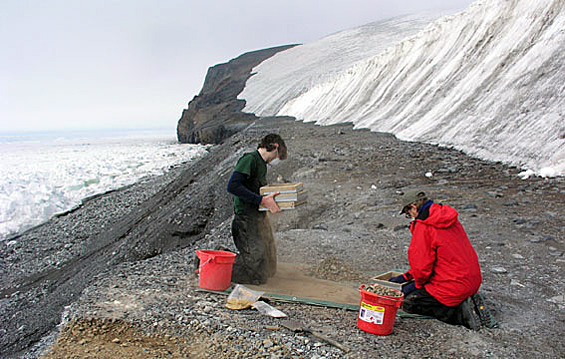
Scientists use screens to sift through dirt on Beaufort Island, searching for remains of ancient penguin colonies. Ornithologist Steve Emslie has found remains as old as 40,000 years on Beautfort Island.


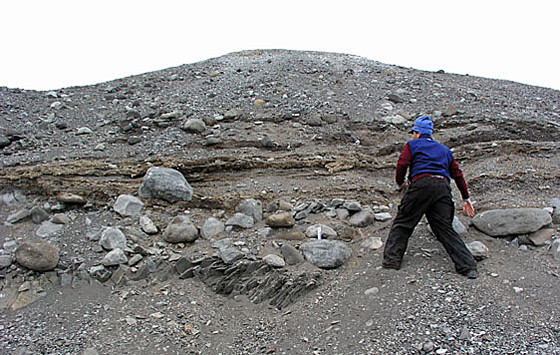
A scientist examines molt layers in a glacial moraine on Beaufort Island.

Penguins on the edge
Location of ancient colonies follow the ebb and flow of Antarctic ice
By Peter Rejcek, Antarctic Sun Editor
Posted October 30, 2009

Location, location, location. For marine ornithologist Steve Emslie External Non-U.S. government site, the long-abandoned homes of Adélie penguins in Antarctica are markers in time that help define how far the continent’s ice sheets advanced and retreated for the last 45,000 years.

“The whole pattern of the colonies coming in and out of the Ross Sea fits really nicely with the forward and backward movement of the ice sheet,” said Emslie, the principal investigator on a National Science Foundation External U.S. government site grant to study how population dynamics of the three Pygoscelis penguin species in Antarctica relate to changes in prey availability and climate.

Scientists have a pretty good idea of what the climate in Antarctica was like over the last 45 millennia thanks largely to the atmospheric record from ice cores. Less well known is the location of the ice sheet edge as the atmosphere alternately warmed and cooled.

By locating and dating Adélie penguin colonies, mainly in the Ross Sea region, Emslie has been able to interpret how the ice moved. That’s because penguins re-establish their seasonal colonies in the same ice-free areas every year unless conditions force them to move.

For instance, in a study published in Geology in 2007, Emslie and his colleagues, geologists Larry Coats and Kathy Licht, determined from the existence of former colonies along the Victoria Land coast that open water existed in the southern Ross Sea from about 40,000 to 27,000 years ago. Then the ice began to advance, reaching as far as Coulman Island, about 300 kilometers north of the current edge of the Ross Ice Shelf External U.S. government site.

The climate pendulum began to swing the other away about 13,000 years ago with the start of the warmer Holocene. As the ice retreated back south, the penguins returned and re-colonized the coast, especially the Scott Coast in the southern Ross Sea, Emslie said.

Then, about 2,000 years ago, a cold snap or perhaps the presence of too much sea ice, caused the penguins to leave their colonies for a thousand years, most apparently retreating to Cape Adare far to the north, where radiocarbon dates indicate that occupation began there at that time.

“Cape Adare is now the largest Adélie penguin colony in the Antarctic, but it is definitely not the oldest,” Emslie noted.

Even after ice conditions became more favorable for the Adélies to return south, they didn’t, except for some apparently intrepid birds that founded the large colonies around Ross Island today, according to Emslie.

“So far, the data indicate that Adélie penguins, even though they’re super abundant on Ross Island today, that only occurred in the last 500 years,” he said. “They still have not reoccupied the Scott Coast, probably because of persistent annual sea ice that blocks access to that shoreline.”

Emslie and members of his research team, including a geologist from China, will revisit previous sites at Cape Bird and Cape Crozier to collect more tissue samples such as feathers, eggshells and even mummified bodies. The scientists use the organic material for radiocarbon dating — measuring the radioactive decay of radioisotope carbon-14 — to determine the age of the remains.
Molt layers in a glacial moraine.
Photo Credit: Steve Emslie
A scientist examines molt layers in a glacial moraine on Beaufort Island.

The field plan also calls for searching for more remains on Beaufort Island, which hosts the oldest samples, dating back more than 40,000 years.

Emslie’s group is one of very few using the historical location of animals like penguins to interpret ice conditions in the past. Another team, led by Brenda Hall External Non-U.S. government site with the University of Maine External Non-U.S. government site, has done similar work in the region using abandoned elephant seal colonies. [See previous article: Cradle to grave.]

Any differences? Well, it sounds like it’s much easier to locate lost penguin colonies than elephant seal colonies, where there are no definite signs to mark the remains, requiring the researchers to get down on hands and knees to search for bits of tissue from skin and hair.

Not so with Adélie penguin colonies, where the birds stack pebbles into little mounds to make a nest.

“Once you have an eye for what an abandoned colony looks like, they stand out pretty well. You can often see them from a distance away,” Emslie said. “I scan large areas with binoculars and tell whether or not abandoned sites are possible.”

Then it’s a matter of digging into the ground in tightly controlled increments, screening for samples. “You excavate them like an archaeological site,” he explained.

“There’s no other place in the world where you can have such good preservation of the same species through time that is also a good indicator of environmental change like the Adélie penguin. There’s nothing in the Arctic that we can use like that,” Emslie said.

“I think it’s pretty remarkable, pretty unique to be able to do this in the Antarctic with these preserved, ancient colonies, some as old as 40,000 years looking like they were abandoned yesterday.”

Source:
http://antarcticsun.usap.gov/science/contentHandler.cfm?id=1941