Monday, January 12, 2009

Like My Feathers?


Zhao Chuang and Xing Lida
Like My Feathers?
A reconstruction of Beipiaosaurus shows how the dinosaur may have displayed its feathers. The fossil, found in China, suggests the earliest feathers were for display purposes only.


Earliest Feathers for Show, Not Flight
Jennifer Viegas, Discovery News


Jan. 12, 2009 -- The world's first feathers probably had nothing to do with flight or staying warm but were instead for showy display purposes, according to a new study that documents the most primitive known version of feathers, which were found on a Chinese dinosaur.

The dinosaur, Beipiaosaurus, sported the likely colorful feathers on its limbs, trunk, tail, head and neck, with the neck feathers resembling a lion's mane.

Paleontologists now believe feathers evolved very early in archosaurs, the group that included dinosaurs, pterosaurs and relatives of crocodiles, in addition to today's modern birds, crocodiles and alligators.

"Our analysis suggests that feathers might have a much longer history than previously thought," lead author Xing Xu told Discovery News.

Story and picture courtesy of Discovery News @

http://dsc.discovery.com/news/2009/01/12/dinosaur-feathers.html

Image of the Day


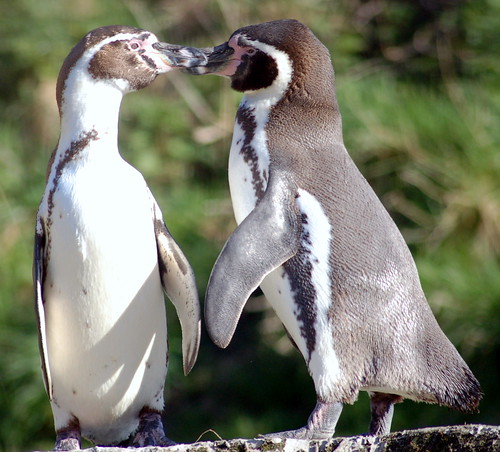
Penguins, originally uploaded by Rune Johnsson's snapshots.

Picture depicts two color morphs in the Humboldt Penguin

Sunday, January 11, 2009

Image of the Day


Penguin's reproductive cycle, originally uploaded by flower_bee.

Magellanic reproductive cycle--on site sign in "dos" languages. :)

Saturday, January 10, 2009

Images of the Day--Pygoscelis

There are three species of penguin in the the genus, Pygoscelis (aka the Brush-Tailed Penguins):


P. antarctica


P. papua


P. adeliae


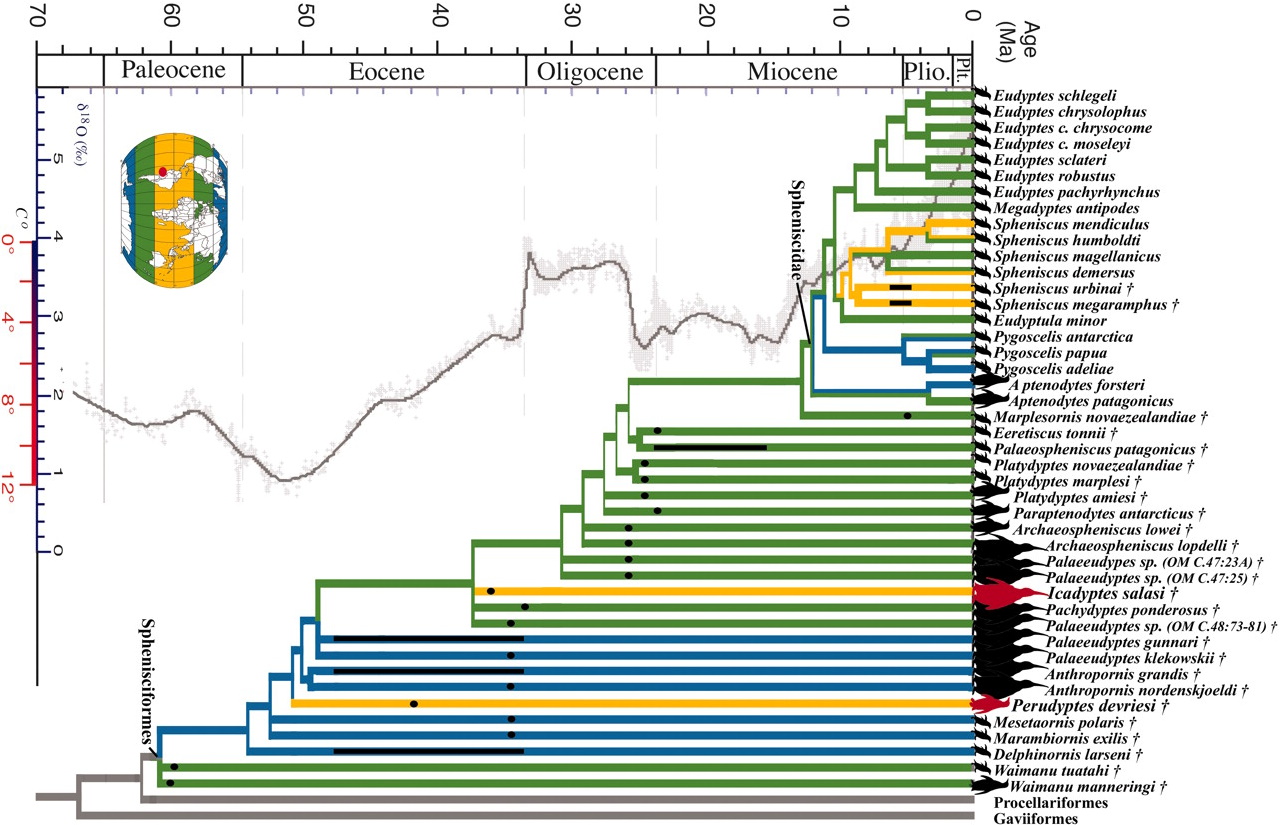
Mitochondrial and nuclear DNA evidence suggests the genus split from other penguins around 38 million years ago, about 2 million years after the ancestors of the genus Aptenodytes. In turn, the Adelie Penguins split off from the other members of the genus around 19 million years ago.*

There are also three extinct species:

1) Pygoscelis grandis (Bahía Inglesa Formation, Late Miocene/Early Pliocene of Bahía Inglesa, Chile)
2) Pygoscelis calderensis (Bahía Inglesa Formation, Late Miocene of Bahía Inglesa, Chile)
3) Tyree's Penguin, Pygoscelis tyreei (Pliocene of New Zealand)

* Baker AJ, Pereira SL, Haddrath OP, Edge KA (2006). "Multiple gene evidence for expansion of extant penguins out of Antarctica due to global cooling". Proc Biol Sci. 273 (1582): 11–17.

Thursday, January 8, 2009

The Harlequin Group of Penguins/Images of the Day


The Magellanic Penguin

Height: 28 inches
Weight: 6 - 11 lbs
Range: Argentina, Southern Chile, and the Falkland Islands
Breeding Season: Sept. to March
Nesting: 2 eggs incubated by both parents, 39 - 43 days.
Fledgling stage: 3 months

The Magellanic penguin stands a little over 2 feet tall and weighs about 10 lbs. Like all of the Tropical group, it has a raucous, braying call; a black back, and white underside, with distinctive rings around the face and chest. The Magellanic penguin has 2 black bands between the chin and the chest. They are rather shy and, if approached too closely, will run in to the water or retreat down their burrows. The Magellanic penguin is named after the Straits of Magellan which lies within their range. They are not directly named after the explorer Magellan. (Although the "Straits" are named for him.)

The Magellanic penguin is migratory and spends April through August at sea, following the ocean currents; and Sept through March at their breeding grounds along the coastlines of Argentina, southern Chile, and the Falkland Islands. They nest close to the sea; in burrows that they dig, or in hollows under bushes. The tunnels in the burrows may be over 5 feet long, especially in soft earth. The nesting chamber is big enough for both adults. The colony habitat varies, from place to place. In Argentina the colonies tend to be huge and densely packed. One famous colony at Punta Tumbo has over 1 million birds. In southern Chile, the colonies are smaller and more scattered. Isolated groups of 4 or 5 nesting pairs are not uncommon. In the Falkland Islands, Magellanic penguins are found nesting in the same area as Rockhopper and Gentoo penguins.

The Magellanic chicks are born blind and helpless. Their eyes usually open within a week. They do not form creches; instead they stay in or near the nest, until fully fledged. The juvenile Magellanic penguins are smaller that the adults. They are duller in color and lack the facial pattern.


The Blackfooted/African Penguin

Height: 27 inches
Weight: 10 lbs
Range: southern shores of South Africa
Breeding Season: February and September
Nesting: 2 eggs incubated by both parents, 42 days.
Fledgling stage: 90 days

The Blackfooted penguin is similar in appearance to the Magellanic penguin, but it has only one chest band. The Blackfooteed penguin is sometimes called the Jackass penguin (because of its loud braying call), or the South African penguin. They are considered by some to be the most attractive of the warm weather penguins.

The Blackfooted penguins breed twice a year, in February and September. They nest in underground burrows, which gives them some relief from the heat. They also nest between boulders and in other sheltered sites.

The Blackfooted penguin is considered a "threatened" species. There are approximately 100,000 - 200,000 birds. They are very vulnerable to oil spills, because so many oil tankers travel through their waters. Also in the past it was common practice to harvest their eggs. Between 1900 and 1930 half a million eggs were collected EVERY YEAR from one colony alone. It was estimated in 1972 that the total population of Blackfooted penguins was 170,000. This is only 10 % of their former numbers.


The Galapagos Penguin

Height: 21 inches
Weight: 4 - 6 lbs.
Range: The Galapagos Island
Breeding Season: No set breeding season.
Nesting: 2 eggs incubated by both parents, 38 - 42 days.
Fledgling stage: 3 months

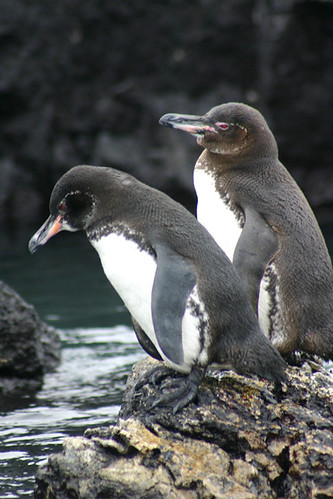
The Galapagos penguin is the second smallest of all the penguin species. They are dull colored, and have two black chest bands. The bill is slender and relatively long. They live farther north than any other penguin species. The Galapagos Island is just south of the equator.

The Galapagos penguin is not very gregarious. They are not seen in large groups (or rookeries). They are not migratory and may breed at any time of the year. Depending on how plentiful the food supply is, they may breed twice a year. Since they molt after each nesting period (as all penguins do), that means they may also molt twice a year. The Galapagos penguins nest in depressions in the lava rock. The young have a very distinctive plumage.

The estimated population of Galapagos penguins is 15,000 birds; and officially it is considered an endangered species. However, it's possible that the population numbers have never been larger than this. that the habitat cannot support a larger number. If this is true, they are not really endangered, but still, must be protected to assure their continued survival.


The Humboldt Penguin

Height: 26 inches
Weight: 10 lbs.
Range: Coasts of Peru and Chile and nearby islands.
Breeding Season: Year round.
Nesting: 2 eggs incubated by both parents, 42 days.
Fledgling stage: 90 days

The Humboldt Penguin is also known as the Peruvian Penguin. It has one Black chest band. The Humboldt Penguin is rather timid and is rarely seen in large groups. The juveniles have very distinctive plumage.

The Humboldt Penguin used to be considered "extremely abundant". Now the species is considered endangered. There are approximately 10,000 birds left. The two major reasons for the decline are the competition for food (mostly anchovies) with the Peruvian fishermen and the fact that many of the nesting areas have been destroyed.

On some of the islands west of Peru, millions of sea birds breed every year (mostly cormorants, pelicans, boobies and penguins). Over the years the quano deposits have accumulated until, in some places, they are over 150 feet thick. The quano is easily burrowed into and is essential to the nesting penguins. Unfortunately, quano is one of the richest type of fertilizer, and the nesting islands were stripped down to bare rock in many places, by people harvesting the quano. (Between 1848 and 1875 an estimated 20 million tons of quano was exported.) This made the area unsuitable for nesting penguins, because they had no where to dig their burrows.

Information courtesy of Darlene's Penguin Pages@

http://www.eliasdesigns.com/penguins/index.htm

Pictures courtesy of Flickr

Wednesday, January 7, 2009

Galapagos penguin (Spheniscus mendiculus)


Galapagos penguin (Spheniscus mendiculus)

Facts
Kingdom Animalia
Phylum Chordata
Class Aves
Order Sphenisciformes
Family Spheniscidae
Genus Spheniscus (1)
Size Length: 53 cm (2)
Status

Classified as Endangered (EN A1bde, B1+2e+3d, C2b) on the IUCN Red List 2003 (1).

Description

The Galapagos penguin is the most northerly of all penguins, occurring on the Galapagos Islands, on the equator (3). It is the third smallest penguin in the world (4) and is the smallest member of the Spheniscidae family (5). This diminutive penguin has a black head and upperparts, with a narrow white line extending from the throat around the head to the corner of the eye (6). The underparts are white with two black bands extending across the breast (2). The upper part of the bill and the tip of the lower part of the bill are black, the rest of the bill and a bare patch around the eye and bill are pinkish yellow (6). Although the sexes are generally similar in appearance, males are larger than females (5). Juveniles have a totally dark head, and lack the dark breast bands seen in adults (2). This species has more bare skin on the face than other penguins; this is an adaptation to the hot temperatures experienced on the Galapagos (4).

Range

Endemic to the Galapagos Islands, Ecuador, with 95% of the population occurring on the western islands of Ferdinandina and Isabela, and 5% on Bartolome, Santiago and Floreana (2). This species has the smallest breeding range and lowest population numbers of all penguins (6). In 1999 the population numbered just 1,200 individuals (2).
UNEP World Conservation Monitoring Centre View a distribution map for this species at UNEP World Conservation Monitoring Centre.

Habitat

Galapagos penguins nest in burrows and depressions in volcanic deposits. They forage in the sea close to the shore during the day (5).

Biology

The Galapagos penguin has a number of unique adaptations that allow it to survive the high temperatures and unpredictable food supply of the Galapagos (4). Foraging in the sea for small schooling fish during the day helps them to avoid overheating (4). Diving takes place between the hours of 05h30 and 18h30, with short breaks on land between dives (7). Most dives are shallow and take place close to the shore (7). This species has a number of behavioural adaptations that allow these birds to keep cool on land. These include standing with the flippers extended to aid heat loss, as well as panting and seeking shade (6) (4). When standing on land they tend to adopt a strange hunched posture, which shades their bare feet, another site of heat loss, aided by increased blood flow to the bare skin (6).

Most penguins have a distinct annual breeding season at a particular time of year, but the Galapagos penguin does not. Furthermore, it may produce as many as three clutches in a single year. These adaptations help this species to cope with the highly unpredictable food resources reaching the Galapagos. The unpredictability of the ocean currents that bring small fish to the islands is compounded further by changes in water temperatures caused by El Nino events (4). The flexibility of breeding in this penguin allows it to take advantage of times of high food abundance (6). When the surface temperature of the sea becomes high, food shortages result as the water becomes very poor in nutrients. These periods are known as El Nino Southern Oscillations (ENSO). During these periods, the penguins will delay breeding completely until the food resources improve (6).

Pair bonds are for life, enabling these birds to begin breeding quickly when conditions improve. The bond is reinforced by mutual preening and bill tapping. Two eggs are produced at an interval of around four days. Incubation takes up to 40 days and is shared by the male and female. After 30 days the chicks develop plumage to protect them from the sun. After 65 days the chicks will have fledged (6).

Threats

The main threat facing this unique penguin is the fluctuations in food supply, compounded by El Nino events. The 1982-1983 El Nino Southern Oscillation (ENSO) resulted in the catastrophic loss of 77% of the population through starvation. A slow period of recovery followed, but the 1997-1998 ENSO resulted in another precipitous population crash of 66%. It is now thought that the species is experiencing another recovery phase (2). Other threats facing this beleaguered penguin include predation by introduced feral animals such as dogs and cats, increased disturbance by tourists, pollution (including oil spills), and fishing (5).

Conservation

All populations of the Galapagos penguin occur within the Galapagos National Park and Marine Reserve (2). At present, all populations are closely monitored and feral animals are controlled. Proposed measures to help this highly endangered species include discouraging the use of fishing nets in the foraging area, preventing coastal developments in the breeding areas, and providing nest-boxes in predator free areas to allow research into the reproductive success of the species (2). As the population of the diminutive and uniquely adapted Galapagos penguin is so small and precarious, and restricted to just one breeding location, unfortunately the species is extremely vulnerable to extinction (1).

References

1. IUCN Red List of Threatened Species 2003 (March 2004):
http://www.redlist.org
2. BirdLife International 2003 Birdlife’s online World Bird Database: the site for bird conservation Version 2.0. Cambridge, UK: BirdLife International (March 2004)
http://www.birdlife.net/datazone/search/species_search.html?action=SpcHTMDetails.asp&sid=3864&m=1
3. Galapagos Online (March 2004)
http://www.galapagosonline.com/Galapagos_Natural_History/Birds_and_Animals/Birds/Penguins.html
4. Chan, A. & Durham, W. (2002) Adaptations of the Galapagos penguin for a harsh and unpredictable environment. (March 2004)
http://www.stanford.edu/class/anthsci10sc/2002_galapagos_website/Albert-Penguin.htm
5. Penguin Taxon Advisory Group (March 2004)
http://www.penguintag.org/species_index_galapogos.htm
6. International Penguin Conservation Work Group (March 2004)
http://www.penguins.cl/galapagos-penguins.htm
7. MILLS, K.L. (2000). Diving behaviour of two Galapagos Penguins Spheniscus mendiculus. Marine Ornithology 28: 75–79. Available at:
http://www.marineornithology.org/PDF/28_1/28_1_12.pdf

Information courtesy of Arkive @

http://www.arkive.org/galapagos-penguin/spheniscus-mendiculus/info.html

Pictures courtesy of Flickr

Antarctica Pre-History


Map: R. Beaman
Map showing details of Gondwana break-up, including glacial scouring as Australia moved northwards.

Antarctic Prehistory

Life has been on earth for about 3.5 billion years. Until about 575 million years ago, all was microscopic plant life.

Before that time life in the Antarctic was very different from the way it is now. Antarctica was part of Gondwana and was fully vegetated with all the animal and plant life that existed elsewhere on the supercontinent. Of course, there were regional differences, just as there are differences between the animals and vegetation in parts of Australia.

When animal life burst forth on earth, initially all in the marine environment, Antarctica lay along what is now Australia's southern margin but the pair was rotated anticlockwise about 90° and the equator ran though both continents. At about 400 million years, Gondwana moved dramatically and Antarctica took up its place over the South Pole, but moving a little from time to time. Thus the South Pole has not always been within Antarctica but always very close to it.

When animal life evolved, carbon dioxide content of the atmosphere was much higher than at present and some estimates put it at 15-20 times as high. As oxygen content grew, the time came when some oxygen could reach the stratosphere, be converted to ozone and give protection from ultraviolet rays. When this happened, plant life moved from the oceans to the land and then land animals evolved to feed on the plant life.

At about 130 million years, Gondwana really began to disintegrate, with India and South America-Africa departing. At about 90 million years, Australia began to move very slowly, and the links between Australia and Antarctica remained very strong until about 55 million years when Australia began moving north quickly, allowing Antarctica to become isolated for the first time since animals evolved. At about 30 million years, Antarctic Circumpolar circulation evolved, the Southern Ocean began to circulate around the southern world and the modern Antarctic environment evolved.

Until 55 million years ago, the history of life on Antarctica was very similar to that on other southern continents, especially Australia. The fossil record is very similar with abundant plants and animals, including those that lived on land. There are abundant plant fossils in many areas of Antarctica from this period.


Fossil leaf embedded in rock.
Glossopteris (fossil) leaf Permian age, Prince Charles Mountains.
Photo: R Oldfield


Perhaps the historically most significant evidence of earlier vegetation, well preserved in Antarctica, is the leaf form Glossopteris which was at the heart of the concept of Gondwana, an hypothesis first proposed to explain the widespread distribution of glacial rocks and Glossopteris. When Robert Falcon Scott's party was found dead in its tent on the way back from the South Pole, specimens of Glossopteris from the Beardmore Glacier region were found with them. While they had jettisoned almost everything else on the way back, they recognised the immense scientific importance of Glossopteris and refused to leave the specimens behind. These are some 280-300 million years old.

There is a major dispute about when Antarctic vegetation died out. It is clear that a good vegetation cover, containing many elements that still exist in some southern hemisphere cold temperate rain forests such as Tasmania, New Zealand and southern South America, continued in Antarctica until about 35 million years ago. There are other tantalising pieces of evidence to suggest it continued until even much more recently, even as young as 2-3 million years ago.

Dinosaurs lived on Antarctica and are particularly well known from the northern tip of the Antarctic Peninsula although few have been described formally. They include ankylosaurs (the armoured dinosaurs), mosasaurs and plesiosaurs (both marine reptilian groups).


Pictorial representation of Gondwana breaking up

Seymour Island, just off the Antarctic Peninsula, is one of the most important fossil sites on earth. It contains a bewildering array of different fossils, representing a great array of different environments, and also includes one of the very few uninterrupted sections across the Cretaceous/Tertiary boundary, the time when dinosaurs and many other life forms died out, probably due to meteorite or asteroid impact.

Abundant remains of the southern beech, Nothofagus (N. beardmorensis) have been found at 86°S, only 400 km from the South Pole. The age is contentious but may be as young as 2-3million years, suggesting that the modern environment of Antarctica, with the large icesheet, may be a more recent development than was thought a few years ago. The leaves occur abundantly in lake sediments which are in turn under- and over-lain by glacial sediments. The leaves represent an autumn leaf-fall and are very similar, though larger than, the Tasmanian species Nothofagus gunnii also known as the Deciduous Beech or Tanglefoot. Study of the wood suggests that the plant grew as a straggly shrub similar in growth form to the Arctic willow (Salix arctica).

Marine Plain in the Vestfold Hills is another important locality which is yielding a ggreat diversity of fossils from 4.5-4.1 million years ago. Perhaps the best known are the fossil dolphins and whales. About 5 or 6 species are known but only two dolphins have been studied in detail. The dolphins are new to science and are very different from modern dolphins. They are quite common and occur as almost complete skeletons as if they died and sank gently into the mud without being disturbed by predators or rough sea conditions. They died in an embayment which was less than 40m deep. They consist of two species, one about 4.5m long and the other about 8-9 m long. They are unusual in lacking teeth, and one, in being so large for a dolphin. They may have consumed squid by sucking them into their very long, slim jaws and locating them by echo-location devices. Other species of cetaceans are represented by fragments only.

An interesting fossil from Marine Plain is a palinurid crustacean, a small lobster. This family includes the modern lobsters of commerce around Australia. The group is now extinct from the Antarctic. The palinurids have another interesting aspect. They belong formally to the Family Palinuridae which includes Palinurus, Panulirus, and Linuparus. These names are all anagrams of each other and suggest a sense of humour among the group of biologists that named them. Palinurus in the ancient world, was the navigator in Virgil's Aeneid.

Marine Plain fossils occur where they died, in contrast with most other localities where fossils of the age are known and this is where the value of the deposit will eventually be documented.

It is clear that a major extinction event occurred around Antarctica in the period 2-3million years ago, but it is now becoming evident that it may be part of a global extinction event that is now being documented. The cause is debated but one strong contributor probably was the closure of the Isthmus of Panama, which caused the flow of water from the Atlantic to Pacific Ocean to stop, thus causing the Gulf Stream and northern hemisphere glaciation to begin. Another contributor may have been the Himalayas which were growing at the time and influenced the circulation of the atmosphere in the northern hemisphere.

How do we work out the story of Antarctic fossil life when there is so little outcrop and so few workers in the field? Modern biochemical methods are allowing us to work out the general trend of evolution, even in some groups which do not leave fossils. Two groups where these techniques have been particularly successful are in the Euphausiacea (including Antarctic krill such as Euphausia superba) and the Antarctic fish that belong to the Notothenioidea. Both groups have no fossil record. For the Euphausiacea this is true globally and yet it constitutes one of the world's great biomass features. One key approach is to examine DNA from mitochondria in modern cells. This DNA is believed to be almost entirely maternal in origin and thus not part of the reproduction process involving nuclear DNA. Mitochondrial DNA accumulates mutations at a rate that is known roughly. The difference in mitochondrial DNA in two similar organisms is a function of the time since they evolved from a common ancestor. Biochemical techniques now allow estimates of this time to be made and a rough evolutionary tree to be established. The evolution of krill and fish is now roughly worked out and the times of change coincide quite well with oceanographic events that are identifiable in the geological record.

Courtesy Australian Antarctic Division © Commonwealth of Australia 2008 @

http://www-aadc.aad.gov.au/default.asp?casid=1542

http://www-aadc.aad.gov.au/default.asp?casid=1680

Friday, January 2, 2009

Friday Videos!


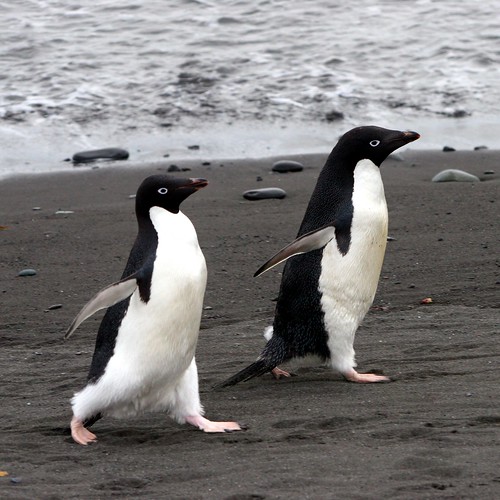
Adelie penguins, originally uploaded by jeroenf.

The Calls and Gesturing of Penguins


Image of the Day


Magellan Penguin, originally uploaded by passengercis.

Magellan Penguin

The Magellanic Penguin, Spheniscus magellanicus, is a South American penguin, breeding in coastal Argentina, Chile and the Falkland Islands, with some migrating to Brazil. It is the most numerous of the Spheniscus penguins. Its nearest relatives are the African Penguin, the Humboldt Penguin and the Galápagos Penguin.
Source: en.wikipedia.org/wiki/Magellan_Penguin