Saturday, December 6, 2008

Image of the Day (Friday)

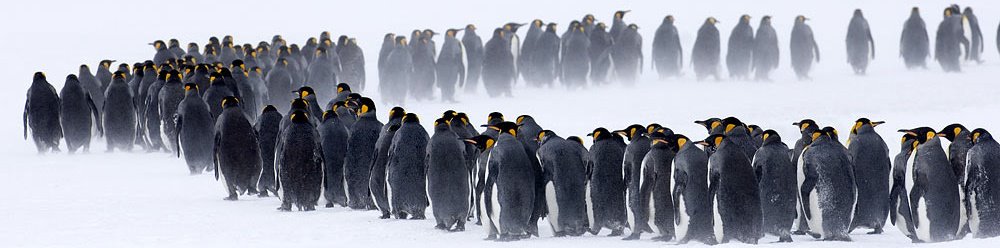
Chinstraps display like this when greeting their mates

Friday, December 5, 2008

Velociraptors and Penguins: Much in Common


Dinosaurs breathed like penguinshttp://news.bbc.co.uk/2/hi/science/nature/7081166.stm
By Helen Briggs
Science reporter, BBC News

Dinosaurs like Velociraptors owe their fearsome reputation to the way they breathed, according to a UK study.

They had one of the most efficient respiratory systems of all animals, similar to that of modern diving birds like penguins, fossil evidence shows.

It fuelled their bodies with oxygen for the task of sprinting after prey, say researchers at Manchester University.

The bipedal meat-eaters, the therapods, had air sacs ventilated by tiny bones that moved the ribcage up and down.

"Finding these structures in modern birds and their extinct dinosaur ancestors suggests that these running dinosaurs had an efficient respiratory system and supports the theory that they were highly active animals that could run relatively quickly when pursuing their prey," said Dr Jonathan Codd, who led the research.

"It provides a mechanism for facilitating avian-like breathing in non-avian dinosaurs and it was there long before the evolution of flight occurred," he told BBC News.

Bony projections

Modern-day birds have a highly specialised respiratory system, made up of a small rigid lung and around nine air sacs.

The bellows-like movement of the sternum and ribs moves air through the system.

Bony projections on the ribcage known as uncinate processes play an important role in both respiration and locomotion.

The small bones act as levers to move the ribs and sternum during breathing. They have become adapted in different types of birds to deal with different ways of getting around.

The bones are shortest in runners like emus that don't need large breast muscles for flight, intermediate in flying birds and longest in divers such as the penguin.

The Manchester team studied a wealth of fossil remains of dinosaurs and extinct birds such as Archaeopteryx, and compared these with skeletons of living birds.

They found that uncinate processes are also found both in the extinct ancestors of birds, the theropod dinosaurs, and in modern species.

Dinosaurs are most like diving birds in their morphology.

"The dinosaurs we studied from the fossil record had long uncinate processes similar in structure to those of diving birds," said Dr Codd.

"This suggests both dinosaurs and diving birds need longer lever arms to help them breathe," he added.

The data, published in the Proceedings of the Royal Society B: Biological Sciences, may provide clues to how dinosaurs evolved and how they might have lived.

Story courtesy of the BBC @:

Friday Videos!


Thursday, December 4, 2008

Image(s) of the Day


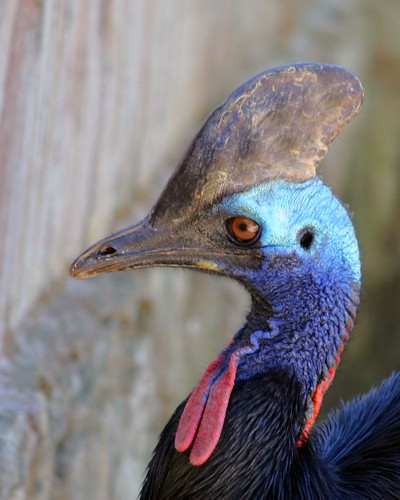
Cassowary, originally uploaded by jesuitjason.

Flightless bird of Queensland--any doubts as to the claim that birds are descended from dinos should end here, with this large and aggressive bird.


Scientific classification
Kingdom: Animalia
Phylum:Chordata
Class: Aves
Order: Struthioniformes
Family: Casuariidae
Genus: Casuarius
Brisson, 1760
Species:

Casuarius casuarius
Casuarius unappendiculatus
Casuarius bennetti


Cassowaries (from the Indonesian name kasuari) are part of the ratite group, which also includes the emu, rhea, ostrich, and kiwi, and the extinct Moa and Elephant Bird. There are three species recognized today:

* Southern Cassowary or Double-wattled cassowary C. casuarius of Australia and New Guinea.
* Dwarf Cassowary C. bennetti of New Guinea and New Britain.
* Northern Cassowary C. unappendiculatus of New Guinea.

The evolutionary history of cassowaries, as of all ratites, is not well known. A fossil species was reported from Australia, but for reasons of biogeography this assignment is not certain and it might belong to the prehistoric "emuwaries", Emuarius, which were cassowary-like primitive emus.


A cassowary's three-toed feet have sharp claws; the dagger-like middle claw is 120 mm (5 inches) long. This claw is particularly dangerous since the Cassowary can use it to kill an enemy, disemboweling it with a single kick. They can run up to 50 km/h (32 mph) through the dense forest. They can jump up to 1.5 m (5 feet) and they are good swimmers.


All three species have horn-like crests called casques on their heads. These consist of "a keratinous skin over a core of firm, cellular foam-like material".[3] Several purposes for the casques have been proposed. One possibility is that they are secondary sexual characteristics. Other suggestions include that they are used to batter through underbrush, as a weapon for dominance disputes, or as a tool for pushing aside leaf litter during foraging. The latter three are disputed by biologist Andrew Mack, whose personal observation suggests that the casque amplifies deep sounds.[4] However, the earlier article by Crome and Moore says that the birds do lower their heads when they are running "full tilt through the vegetation, brushing saplings aside and occasionally careering into small trees. The casque would help protect the skull from such collisions."[3] Mack and Jones also speculate that the casques play a role in either sound reception or acoustic communication. This is related to their discovery that at least the Dwarf Cassowary and Southern Cassowary produce very-low frequency sounds, which may aid in communication in dense rainforest.[4] This "boom" is the lowest known bird call, and is on the edge of human hearing.[3]

Description

Females lay three to eight large, pale green-blue eggs in each clutch. These eggs measure about 9 by 14 cm (3½ by 5½ inches) — only ostrich and emu eggs are larger. The female does not care for the eggs or the chicks; the male incubates the eggs for two months, then cares for the brown-striped chicks for nine months, defending them fiercely against all potential predators, including humans.


They call 55-million-year-old Diatryma gigantean a terror bird. And the evidence is compelling.

This flightless species stood some seven feet (two meters) tall and was armed with a strong beak and powerful clawed feet. In North America and western Europe, scientists say, Diatryma likely took over as top predators once the dinosaurs had died offpossibly even hunting ancestors of today's horses.

Convergent evolution? Cousins? Surely joined by a common ancestor... but which one (and was it flightless)?

Information source and first photo credit: Wikipedia
Remaining Cassowary images: Flickr
Terror Bird: National Geographic, info and picture

Wednesday, December 3, 2008

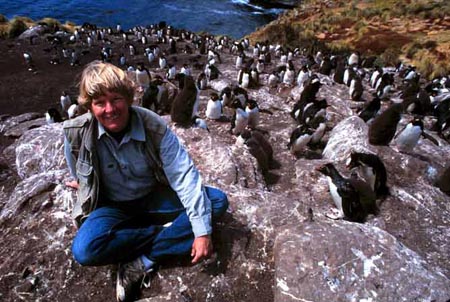
A New Letter from Dr. Dee Boersma


Pictured: Dr. Boersma and her beloved penguins

Penguin_Update

Greeting from the Penguin Project.

Each year brings new challenges and opportunities, and this year will be particularly challenging. Our success at Punta Tombo is closing the road within the colony to cars so no more penguins are being hit. No new areas have been opened to tourists which is good for the penguins. The Wildlife Conservation Society (WCS)/University of Washington (UW) Penguin Project will continue to advise the Province on what the penguins require. I worry that a new anchovy fishery may start, and the financial crisis may limit our ability to study penguins.

On April 4, 2009 we plan to have a 25th year anniversary party at the Burke Museum in Seattle for the WCS/UW Penguin Project. Additionally, during the first week of November 2009 I will lead a UW alumni group trip to the Galapagos Islands. You don't have to be an alumni to go but it will help to be a penguin lover. If you're interested go to http://www.washington.edu/alumni/tours/tour-

Attached is the Penguin Project Fall Newsletter which will also be posted on our Web site www.penguinstudies.org:

Download newletter HERE

Regards,

Dee

P. Dee Boersma, Ph.D
University of Washington
Seattle, Washington
USA


(from wiinterrr---be sure to check out the newsletter and meet "Turbo."

The Diet of Penguins


Going on a Diet

Posted: December 1, 2008

Courtesy: Antarctic Sun

By Peter Rejcek
There’s an old saying: You are what you eat. But the krill-based diet of penguins breeding and living on King George Island off the northern end of the Antarctic Peninsula first tipped scientists off that food could provide an altogether different insight.

“It was the penguins that actually keyed us into to the global change scenario that has become the leading hypothesis about climate change in the peninsula region,” explained Wayne Trivelpiece , a scientist with the National Oceanic and Atmospheric Administration (NOAA) National Marine Fisheries Service whose research also receives support from the National Science Foundation (NSF) .

Trivelpiece, along with his wife and co-principal investigator, Susan Trivelpiece , has compiled more than 30 years of continuous data on the three types of penguins from a seabird research program at King George Island — Adélies, chinstraps and gentoos. During that time, atmospheric temperatures in the peninsula region have risen faster than anywhere on the planet, particularly in the winter, where the average has increased by 5 degrees Celsius.

“Studying all three [penguins] at once has given us some real insights into just what happens when we come across some major changes in environmental features and climate, which has certainly happened there,” Wayne Trivelpiece said.

Krill are shrimplike crustaceans that penguins, seals and other marine denizens feed on. Krill rely on sea ice in the winter as a habitat, grazing on algae that form underneath the ice. But the increasing temperatures have made the formation of sea ice, once predictable and reliable, uncertain from year to year, according to Wayne Trivelpiece.

That’s directly affected the abundance of krill and the survival rates of penguins.


The remainder of the article is at this addy:
http://www.antarcticconnection.com/antarctic/news/2008/120108diet.shtml

Image of the Day


Beware of the Penguin, originally uploaded by clarity25.

Random Penguin fact of the day

Do penguins bite?

Yes, penguins defend themselves and their nest sites with their beaks and wings. They bite fiercely and also use their thick, strap-like, wings to beat their opponent. Blue penguins and most of the crested species are regular fighters, often getting into bloody brawls during the breeding season. The more reclusive species, like yellow-eyed penguins, rarely fight among themselves, but are still prepared to bite anybody that comes too close.

Like most penguins, the species in New Zealand do not like being handled by humans. The closest thing to being beaten up by a penguin is being grabbed with a pair of needle-nosed pliers and beaten with sandals!

They look cute yes..

But it's probably a good idea to keep your distance

Tuesday, December 2, 2008

Image of the Day


Penguin, originally uploaded by jiless.

Our newsworthy subject: less diversity of life in the Galapagos than in Antarctica. The Galapagos Penguin is the only penguin species to exist on these islands and the northernmost of all penguin species, including the Humboldt (but excluding special cases). Within the sub-Antarctic region, there are 15 species. Huge difference.

Have a great day...

Antarctica More Rich in Species than Galapagos


Antarctica Has More Species Than Galapagos, First Comprehensive Inventory Of Antarctic Life Shows

ScienceDaily (Dec. 1, 2008) — The first comprehensive “inventory” of sea and land animals around a group of Antarctic islands reveals a region that is rich in biodiversity and has more species than the Galapagos. The study provides an important benchmark to monitor how they will respond to future environmental change.

Reporting this week in the Journal of Biogeography, the team from British Antarctic Survey and University of Hamburg, describe how they combed the land, sea and shores of the South Orkney Islands, near the tip of the Antarctic Peninsula, using scuba divers and trawled nets to catch creatures as deep as 1500 metres.

Animals recorded were then checked with a century of literature and modern databases and the team concludes there are over 1200 known marine and land species. These include sea urchins, free-swimming worms, crustaceans and molluscs, mites and birds. Five were new to science.

Lead author Dr David Barnes from British Antarctic Survey (BAS) says: “This is the first time anybody has done an inventory like this in the polar regions. It’s part of the Census of Marine Life (COML) – an international effort to assess and explain the diversity and distribution of marine life in the world’s oceans. If we are to understand how these animals will respond to future change, a starting point like this is really important.”

Author Stefanie Kaiser from University of Hamburg says: “We never knew there were so many different species on and around these islands. This abundance of life was completely unexpected for a location in the polar regions, previously perceived to be poor in biodiversity.”

The research team, consisting of 23 scientists from five research institutes, spent seven weeks on the BAS Royal Research Ship James Clark Ross in 2006.
Adapted from materials provided by British Antarctic Survey (BAS).

British Antarctic Survey (BAS). "Antarctica Has More Species Than Galapagos, First Comprehensive Inventory Of Antarctic Life Shows." ScienceDaily 1 December 2008. 2 December 2008 .

Monday, December 1, 2008

Fiordland crested penguin (Eudyptes pachyrhynchus)


Facts
Also known as: thick-billed penguin
Kingdom Animalia
Phylum Chordata
Class Aves
Order Sphenisciformes
Family Spheniscidae
Genus Eudyptes (1)
Size Length: up to 55 cm (2)
Height: 40 cm (2)
Weight 4 kg (2)
Status

Classified as Vulnerable (VU) on the IUCN Red List 2007 (1).

Description

One of the smaller members of the penguin family, the Fiordland crested penguin has a black head, throat and back, a white front and underside, a thick stubby orange bill and pink feet. The most distinguishing features are the yellow sulphur-coloured crests above the eyes that extend from the bill to just behind the head. Both sexes are similar, whereas young birds have paler cheeks and shorter crests (2) (4).

Like other members of the genus Eudyptes the Fiordland crested penguin has a black throat but can be distinguished from the similar Rockhopper, Macaroni and Royal penguins by the shape, extent and colour of the eye crests (4). The two species that can be confused with the Fiordland crested are the erect-crested penguin and the Snares Island penguin. The former has eye crests that stand proud of the top of the head and no part which extends to below the eye itself. The latter is a slightly larger bird with a thicker bill (4).

Range

A migratory species, found in Antarctic waters and around the southern circumpolar islands, the Fiordland penguin breeds on the coast of southwest New Zealand, Stewart Island and Solander Island (5).

Habitat

Outside the breeding season, Fiordland crested penguins are birds of the open ocean. When ashore to breed they prefer secluded coastlines and chose nesting sites that are amongst rocks or have tree cover (3).

Biology

After spending much of the year alone in the open ocean, males arrive at the chosen breeding site ahead of the females during late June or July. Two weeks later the females arrive and mating takes place. The birds are monogamous and prefer their nest sites to be hidden from one another. Two pale-green eggs are laid in a cavity between tree roots, stones or small burrows in the coastal forest, and incubation takes from four to six weeks. The birds do not attempt to collect nest materials. Although it is usual for just one egg to hatch successfully, occasionally both chicks emerge. However, the parents rarely catch enough food for two offspring and the smaller chick usually dies (3).

While the chick is still defenceless, one parent (usually the male), will guard it whilst the other finds food. Fiordland crested penguins feed inshore and catch crustaceans, squid and small fish which they regurgitate for the chick. Once the young is large enough to be safe from most native predators, both parents take on the role of fishing to provide their offspring with food. Chicks often wander about the nest site or gather in loose-knit crèches. After about 10 or 11 weeks, the chick moults and leaves the nest site, finally adopting the solitary pelagic lifestyle of the adult birds. It will return to breed at the age of five years (2) (3).

Threats

The Fiordland crested penguin has declined in numbers drastically during the last twenty years. In the 1980s, the global population was estimated to number 10,000 breeding pairs. Today, the number is thought to be 2,500 to 3,000 pairs. The principal cause is believed to be from introduced animals such as cats and stoats (5), although where the birds' breeding sites are close to public beaches, pet dogs are thought to be largely responsible for disturbing adult birds and catching chicks. With the increase in human leisure activities, this pressure is bound to intensify (2). There is also a problem with the endemic weka, Gallirallus australis, which preys on eggs and chicks and is thought to contribute to over a third of egg loses in some breeding areas, especially Solander Island (5).

At sea, penguins are in constant competition for food with fishing vessels and sometimes find themselves caught in fishing nets. Perhaps the biggest threat, however, is through marine pollution, particularly oil spillage and the illegal but common practice of discharging oil tanker ballast water off-shore (5). As yet, little is known about the possible effects of global warming on penguin populations (5).

Conservation

Recent surveys of a number of the Fiordland crested penguin's breeding areas have suggested that more research into predator-related threats need to be examined. One idea is to eradicate the weka – the principal local predator – from Solander Island to reduce the losses of eggs and chicks (5).

References

1. IUCN Red List (April, 2007)
http://www.iucnredlist.org
2. International Penguin Conservation (April, 2004)
http://www.penguins.cl/fiordland-penguins.htm
3. Animal Diversity Web, University of Michigan Museum of Zoology (April, 2004)
http://animaldiversity.ummz.umich.edu/site/accounts/information/Eudyptes_pachyrhynchus.html
4. Sparks, J. and Soper, T. (1968) Penguins. David and Charles, Newton Abbott.
5. Birdlife International (2003) Birdlife's on-line World Bird Database: the site for bird conservation. Version 2.0. Cambridge, UK: Birdlife International (April, 2004)
http://www.birdlife.org/datazone/species/index.html?action=SpcHTMDetails.asp&sid=3854&m=0

Fact sheet from Archive@
http://www.arkive.org/fiordland-crested-penguin/eudyptes-pachyrhynchus/info.html
Picture from: http://www.md.ucl.ac.be/peca/test/Fiordland%20Crested%20Penguin.jpg