Saturday, October 4, 2008

Image of the Day


Ancient swimming bird cast, originally uploaded by mr_drew.

I would say this prehistoric bird was very closely related to the penguin.

Friday, October 3, 2008

Thursday, October 2, 2008

Image of the Day


Auckland Museum, originally uploaded by angry.badger.

Ancestor Day "Continues....


Science News

Mass Extinctions And The Evolution Of Dinosaurs

ScienceDaily (Sep. 30, 2008) — Dinosaurs survived two mass extinctions and 50 million years before taking over the world and dominating ecosystems, according to new research published this week.

Reporting in Biology Letters, Steve Brusatte, Professor Michael Benton, and colleagues at the University of Bristol show that dinosaurs did not proliferate immediately after they originated, but that their rise was a slow and complicated event, and driven by two mass extinctions.

“The sheer size of dinosaurs like Tyrannosaurus makes us think there was something special about these animals that preordained them for success right from the beginning,” Brusatte said. “However, our research shows that the rise of dinosaurs was a prolonged and complicated process. It isn’t clear from the data that they would go on to dominate the world until at least 30 million years after they originated.”

Importantly, the new research also shows that dinosaurs evolved into all their classic lifestyles – big predators, long-necked herbivores, etc. – long before they became abundant or diversified into the many different species we know today.

Brusatte added: “It just wasn’t a case of dinosaurs exploding onto the scene because of a special adaptation. Rather, they had to wait their turn and evolved in fits and starts before finally dominating their world.”

Dinosaurs originated about 230 million years ago and survived the Late Triassic mass extinction (228 million years ago), when some 35 per cent of all living families died out. It was their predecessors dying out during this extinction that allowed herbivorous dinosaurs to expand into the niches they left behind.

The rapid expansion of carnivorous and armoured dinosaur groups did not happen until after the much bigger mass extinction some 200 million year ago, at the Triassic-Jurassic boundary. At least half of the species now known to have been living on Earth at that time became extinct, which profoundly affected life on land and in the oceans.

Historically the rise of the dinosaurs has been treated as a classic case in which a group evolves key features that allow it to rapidly expand, fill many niches, and out-compete other groups. But Professor Benton said the story isn’t so simplistic: “We argue that the expansion of the dinosaurs took up to 50 million years and was not a simple process that can be explained with broad generalizations.”
Adapted from materials provided by University of Bristol.

Need to cite this story in your essay, paper, or report?
MLA
University of Bristol. "Mass Extinctions And The Evolution Of Dinosaurs." ScienceDaily 30 September 2008. 2 October 2008 .

Myth busted? Pterosaurs 'too heavy to fly'


Sci. & Tech.
Myth busted? Pterosaurs 'too heavy to fly'

London (PTI): Pterosaurs, the ancient reptiles which could grow to the size of small aircraft, were too heavy to fly even with their massive wings, a new study has claimed.

Pterosaurs, which existed alongside the dinosaurs and vanished along with them around 65 million years ago after a possible asteroid impact, were often known as the terror of the prehistoric skies.

Now, scientists in Japan have found evidence that the pterosaurs struggled to get off the ground because they could not flap fast enough to create the thrust that's required to keep their enormous bulk airborne.

According to lead scientist Katsufumi Sato, the largest animal capable of soaring across the sky unaided could have weighed no more than 40 kg or the size of a labrador dog, 'The Daily Telegraph' reported.

They have based their findings on an analysis of data on the flight of 28 birds from five large species, including the world's biggest, the wandering albatross. They calculated that it was physically impossible for them to stay aloft.

In fact, Prof Soto and colleagues travelled to the Crozet Islands -- halfway between Madagascar and Antarctica -- and attached accelerometers, devices the size of AA batteries which measure thrust, to the wings of the birds.

Unlike turkeys or bustards, whose short wings are good for quick take-off but not for soaring, these larger birds fly long distances using dynamic soaring -- they ride changing wind currents without moving their wings.

But when the wind dies down, or blows at a constant speed, they have to flap or be pulled down by air resistance and gravity. The maximum speed a bird can flap is limited by its muscle strength and decreases for heavier species with longer wings.

Prof Sato concluded that animals heavier than 40 kg would not be able to flap fast enough to stay aloft. And, this would explain why the wandering albatross weighs only 22 kg.

"A bird weighing close to 40 kg would be incredible unstable and would not have a safety margin to fly in bad weather."

Story courtesy of The Hindu News@

http://www.hindu.com/thehindu/holnus/008200810021631.htm

Image courtesy of Flickr @

http://flickr.com/photos/markwitton/1386125619

Antarctic Waters Were Once Warm


BBC NEWS
Antarctic waters were 'once warm'


New research suggests Antarctica 40 million years ago had a warmer climate than previously thought with little or no ice.

Cardiff University researchers analysed fossils from sediments on a cliff in South Island, New Zealand.

New Zealand was around 1,100km further south 40 million years ago, so was much closer to Antarctica.

The surface sea temperature would have been around 23-25C (73-77F), higher than off the South African coast today.

The research has been published in the journal Geology this week by a team of scientists from the university.


ANTARCTIC FACTS
Antarctica is the coldest place on Earth
98% is covered by ice
Antarctica is divided in two by the Transantarctic Mountains
The highest peak is 4,892 metres
Antarctica is home to more than 70 lakes that lie below the continental ice sheet
Emilio Marcos Palma was the first person born on the Antarctic mainland, at Base Esperanza in 1978

"This is too warm to be the Antarctic water we know today," said Cat Burgess, who led the study.

"And the sea water chemistry shows there was little or no ice on the planet."

The research came from analysis of fossils of marine micro-organisms found in rocks.

"Because the fossils are so well preserved, they provide more accurate temperature records," said Miss Burgess.

"Our findings demonstrate that the water temperature these creatures lived in was much warmer than previous records have shown."

She added that several studies had suggested that greenhouse gases 40 million years ago were similar to those forecast for the end of this century and beyond.

This could provide clues about how temperatures may change in the future.

"Our work provides another piece of evidence that, in a time period with relatively high carbon dioxide levels, temperatures were higher and ice sheets were much smaller and likely to have been completely absent," she said.

Story from BBC NEWS:
http://news.bbc.co.uk/go/pr/fr/-/2/hi/uk_news/wales/south_east/7530702.stm

Published: 2008/07/30 11:09:45 GMT

© BBC MMVIII

Wednesday, October 1, 2008

Meat Eater 'Saur Had Birdlike Breathing System

From:
http://www.sciencedaily.com/releases/2008/09/080929212931.htm

Meat-eating Dinosaur From Argentina Had Bird-like Breathing System
enlarge


Flesh rendering of the predator Aerosteon with the body wall removed to show a reconstruction of the lungs (red) and air sacs (other colors) as they might have been in life. (Credit: Drawing: Todd Marshall c 2008, courtesy of Project Exploration)

ScienceDaily (Sep. 30, 2008) — The remains of a 30-foot-long predatory dinosaur discovered along the banks of Argentina's Rio Colorado is helping to unravel how birds evolved their unusual breathing system.

University of Michigan paleontologist Jeffrey Wilson was part of the team that made the discovery, to be published Sept. 29 in the online journal Public Library of Science ONE and announced at a news conference in Mendoza, Argentina.

The discovery of this dinosaur builds on decades of paleontological research indicating that birds evolved from dinosaurs.

Birds have a breathing system that is unique among land animals. Instead of lungs that expand, birds have a system of bellows, or air sacs, which help pump air through the lungs. This novel feature is the reason birds can fly higher and faster than bats, which, like all mammals, expand their lungs in a less efficient breathing process.

Wilson was a University of Chicago graduate student working with noted dinosaur authority Paul Sereno on the 1996 expedition during which the dinosaur, named Aerosteon riocoloradensis ("air bones from the Rio Colorado") was found. Although the researchers were excited to find such a complete skeleton, it took on even more importance as they began to understand that its bones preserved hallmark features of a bird-like respiratory system.

Arriving at that understanding took some time. Laboratory technicians spent years cleaning and CT-scanning the bones, which were embedded in hard rock, to finally reveal the evidence of air sacs within Aerosteon's body cavity. Previously, paleontologists had found only tantalizing evidence in the backbone, outside the cavity with the lungs.

Wilson worked with Sereno and the rest of the team to scientifically describe and interpret the find. The vertebrae, clavicles, and hip bones bear small openings that lead into large, hollow spaces that would have been lined with a thin layer of soft tissue and filled with air in life. These chambers result from a process called pneumatization, in which outpocketings of the lungs (air sacs) invade the bones. Air-filled bones are the hallmark of the bellows system of breathing in birds and also are found in sauropods, the long-necked, long-tailed, plant-eating dinosaurs that Wilson studies.

"In sauropods, pneumaticity was key to the evolution of large body size and long necks; in birds it was key to the evolution of a light skeleton and flight," Wilson said. "The ancient history and evolutionary path of this feature is full of surprising turns, the explanations for which must account for their presence in a huge predator like Aerosteon and herbivores like Diplodocus, as well as in a chicken."

In the PLoS ONE paper, the team proposes three possible explanations for the evolution of air sacs in dinosaurs: development of a more efficient lung; reduction of upper body mass in tipsy two-legged runners; and release of excess body heat.

Sereno, a National Geographic Explorer-in-Residence, said he is especially intrigued by heat loss, given that Aerosteon was likely a high-energy predator with feathers but without the sweat glands that birds possess. At approximately 30 feet in length and weighing as much as an elephant, Aerosteon might well have used an air system under the skin to rid itself of unwanted heat.

In addition to Sereno and Wilson, coauthors of the PLoS ONE article include Ricardo Martinez and Oscar Alcober of the Universidad Nacional de San Juan, Argentina, David Varricchio of Montana State University and Hans Larsson of McGill University. The expedition that led to the discovery was supported by the National Geographic Society and The David and Lucille Packard Foundation.
Adapted from materials provided by University of Michigan.
Need to cite this story in your essay, paper, or report? Use one of the following formats:


MLA Citation
University of Michigan. "Meat-eating Dinosaur From Argentina Had Bird-like Breathing System." ScienceDaily 30 September 2008. 1 October 2008 .

Image(s) of the Day

Tuesday, September 30, 2008

The Ground-Breaking Research Must Be Included Here


Artist: Michael Skrepnick 2005.

Jan. 19, 2005

Relatives of Living Ducks and Chickens Existed Alongside Dinosaurs More Than 65 Million Years Ago


A reconstruction by well-known dinosaur artist Michael Skrepnick shows Vegavis in the immediate foreground with a duckbill dinosaur (hadrosaur) in the background.
A reconstruction by well-known dinosaur artist Michael Skrepnick shows Vegavis in the immediate foreground with a duckbill dinosaur (hadrosaur) in the background. Copyright Michael Skrepnick 2005.

Newly published North Carolina State University research into the evolution of birds shows the first definitive fossil proof linking close relatives of living birds to a time when dinosaurs roamed the earth.

Research by paleontologist Dr. Julia A. Clarke, an assistant professor in the marine, earth and atmospheric sciences department at NC State, and colleagues provides unprecedented fossil proof that some close cousins to living bird species coexisted with dinosaurs more than 65 million years ago. Information from a new avian species called Vegavis iaai indicates that these birds lived in the Cretaceous period and must have survived the Cretaceous/Tertiary (K/T) mass extinction event that included the disappearance of all other dinosaurs.

Analysis of fresh evidence from computed tomography (CT) scans of the fossil – which uncovered new bones deep within the rock matrix – and recovery of latex peels made of the specimen just after its discovery in Antarctica in 1992 revealed its importance to avian evolution and that it represented a new species. This partial skeleton is the most complete specimen from the Cretaceous to be found to have its evolutionary relationship to a living bird group. These new data show Vegavis is within the group Anseriformes, which includes ducks and geese.

The research is published in the Jan. 20 edition of the scientific journal Nature.
One half of the Vegavis iaai specimen (left) and the volumetric rendering from the computed tomography (CT) data (right).


The question of whether relatives of living birds existed alongside non-bird dinosaurs has evoked intense recent controversy in scientific circles. Some scholars, arguing from some “molecular clock” models and new DNA sequence data as well as the distribution of living bird groups, have concluded that relatives of living birds must have existed alongside non-avian dinosaurs and survived the mass extinction of dinosaurs at the K/T boundary, about 65 million years ago. Until the discovery of Vegavis, fossil data to support this hypothesis was weak at best.

Other scientists have claimed this limited previous data was unreliable and that the fossil record showed no evidence of living bird lineages in the Cretaceous. In a “big bang” theory of bird evolution, these scientists have proposed that relatives of today’s birds came on the scene only after non-avian dinosaurs became extinct at the K/T boundary.

“We have more data than ever to propose at least the beginnings of the radiation of all living birds in the Cretaceous,” Clarke says. “We now know that duck and chicken relatives coexisted with non-avian dinosaurs. This does not mean that today’s chicken and duck species lived with non-avian dinosaurs, but that the evolutionary lineages leading to today’s duck and chicken species did.”

The fossil’s fragility – the specimen was damaged as it was being prepared for study – led to difficulties in conducting a full examination in 1992. Earlier this year, Clarke received a grant from the National Science Foundation to give the fossil – named for the location it was discovered (Vega Island in western Antarctica) and for the name of the party that made the discovery (the Instituto Antártico Argentino, or IAA) – a second look with a team of colleagues from Argentina and the United States.

Clarke and her fellow scientists conducted new analyses on the fragile partial skeleton. CT scans were performed on the fossil for the first time; these X-rays uncovered new bones in the rock matrix, including a number of vertebrae, pelvic bones, and arm and leg bones. The researchers also found the original latex peels – applied to the fossil before any other preparation had been done – that provided a mirror image of the bones originally exposed on the rock surface.

The newly discovered bones and latex peels allowed the scientists to compare features of Vegavis to other birds and determine its evolutionary relationships. Clarke and her colleagues used some of the largest data sets available and all placed Vegavis within the radiation of living birds – as most closely related to ducks and geese. Histological analysis of the bone tissues present in a cross section of a Vegavis arm bone not only indicates that Vegavis was an adult at the time of death but also supports inference of its evolutionary relationships from the independent phylogenetic results.

The data place Vegavis within Aves, which includes common ancestors of all living birds we have today and all its descendents – that is, the radiation of all living birds – and specifically within one group of Aves called Anseriformes, the waterfowl, which includes ducks, geese and allies. Within this group Vegavis is positioned close to the lineage leading to true ducks and geese, called Anatidae.

Clarke will now continue her search for more clues to the evolution of birds. “Looking to the Cretaceous for more parts of extant avian radiation is essential,” she says.

Funding for the research came from an NSF Office of Polar Programs Small Grant for Experimental Research.

- kulikowski -

An abstract of the Nature paper follows.

“Definitive Fossil Evidence for the Extant Avian Radiation in the Cretaceous”
Authors: Julia A. Clarke, North Carolina State University; Claudia P. Tambussi, Museo de la Plata-Conicet, La Plata, Argentina; Jorge I. Noriega, Centro de Investigaciones Cientificas y TTP-Conicet, Entre Rios, Argentina; Gregory M. Erickson, Florida State University; Richard A. Ketcham, University of Texas
Published: Jan. 20, 2005, in Nature
Abstract: Long-standing controversy surrounds the question of whether living bird lineages emerged after non-avian dinosaur extinction at the Cretaceous/Tertiary (K/T) boundary or whether these lineages coexisted with other dinosaurs and passed through this mass extinction event. Inferences from biogeography and molecular sequence data project major avian lineages deep into the Cretaceous period, implying their “mass survival” at the K/T boundary. By contrast, it has been argued that the fossil record refutes this hypothesis, placing a “big bang” of avian radiation only after the end of the Cretaceous. However, other fossil data – fragmentary bones referred to extant bird lineages – have been considered inconclusive. These data have never been subjected to phylogenetic analysis. Here we identify a rare, partial skeleton from the Maastrichtian of Antarctica as the first Cretaceous fossil definitively placed within the extant bird radiation. Several phylogenetic analyses supported by independent histological data indicate that a new species, Vegavis iaai, is a part of Anseriformes (waterfowl) and is most closely related to Anatidae, which includes true ducks. A minimum of five divergences within Aves before the K/T boundary are inferred from the placement of Vegavis; at least duck, chicken and ratite bird relatives were coextant with non-avian dinosaurs.

Article and Abstract courtesy of NC University@
http://www.ncsu.edu/news/press_releases/05_01/015.htm

University News Services
newstips@ncsu.edu.

Image of the Day


Hesperornis was a large, up to about five-foot-tall, flightless seabird. It was equipped with sharp, pointed teeth and probably preyed on fish and squids underwater. Although it was incapable of flight, Hesperornis was a swift swimmer that could propel itself through the shallow coastal waters of the Pierre Sea with its powerful hind legs. Painting by Dan Varner.

Penguins-Origin and Expansion

Origin and expansion of penguins --

* Penguins (Spheniscidae)
o distribution centered in the southernmost part of the southern hemisphere
o almost certainly had an extensive Cretaceous distribution within Gondwanaland (Cracraft 1974)
o early Tertiary fossil faunas suggest the influence of intercontinental connections

Fossil Evidence for the Extant Avian Radiation in the Cretaceous -- Clarke et al. (2005) provide apparent evidence that cousins of living birds coexisted with dinosaurs more than 65 million years ago. Information from a new species called Vegavis iaai indicates that these birds lived in the Cretaceous and must have survived the Cretaceous/Tertiary (K/T) mass extinction event that included the disappearance of all other dinosaurs. Analysis of the fossil, discovered in Antarctica in 1992, revealed a new species in the group Anseriformes, which includes ducks and geese. The question of whether relatives of living birds co-existed with non-bird dinosaurs has evoked controversy. Some investigators, using “molecular clock” models and DNA sequence data as well as the distribution of living birds, have concluded that relatives of living birds must have existed alongside non-avian dinosaurs and survived the mass extinction of dinosaurs at the K/T boundary. Others believe such data are unreliable, that the fossil record shows no evidence of living bird lineages in the Cretaceous, and that relatives of today’s birds evolved after the K/T boundary.

“We have more data than ever to propose at least the beginnings of the radiation of all living birds in the Cretaceous,” Clarke says. “We now know that duck and chicken relatives coexisted with non-avian dinosaurs. This does not mean that today’s chicken and duck species lived with non-avian dinosaurs, but that the evolutionary lineages leading to today’s duck and chicken species did.”
Vegavis


Fossil record and phylogeny of ornithurine birds (ornithurine = bird-like, as opposed to sauriurine = reptile-like, e.g, Archaeopteryx).
Solid lines show geological ranges of taxa with first and last occurrences shown by squares.
Dashed lines show postulated phylogeny compiled from the literature (Slack et al. 2006).


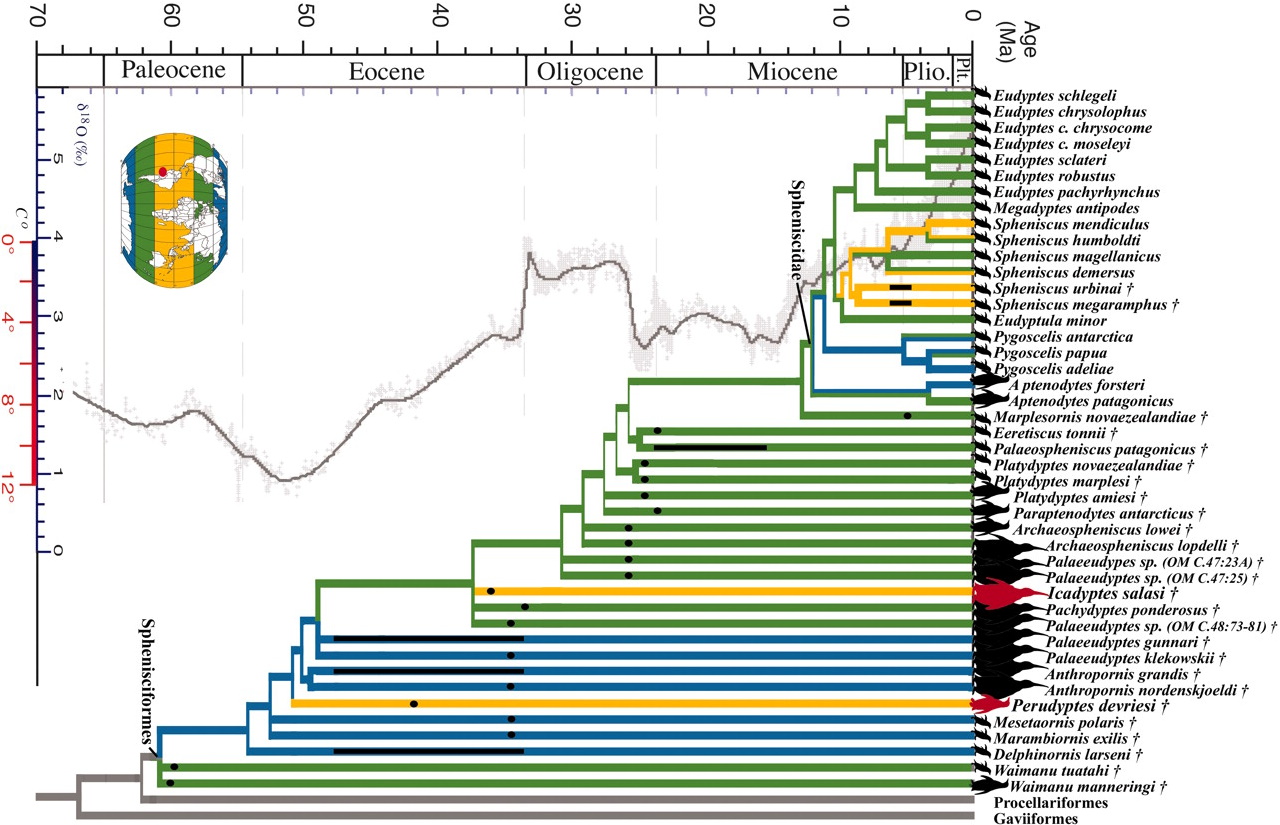
Calibrating avian evolution -- Slack et al. (2006) described the earliest penguin fossils and analyzed complete mitochondrial genomes from an albatross, a petrel, and a loon. The penguin fossils were from a Paleocene (early Tertiary) formation just above a well-known Cretaceous/Tertiary boundary site. The fossils, in a new genus (Waimanu), provide a lower estimate of 61–62 Ma for the divergence between penguins and other birds and thus establish a reliable calibration point for avian evolution. Combining fossil calibration points, DNA sequences, maximum likelihood, and Bayesian analysis, the penguin calibrations imply a radiation of modern (crown group) birds in the Late Cretaceous. This includes a conservative estimate that modern sea and shorebird lineages diverged at least by the Late Cretaceous about 74 million years ago. It is clear that modern birds from at least the latest Cretaceous lived at the same time as archaic birds including Hesperornis, Ichthyornis, and the diverse Enantiornithiformes. Pterosaurs also coexisted with early birds. Additional fossils and molecular data are still required to help understand the role of biotic interactions in the evolution of Late Cretaceous birds and thus to test that the mechanisms of microevolution are sufficient to explain macroevolution

Classic problems in historical biogeography are where did penguins originate, and why are such mobile birds restricted to the Southern Hemisphere? Competing hypotheses posit they arose in tropical-warm temperate waters, species-diverse cool temperate regions, or in Gondwanaland 100mya when it was further north. To test these hypotheses, Baker et al. (2006) constructed a phylogeny of extant penguins from 5851bp of mitochondrial and nuclear DNA. Their analysis suggests that an Antarctic origin of extant taxa is highly likely, and that more derived taxa occur in lower latitudes. Molecular dating indicates that penguins originated about 71 million years ago (i.e., penguins and albatrosses shared a common ancestor approximately 71 mya) in Gondwanaland when it was further south and cooler (and Antarctica was still attached to Australia and South America, and New Zealand was still relatively close to the supercontinent). Moreover, extant taxa are inferred to have originated about 40 mya (Eocene) when Aptenodytes diverged as the basal lineage, and coincident with the extinction of the larger-bodied fossil taxa as global climate cooled. Baker et al. (2006) hypothesized that, as Antarctica became ice-encrusted, modern penguins expanded via the circumpolar current to oceanic islands within the Antarctic Convergence, and later to the southern continents. Thus, global cooling has had a major impact on penguin evolution, as it has on vertebrates generally. Penguins only reached cooler tropical waters in the Galapagos about 4 mya, and have not crossed the equatorial thermal barrier.

The demise of the larger-bodied putative stem-group taxa near the end of the Eocene about 40 mya coincides roughly with the origin of Antarctic-breeding extant taxa (Aptenodytes and Pygoscelis) in the crown-group, and with the beginning of a general cooling in global climate. This was also approximately when the fish-eating cetaceans evolved, and it has been hypothesized they may have out-competed these larger penguins which probably relied on the same food source. Two abrupt cooling periods resulting in the formation of large ice sheets in Antarctica are associated with the diversification of penguin taxa. The first cooling occurred about 34-25 mya, when Spheniscus, Eudyptes and Eudyptula diverged from the older Antarctic genera. These latter ancestral lineages may have dispersed northward by the newly formed circumpolar current, judging from the occurrence of a Eudyptula fossil in New Zealand about 24 mya. As surface waters in the Southern Oceans continued to cool towards the middle Miocene, and the flow of the circumpolar current around Antarctica intensified, another rapid climate transition, the middle miocene climate transition (MMCT) and subsequent increase in Antarctic ice volume occurred between 14 and 12 mya. The MMCT was accompanied by a second bout of cladogenesis that gave rise to multiple species of extant penguins distributed at even lower latitudes, including tips of southern continents. If this scenario is run backwards in the future, continued global warming might be expected to drive temperate-adapted species out of lower latitudes towards their ancestral distribution, possibly causing multiple extinctions of existing species.

Information courtesy of:
http://people.eku.edu/ritchisong/birdbiogeography1.htm#cretaceousduck