Slightly older document, but still valid information:
Fossilised penguin discovered in the Waikato
By: Dr Nichola Harcourt
In January 2006, the children of the Hamilton Junior Naturalist Club (JUNATs) discovered the fossilised remains of a penguin on the foreshore of the Te Waitere Inlet at Kawhia.
Penguins are the heroes of many children's books and videos, being known and loved throughout the world for their comical walk and distinctive coats. Emperor penguins are the largest living penguins, obtaining heights of 1.2m tall and weights of 20-40kg. However, there were once far larger penguins waddling across the earth. In January 2006, the children of the Hamilton Junior Naturalist Club (JUNATs) discovered the fossilised remains of a penguin on the foreshore of the Te Waitere Inlet at Kawhia. At first glance the fossilised bones resembled rusty iron, however, as luck would have it amateur archaeologist Chris Templer was present on the trip and immediately recognised that the fossil was in fact a penguin. Penguin fossil - JUNATs
The penguin skeleton is almost complete, though missing the skull, which makes it a very important scientific find as other penguin fossils consist of a few bones only. One of the difficulties with unearthing a fossil on a muddy foreshore is that it can be rapidly covered by mud deposits from the incoming tide. Realising that the careful removal of the fossil would require forward planning, the JUNATs left the fossil in situ with the intention of returning at a later date with the appropriate tools. On their return, the JUNATs worked quickly to retrieve the fossil before it would be submerged by the incoming tide. The recovery involved cutting a trench in the rock and making a horizontal slice under the fossil. The fossil was then lifted out as a large embedded rock.
Having some experience in fossil stabilisation, Chris Templer removed residual debris from around the bones and coated the exposed bone surfaces with diluted polyvinyl acetate. The penguin fossil was placed in a custom-built cradle and anchored in place using a plaster mold. The fossil was then moved to the Waikato Museum and housed under controlled conditions. As it is anticipated that the fossil will undergo further rounds of preservation in the future, current stabilisation techniques are restricted to reversible methods. The fossil has been prepared for display and is now being exhibited in the foyer of the Waikato Museum.
We know from the structure and arrangement of the bones that the fossil is a penguin.
The key bones required for description and identification of the penguin include the wing bones, coracoid and tibiotarsus. The length of the femur is also a useful predictor for height of the bird. The straight shafts of the femur and humerus coincide with the genus Palaeeudyptes (as based on comparison with catalogued bones) while these bones are curved in other genera.
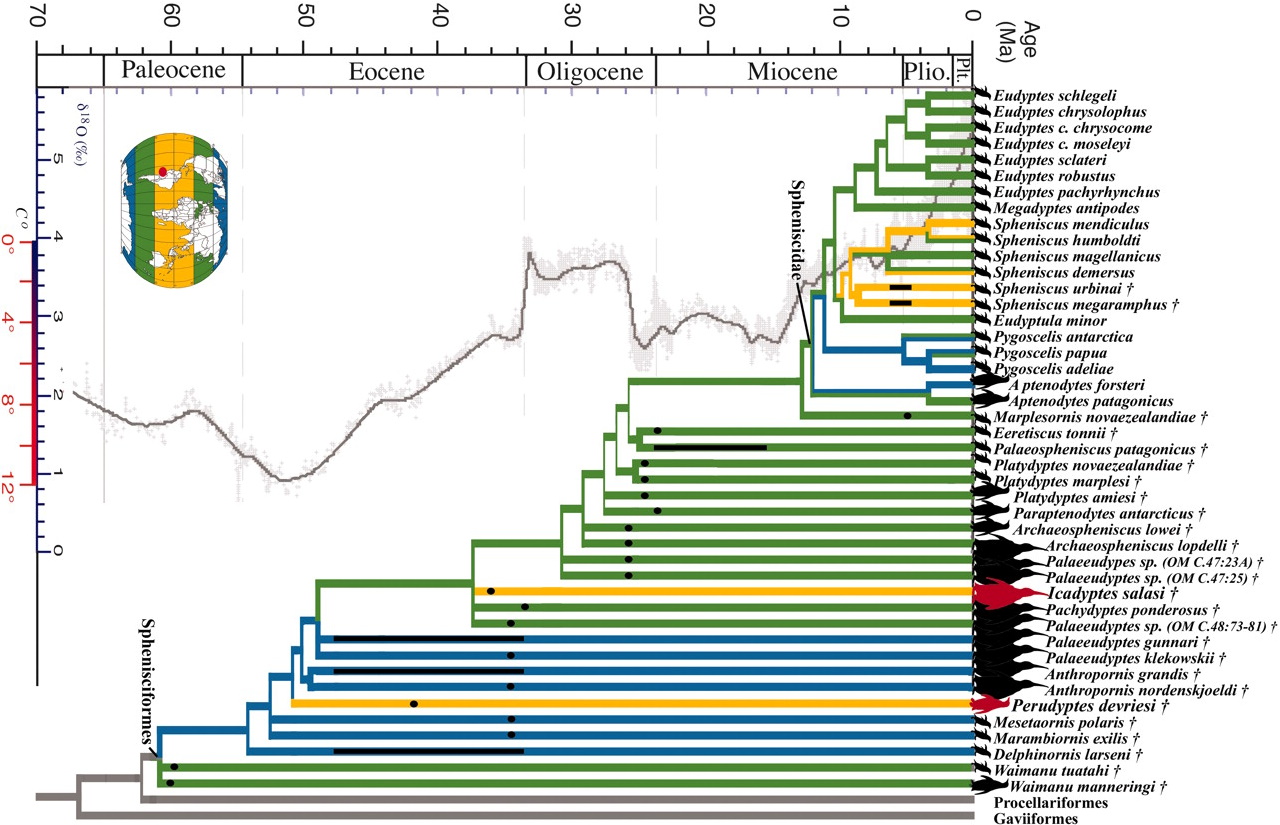
By comparing the length of the fossilised wing bone with that obtained from an adult Emperor penguin, we know that the fossil penguin was far larger. Comparing the length of the humerus, the fossilised penguin measures 180 mm, the Emperor's 128 mm, and the Little Blue penguin, 46 mm. It is not known why the early fossil penguins were so large, but may reflect their evolution in the absence of predators (which may have evolved somewhat later). This is based on the observation that the extinction of larger penguins coincides with the time that seals and smaller whales developed. This is the most complete fossilised penguin found yet to date. Therefore, it has the potential to solve many problems in understanding the evolution of fossil penguins. Given that all known penguins (living and fossilised) are found in the Southern Hemisphere, it is likely that penguins evolved there. New Zealand has an extensive fossil record of penguins with 13 species currently recognised.
Based on the established age of rocks in the Te Kuiti Group which are widespread in the Kawhia area, it is likely that the penguin would be aged in the range of 25-30 million years old. As a fossil of this antiquity lies well outside the sensitivity range of carbon dating, a rock specimen has been removed for further dating based on the foraminifera contained within. Two thirds of modern day New Zealand were submerged during the Oligocene. The movement of tectonic plates in the north of New Zealand caused large areas of the oceanic crust to be subducted, so that these areas were pushed into and over northern and western parts of the North Island. The Kawhia area was a series of small low-lying islands. Large marine species (e.g. sea urchins, oysters such as those found fossilised in limestone at Marokopa, molluscs and giant sharks) and giant penguins were abundant in the shallow seas.
Article courtesy of Waikato Museum @
http://www.waikatomuseum.co.nz/images/1645.jpg?w=267&h=200